Cold Email for Telecom: Reaching Carriers and MSPs
Telecom companies face rapid technology changes and competitive pressures. Here's how to approach cold email outreach to carriers, MSPs, and UCaaS providers.
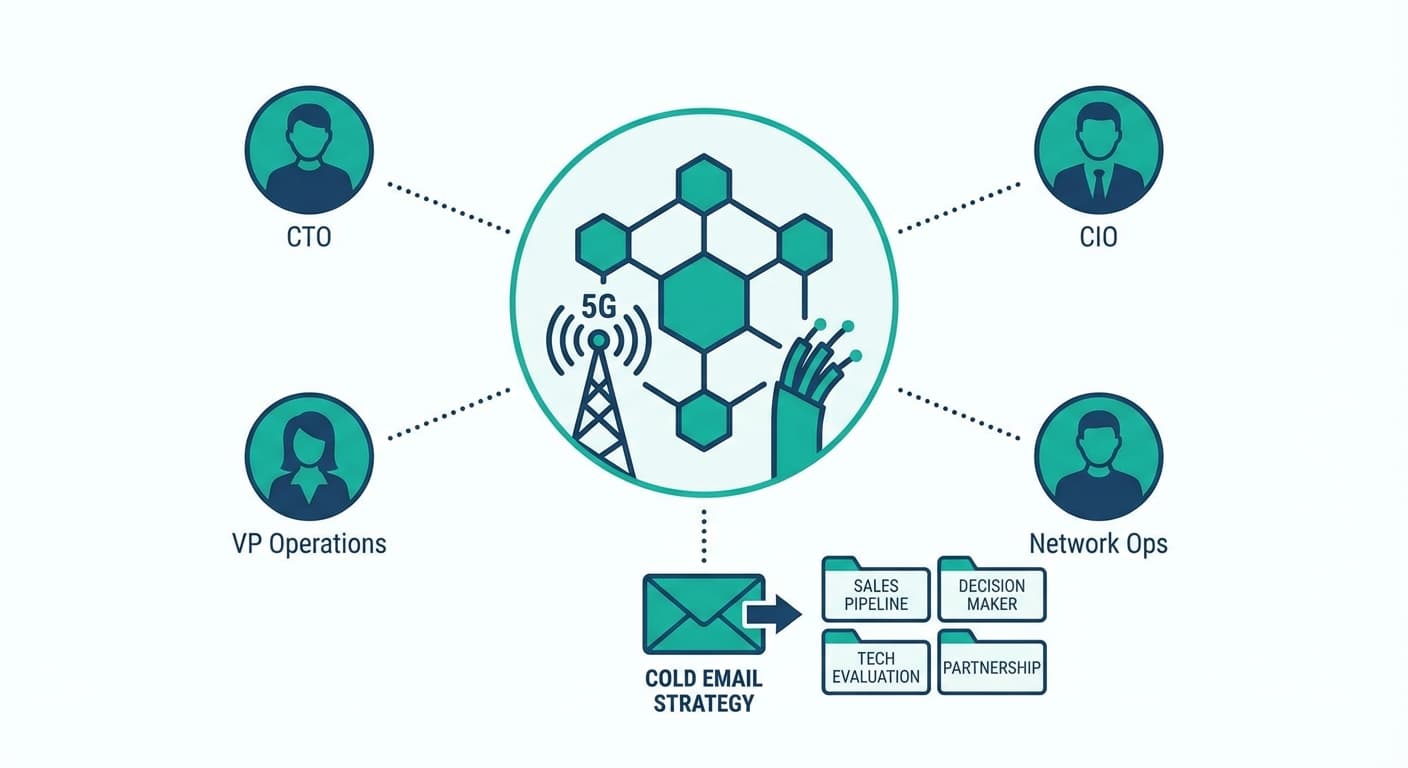
Cold email outreach to telecom companies requires segment-specific messaging tailored to Tier 1 carriers, regional providers, MSPs, or UCaaS platforms. Target technical decision-makers like CTOs and Network Engineering Directors with precise technical language, reference relevant protocols, and acknowledge integration complexity. Timing matters: align outreach with budget cycles, technology refresh periods, and major network initiatives. Avoid generic claims and one-size-fits-all approaches: telecom buyers expect vendors who understand network architecture, scale requirements, and regulatory context.
Key takeaways
- Tier 1 carriers have formal RFP processes with sales cycles ranging from 12 to 24 months, while MSPs and regional carriers make faster purchasing decisions.
- Target technical stakeholders like CTOs, Chief Network Officers, and VPs of Engineering rather than procurement teams to influence requirements early.
- Effective telecom cold emails reference specific standards and protocols, acknowledge integration complexity, and demonstrate understanding of network scale.
- Align outreach timing with budget cycles, technology refresh cycles, major network initiatives like 5G deployment, and regulatory deadlines.
- Segment-specific messaging is essential: an email resonating with an MSP owner will fall flat with a carrier procurement team.
Reviewed and updated September 2, 2026
Cold Email for Telecom: Reaching Carriers, MSPs, and Communications Providers
The telecommunications industry sits at the intersection of massive infrastructure investment, rapid technology evolution, and intense competitive pressure.
Telecom companies range from global carriers managing billions in network assets to regional managed service providers (MSPs) serving local businesses. Each segment has distinct buying behaviors, decision-making structures, and pain points that shape how they respond to cold outreach.
Managed service providers on that list often resell or deliver somebody else's product, and the obligations that follow from each arrangement are set out in what a channel partner actually owns.
Selling to telecom requires understanding this complexity. A cold email that resonates with an MSP owner will fall flat with a carrier procurement team. A message about cost reduction might interest a regional provider but bore an enterprise carrier focused on network transformation.
This guide covers everything you need to know about cold emailing telecom companies effectively, from understanding market segments to crafting messages that generate responses.
Understanding the Telecom Landscape
The telecommunications industry encompasses multiple distinct segments, each with unique characteristics and buying behaviors.
If you work at a carrier, a provider or an advisor and want business customers of your own, telecommunications lead generation covers where those leads come from.
Tier 1 Carriers
Large national and international carriers operate massive network infrastructure, serve millions of customers, and make purchasing decisions through formal procurement processes. Think of major mobile network operators, long-distance carriers, and national broadband providers.
These organizations have:
- Formal RFP processes for significant purchases
- Multiple stakeholders across engineering, operations, finance, and procurement
- Long sales cycles (12 to 24 months is common)
- Strict vendor qualification requirements
- Established relationships with incumbent vendors
Cold email success with Tier 1 carriers typically involves reaching the right technical stakeholders to influence requirements, rather than direct sales to procurement.
Regional and Local Exchange Carriers
Smaller carriers serving specific geographic regions operate with different dynamics. They often have:
- Shorter decision cycles
- More accessible leadership
- Budget constraints driving interest in efficiency
- Competitive pressure from larger carriers
- Less formal procurement processes
Regional carriers can be more responsive to cold outreach, especially from vendors offering competitive advantages against larger players.
Managed Service Providers (MSPs)
MSPs provide outsourced IT and communication services to businesses. They range from small local operations to large national providers.
MSPs are constantly evaluating:
- Tools that improve service delivery efficiency
- Technologies that create differentiation
- Solutions that expand service offerings
- Platforms that reduce operational costs
MSPs often make faster purchasing decisions and respond well to outreach demonstrating clear ROI and competitive advantage.
Unified Communications as a Service (UCaaS) Providers
UCaaS providers deliver cloud-based communication solutions including voice, video, messaging, and collaboration tools. This segment has seen significant growth and consolidation.
UCaaS companies focus on:
- Platform reliability and uptime
- Feature differentiation
- Integration capabilities
- Customer acquisition and retention
- Margin optimization
Internet Service Providers (ISPs)
ISPs range from small local providers to large regional broadband companies. They face:
- Infrastructure investment requirements
- Customer experience expectations
- Competition from wireless and cable providers
- Regulatory compliance needs
- Network capacity planning challenges
Cable and Broadband Operators
Cable companies have evolved from entertainment providers to full telecommunications competitors offering voice, data, and video services.
These organizations balance:
- Legacy infrastructure modernization
- Competitive positioning against fiber providers
- Service bundle optimization
- Customer experience improvement
- Regulatory navigation
Key Decision Makers in Telecom
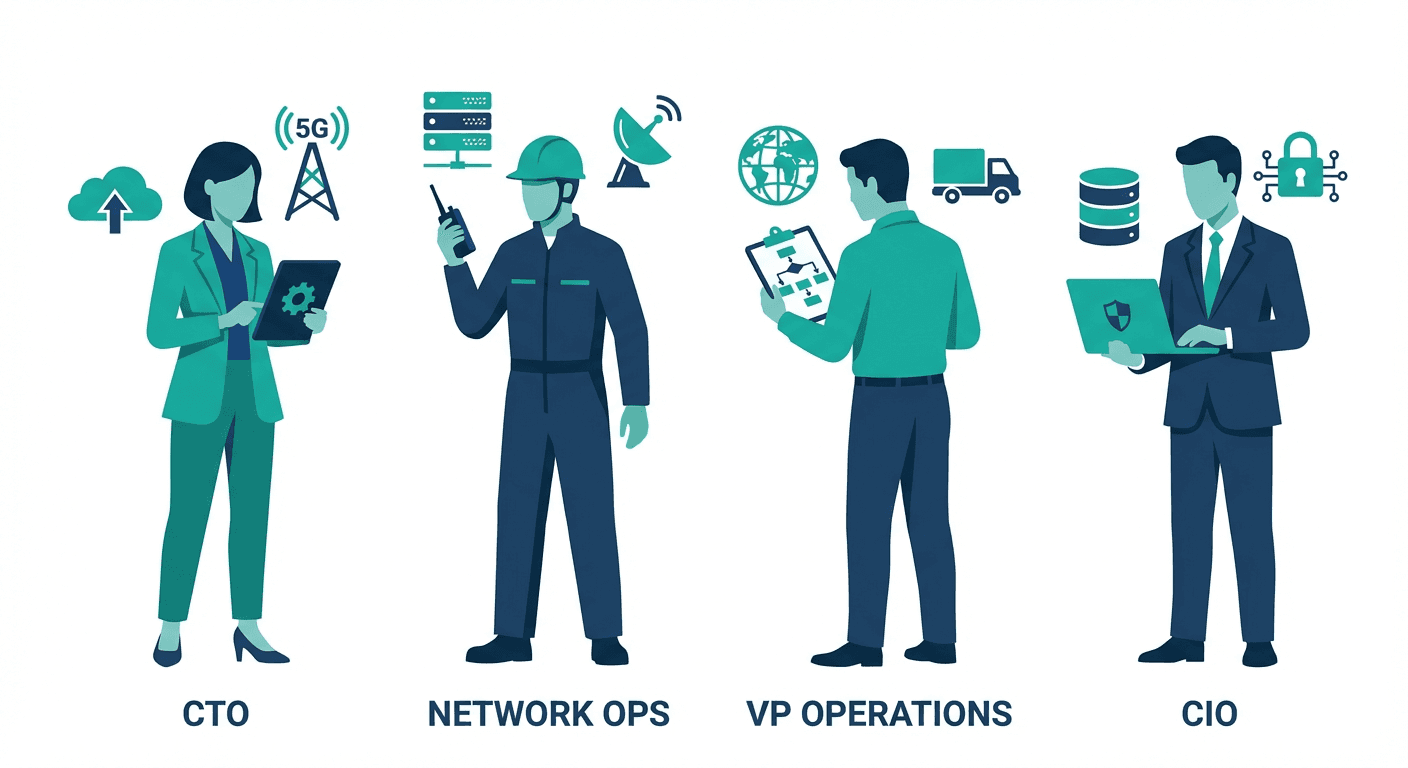
Telecom organizations have specialized roles that differ from typical enterprise structures. Understanding who makes decisions and what they care about is essential for effective outreach.
Chief Technology Officer (CTO) or Chief Network Officer (CNO)
What they care about: Network architecture evolution, technology roadmap, capacity planning, service enablement, vendor strategy, emerging technology adoption.
Pain points: Legacy system constraints, network complexity, talent shortage, technology debt, integration challenges, speed of technology change.
Trigger events: Network expansion plans, technology refresh cycles, competitive launches, capacity issues, M&A activity.
Email angle: Focus on technology differentiation and network transformation. CTOs respond to vendors who understand telecom architecture and can articulate specific technical benefits.
VP of Engineering or Network Engineering Director
What they care about: Network performance, reliability, deployment efficiency, operational metrics, team productivity, technical debt reduction.
Pain points: Outage prevention, capacity management, deployment complexity, monitoring gaps, legacy protocol support, skill gaps.
Trigger events: Major outages, capacity constraints, new service launches, team changes, technology migrations.
Email angle: Lead with technical specifics and operational improvements. Engineering leaders appreciate vendors who speak their language and understand network realities.
VP of Operations or Network Operations Director
What they care about: Service availability, incident response, operational efficiency, NOC performance, customer impact metrics, mean time to repair.
Pain points: Alert overload, manual processes, tool fragmentation, staffing challenges, service level agreement (SLA) compliance, customer complaints.
Trigger events: SLA breaches, major incidents, staffing changes, tool consolidation initiatives, efficiency mandates.
Email angle: Emphasize operational efficiency and reliability improvement. Operations leaders need solutions that reduce workload and improve service metrics.
Chief Information Officer (CIO)
What they care about: Enterprise IT systems, business support systems (BSS), operations support systems (OSS), digital transformation, IT security, data management.
Pain points: System integration complexity, data silos, legacy BSS/OSS limitations, digital transformation pace, IT operational costs.
Trigger events: System modernization initiatives, M&A integration, digital transformation mandates, security incidents.
Email angle: Connect technical capabilities to business outcomes. CIOs balance technology needs with business requirements.
VP of Product or Product Management Director
What they care about: Service portfolio development, feature roadmap, competitive positioning, time to market, customer experience, revenue enablement.
Pain points: Development velocity, feature parity with competitors, customer feedback integration, technical limitations, market timing.
Trigger events: Competitive launches, customer churn signals, new market opportunities, technology enablement.
Email angle: Focus on enabling new services or improving existing offerings. Product leaders value vendors who accelerate their roadmap.
Procurement and Vendor Management
What they care about: Vendor consolidation, cost optimization, contract terms, compliance, risk management, vendor performance.
Pain points: Vendor sprawl, contract management complexity, cost pressures, vendor performance issues, compliance requirements.
Trigger events: Contract renewals, cost reduction mandates, vendor consolidation initiatives, compliance audits.
Email angle: Procurement often enters later in the sales cycle. Focus on total cost of ownership, vendor stability, and contract flexibility.
MSP Owner or General Manager
For smaller MSPs, the owner or GM makes most purchasing decisions.
What they care about: Business growth, profitability, service differentiation, customer retention, operational efficiency, competitive positioning.
Pain points: Margin pressure, talent acquisition, service delivery consistency, technology complexity, customer expectations.
Trigger events: Customer growth, competitive pressure, technology evolution, market opportunities, operational challenges.
Email angle: Speak directly to business impact. MSP owners respond to clear ROI and competitive differentiation.
Technology Trends Driving Telecom Purchases
Understanding current technology priorities helps you position your solution within ongoing initiatives.
5G Network Deployment
The rollout of 5G networks creates purchasing activity across the telecom ecosystem:
- Radio access network (RAN) equipment
- Core network upgrades
- Edge computing infrastructure
- Network management tools
- Security solutions
- Orchestration platforms
If your solution relates to 5G deployment or management, timing outreach to organizations in active buildout phases improves relevance.
Network Function Virtualization (NFV) and Software-Defined Networking (SDN)
Telecom networks are transitioning from hardware-centric to software-defined architectures:
- Virtual network functions (VNFs)
- SDN controllers and orchestration
- Management and orchestration (MANO) platforms
- Service chaining solutions
- Performance monitoring for virtualized environments
Organizations undergoing network virtualization initiatives are receptive to supporting technologies.
Edge Computing
Distributed computing at the network edge creates new requirements:
- Edge infrastructure management
- Latency-sensitive application support
- Security for distributed environments
- Orchestration across edge locations
- Monitoring and observability
Cloud Migration
Telecom companies are moving workloads to public and private clouds:
- Cloud-native BSS/OSS
- Hybrid cloud management
- Cloud security
- Cost optimization
- Multi-cloud orchestration
Customer Experience Platforms
Telecom companies invest heavily in customer experience:
- Digital self-service portals
- Customer analytics platforms
- Omnichannel support solutions
- Proactive service monitoring
- Customer journey optimization
Network Automation and AI/ML
Automation initiatives address operational complexity:
- Intent-based networking
- Self-healing network capabilities
- Predictive maintenance
- AIOps platforms
- Closed-loop automation
Building Telecom Credibility
Telecom buyers expect vendors to understand their industry. Generic technology pitches fail. Demonstrating telecom knowledge earns attention.
Speak Telecom Language
Use terminology accurately. Misusing industry terms signals you do not understand the business.
Key terms to use correctly:
- OSS (Operations Support Systems) vs. BSS (Business Support Systems)
- NOC (Network Operations Center) vs. SOC (Security Operations Center)
- SLA (Service Level Agreement) metrics
- MTTR (Mean Time to Repair) vs. MTBF (Mean Time Between Failures)
- Churn and retention metrics
- Network protocols and standards (specific to your solution area)
Weak:
"Our platform improves telecom operations."
Strong:
"Our platform reduces MTTR for network incidents by correlating alarms across OSS platforms and automating initial diagnostics."
Reference Relevant Standards and Protocols
Telecom operates within standards frameworks. Reference relevant standards to demonstrate understanding:
- TMForum standards (eTOM, SID, TAM)
- 3GPP for mobile networks
- MEF for carrier ethernet
- ITU-T for international standards
- Specific protocols relevant to your solution
Acknowledge Integration Complexity
Telecom environments are complex. Vendors who acknowledge this complexity and explain their integration approach build trust.
Example:
"We integrate with legacy OSS platforms including [specific vendors]. Typical deployment involves [realistic timeline] with your existing stack."
Demonstrate Scale Understanding
Telecom operates at scale. Ensure your solution claims account for telecom volumes.
Example:
"Processing 100 million events per day with sub-second latency. Deployed at carriers managing 50 million+ subscribers."
Timing Your Telecom Outreach
Telecom purchasing follows patterns driven by budget cycles, technology roadmaps, and regulatory requirements.
Budget Cycles
Most telecom companies operate on calendar-year budgets with planning beginning in Q3:
Q3 (July through September): Budget planning begins. Decision-makers identify priorities for the following year. Reach out to influence planning.
Q4 (October through December): Budgets finalize. Late Q4 may have year-end budget that must be spent. Quick decisions possible for smaller purchases.
Q1 (January through March): New budgets activate. Teams execute on approved initiatives. Strong window for solutions aligned with approved plans.
Q2 (April through June): Mid-year execution. New initiatives outside budget face higher scrutiny. Focus on urgent needs or pilot programs.
Technology Refresh Cycles
Network equipment has defined lifecycle periods. Major refresh cycles create purchasing windows:
- Core network equipment (7 to 10 year cycles)
- Access network equipment (5 to 7 year cycles)
- Customer premises equipment (3 to 5 year cycles)
- Software systems (annual renewal cycles)
If you can identify where a prospect is in their technology refresh cycle, timing outreach accordingly improves relevance.
Major Network Initiatives
Large network projects create related purchasing activity:
- Network expansion or upgrade projects
- Technology migrations (4G to 5G, copper to fiber)
- Platform consolidation initiatives
- Digital transformation programs
News of major initiatives signals openness to related vendor conversations.
Regulatory Deadlines
Regulatory requirements drive purchasing timelines:
- Spectrum deployment commitments
- Network build obligations
- Security and compliance requirements
- Reporting mandates
Understanding regulatory timelines in your target markets helps you time outreach appropriately.
M&A Activity
Telecom consolidation creates purchasing activity:
- Network integration requirements
- Platform consolidation
- Vendor rationalization
- Scale optimization
Organizations undergoing merger integration have specific needs and often accelerated timelines.
Email Templates for Telecom
Here are templates adapted for different telecom scenarios. Customize based on your specific offering and target segment.
Template 1: Carrier Technology Leader
Subject: [Company] network operations question
Body:
[First Name],
Quick question: how is [Company] currently handling [specific network challenge, e.g., alarm correlation across your OSS platforms, capacity forecasting for your RAN, service assurance for virtualized network functions]?
We work with [X] carrier engineering teams on this, including [notable reference if available]. Typical result: [specific quantified outcome, e.g., 40% reduction in MTTR, 60% improvement in capacity utilization accuracy].
Our platform integrates with [relevant telecom platforms/vendors they likely use].
Worth a brief technical conversation this month?
[Your name]
Why it works: Opens with specific network challenge relevant to their role, demonstrates telecom knowledge with appropriate terminology, offers integration context.
Template 2: MSP Owner
Subject: [Company] service delivery efficiency
Body:
[First Name],
Question for you: how much time does your team spend on [specific operational challenge, e.g., service provisioning, network monitoring, customer onboarding]?
MSPs we work with were spending [X hours] on this. After implementing our platform, that dropped to [Y hours]. That translates to [specific business impact, e.g., supporting 30% more customers without adding headcount, improving margins by X%].
Currently supporting [X] MSPs ranging from [size range].
Worth a quick call to see if there is a fit?
[Your name]
Why it works: Speaks directly to business outcomes MSP owners care about, provides specific efficiency metrics, acknowledges MSP business model.
Template 3: UCaaS Product Leader
Subject: [Company] platform differentiation
Body:
[First Name],
Noticed [Company] is expanding [specific area, e.g., your contact center offering, video capabilities, integrations portfolio].
We help UCaaS providers accelerate their roadmap by [specific capability, e.g., providing pre-built integrations, enabling custom features without core development, improving platform reliability].
Currently powering [X] UCaaS platforms, helping them [specific outcome, e.g., launch new integrations 3x faster, reduce development costs by 40%].
Worth exploring if this could accelerate your roadmap?
[Your name]
Why it works: References specific initiative, focuses on product acceleration, demonstrates UCaaS understanding.
Template 4: Network Operations Leader
Subject: NOC efficiency at [Company]
Body:
[First Name],
Your NOC team is likely dealing with [specific operational challenge, e.g., alarm fatigue from multiple network management systems, manual correlation across OSS platforms, SLA reporting complexity].
We help network operations teams reduce [specific metric, e.g., time to diagnose network issues, false positive alarms, manual correlation effort].
NOC teams using our platform typically see [specific quantified result, e.g., 50% reduction in alarm volume through intelligent correlation, 40% faster root cause identification].
Integrates with [relevant network management platforms].
Worth a conversation about your operational priorities?
[Your name]
Why it works: Addresses operational pain directly, provides specific metrics, mentions integration with existing platforms.
Template 5: Digital Transformation Context
Subject: [Company] digital transformation question
Body:
[First Name],
Noticed [Company] is [specific digital initiative, e.g., modernizing your BSS stack, moving network functions to the cloud, implementing automation].
Organizations going through similar transformations often struggle with [specific challenge, e.g., integration between legacy and modern systems, maintaining service continuity during migration, measuring transformation progress].
We help telecom companies navigate this by [specific capability].
Currently supporting [X] carriers through [relevant transformation type].
Worth a brief conversation about your transformation priorities?
[Your name]
Why it works: References specific initiative, demonstrates understanding of transformation challenges, offers relevant experience.
Template 6: Competitive Positioning
Subject: [Competitor move] and [Company]
Body:
[First Name],
With [competitor] launching [specific competitive move, e.g., new service, pricing change, technology announcement], your team is likely evaluating how to respond.
We help [carrier type] providers [specific competitive capability, e.g., accelerate new service launches, optimize network performance, reduce operational costs].
Organizations using our platform have [specific competitive outcome, e.g., launched competitive services 40% faster, achieved 25% better network efficiency].
Worth discussing how this could help [Company] respond to competitive pressure?
[Your name]
Why it works: Timely reference to competitive dynamics, positions solution within competitive context, offers specific competitive advantages.
Common Mistakes to Avoid
Mistake 1: Generic Technology Claims
Telecom buyers have heard every generic claim. Specificity wins.
Weak:
"Our platform improves network performance and reduces costs."
Strong:
"Our platform reduces alarm processing time from hours to minutes by correlating events across your Ericsson OSS and Nokia network management systems."
Mistake 2: Ignoring Integration Reality
Telecom environments are complex. Claiming simple deployment when reality is different damages credibility.
Weak:
"Deploy in days with our simple platform."
Strong:
"Typical carrier deployment: 6 to 8 weeks including integration with your existing OSS/BSS stack. We handle the complexity so your team can focus on operations."
Mistake 3: Misunderstanding the Buyer
A message appropriate for an MSP owner will not work for a carrier procurement team. Segment your outreach.
Mistake 4: Missing the Scale Question
Telecom operates at scale. Ensure your solution claims address telecom volumes.
Weak:
"Handle thousands of events."
Strong:
"Process 50 million events per hour across distributed edge locations."
Mistake 5: Overlooking Regulatory Context
Telecom is regulated. Missing regulatory awareness signals you do not understand the industry.
If your solution relates to compliance, security, or reporting, connect it to regulatory requirements.
Mistake 6: Forgetting the Ecosystem
Telecom purchases often involve ecosystem partners (system integrators, channel partners, consultants). Consider how your outreach accounts for these relationships.
Mistake 7: One-Size-Fits-All Messaging
A message for a Tier 1 carrier will not resonate with a regional MSP. Segment your approach by company type, size, and technology environment.
Building a Telecom Cold Email Program
Success in telecom outreach requires systematic execution adapted to telecom buying dynamics.
List Building
Quality targeting is essential given long telecom sales cycles:
- Focus on organizations that match your ideal customer profile
- Identify decision-makers at appropriate levels for your solution
- Research technology environments and current initiatives
- Track trigger events (announcements, job postings, regulatory filings)
- Map organizational structures for larger carriers
Segmentation Strategy
Effective telecom segmentation includes:
By company type:
- Tier 1 carriers
- Regional and local carriers
- MSPs (by size and specialty)
- UCaaS providers
- ISPs and cable operators
By technology environment:
- Network technology (wireline, wireless, converged)
- Platform vendors (Ericsson, Nokia, Huawei, Cisco, etc.)
- Cloud strategy (public, private, hybrid)
- Virtualization maturity
By initiative:
- 5G deployment
- Network virtualization
- Cloud migration
- Digital transformation
- Customer experience improvement
By role:
- Technical (CTO, engineering)
- Operational (NOC, operations)
- Business (product, finance)
- Procurement
Personalization Requirements
Telecom buyers expect relevance. Invest in personalization:
- Reference specific technology announcements
- Acknowledge network technology environment
- Mention relevant integrations for their vendor stack
- Connect to announced initiatives or regulatory requirements
Where we differ from standard practice
Much of the advice on this page reflects how outbound is commonly run. We run it differently, and since this page sits on our site it is worth saying where the difference is and what it costs us.
- A sequence of messages to each prospect over several weeks
- Later messages often land in the same email thread
- Every contact is reached more than once, so a distracted reader gets another chance
- The later messages go only to people who did not answer the first
- Reputation cost accrues on the sending domain across everything else it sends
- One message, then that campaign is finished for that contact
- No thread replies and no bumps
- A non-responding audience becomes a new campaign with a genuinely different premise, not a reminder
- More of the work moves into targeting and into the one message
- We reach each contact less often, and that is the cost we accept
The reasoning is mechanical rather than moral. A follow-up arrives underneath a message the recipient has already seen and chosen not to answer, so it is delivered to the population most likely to mark it as spam, and the reputation cost of that lands on the sending domain across every campaign running on it. We set that cost against the replies a sequence recovers and decided the trade was not worth it. The full argument, with the numbers from our own campaigns, is in why we stopped using follow-ups.
Follow-Up Strategy
Telecom sales cycles are long, so every approach has to earn its own place in the inbox:
- Most programmes wait seven to ten business days between messages here, longer than typical B2B
- Lead with value rather than a check-in (industry insights, relevant news, technical content)
- Reference telecom-specific developments
- Most programmes plan five to eight touches before concluding a sequence; we send one message per campaign instead
- Longer nurture programmes are common for Tier 1 carriers; we re-approach a non-responding audience with a new campaign and a different premise instead
Measurement
Track metrics appropriate for telecom sales dynamics:
- Open and reply rates by segment
- Meeting conversion rates
- Technical evaluation progression
- Procurement engagement
- Pipeline velocity by segment
- Win rates and deal size
Telecom sales cycles are longer, so measure progress indicators alongside final outcomes.
Working with Channel Partners
Many telecom purchases involve channel partners, system integrators, or consultants. Consider these relationships in your outreach strategy.
For telecom sellers booking their own meetings, the same channel question is one of three qualifying gates in appointment setting for telecom companies.
System Integrators
Large carriers often work through system integrators for implementation. Building relationships with relevant SIs can accelerate carrier access.
Master Agents and Distributors
MSPs and smaller providers often purchase through master agents. Understanding channel dynamics helps you reach these buyers.
Technology Partners
Partnerships with established telecom vendors can provide introductions and credibility. Consider how partner relationships factor into your go-to-market strategy.
Summary
Cold emailing telecom companies requires understanding the industry's complexity, specialized terminology, and diverse buyer segments.
Success depends on:
- Understanding market segments from Tier 1 carriers to regional MSPs, and adapting your approach accordingly
- Speaking telecom language with accurate terminology and demonstrated industry knowledge
- Targeting the right decision-makers with role-appropriate messaging
- Connecting to technology initiatives like 5G, network virtualization, and digital transformation
- Timing outreach around budget cycles, technology refresh periods, and regulatory deadlines
- Avoiding common mistakes like generic claims, ignoring integration complexity, and missing scale requirements
- Building for long sales cycles with systematic follow-up and sustained engagement
Telecom buyers expect vendors to understand their industry. Generic technology pitches get deleted. Relevant, informed outreach that demonstrates telecom knowledge and addresses specific challenges earns attention.
Meet telecom buyers where they are, speak their language, and prove you understand their world. That is how you stand out in an industry where vendor relationships often span decades.
Related Reading
- Cold Email for Insurance: Reaching Carriers, Brokers, and Insurtech Companies
- Cold Email for Retail: The Complete Guide to B2B Outreach
If you would rather have this run for you, RevenueFlow books qualified meetings on a pay-per-meeting basis and publishes client results.
Frequently asked questions.
Frequently asked questions- Who should I target with cold emails at telecom companies?
- Target technical decision-makers including Chief Technology Officers (CTOs), Chief Network Officers (CNOs), VPs of Engineering, and Network Engineering Directors. These roles influence requirements and technology selection. For MSPs, reach owners or general managers who make faster purchasing decisions. Avoid starting with procurement teams at large carriers: instead, reach technical stakeholders who shape vendor requirements during the 12-24 month sales cycle.
- What mistakes should I avoid when cold emailing telecom companies?
- Avoid generic technology claims that don't speak to telecom-specific needs. Don't ignore integration complexity or miss the scale question: telecom buyers need to know solutions work at their infrastructure level. Never use one-size-fits-all messaging across segments; an MSP owner has different priorities than a Tier 1 carrier procurement team. Don't overlook regulatory context or forget the ecosystem of partners and integrations that affect purchasing decisions.
- How do I build credibility in cold emails to telecom decision-makers?
- Speak telecom language using industry-specific terminology correctly. Reference relevant standards and protocols that demonstrate technical understanding. Acknowledge integration complexity rather than promising simple plug-and-play solutions. Demonstrate understanding of scale: telecom infrastructure operates at levels that break typical enterprise solutions. Show knowledge of network architecture realities, regulatory requirements, and the technology ecosystem telecom companies operate within.
- When is the best time to send cold emails to telecom companies?
- Align outreach with budget cycles, technology refresh cycles, and major network initiatives like 5G deployment, NFV/SDN adoption, or cloud migration projects. Watch for regulatory deadlines that drive technology purchases. Monitor M&A activity, which creates vendor evaluation periods. Timing varies by segment: Tier 1 carriers follow formal annual planning cycles, while MSPs and regional providers have more flexible timing tied to competitive pressures and customer demands.
About the author.

Fernando Cao is CEO at RevenueFlow, which builds and operates outbound revenue engines for B2B companies. Previously at Accenture Strategy. Studied at University of Bath.
Fernando Cao · CEO
Connect on LinkedIn →Explore more.
Ready to scale your outreach?
We build GTM engines that book real meetings. See the receipts.
Related articles.
Cold Email for Architecture Firms: 2026 Strategy Guide
Architecture firms buy on project phases rather than fiscal quarters. How to build a list, time the spec window, and write cold emails principals answer.
Cold Email for Trucking and Fleet Companies: 2026 Guide
How to reach carriers, fleet operators, and safety buyers with cold email: FMCSA-driven list building, trigger timing, four templates, and compliance.
Cold Email for Cannabis Companies: 2026 Strategy Guide
The April 2026 rescheduling order split cannabis buyers into two tax realities. Here is how to segment, list-build, and write cold email for each.
Cold Email for Private Equity Firms: 2026 Strategy Guide
How to run cold email into private equity: mapping fund-level and portfolio-level buyers, list sources, four templates, and PE-specific deliverability rules.
Cold Email for Wealth Management Firms: 2026 Strategy Guide
RIAs are 16,500+ mostly small firms with public Form ADV data, small buying committees, and a compliance gate. How to run cold email into wealth management.
Cold Email for Interior Design Firms: 2026 Strategy Guide
Commercial interior designers specify products they never buy. Here is how to build cold email that wins the specification, plus four templates.