Best Copper Alternatives in 2026
Copper lists Basic at $29 per seat per month, above several rivals, and buys the deepest Google Workspace capture. Compare seven CRMs on price and integration depth.
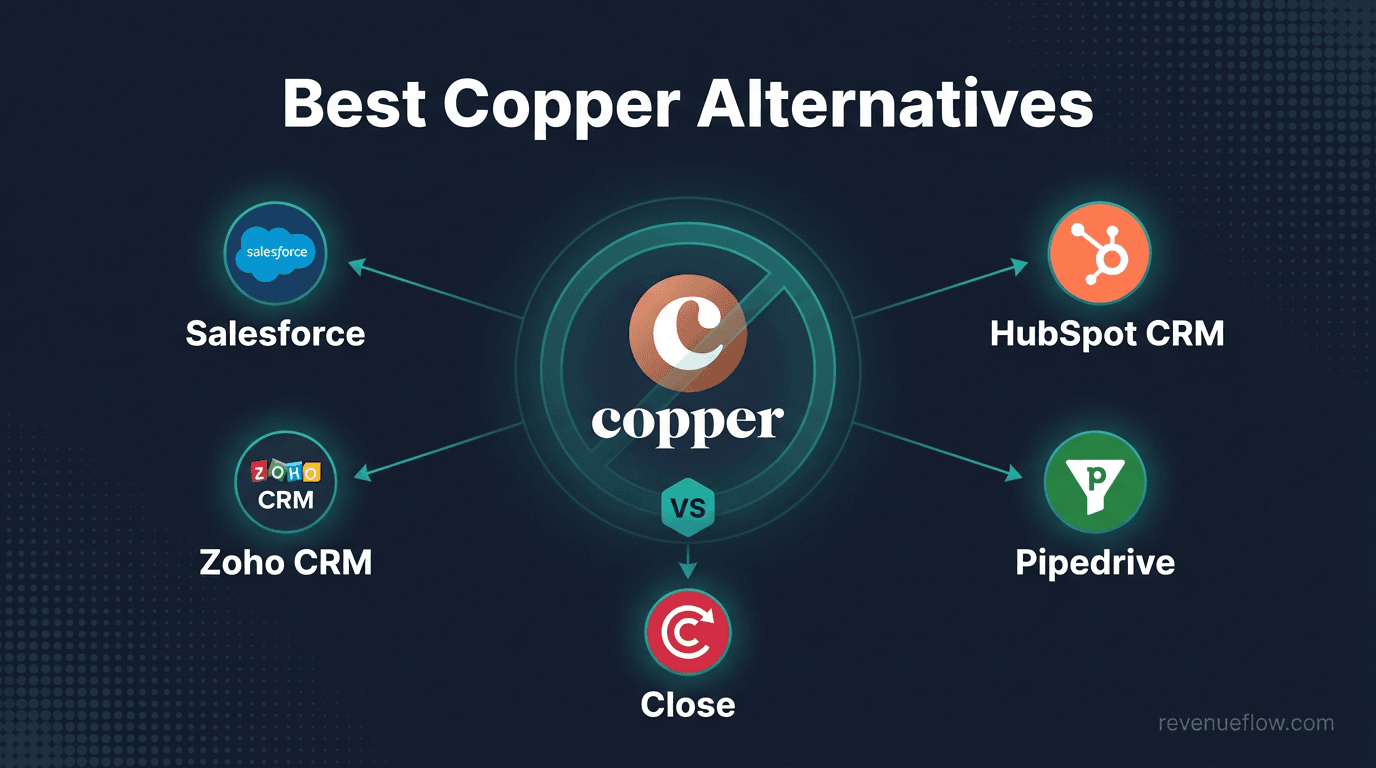
HubSpot CRM, Zoho CRM, Freshsales, Monday CRM, Pipedrive, Close and Salesforce are the main Copper alternatives. HubSpot and Zoho offer free entry points, Freshsales is cheapest at $9 per user per month, Close suits phone-led teams, and Salesforce is the configuration platform.
Key takeaways
- Copper's pricing page lists Basic at $29 per seat per month, or $23 paid annually, above Salesforce Starter Suite at $25 per user per month.
- The premium buys native Google Workspace capture, so contacts and activity land without anybody deciding to log them.
- The most common CRM failure is a record nobody trusts because activity was never logged, which automatic capture removes rather than mitigates.
- Off Google Workspace the architectural advantage disappears, so a stack migration changes the calculation completely rather than gradually.
Reviewed and updated August 28, 2026
Best Copper Alternatives in 2026
Copper's pricing page lists Basic at $29 per seat per month, or $23 paid annually, which makes it more expensive than several CRMs in this roundup rather than less. What the premium buys is the deepest Google Workspace integration available: contacts and activity captured out of Gmail and Calendar without anybody typing them in. Off Google, that argument disappears.
Read against Copper's own pricing page on 2 September 2026, that entry figure is the bottom of a three tier ladder: Basic at $29 per seat per month billed monthly and $23 paid annually, Professional at $69 and $59, and Business at $134 and $99, with contact ceilings of 2,500, 15,000 and unlimited respectively.
The Integration Is the Product
Every CRM claims a Gmail integration. The difference is where the work happens.
A typical integration is a sidebar: the CRM shows you a panel next to the email, and logging the interaction is still an action somebody takes. It works, and compliance depends on reps doing it.
Copper's pitch is that the capture is automatic, because the product is built around Google Workspace rather than connected to it. Contacts and activity from Gmail and Calendar land in the CRM without a decision being made each time.
That matters more than it sounds, because the most common CRM failure is not a missing feature. It is a record nobody trusts, caused by activity that was never logged. A tool that removes the logging decision removes the failure mode.
The trade is a hard dependency. Copper is worth its premium on Google Workspace and very little off it, so a Microsoft 365 migration, or a merger with a company running one, changes the calculation completely rather than gradually.
Why Consider Alternatives to Copper
Copper does the Google job better than anyone, and the reasons to leave follow from the same design.
The price is above the field. At $29 per seat per month on monthly billing it sits over Salesforce Starter Suite at $25 and well over Freshsales at $9 per user per month billed annually.
The stack moved off Google. The premium buys an integration you are no longer using, which is the clearest possible signal.
You need a customer platform. Marketing automation, service and lifecycle reporting are somewhere else, and every additional system is another version of the customer record.
The motion turned phone-led. Close and Freshsales both put calling in the core product; Copper does not.
Top Copper Alternatives

- Contact and company management
- Deal pipeline and tracking
- Email tracking and notifications
- Meeting scheduling
- and 4 more listed below
- Lead, contact, and deal management
- Sales automation and workflow rules
- Zia AI assistant with predictions and suggestions
- Multichannel communication (email, phone, social, live chat)
- and 4 more listed below
- Contact, account, and deal management
- Built-in email and phone with call recording
- Freddy AI lead scoring and deal insights
- Visual sales pipeline management
- and 4 more listed below
1. HubSpot CRM
Starting Price: Free | Website: www.hubspot.com
A popular all-in-one CRM platform with a generous free tier that includes contact management, deal tracking, and email marketing. HubSpot offers separate Hubs for marketing, sales, service, and content, making it ideal for growing businesses that want a unified platform.
Key Advantages over Copper:
- Lower starting price ($9/user/mo billed annually vs $29/seat/mo)
- Unique capabilities: Contact and company management, Deal pipeline and tracking, Email tracking and notifications
Considerations:
- Requires evaluation to see if it fits your specific workflow
Notable Features: Contact and company management, Deal pipeline and tracking, Email tracking and notifications, Meeting scheduling, Live chat and chatbot builder
Integrations: Gmail, Microsoft Outlook, Slack, Salesforce, Zapier, Shopify, WordPress, Zoom
2. Zoho CRM
Starting Price: Free | Website: www.zoho.com/crm/
A feature-rich and affordable CRM from the Zoho ecosystem, offering sales automation, multichannel communication, analytics, and AI-powered predictions via Zia. Known for competitive pricing and deep integration with 45+ other Zoho products.
Key Advantages over Copper:
- Lower starting price ($9/user/mo billed annually vs $29/seat/mo)
- Unique capabilities: Lead, contact, and deal management, Sales automation and workflow rules, Zia AI assistant with predictions and suggestions
Considerations:
- Requires evaluation to see if it fits your specific workflow
Notable Features: Lead, contact, and deal management, Sales automation and workflow rules, Zia AI assistant with predictions and suggestions, Multichannel communication (email, phone, social, live chat), Advanced analytics and custom dashboards
Integrations: Zoho Suite (45+ apps), Google Workspace, Microsoft 365, Slack, Zapier, Mailchimp, Shopify, QuickBooks
3. Freshsales
Starting Price: $9/user/mo | Website: www.freshworks.com/crm/sales/
An AI-powered CRM by Freshworks that combines contact management, deal tracking, and communication tools in one platform. Features Freddy AI for lead scoring, deal insights, and next-best-action recommendations, with built-in phone and email capabilities.
Key Advantages over Copper:
- Lower starting price ($9/user/mo billed annually vs $29/seat/mo)
- Unique capabilities: Contact, account, and deal management, Built-in email and phone with call recording, Freddy AI lead scoring and deal insights
Considerations:
- Requires evaluation to see if it fits your specific workflow
Notable Features: Contact, account, and deal management, Built-in email and phone with call recording, Freddy AI lead scoring and deal insights, Visual sales pipeline management, Workflow automation and sequences
Integrations: Freshworks Suite, Gmail, Microsoft Outlook, Slack, Zoom, Zapier, Segment, Shopify
4. Monday CRM
Starting Price: $12/mo | Website: monday.com/crm
A flexible CRM built on the monday.com Work OS platform, offering highly customizable pipelines, automations, and dashboards. Ideal for teams that want a CRM tightly integrated with project management and collaboration workflows, with a visual and intuitive interface.
Key Advantages over Copper:
- Unique capabilities: Customizable deal pipeline boards, Lead and contact management, Sales automations and workflows
Considerations:
- Lower starting price ($12/mo vs $29/seat/mo)
Notable Features: Customizable deal pipeline boards, Lead and contact management, Sales automations and workflows, Email tracking and templates, Activity management and logging
Integrations: Gmail, Microsoft Outlook, Slack, Zoom, Zapier, Google Workspace, Microsoft Teams, DocuSign
5. Pipedrive
Starting Price: $14/mo | Website: www.pipedrive.com
A sales-focused CRM designed by salespeople for salespeople, built around a visual deal pipeline. Pipedrive emphasizes simplicity and ease of use with powerful automation features, AI-powered sales assistance, and activity-based selling methodology.
Key Advantages over Copper:
- Unique capabilities: Visual deal pipeline management, Activity-based selling methodology, Email sync with templates and tracking
Considerations:
- Lower starting price ($14/mo vs $29/seat/mo)
Notable Features: Visual deal pipeline management, Activity-based selling methodology, Email sync with templates and tracking, Workflow automation builder, AI-powered sales assistant
Integrations: Google Workspace, Microsoft Outlook, Slack, Zoom, Zapier, Mailchimp, Trello, Asana
6. Close
Starting Price: $19/mo | Website: www.close.com
A CRM built specifically for inside sales teams, with built-in calling, SMS, and email functionality. Close focuses on reducing manual data entry and increasing sales velocity with features like Power Dialer, predictive dialing, and workflow automation.
Key Advantages over Copper:
- Unique capabilities: Built-in calling with Power Dialer, Native SMS messaging, Email sequences and templates
Considerations:
- Lower starting price ($19/mo vs $29/seat/mo)
Notable Features: Built-in calling with Power Dialer, Native SMS messaging, Email sequences and templates, Automated workflows, Predictive dialing
Integrations: Zapier, Slack, Gmail, Microsoft Outlook, Zoom, HubSpot, Segment, Calendly
7. Salesforce
Starting Price: $25/mo | Website: www.salesforce.com
The world's leading CRM platform offering a comprehensive suite of sales, service, marketing, and commerce tools. Known for extensive customization, AI-powered insights via Einstein, and a vast ecosystem of third-party integrations through AppExchange.
Key Advantages over Copper:
- Unique capabilities: Lead, account, and contact management, Opportunity and pipeline tracking, Einstein AI-powered analytics and predictions
Considerations:
- Lower starting price ($25/mo vs $29/seat/mo)
Notable Features: Lead, account, and contact management, Opportunity and pipeline tracking, Einstein AI-powered analytics and predictions, Sales forecasting and territory management, Workflow automation and approval processes
Integrations: Slack, Google Workspace, Microsoft Outlook, Mailchimp, DocuSign, Zapier, Tableau, MuleSoft
Quick Comparison Table
| Tool | Starting Price | Features | Integrations |
|---|---|---|---|
| Copper (original) | $29/seat/mo | 8 features | 8 integrations |
| HubSpot CRM | Free | 8 features | 8 integrations |
| Zoho CRM | Free | 8 features | 8 integrations |
| Freshsales | $9/user/mo | 8 features | 8 integrations |
| Monday CRM | $12/mo | 8 features | 8 integrations |
| Pipedrive | $14/mo | 8 features | 8 integrations |
| Close | $19/mo | 8 features | 8 integrations |
| Salesforce | $25/mo | 8 features | 8 integrations |
Reading the Roster: What Each Option Trades
The roster above lists what each tool does. What follows is what each one costs you in something other than money. Prices come from each vendor's own pricing page, read on the day of writing and kept as a dated snapshot; where a page carries a billing toggle both figures are given, and where a vendor localises its pricing page by region the currency is named rather than converted.
HubSpot CRM has the most generous free tier here, and its product page says so plainly: free, no credit card, with contact management, deal pipelines and reporting. Its pricing page puts paid Starter at $15/month per seat. That free tier is an on-ramp to a suite priced per seat and per hub, so budget for where the team will be in a year.
Zoho CRM publishes a free edition for up to three users, which its pricing page carries in the page title itself. Beyond that it is the value play: a deep feature set well under enterprise prices, with the Zoho suite alongside. The trade is interface density and setup effort, a real cost that never appears on the invoice.
Freshsales lists its lowest plan at $9 per user per month billed annually on the Freshworks pricing page, the cheapest genuine CRM in this group. Built-in email and phone with call recording means an inside sales team gets a dialer without a second purchase. The integration list is shorter than HubSpot's or Salesforce's, which an unusual stack will notice.
Monday CRM sits on the monday.com work platform, so pipelines are boards and the CRM inherits the automation and view flexibility of a general work tool. That suits teams already running projects there. It also means the CRM is a configuration rather than a finished product, and somebody has to own that configuration.
Pipedrive is the pipeline-first option, built around a visual deal board and activity-based selling, and it is the easiest tool here to adopt without training. Its billing help article lists four plans: Lite, Growth, Premium and Ultimate. The trade is scope, since marketing automation and service ticketing live somewhere else.
Close is built for inside sales teams that spend the day on the phone, with a power dialer, native SMS and email sequencing in the core product rather than as add-ons. Its pricing page lists Solo at $19 per user per month. A team whose motion is not calling pays for a dialer it will not use.
Salesforce is the platform answer, and its pricing page puts Starter Suite at $25 per user per month. That figure hides the shape of the purchase: Salesforce is a configuration surface rather than a finished product, and the depth enterprises buy it for is why implementation is a budgeted project rather than an afternoon.
- Built around Google Workspace rather than connected to it
- Gmail and Calendar activity lands without a decision
- Removes the most common cause of an untrusted record
- Worth very little off Google Workspace
- A panel beside the inbox, with a log action
- Portable across Google and Microsoft
- Compliance depends on reps remembering
- Works well where the team is disciplined
- Calls and SMS logged as part of the dialing loop
- Strong where the motion is telephone-led
- Email capture is a sidebar like everyone else's
- Freshsales lists at $9/user/mo billed annually
What an Outbound-Led Team Actually Needs From a CRM

Most CRM comparisons are written for a team whose pipeline arrives through inbound and referral. A team running cold outbound needs a shorter list.
It needs the meeting recorded against the account with enough structure to join it back to the campaign that produced it, because a stage existing only as a word in a notes field cannot be counted later.
It needs to be the source of truth about who is off-limits: current customers, live opportunities, accounts somebody has asked you not to touch. That is what the next build suppresses against, and a CRM that cannot export it cleanly turns every list build into manual reconciliation. It also needs to deduplicate against the sending tool, so nobody is enrolled twice under two spellings of one company.
What it does not need to be is the sequencer. Several tools here bundle email sequencing, and a sequencer built around multi-step cadences is a poor fit for a programme that sends one message per campaign and never bumps. Judge the CRM on the record it keeps rather than the sending it offers.
When Moving Off Copper Is Worth It
Google Workspace is no longer the stack. The whole premium is the integration, so this is the decision rather than a factor in it.
Cost per seat is the problem. Freshsales at $9 per user per month billed annually, or a free tier from HubSpot CRM or Zoho CRM, is a large step down in licence cost.
A platform is needed. Marketing, service and lifecycle in one record is HubSpot, Zoho or Salesforce territory.
The team wants a pipeline tool, not a CRM. Pipedrive is adopted faster and asks for less configuration.
When Staying on Copper Wins
If the company runs on Google Workspace and the record is trusted because activity captures itself, staying is correct and the seat premium is buying something real. Migrating to a cheaper CRM with a sidebar integration usually reintroduces the manual logging that Copper removed, and the licence saving is smaller than the data quality it costs.
Staying is also right when the complaint is reporting depth rather than capture. That is worth solving with a reporting layer before it is worth solving with a migration.
Running the Migration Without Losing the Record
A CRM migration is a data project wearing a software purchase's clothes.
Decide what has to move first. Accounts, contacts and open opportunities do; deep closed history usually does not. Leaving that boundary undecided is what turns a two-week migration into a two-month one.
Copper's automatic capture means there is often more activity history in it than a team expects, so check what the replacement will actually take and what it silently drops. Export a full backup while the subscription is live, custom fields and report definitions included.
Rebuild the outbound suppression export early, since the next list build depends on knowing who is a customer or in a live deal. Then run both systems in parallel for a short fixed window with one team writing to the new one, and cut over rather than letting the overlap drift.
The Short Version

If the stack left Google Workspace, almost anything here is a better fit, and HubSpot CRM's free tier is the cheapest place to start. If seat cost is the problem, Freshsales at $9 per user per month billed annually keeps a full CRM with calling built in. If a platform is the requirement, HubSpot CRM, Zoho CRM and Salesforce are the three shapes it comes in. If the motion is phone-led, Close is built for it.
If you are on Google Workspace and the record is clean, staying is worth the premium.
Related Reading
- Copper vs Salesforce: CRM Platform Comparison
- Copper vs HubSpot CRM: CRM Platform Comparison
- Copper vs Pipedrive: CRM Platform Comparison
- Close vs Copper: CRM Platform Comparison
If you would rather have this run for you, RevenueFlow books qualified meetings on a pay-per-meeting basis and publishes client results.
Pricing and features are taken from the vendors' own pages. Verify current terms with the vendor before relying on them.
Frequently asked questions.
Frequently asked questions- Is Copper expensive compared to other CRMs?
- Yes, at the entry tier. Its pricing page lists Basic at $29 per seat per month on monthly billing, or $23 paid annually, which is above Salesforce Starter Suite at $25 per user per month and well above Freshsales at $9 per user per month billed annually. The premium buys the Google integration.
- What happens if we move off Google Workspace?
- The main reason to pay for Copper goes with it. The product is built around Google Workspace rather than connected to it, so on Microsoft 365 the native capture advantage is gone and Copper competes on a feature list where cheaper tools do as well or better.
- Which alternative logs activity automatically?
- None of them to the same degree, which is the honest answer. Most CRMs here offer a Gmail sidebar where logging is still an action somebody takes. Close and Freshsales capture calls automatically as part of the dialing loop, but their email capture is a sidebar like everyone else's.
- What is the cheapest Copper alternative?
- HubSpot CRM's free tier and Zoho CRM's free edition for up to three users both cost nothing to start. Among paid tools, Freshsales lists at $9 per user per month billed annually, which is roughly a third of Copper's entry price and includes built-in phone with call recording.
About the author.

Tim Carden is CMO / CTO at RevenueFlow, which builds and operates outbound revenue engines for B2B companies. Studied at McGill University.
Tim Carden · CMO / CTO
Connect on LinkedIn →Explore more.
Ready to scale your outreach?
We build GTM engines that book real meetings. See the receipts.
Related articles.
Agile CRM vs Copper: CRM Platform Comparison
Compare Agile CRM and Copper side by side. See pricing, features, and integrations to choose the right CRM platform for your needs.
HubSpot CRM vs Twenty: CRM Platform Comparison
Compare HubSpot CRM and Twenty side by side. See pricing, features, and integrations to choose the right CRM platform for your needs.
AroundDeal vs Salesflare: Data Enrichment Tool vs CRM Platform Comparison
Compare AroundDeal (data enrichment tool) and Salesflare (CRM platform) side by side. See pricing, features, and integrations to decide which one, or both, your stack needs.
Evaboot vs Microsoft Dynamics 365 Sales: Data Enrichment Tool vs CRM Platform Comparison
Compare Evaboot (data enrichment tool) and Microsoft Dynamics 365 Sales (CRM platform) side by side. See pricing, features, and integrations to decide which one, or both, your stack needs.
Agile CRM vs LeadIQ: CRM Platform vs Data Enrichment Tool Comparison
Compare Agile CRM (CRM platform) and LeadIQ (data enrichment tool) side by side. See pricing, features, and integrations to decide which one, or both, your stack needs.
Kommo vs Luru: CRM Platform vs Sales Engagement Platform Comparison
Compare Kommo (CRM platform) and Luru (sales engagement platform) side by side. See pricing, features, and integrations to decide which one, or both, your stack needs.