Cold Email for Architecture Firms: 2026 Strategy Guide
Architecture firms buy on project phases rather than fiscal quarters. How to build a list, time the spec window, and write cold emails principals answer.
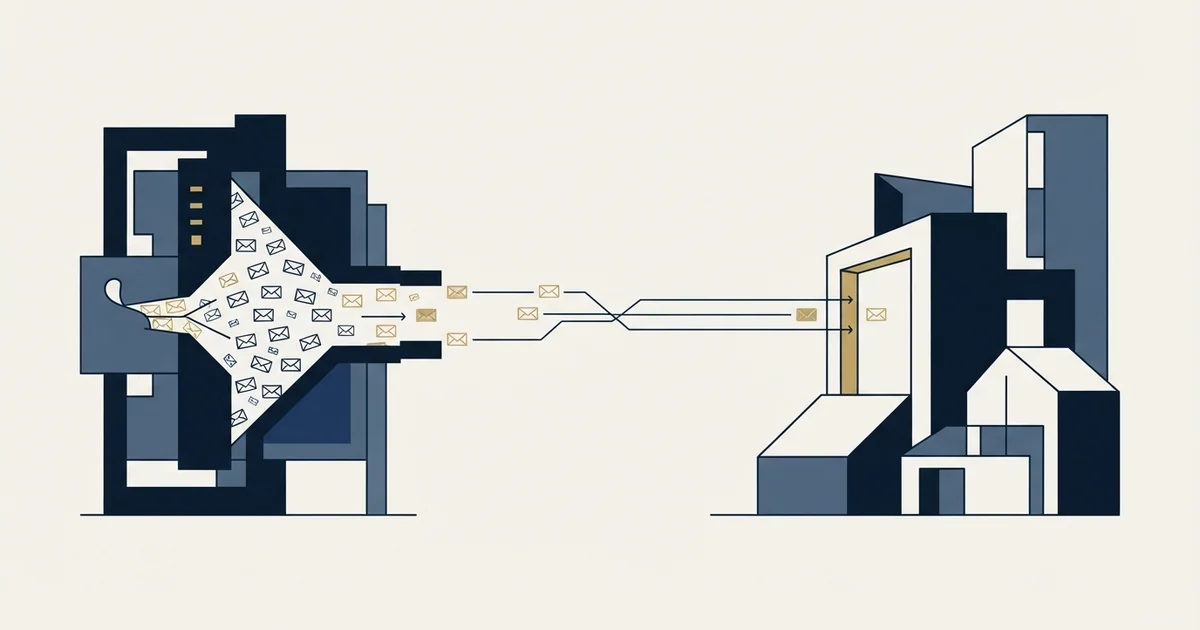
Cold email works for architecture firms when it matches project rhythm rather than quarterly budgets. Identify whether you sell to the firm (software, services) or through it (specified products), target principals at small firms and spec writers at large ones, and send during schematic or design development before the specification section closes.
Key takeaways
- Roughly 75% of US architecture firms have fewer than ten employees, so the principal is usually the entire buying committee (AIA 2024 Firm Survey Report).
- Decide first whether you are selling to the firm (weeks-long cycle, principal or ops lead) or through the firm as a specified product (6 to 24 months, governed by project phases).
- The specification window closes at construction documents. Schematic design and design development are the only phases where a cold email can still change the assembly.
- AIA Architect members must earn 18 learning units per year, 12 in health, safety, and welfare, which makes a registered AIA/CES lunch-and-learn the most reliable door for product manufacturers.
- Small firm domains receive low mail volume, so cap sends per domain and never hit studio@ plus several named addresses at the same practice in one week.
- Measure spec inclusions and sessions booked rather than closed revenue, because purchase orders arrive one to two years later through a contractor.
Reviewed and updated August 28, 2026
Cold Email for Architecture Firms: 2026 Strategy Guide
A curtain wall manufacturer sends 400 emails to project architects and gets 14 replies. Twelve say some version of "interesting, but we're not on a project where that applies right now." The rep marks the campaign a failure and goes back to trade shows.
That campaign was mistimed rather than failed. Those twelve architects will start a project where it does apply, and the only question is whether the manufacturer is still in their inbox when it happens. Architecture firms buy on project rhythm, and most cold email programs that die here were built for a quarterly-budget buyer who does not exist in this vertical.
This guide covers who signs, when the window opens, how to build a list in a market where 75% of firms have fewer than ten people, and what to say when you get an opening.
Most of what is sold as lead generation for architects is residential project matching, where a homeowner is routed to three practices by a marketplace; a commercial practice buying that is buying a different business, and the targeting below assumes the buyer on the other end is a developer, contractor or estates team rather than a household.
The practice itself, deciding how to write to those developers, contractors and estates teams for its own project work, is the reader of outbound sales for architecture firms, which takes the private road and the public qualifications road separately.
If you are reading this as one of the professional-services firms it is written for, the persona-specific version of this playbook lives in our guide to outbound for professional-services firms.
Two Different Sales Motions
Decide which of these you are running first, because the messaging, the list, and the timeline are completely different.
Selling to the firm. Your buyer is the business: practice management software, professional liability insurance, rendering, energy modeling, MEP consulting, recruiting, proposal support, IT. The firm pays you. The decision maker is a principal or operations lead. The cycle is short (weeks) and driven by pain, headcount, or backlog.
Selling through the firm. Your buyer is the specifier. Building products and assemblies that the architect writes into a specification section and the owner or contractor eventually pays for. The firm never sends you a purchase order. Your win condition is getting named in the project manual as basis of design, and the cycle runs 6 to 24 months on project phases rather than the firm's calendar.
Manufacturers who aim "selling to the firm" playbooks (demo requests, free trials, ROI calculators) at specifiers get nowhere, because the architect has no budget authority over your product.
- practice management software, professional liability insurance, rendering, energy modeling, MEP consulting, recruiting, proposal support, IT
- The firm pays you. The decision maker is a principal or operations lead.
- The cycle is short (weeks) and driven by pain, headcount, or backlog.
- Building products and assemblies that the architect writes into a specification section and the owner or contractor eventually pays for.
- The firm never sends you a purchase order. Your win condition is getting named in the project manual as basis of design
- the cycle runs 6 to 24 months on project phases rather than the firm's calendar
Who Actually Buys
Architecture is a small-firm profession. Roughly 75% of US architecture firms have fewer than ten employees, with 28% sole practitioners and 32% at two to four people. Source: AIA Firm Survey Report 2024.
That distribution shapes everything. At most firms you email there is no procurement function, no vendor management, no committee. There is a principal who is also billing hours, which is why your email gets read at 6:40 AM or 9:30 PM and not during the workday.
| Title | Owns | Responds to |
|---|---|---|
| Principal / Managing Partner | Everything under 20 people: software, consultants, insurance, hiring | Utilization, risk, winning work, staff retention |
| Director of Operations | Back office at 20+ person firms: timekeeping, billing, PM tools | Lost admin hours, invoicing delays, project accounting |
| Design Technology / BIM Manager | Revit standards, content libraries, plugins, model workflow | Object libraries, interoperability, model hygiene |
| Specifications Writer | Project manuals, CSI sections, product research, substitutions | Tested performance data, code compliance, warranties |
| Project Architect | Day-to-day product selection on a live job | The detail problem in front of them this week |
| Marketing / BD Director | Pursuits, proposals, SF330s, visualization spend | Win rate, proposal turnaround, imagery quality |
At a 6-person firm, one person is all six rows. At a 300-person firm they are six people who rarely talk, and emailing the wrong one is worse than silence, because a forwarded vendor pitch reads as spam twice.
How the Buying Cycle Actually Works

Project phases set the window
Standard delivery runs through schematic design, design development, construction documents, bidding, and construction administration. The useful window for a specified product is narrow.
In schematic design the architect is still deciding whether your product category is in the building at all, which is when precedent images and performance concepts shape the outcome most. In design development the assembly gets resolved and the specifier pulls real technical data. By construction documents the section is written and you are either in it or filing a substitution request against a competitor who is. Once the job is bidding, your leverage is gone.
So the highest-value cold email here goes to a firm that just won a project in your sector, sent before the assembly locks.
- Schematic designthe architect is still deciding whether your product category is in the building at all
precedent images and performance concepts shape the outcome most
- Design developmentthe assembly gets resolved and the specifier pulls real technical data
- Construction documentsthe section is written and you are either in it or filing a substitution request against a competitor who is
- Once the job is biddingyour leverage is gone
Firm operations buy between pursuits
For "selling to the firm" offers, the trigger is capacity. Firms buy software, consultants, and outsourced services when backlog spikes and they cannot hire fast enough, or right after a painful billing cycle. AIA and Deltek publish the Architecture Billings Index monthly, derived from the Work-on-the-Boards survey, forecasting nonresidential construction activity roughly 9 to 12 months ahead. Source: AIA/Deltek Architecture Billings Index. It is a reasonable macro read on whether your targets are hiring or hunkering down.
Either way, the approval chain at a small firm is one or two people who are billable, deadline-driven, and treat email triage as a two-second decision.
Building the List
Architecture is a finite market. Depending on sector and geography, your realistic universe might be 800 firms rather than 80,000 contacts. Treat list building as research.
Readers building similarly tight lists in another niche can see the same registry-based approach applied to enrollment-driven outreach in childcare.
Where the names come from:
- State licensing board registries, public in most states. Licensure is state-based, so this also solves your geographic filter.
- AIA national and local chapter directories, plus committee rosters, which surface who is active in a given sector.
- Project credits on ArchDaily, Architizer, Dezeen, and firm portfolio pages, which name the firm and often the project architect by building type.
- Industry rankings such as Architectural Record's Top 300 and BD+C's Giants list for the large-firm tier.
- Construction lead databases (Dodge, ConstructConnect) plus permit and bid data for early-phase triggers. Highest-signal source for specified products.
How to segment:
| Axis | Why it matters |
|---|---|
| Sector specialization | Healthcare, K-12, higher ed, multifamily, hospitality. Nothing predicts relevance better. |
| Firm size band | 1-9, 10-49, 50+. Determines who the buyer is and whether ops offers land at all. |
| Geography / climate zone | Licensure, code adoption, and envelope priorities all vary regionally. |
| Software stack | Revit, ArchiCAD, Vectorworks, Rhino. Critical if you ship content libraries or plugins. |
| Recent project activity | A firm with a live job in your sector is worth fifty firms without one. |
A practical warning on emails. Small firms lean heavily on catch-all addresses (info@, studio@, mail@). Catch-alls accept everything, so verification tools return "valid" for addresses no human reads, and your reply rate collapses while your bounce rate looks fine. Prefer named addresses on the firm domain, and treat catch-all-only records as low priority.
Four Email Approaches That Work Here
1. The project-trigger email (specified products)
Subject: {{project_name}} envelope

Hi {{first_name}},

Saw {{firm_name}} is on {{project_name}} in {{city}}. Congrats on the win.

If the envelope package is still open: {{technical_constraint}} usually
forces a compromise between {{tradeoff_a}} and {{tradeoff_b}} on projects
like this. We make a {{product_category}} that resolves it, tested at
{{performance_number}}.

Want the spec section and the details in Revit? Two minutes to look at,
and one detail tells you whether it's worth a conversation.

{{sender_name}}
{{title}} | {{company}}
Why this works: It arrives during design development instead of after the CD set is issued, opens with the project rather than the product, and asks for a file transfer rather than a meeting. Architects take documents from strangers long before they give up thirty minutes. The Revit content offer does real work: a family that saves an hour of modeling is a favor, and favors get replies.
2. The sector-specialist email (services to principals)
Subject: {{sector}} projects at {{firm_name}}

{{first_name}},

You've done {{number}} {{sector}} projects in the last few years, which
is why I'm writing you and not a generalist firm.

We handle {{service}} for firms working in {{sector}}. The usual reason
principals bring us in: {{bottleneck}} eats into fee on every one of
these jobs, and hiring for it full time doesn't pencil until you're
doing {{threshold}} a year.

Two firms your size in {{region}} use us per project. Happy to send how
the engagement is structured, no call needed.

{{sender_name}}
Why this works: It leads with a countable fact about their portfolio, names the economic reason they have not solved the problem internally, and prices per project rather than as a retainer, matching how architecture firms think about cost. The closing line removes the meeting entirely.
3. The operations email (software and back office)
Subject: timesheets at {{firm_name}}

Hi {{first_name}},

Quick question, not a pitch.

At {{employee_count}} people, is somebody still reconciling timesheets
against project phases by hand at the end of the month? That's the
point where most firms your size discover a project went 30% over on
{{phase}} four weeks after it happened.

If that's a non-issue, ignore this. If it's a monthly annoyance, I can
show you what the reconciliation looks like when it's automatic. Ten
minutes, screen share, no deck.

{{sender_name}}
Why this works: It asks about a process rather than announcing a product, uses firm size as the qualifying detail, and gives explicit permission to ignore it. Principals who are also billing hours respond well to a disposable email. The specificity of "four weeks after it happened" reads as written by someone who has seen a project accounting report.
4. The lunch-and-learn / CEU offer
AIA Architect members must complete 18 learning units annually, 12 of them in health, safety, and welfare topics. Source: AIA & state continuing education requirements. That is a standing, non-optional demand inside every firm you email, and the most reliable door in the vertical for product manufacturers.
Subject: HSW session for the {{firm_name}} studio

Hi {{first_name}},

We run a {{duration}} session on {{technical_topic}} for design teams.
It's registered through AIA/CES and carries {{number}} HSW learning
units.

It's a real technical session on {{specific_problem}}, not a product
walkthrough. Roughly {{number}} firms have had us in this year and the
question that comes up every time is {{common_question}}.

We bring lunch. If your teams are short on HSW hours heading into the
end of the year, {{month}} or {{month}} both have open dates.

{{sender_name}}
Why this works: It trades something the firm needs anyway for an hour of attention from the whole studio, including specifiers and project architects you could never reach individually. The "not a product walkthrough" line matters, because every architect has sat through a bad one. Only send this if you are a registered AIA/CES provider. Claiming credits you cannot award ends the relationship immediately and travels fast through a chapter.
Sellers looking for cold calling scripts for architecture firms should treat the phone as a way to schedule a session like this one, since a principal who is billing hours rarely takes an unscheduled call.
Deliverability and Compliance in This Vertical
Tiny domains punish volume. A 5-person firm receives low, predictable mail volume. A burst of similar messages to studio@, principal@, and three named addresses at one domain in a week is an obvious pattern to any filter. Cap sends per domain and never hit multiple contacts at a small firm at once.
Directory data goes stale fast. Architects move firms often, and small practices dissolve, merge, and rebrand constantly. Scraped chapter directories and old award lists carry high bounce rates. Verify before every send, not once at import.
Know which law applies. US firms fall under CAN-SPAM, which requires accurate headers, a physical address, and a working opt-out honored within ten business days. Source: FTC CAN-SPAM Act compliance guide. Canadian firms fall under CASL, which is consent-based and stricter. UK and EU firms fall under GDPR and PECR. Architecture practices are unusually international for their size, and a list built from project credits will quietly mix all four regimes. Segment by jurisdiction before you send.
Do not imply licensed practice. If you sell design-adjacent services, avoid language suggesting you offer architectural or engineering services. State practice acts restrict those terms, and a principal will notice immediately.
Respect the reply. A "not right now, but keep me posted" is a genuine invitation in a market with 18-month cycles. Move it to a low-frequency nurture track.
Realistic Expectations
Set goals against the size of the market rather than a SaaS benchmark deck. If you sell a healthcare-specific product to US firms with 20 or more staff, your addressable universe is measured in hundreds of firms. You cannot brute-force it, and if you burn that list with a generic sequence, there is no second list.
Measure inclusion first. For specified products, the near-term metrics are spec inclusions, basis-of-design mentions, and sessions booked. Revenue shows up one to two years later on a contractor purchase order that never mentions your email.
Expect long silence followed by sudden urgency. The reply in month nine often reads "we're on a project where this applies, can you send data by Thursday." Keep the sender address alive and make sure whoever gets that reply can answer technically within a day.
Personalization is the whole job. In a vertical this small and this credential-conscious, one email referencing an actual project outperforms a thousand referencing a persona. Teams that outsource this (RevenueFlow included) still win or lose on whether the research behind each send is real.
Pre-Send Checklist
- Confirmed which motion you are running (to the firm or through it)
- Segmented by sector specialization beyond SIC or NAICS code
- Matched contact title to offer (spec writer, principal, or ops lead)
- Identified a live or recently announced project where applicable
- Verified named addresses and deprioritized catch-alls
- Capped sends per domain and spaced multi-contact firms
- Segmented by jurisdiction for CAN-SPAM, CASL, and GDPR
- Confirmed AIA/CES registration before offering learning units
- One message per campaign, with a low-frequency track for anyone who replied "not right now"
- Defined success as spec inclusions and sessions booked, not closed revenue
The Short Version

Architecture firms are more reachable by cold email than most verticals, because the decision maker is usually the owner and the inbox is not saturated with B2B sequences. What they punish is generic timing. Send an early-phase note about a real project, an operational question sized to their headcount, or a genuine CEU session, and you will get replies from principals who ignore everything else.
Teams that still treat every vertical the same will find strategy guide for breweries and distilleries useful for seeing how owner-read inboxes and production cycles change the same cold email playbook.
If you would rather have this built and run for you, book a strategy call with RevenueFlow and we will map the addressable firm universe for your product first.
Related Reading
- Cold Email for Interior Design Firms: 2026 Strategy Guide
- Cold Email for Private Equity Firms: 2026 Strategy Guide
- Cold Email for Wealth Management Firms: 2026 Strategy Guide
If you would rather have this run for you, RevenueFlow books qualified meetings on a pay-per-meeting basis and publishes client results.
Frequently asked questions.
Frequently asked questions- Does cold email actually work for reaching architects?
- Yes, and often better than in software-heavy verticals, because architects' inboxes are not saturated with B2B sequences and the decision maker at most firms is the owner. The constraint is timing rather than access. Emails that reference a live project or a real operational problem get replies; generic product pitches sent outside a project window get ignored.
- Who should I email at an architecture firm?
- At firms under twenty people, email the principal or managing partner, who controls software, consultants, insurance, and product decisions. At larger firms, split by offer: specifications writers and technical directors for product data, design technology managers for Revit content and plugins, directors of operations for back-office software, and marketing directors for proposal and visualization services.
- When is the best time to email an architect about a building product?
- During schematic design or early design development, before the specification section is written. Once the project reaches construction documents, your product is either named as basis of design or you are filing a substitution request against a competitor. Project lead databases and permit data are the practical way to find firms in that window.
- Can I offer AIA continuing education credits in a cold email?
- Only if your organization is a registered AIA/CES provider. AIA Architect members must complete 18 learning units annually, 12 of them health, safety, and welfare, so a genuine credited session is a strong offer. Claiming credits you cannot award will end the relationship and the reputational damage spreads quickly through a local AIA chapter.
- How big is the addressable market for cold email in architecture?
- Smaller than most B2B verticals. Filtering US firms by sector specialization, staff size, and geography often leaves a universe in the hundreds rather than tens of thousands. That makes list quality and research depth the deciding variables, since burning the list with a generic sequence leaves no second attempt.
About the author.

Fernando Cao is CEO at RevenueFlow, which builds and operates outbound revenue engines for B2B companies. Previously at Accenture Strategy. Studied at University of Bath.
Fernando Cao · CEO
Connect on LinkedIn →Explore more.
Ready to scale your outreach?
We build GTM engines that book real meetings. See the receipts.
Related articles.
Cold Email for Trucking and Fleet Companies: 2026 Guide
How to reach carriers, fleet operators, and safety buyers with cold email: FMCSA-driven list building, trigger timing, four templates, and compliance.
Cold Email for Cannabis Companies: 2026 Strategy Guide
The April 2026 rescheduling order split cannabis buyers into two tax realities. Here is how to segment, list-build, and write cold email for each.
Cold Email for Private Equity Firms: 2026 Strategy Guide
How to run cold email into private equity: mapping fund-level and portfolio-level buyers, list sources, four templates, and PE-specific deliverability rules.
Cold Email for Wealth Management Firms: 2026 Strategy Guide
RIAs are 16,500+ mostly small firms with public Form ADV data, small buying committees, and a compliance gate. How to run cold email into wealth management.
Cold Email for Interior Design Firms: 2026 Strategy Guide
Commercial interior designers specify products they never buy. Here is how to build cold email that wins the specification, plus four templates.
Cold Email for Supplement and Nutrition Brands: 2026 Guide
How to run cold email into DTC and retail supplement brands: the buyer map, retail and trade show timing, list sources, four templates, and FTC-safe copy.