Outbound for Professional Services: A Chargeable Hour Target
Partners are the only credible senders and the ones carrying a utilisation target. How the build versus buy decision looks from that seat.

Clients change professional services firms at trigger events rather than because a better firm asked, so outbound buys presence before the trigger. The conflicts screen and conduct-rule compliance stay with the firm. List building, infrastructure and scheduling can be handed over. Size the program against available partner hours.
Key takeaways
- Firms switch advisers at trigger events, so a cold message rarely creates a decision and instead buys presence for when the event arrives.
- The conflicts screen and compliance with professional conduct rules stay with the firm, and the screen has to gate the first send.
- Cost per lead is close to meaningless when cycles run quarters; cost per attended conversation with a qualified organisation is the useful unit.
- Size the program against the introductory calls partners will genuinely hold each month, not against the size of the addressable market.
Reviewed and updated September 1, 2026
Outbound for Professional Services: Business Development Against a Chargeable Hour Target
In most professional services firms, business development is what partners do after the chargeable work is finished, which means it is what partners do in the weeks when there is not enough chargeable work. That is precisely the wrong schedule. Pipeline built in the quiet months arrives in the busy ones, and the firms that stay steady are the ones that kept a small motion running while everybody was flat out.
The structural reason is easy to state and hard to fix. The partner is the only person in the building whose name carries the credibility a cold message needs, and the partner is also the person carrying a utilisation target. Business development competes with the thing the firm measures.
What a professional services firm is really selling
Clients rarely change accountants, lawyers or advisers because a better firm asked. They change when something happens: a funding round, an acquisition, an audit threshold crossed, a partner they trusted retiring, a dispute nobody planned for. Most of those events are visible from outside if somebody is looking. The trigger view of this market, worked through for accounting specifically, is in accounting lead generation.
That has a direct consequence for how outbound should be judged. A message that arrives before the trigger is not wasted, it is early, and the return on it shows up in a quarter you will not attribute correctly. Firms that expect a cold message to create a switching decision are disappointed. Firms that treat outbound as a way to be present and specific when the trigger arrives get more out of it.
The second thing being sold is judgement under uncertainty, which is exactly what a stranger cannot assess. So the message has to demonstrate something rather than assert competence. A firm claiming deep sector expertise says the same thing as every competitor. A firm naming the specific thing that goes wrong for companies in that sector at that stage has said something only a practitioner could say.
The three constraints that make this different
Conflicts. A professional services firm cannot approach whoever it likes. Approaching a company adverse to an existing client is a problem that no amount of pipeline justifies, and the check has to happen before the first message rather than after a reply. This is the firm's obligation and it cannot be delegated to a supplier, whatever the supplier offers to do.
Professional conduct rules. Solicitation of prospective clients is governed by the rules of the relevant professional body and, for lawyers, by the jurisdiction's own conduct rules. These vary by profession and by jurisdiction, they apply to anything sent on the firm's behalf, and the firm remains responsible for compliance. Confirm the applicable requirements with your own regulator or professional body before any program launches, and make sure whoever runs it knows what the constraints are.
Partner scarcity. The credible sender, the person who answers a technical reply, and the person who takes the first call are usually the same person. A program that generates more conversations than that person can hold has not helped.
Whether that person should be the seller at all, and which of the four selling models a firm runs, is decided before any programme in sales strategy for professional services.
- The conflicts check, before the first send
- Compliance with the applicable conduct rules
- The point of view and the sector observation
- Approval of every message sent over a partner name
- The reply, the technical answer and the first call
- Building and verifying the prospect list
- Loading exclusions and suppression
- Sending infrastructure and deliverability
- Scheduling, tracking and reporting
The build-versus-buy decision at partner rates

The arithmetic below is illustrative and invented to show the shape of the calculation rather than to report anything measured. Substitute your own numbers.
Using invented placeholder figures, suppose a partner charges 300 an hour and spends five hours a week on business development once list work, writing and follow-through are counted. That is 1,500 a week of chargeable capacity, or roughly 6,500 a month, which is a substantial figure to set beside a program fee before any tooling or data cost is added. The comparison sharpens further when ramp is included, because the in-house version pays for a first learning cycle that produces nothing.
The method for building both sides of that number properly, fully loaded and divided by meetings that actually happened, is in outsourced SDR vs in-house. The broader question of what a firm should own permanently and what it should rent for a defined period is worked through in in-house versus agency, and the answer for most professional services firms is that the relationship compounds and belongs inside, while the machinery around it is episodic and does not.
One warning about metrics. Firms new to buying outbound often ask for a cost per lead, and in this category that number is close to meaningless. A lead is not a unit of anything when the sales cycle runs quarters and a single engagement can be worth more than a year of small ones. The reasons the metric misleads even when computed honestly are set out in cost per lead in B2B. Cost per attended conversation with a qualified organisation is a harder number to produce and a much more useful one.
- Weeks 1 to 3Setup
Conflicts screen, exclusions, infrastructure warmup, copy approved
- Month 1First sends
Replies begin, most are not-now rather than no
- Months 2 to 4Conversations
Introductory calls, some scoping, little revenue
- Months 4 and laterTriggers land
Earlier contacts return when the event arrives
How a done-for-you motion maps to a firm
Stated as documented policy rather than as a claim about outcomes.
One message per campaign. One premise, sent once. No bump sequences and no thread replies. For a firm whose brand is restraint and discretion, this is not a compromise. A single considered message reads as professional in a way that a five-step sequence does not, and the reputational exposure of an automated chase under a partner's name is entirely avoided.
Qualification agreed in writing before launch. What counts as a conversation worth a partner's hour is defined up front: organisation size, sector, the role that must be present, the situation that makes the firm relevant. Budget, timing and authority are never billing conditions, which matters here because a prospect who says the work is eighteen months out may still be the most valuable name on the list.
Copy sign-off by the firm. Nothing sends over a partner's name without approval. Prospect lists are not sent back for line-by-line review, with one deliberate exception: the conflicts screen. That is the firm's responsibility, it happens on the firm's side, and it gates the send.
Email and LinkedIn, not phone. Written channels only, which also keeps the record of what was sent complete and reviewable.
The referral question
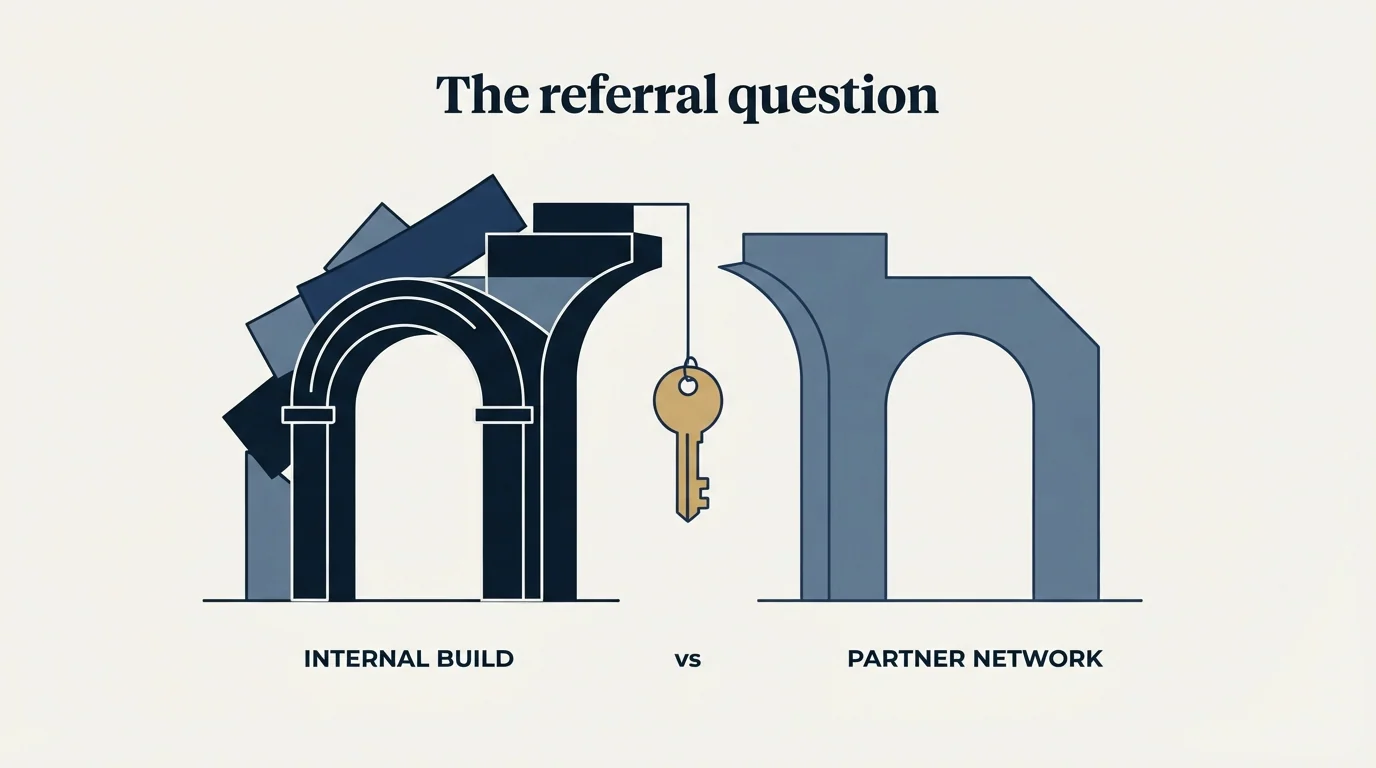
Almost every professional services firm is referral-led, and almost every one of them is uneasy about saying so. Referrals convert better than any cold first contact and they always will, because the introduction transfers trust the firm has not had to build. The reason to add outbound beside them is not that referrals are inferior. It is that referrals reach only the segments the firm has already served, and they cannot be scheduled.
The wider channel mix that sits beside outbound, from hosted events to panel reviews, is set out in professional services lead generation.
That second point matters more than firms expect. A practice cannot make hiring decisions, open an office or take on a lateral partner against a pipeline whose timing is unknown. A modest outbound motion that produces a predictable trickle of conversations is worth more as a planning instrument than the raw number of meetings suggests.
The related piece on distinguishing fit from go-to-market issues explains why retention, not lead volume, separates a demand problem from an execution one.
Outbound also does something referrals structurally cannot, which is reach a sector the firm wants to move into and has no relationships in yet. That is usually the strongest case for starting, and it is the case where the specificity of the message matters most, since the firm has no track record in the segment to lean on and only judgement to show.
What to evaluate in any provider
- Yes: How does the process accommodate a conflicts screen before the first send
- Yes: Does the provider understand that conduct rules apply to messages sent on your behalf
- Yes: Can the copy carry a sector observation rather than a service description
- Yes: Who answers a technical reply, and how quickly does it reach a partner
- Yes: Is the volume matched to the partner hours available to hold conversations
- Yes: What triggers payment, and who wrote the definition of a qualified meeting
- Yes: Can you see rendered messages across the real list, not a template with sample data
Two of these decide most of it.
Volume matched to partner capacity. A program that books more introductory calls than the firm can staff converts a pipeline problem into a delivery problem, and the second one is more damaging because prospects notice. Size the program against the hours the partners will actually give it, and be pessimistic about that number.
Tone control. The register of a professional services message is narrow. Anything that reads as a sales sequence undermines the positioning the firm spends years building. Ask to see rendered messages across the real list rather than a polished template, because the failure cases live in the records with missing or odd data, and those are the ones a prospect remembers.
For a sense of how outreach performs in adjacent professional categories, legal cold email benchmarks covers the distribution people report when the audience is law firms and legal departments.
Where to start

Name the sector and the situation, not the service line. Run the conflicts screen against the target universe before anybody writes copy, because it can remove a meaningful part of the list and it is cheaper to discover early. Confirm what your professional body requires of solicitation and make it part of the brief rather than a late review. Decide how many introductory conversations the partner group can genuinely hold in a month, and size everything against that number rather than against the market.
If the firm would rather keep partners on chargeable work and have the outbound machinery run alongside it, RevenueFlow is paid on attended meetings that meet criteria agreed in writing before launch. You can see what a campaign would look like for your market.
Frequently asked questions.
Frequently asked questions- Is cold outreach allowed for a regulated professional firm?
- Solicitation of prospective clients is governed by the rules of the relevant professional body and, for lawyers, by the jurisdiction's conduct rules. Those requirements vary and they apply to anything sent on the firm's behalf. Confirm what applies with your own regulator before launch, and make the constraints part of the brief rather than a late review.
- How do we handle conflicts if someone else builds the list?
- The conflicts screen stays with the firm and runs against the target universe before any message is written. It is the one point where a professional services firm should review the list rather than rely on structural exclusions. Doing it early is also cheaper, because it can remove a meaningful share of the market and change the sensible program size.
- Will outbound replace our referral network?
- No, and it should not try. Referrals convert better because the introduction transfers trust the firm never had to build. What outbound adds is reach into sectors the firm has no relationships in yet, and timing you can plan against. A pipeline whose arrival is predictable supports hiring decisions that referrals cannot.
- How many meetings should a partner-led program aim for?
- Fewer than the market would allow. The binding constraint is the hours partners will actually give to introductory calls, and a program that books more converts a pipeline problem into a delivery problem that prospects notice. Decide the monthly number the partner group can hold, be pessimistic about it, and size everything against that.
About the author.

B2B cold email experts helping companies generate qualified leads through done-for-you outreach campaigns.
RevenueFlow Team
Explore more.
Ready to scale your outreach?
We build GTM engines that book real meetings. See the receipts.
Related articles.
SDR Outsourcing for Logistics Companies: The Brokerage Line
What an outside sales development team may do in a freight company's name, the calling and email rules it inherits, and which arrangement survives a bid-shaped market.
SDR Outsourcing for Business Brokers: The Fee Timing
Whether a success-fee brokerage should rent sales development at all: the fee timing, the texts that limit what an outside person may say about value, and who signs.
Appointment Setting for Business Brokers: The Seller Meeting
What a bought meeting with a business owner has to be for a brokerage: the three-part qualification, the confidentiality rules, the licence line and the owner's reasons.
B2B Lead Lists for Aviation Companies: Build or Buy
Aviation is one of the few industries whose accounts are published by its regulator, which changes what is worth buying and what is worth downloading yourself.
LinkedIn Outreach for Banks: A Regulated Message
How a bank's relationship managers use LinkedIn to reach business owners: what the FFIEC guidance, FINRA's notices and LinkedIn's own rules require, and where to stop.
Cold Calling for PPC Agencies: What You Can See First
A paid media prospect is partly readable before the call and has already been told by the platform what to do when a stranger rings about its ads.