Legal Cold Email Benchmarks: 2026 Performance Data
Industry benchmark data for legal cold email campaigns, including open rates, reply rates, and conversion metrics for companies targeting law firms, legal departments, and legal service providers.
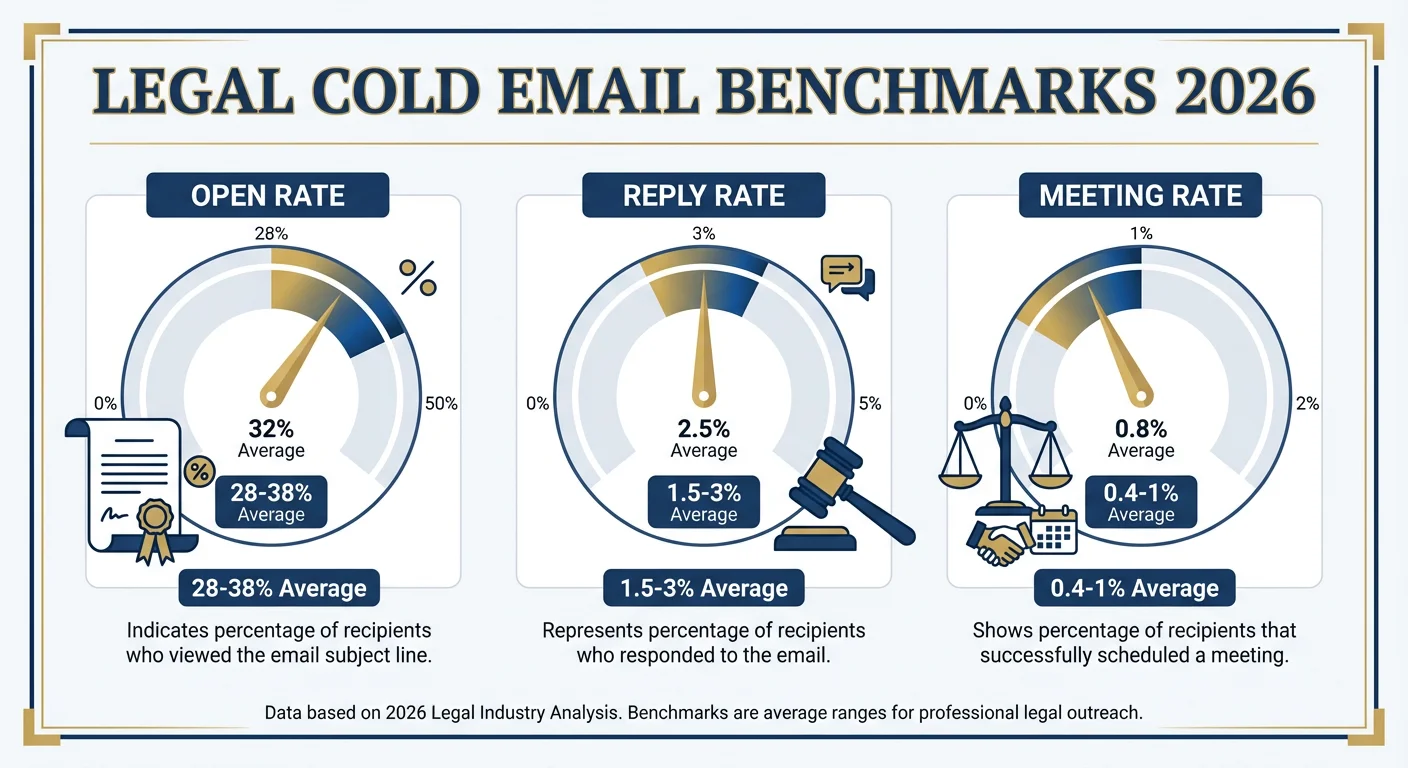
Legal cold email benchmarks for 2026 show average open rates of 28-38%, reply rates of 1.5-3%, and meeting booking rates of 0.4-1%. Smaller law firms (under 100 attorneys) consistently outperform larger firms, with solo practitioners achieving 42-55% open rates and 1.2-2.8% meeting rates. Practice management software generates the strongest engagement at 38-52% opens and 1-2.5% meetings, while e-discovery tools see lower performance at 30-42% opens and 0.5-1.2% meetings.
Key takeaways
- Solo practitioners and small firms (2-10 attorneys) achieve 42-55% and 38-52% open rates respectively, significantly outperforming Am Law 100/200 firms at 25-38%.
- Practice management software campaigns generate the highest meeting booking rates at 1-2.5%, followed by legal billing solutions at 0.8-1.8%.
- Below-average performance in legal cold email is defined as under 28% open rates, under 1.5% reply rates, and under 0.4% meeting booking rates.
- Corporate legal departments show 30-42% open rates and 0.5-1.2% meeting booking rates, falling between small and large law firms in responsiveness.
- Legal research and analytics tools face suppressed engagement due to established player dominance, achieving only 0.6-1.5% meeting booking rates.
Reviewed and updated September 15, 2026
The legal industry presents unique challenges and opportunities for B2B cold email campaigns. Law firms and corporate legal departments are traditionally conservative in their technology adoption, but increasing pressure for efficiency and client service improvements has opened doors for well-positioned solutions.
This benchmark report provides legal-specific data to help companies evaluate their cold email performance when targeting law firms, corporate legal departments, and legal service providers. The metrics represent typical performance ranges observed across legal technology, professional services, and solutions companies.
A law firm running its own business development is a different sender under different rules, and outbound sales for law firms sets out what the ABA Model Rules allow.
Methodology Note
The legal industry encompasses diverse segments from solo practitioners to global law firms to corporate legal departments. The benchmarks in this report are compiled from industry research and commonly observed performance ranges. Your results will vary based on your specific target segment, product type, and competitive landscape.
Key Legal Cold Email Metrics
Legal professionals tend to be cautious and analytical in their evaluation processes. Email communication remains central to legal practice, creating opportunities for well-crafted outreach.
Average
Average
Average
Average
Bar widths are equal here because these stage values are not a single comparable measure.
Open Rates
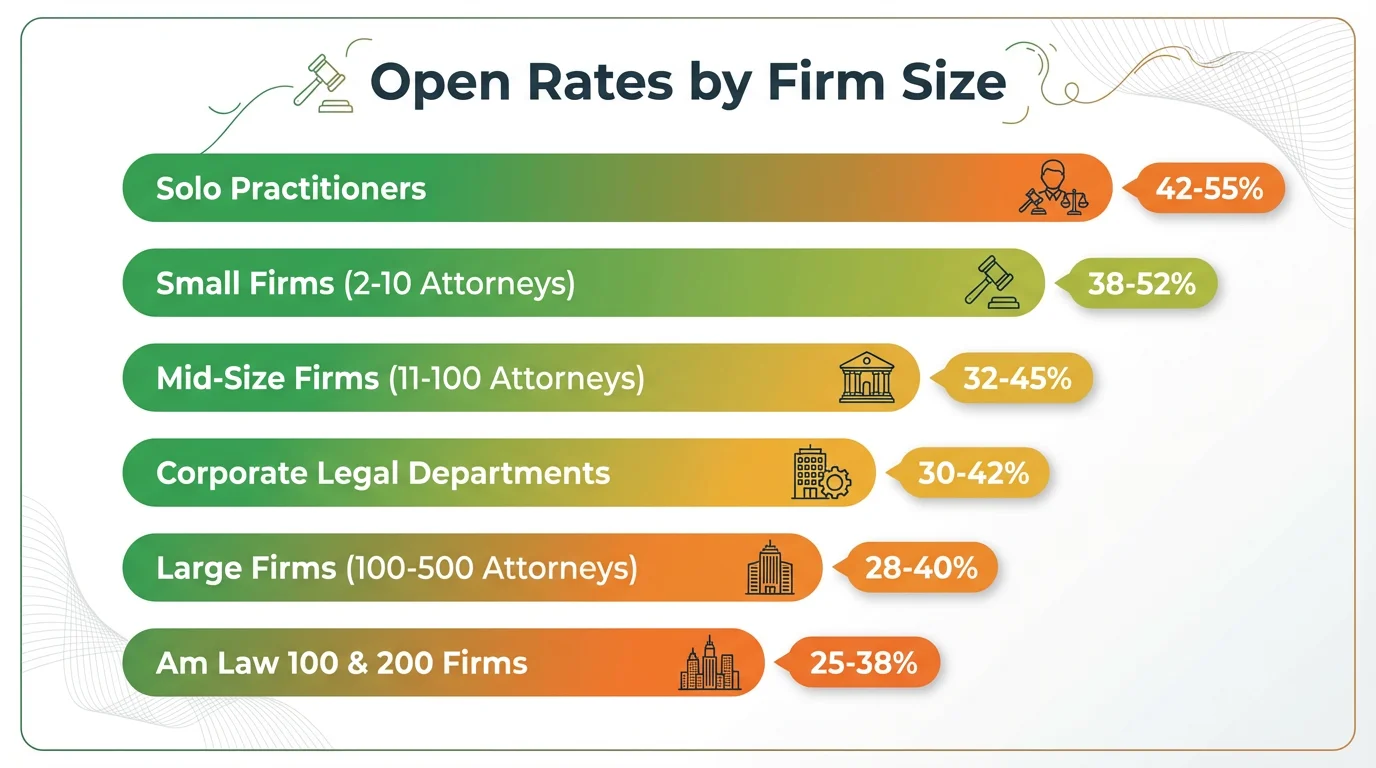
Open rates in legal tend to be moderate, with attorneys being discerning about which emails receive attention.
Legal Industry Benchmarks:
- Below average: Under 28%
- Average: 28-38%
- Good: 38-48%
- Excellent: 48%+
By Legal Organization Type:
| Organization Type | Typical Open Rate Range |
|---|---|
| Solo Practitioners | 42-55% |
| Small Firms (2-10 attorneys) | 38-52% |
| Mid-Size Firms (11-100 attorneys) | 32-45% |
| Large Firms (100-500 attorneys) | 28-40% |
| Am Law 100/200 Firms | 25-38% |
| Corporate Legal Departments | 30-42% |
Smaller firms show higher open rates because attorneys at these firms often manage their own email without extensive gatekeeping. Large firm attorneys have support staff filtering communications.
Reply Rates
Legal professionals are generally direct in their responses, though the conservative nature of the profession can suppress initial engagement.
Legal Industry Benchmarks:
- Below average: Under 1.5%
- Average: 1.5-3%
- Good: 3-5%
- Excellent: 5%+
By Legal Organization Type:
| Organization Type | Typical Reply Rate Range |
|---|---|
| Solo Practitioners | 3.5-6% |
| Small Firms (2-10 attorneys) | 3-5.5% |
| Mid-Size Firms (11-100 attorneys) | 2-4% |
| Large Firms (100-500 attorneys) | 1.5-3% |
| Am Law 100/200 Firms | 1-2.5% |
| Corporate Legal Departments | 1.8-3.5% |
Positive Reply Rates
Legal professionals often seek detailed information before committing to meetings. Requests for additional materials should be treated as positive engagement.
Legal Industry Benchmarks:
- Below average: Under 0.8%
- Average: 0.8-1.8%
- Good: 1.8-3%
- Excellent: 3%+
Meeting Booking Rates
Converting legal professionals to scheduled meetings requires navigating busy schedules and often competing with billable work priorities.
Legal Industry Benchmarks:
- Below average: Under 0.4%
- Average: 0.4-1%
- Good: 1-2%
- Excellent: 2%+
By Legal Organization Type:
| Organization Type | Typical Meeting Rate Range |
|---|---|
| Solo Practitioners | 1.2-2.8% |
| Small Firms (2-10 attorneys) | 1-2.5% |
| Mid-Size Firms (11-100 attorneys) | 0.6-1.5% |
| Large Firms (100-500 attorneys) | 0.4-1% |
| Am Law 100/200 Firms | 0.3-0.8% |
| Corporate Legal Departments | 0.5-1.2% |
Benchmarks by Legal Product Category
Performance varies significantly based on your product type and its position in legal workflows.
Practice Management Software
Platforms for case management, billing, client intake, and firm operations.
Typical Performance Ranges:
- Open rates: 38-52%
- Reply rates: 3-5.5%
- Positive reply rates: 1.5-3.5%
- Meeting booking rates: 1-2.5%
Practice management sees strong engagement, particularly from small and mid-size firms seeking efficiency improvements.
Legal Research and Analytics
Research platforms, case analytics, and legal intelligence tools.
Typical Performance Ranges:
- Open rates: 32-45%
- Reply rates: 2-4%
- Positive reply rates: 1-2.5%
- Meeting booking rates: 0.6-1.5%
Legal research is a competitive category dominated by established players, which can suppress engagement for newer entrants.
E-Discovery and Litigation Support
Document review, e-discovery platforms, and litigation support services.
Typical Performance Ranges:
- Open rates: 30-42%
- Reply rates: 1.8-3.5%
- Positive reply rates: 0.9-2%
- Meeting booking rates: 0.5-1.2%
E-discovery engagement often spikes around specific matters or anticipated litigation.
Contract Management and CLM
Contract lifecycle management, document automation, and contract analytics.
Typical Performance Ranges:
- Open rates: 35-48%
- Reply rates: 2.5-4.5%
- Positive reply rates: 1.2-2.8%
- Meeting booking rates: 0.7-1.6%
Contract management sees growing interest, particularly from corporate legal departments.
Legal Billing and Time Tracking
Time tracking, billing automation, and legal accounting solutions.
Typical Performance Ranges:
- Open rates: 38-50%
- Reply rates: 2.8-5%
- Positive reply rates: 1.4-3%
- Meeting booking rates: 0.8-1.8%
Client Development and Marketing
Marketing automation, CRM, and business development tools for law firms.
Typical Performance Ranges:
- Open rates: 35-48%
- Reply rates: 2.5-4.5%
- Positive reply rates: 1.2-2.8%
- Meeting booking rates: 0.7-1.6%
Benchmarks by Target Persona
Legal organizations involve various decision-makers with different priorities and authority levels.
Managing Partners and Firm Leadership
Typical Performance Ranges:
- Open rates: 28-40%
- Reply rates: 1.5-3%
- Positive reply rates: 0.8-1.8%
- Meeting booking rates: 0.4-1%
Firm leadership is difficult to engage but carries significant decision-making authority.
Practice Group Leaders
Typical Performance Ranges:
- Open rates: 32-45%
- Reply rates: 2-4%
- Positive reply rates: 1-2.5%
- Meeting booking rates: 0.5-1.3%
Practice group leaders often drive technology decisions within their groups.
General Counsel and Legal Operations
Typical Performance Ranges:
- Open rates: 32-44%
- Reply rates: 2-4%
- Positive reply rates: 1-2.5%
- Meeting booking rates: 0.6-1.4%
Corporate legal leaders increasingly drive legal technology purchasing.
Legal Operations and Administration
Typical Performance Ranges:
- Open rates: 38-50%
- Reply rates: 3-5.5%
- Positive reply rates: 1.5-3.5%
- Meeting booking rates: 0.9-2%
Legal operations professionals are typically the most receptive to technology solutions and often champion purchases.
Where a legal tech vendor reaches those desks by phone rather than by email, cold calling for legal tech companies covers who answers at a firm, when the shows empty the desks, and what confidentiality keeps off the call.
IT Directors in Law Firms
Typical Performance Ranges:
- Open rates: 35-48%
- Reply rates: 2.5-4.5%
- Positive reply rates: 1.2-2.8%
- Meeting booking rates: 0.7-1.6%
Law firm IT leaders influence technology decisions, particularly for infrastructure and security solutions.
Associate Attorneys
Typical Performance Ranges:
- Open rates: 35-48%
- Reply rates: 2-4%
- Positive reply rates: 0.8-2%
- Meeting booking rates: 0.4-1%
Associates may be early adopters and internal champions but typically lack purchasing authority.
Practice Area Variations

Performance varies by legal practice area based on technology orientation and business pressure.
Practice Area Performance Ranges
| Practice Area | Open Rate Range | Reply Rate Range |
|---|---|---|
| Corporate/M&A | 30-42% | 1.8-3.5% |
| Litigation | 32-45% | 2-4% |
| Intellectual Property | 35-48% | 2.5-4.5% |
| Real Estate | 38-50% | 2.8-5% |
| Employment/Labor | 35-48% | 2.5-4.5% |
| Tax | 32-44% | 2-3.8% |
| Family Law | 40-52% | 3-5.5% |
| Personal Injury | 42-55% | 3.5-6% |
| Immigration | 38-50% | 3-5% |
| Criminal Defense | 40-52% | 3-5.5% |
Personal injury and criminal defense attorneys often show higher engagement because their practices are more directly dependent on client acquisition and operational efficiency.
Seasonal Patterns in Legal Outreach
Legal cold email performance follows distinct patterns tied to industry rhythms.
Optimal Timing Windows
Best Performing Periods:
- January-February: New year planning and budget allocation
- May-June: Mid-year evaluation and adjustments
- September-October: Fall planning before year-end
Challenging Periods:
- December: Holiday schedules and year-end matters
- Late summer (July-August): Vacation schedules
- Major filing deadlines and court calendar peaks
Day and Time Considerations
Typical Best Performing Times:
- Tuesday through Thursday outperform other weekdays
- Early morning sends (7-9 AM) before court appearances and client meetings
- Evening sends (6-8 PM) may catch attorneys reviewing email after business hours
- Avoid Monday mornings (backlog from weekend) and Friday afternoons
What Top Performers Do Differently
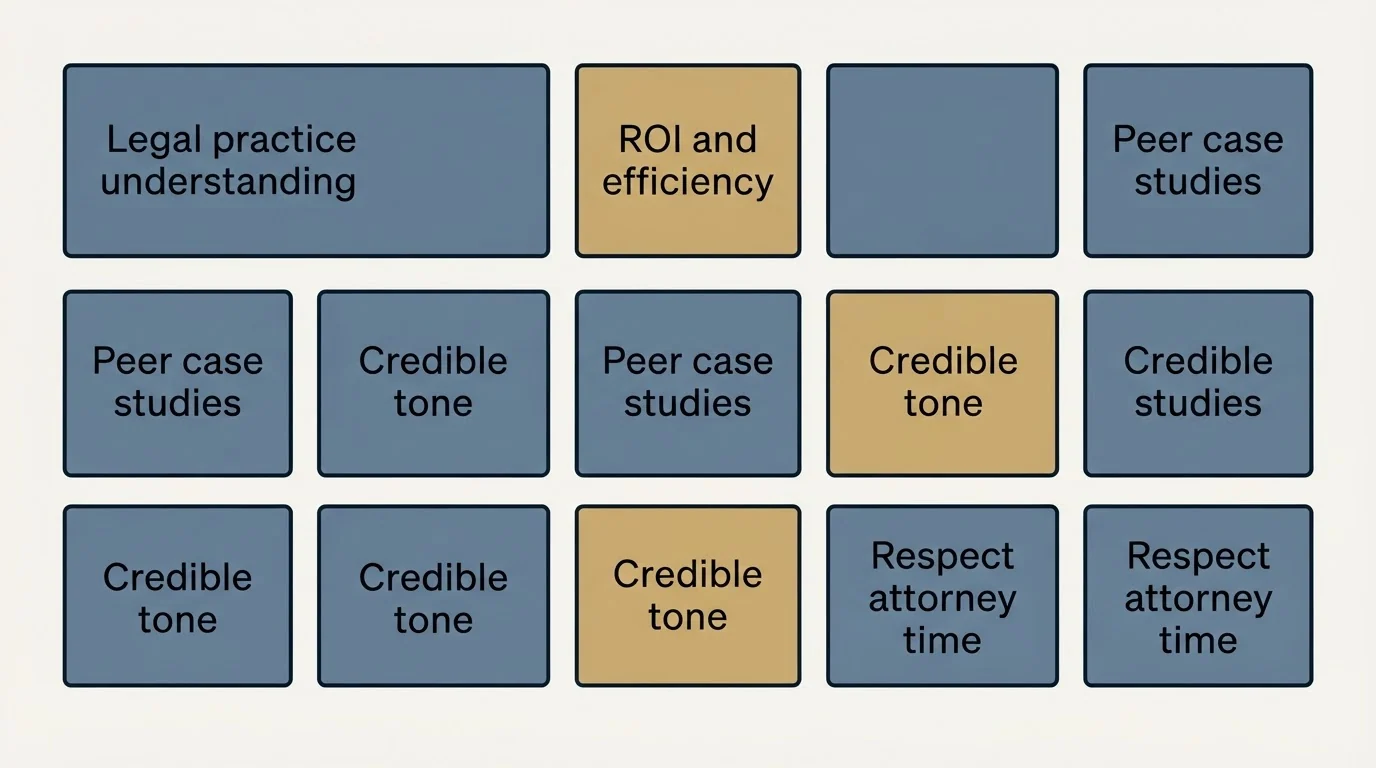
Companies achieving top-quartile performance in legal cold email share common characteristics.
Deep Understanding of Legal Practice
Top performers demonstrate knowledge of legal workflows, billing pressures, and the specific challenges facing different practice areas and firm types.
ROI and Efficiency Focus
Legal professionals operate under intense time pressure. Successful campaigns clearly communicate time savings, efficiency gains, or revenue impact.
Peer Validation and Case Studies
Law firms are heavily influenced by peer adoption. References to similar firms (by size, practice area, or geography) significantly strengthen engagement.
Professional and Credible Tone
Legal professionals expect polished, professional communications. Casual language or marketing hyperbole can undermine credibility.
Respect for Attorney Time
Successful campaigns acknowledge the value of attorney time and offer flexible, low-commitment initial engagements.
- Yes: Deep Understanding of Legal Practice
- Yes: ROI and Efficiency Focus
- Yes: Peer Validation and Case Studies
- Yes: Professional and Credible Tone
- Yes: Respect for Attorney Time
Improving Your Legal Cold Email Performance
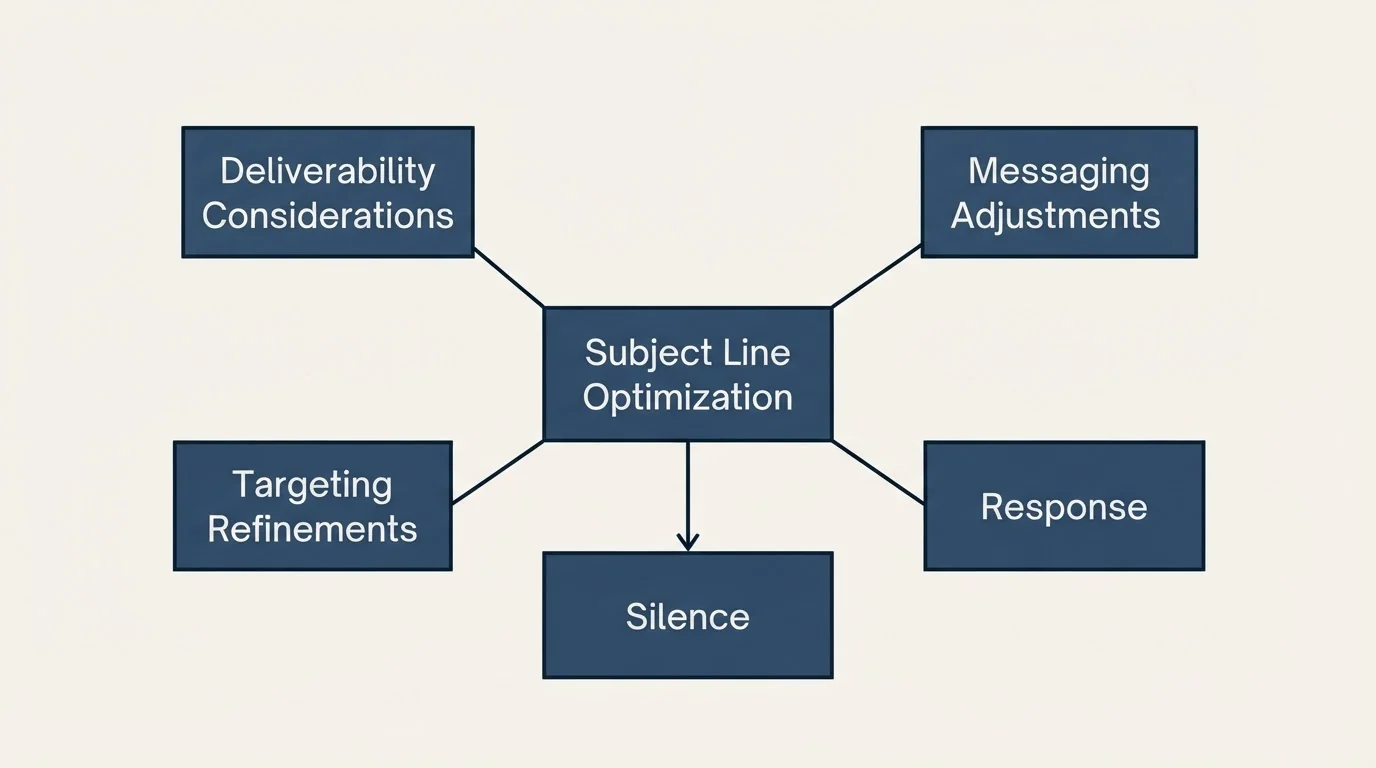
If your metrics fall below these benchmarks, focus on these high-impact areas.
For Below-Average Open Rates
Subject Line Optimization for Legal:
- Reference specific practice areas or firm challenges
- Use professional, straightforward language
- Avoid promotional or salesy phrasing
- Include personalization when relevant (firm name, practice area)
Deliverability Considerations:
- Law firms increasingly use sophisticated email filtering
- Ensure proper domain authentication (SPF, DKIM, DMARC)
- Monitor deliverability to specific firm domains
- Maintain clean sender reputation
For Below-Average Reply Rates
Messaging Adjustments:
- Lead with specific, quantified benefits
- Reference similar firm success stories
- Keep initial messages concise and professional
- Offer clear, low-friction call to action
Targeting Refinements:
- Segment by firm size, practice area, and geography
- Target firms showing growth or change signals
- Identify legal operations contacts at larger organizations
- Consider timing alignment with industry events or regulatory changes
For Below-Average Meeting Rates
Response Handling:
- Respond promptly and professionally
- Offer flexible meeting formats (brief call vs. full demo)
- Provide relevant materials in advance of meetings
- Acknowledge schedule constraints and offer alternatives
When Silence Is A Timing Signal:
- Legal professionals may intend to respond but get absorbed in matters, so no reply usually means the matter calendar is wrong rather than the offer
- Note the firm development or industry news that changes their priorities
- Reach them again in a separate campaign built on that development, not as a second message under the first
Compliance Considerations
Cold email to legal professionals should maintain high professional standards.
CAN-SPAM Compliance
Standard email regulations apply:
- Clear sender identification
- Accurate subject lines
- Functional unsubscribe mechanism
- Physical address inclusion
Professional Courtesy Standards
Legal marketing is subject to state bar regulations that vary by jurisdiction. While cold email typically falls outside solicitation rules, maintain awareness of:
- State bar advertising and solicitation rules
- Restrictions on claims about outcomes or results
- Disclosure requirements for certain types of services
Data Privacy Considerations
If your solution handles client data, be prepared to address confidentiality and data security concerns that are paramount in legal practice.
Benchmarking Your Performance
To effectively benchmark your legal cold email campaigns:
Segment Your Data
Break down performance by:
- Firm size and type
- Practice area focus
- Target persona and role
- Geographic region
- Product category if you offer multiple solutions
Track Full Funnel Metrics
Beyond initial response rates, track:
- Time from first reply to scheduled meeting
- Demo to trial or purchase conversion
- Average deal size by firm segment
- Customer lifetime value by acquisition source
Account for Extended Evaluation Cycles
Legal organizations, particularly larger firms, may have extended evaluation processes. Track long-term pipeline development alongside immediate conversion metrics.
The Path Forward
Legal cold email presents challenges due to the conservative nature of the profession, but well-executed campaigns can achieve strong results. The increasing pressure on law firms to improve efficiency and the growing influence of legal operations professionals create opportunities for solutions that clearly demonstrate value.
Success requires deep understanding of legal practice, professional communication standards, and patience for longer evaluation cycles.
If your current performance falls below these benchmarks, consider whether your team has the legal industry expertise to optimize effectively. Our done-for-you cold email campaigns combine deep understanding of legal practice with proven outreach methodologies to help companies achieve above-benchmark results in the legal market.
Get your free campaign strategy to see how your legal cold email metrics compare to industry benchmarks and identify specific opportunities for improvement.
Related Reading
Frequently asked questions.
Frequently asked questions- What are good cold email benchmarks when targeting law firms?
- Good performance when targeting legal organizations is 38-48% open rates, 3-5% reply rates, and 1-2% meeting booking rates. Excellent performance exceeds 48% opens, 5% replies, and 2% meetings. These benchmarks vary significantly by firm size, with solo practitioners and small firms achieving substantially higher rates than large firms or Am Law 100/200 firms.
- Which types of law firms respond best to cold email outreach?
- Solo practitioners and small firms (2-10 attorneys) respond best, achieving 42-55% open rates and 1.2-2.8% meeting booking rates. Mid-size firms (11-100 attorneys) show moderate performance at 32-45% opens and 0.6-1.5% meetings. Large firms and Am Law 100/200 firms have the lowest response rates, with 25-38% opens and 0.3-1% meetings, primarily due to gatekeeping and support staff filtering communications.
- What meeting booking rates should I expect from legal cold email campaigns?
- Average meeting booking rates for legal cold email campaigns range from 0.4-1%, with below-average performance under 0.4% and excellent performance above 2%. Solo practitioners convert at 1.2-2.8%, while Am Law 100/200 firms convert at only 0.3-0.8%. Product category also impacts results, with practice management software achieving 1-2.5% and e-discovery tools reaching 0.5-1.2% meeting rates.
- Does legal product category affect cold email performance?
- Yes, product category significantly impacts performance. Practice management software achieves the strongest results at 38-52% opens and 1-2.5% meetings, as small and mid-size firms actively seek efficiency improvements. Legal billing tools also perform well at 38-50% opens and 0.8-1.8% meetings. E-discovery and legal research tools see lower engagement at 30-42% opens and 0.5-1.5% meetings due to competitive markets dominated by established players.
- Why do large law firms have lower cold email response rates?
- Large firms and Am Law 100/200 firms show lower response rates (25-38% opens, 0.3-0.8% meetings) because attorneys at these firms have extensive support staff filtering communications and gatekeeping access. These attorneys also face higher email volumes and more competing priorities. In contrast, solo practitioners and small firm attorneys manage their own email directly, resulting in 42-55% open rates and substantially higher engagement overall.
About the author.

Hosun Chung is COO at RevenueFlow, which builds and operates outbound revenue engines for B2B companies. Previously at Gleacher Shacklock LLP. Studied at London School of Economics.
Hosun Chung · COO
Connect on LinkedIn →Explore more.
Ready to scale your outreach?
We build GTM engines that book real meetings. See the receipts.
Related articles.
Cold Email Conversion Benchmarks: 2026 Performance Data
Complete benchmark data for cold email conversion rates from reply to meeting to opportunity. Learn what drives conversions and how to optimize your full funnel.
Education Cold Email Benchmarks: 2026 Performance Data
Industry benchmark data for education cold email campaigns, including open rates, reply rates, and conversion metrics for companies targeting K-12 schools, higher education, and corporate training organizations.
Automotive Cold Email Benchmarks: 2026 Performance Data
Industry benchmark data for automotive sector cold email campaigns, covering OEMs, suppliers, dealerships, and automotive technology with performance metrics by segment and buyer role.
Real Estate Cold Email Benchmarks: 2026 Performance Data
Comprehensive benchmark data for real estate cold email campaigns, including open rates, reply rates, and conversion metrics for companies targeting brokerages, property managers, developers, and real estate investors.
Fintech Cold Email Benchmarks: 2026 Performance Data
Comprehensive benchmark data for fintech cold email campaigns, including open rates, reply rates, and conversion metrics specific to financial technology companies targeting banks, financial institutions, and businesses.
Media Cold Email Benchmarks: 2026 Performance Data
Comprehensive benchmark data for media and entertainment industry cold email campaigns, covering publishers, streaming platforms, advertising, and content creators.