Accounting Lead Generation: The Trigger Moments
Businesses almost never change accountants because a better firm asked. They change at trigger moments, and most of those are visible from the outside.

Accounting lead generation works when the list is built from switching triggers rather than firmographics. Businesses change firms at specific moments: growth beyond current capacity, a funding round or sale, a new state or regime, a new finance leader, a first audit requirement, or their partner retiring.
Key takeaways
- Accounting relationships are sticky, so the qualifying fact is a change in the client's circumstances rather than dissatisfaction a message can create.
- A new finance leader is the most underused trigger in the category, and the first six months of that tenure is when firm decisions get made.
- The window immediately after a filing deadline is the strongest of the year and the one most firms miss, because their own people are recovering.
- Specialist niche work opens conversations that compliance work cannot, because taking a one-off specialist engagement does not require firing anyone.
Reviewed and updated September 1, 2026
Accounting Lead Generation: The Trigger Moments That Make a Business Change Firms
A twelve-partner firm decides to build a pipeline and launches its first outbound campaign in February. Response is close to zero. The partners conclude that outbound does not work for accounting practices, and the experiment is quietly shelved.
The timing was the problem, and so was the premise. Businesses very rarely change accountants because a better firm asked them to. They change when something happens that makes staying inconvenient, and most of those somethings are visible from the outside if you know what you are looking for.
Switching is rare, and it is triggered
An accounting relationship is sticky in a way most B2B services are not. The incumbent holds the history, the working papers and the relationships with the client's own people, and moving all of that costs the client real disruption at a moment when nothing is obviously wrong. A generic message about better service asks the reader to absorb that disruption for a reason they did not have this morning.
What moves a business is a change in circumstances that the current firm no longer fits.
- Yes: Rapid growth that has outgrown the current firm's capacity or expertise
- Yes: A funding round, an acquisition, or preparation for a sale
- Yes: Entering a new state, country or regulatory regime
- Yes: A finance leader joining who has worked with a different firm before
- Yes: An audit requirement appearing for the first time
- Yes: Their partner or relationship lead retiring, or their firm being acquired
- Depends: A missed deadline, a restatement, or a service failure they have talked about
- No: Being in an industry the firm serves
- No: Being the right revenue size
The last two are how most accounting target lists are built. They describe who could be a client, which is a different question from who could become one this quarter. A list built on the top six rows is smaller, harder to assemble, and worth more than a list ten times its size built on the bottom two.
The single most underrated row on that list is a new finance leader. A CFO or controller starting a role brings a view of how finance should be run and often a firm they trust, and the first six months is when that gets acted on. That is a publicly observable event.
Where accounting relies on public filing and hiring events, HR buying triggers and renewal timing shows how a new HR leader or first HR hire signals a similar window of openness.
Seasonality is a targeting input, not an excuse
Accounting firms often treat the calendar as a reason not to do business development, which produces the pattern of a year with two bursts of activity and no pipeline. The calendar is more useful read as a map of when different conversations are possible.
- Deep in busy seasonPoor timing for a switching conversation
Nobody changes firms mid-filing; use the period for research and list building
- Immediately after filingsThe best window of the year
Frustrations are fresh and the client has just experienced their firm at full stretch
- Mid yearAdvisory and planning conversations
Structure, planning and systems work can be discussed without deadline pressure
- Ahead of year endBudget and appointment decisions
Firms are chosen for the coming year before the year starts, not during it
The window right after a filing deadline is the one most firms miss, because it is also when their own people are recovering. It is the moment a business has the clearest memory of what their current firm was like under pressure.
Firms that use that window by phone will find the wording, and the conduct rule that governs it, in cold calling scripts for accountants.
The service line you lead with decides who you can reach

"Accounting services" is not something a business goes looking for. Specific problems are. Which service line the outreach leads with changes the buyer, the trigger and the message entirely.
- Buyer is an owner, CFO or controller
- Trigger is a new obligation or a failed relationship
- Competes directly with an incumbent
- Price comparison arrives early in the conversation
- Buyer is an owner or a founder without a finance function
- Trigger is growth, a hire they cannot make, or a mess in the books
- Often additive rather than displacing anyone
- Sells on capacity and clarity rather than on rates
- Buyer may be a company or another accounting firm
- Trigger is a specific event with a date attached
- Least competitive and easiest to make specific
- Frequently the best opening for a first conversation
Specialist work deserves particular attention as an entry point, because it does not ask anyone to fire their accountant. A business can take a one-off piece of specialist work from a new firm with no disruption, and firms that win larger relationships often start there. Building the campaign around that narrow service is easier than building it around the whole practice, and it gives the message something concrete to say.
There is a version of this where the buyer is another accounting firm entirely, referring out work they do not do. That audience is small, highly reachable, and almost never targeted. A firm without a transfer pricing capability has a genuine problem when a client needs one, and the message that solves it is not a pitch so much as an offer of cover.
What the message has to overcome
Business owners receive a great deal of accounting solicitation, and almost all of it says the same three things: that the firm is proactive, that it acts as a partner rather than a vendor, and that it offers more than compliance. Those claims are unfalsifiable, indistinguishable between senders, and therefore invisible.
The way out is not better adjectives. It is a message that could only have been written to that specific business, which in practice means naming the circumstance that prompted the contact. A company that has just registered in a second state, a firm whose long-time partner has retired, a business that has just closed a funding round: each of those is a factual observation the reader recognises, and it does the work that three paragraphs of positioning cannot.
That has an obvious implication for how much research each target deserves. If the message must reference a real circumstance, targets have to be selected and researched individually rather than filtered in bulk. Firms that resist this usually end up sending the unfalsifiable version instead, which is why so much accounting outreach reads identically.
Choosing which businesses to research individually is a discipline that shows up differently in biotech, where funding and trial timing signals reveal when a decision is actually being made.
There is also a credibility floor to clear. A prospect who is interested will look the firm up before replying, and what they find has to match the message. If the outreach leads with specialist niche work, the website should demonstrate that specialism rather than presenting a general practice, because a mismatch between the two reads as opportunism at precisely the moment the reader is deciding whether to trust the sender.
Partner time is the constraint that sinks most programs
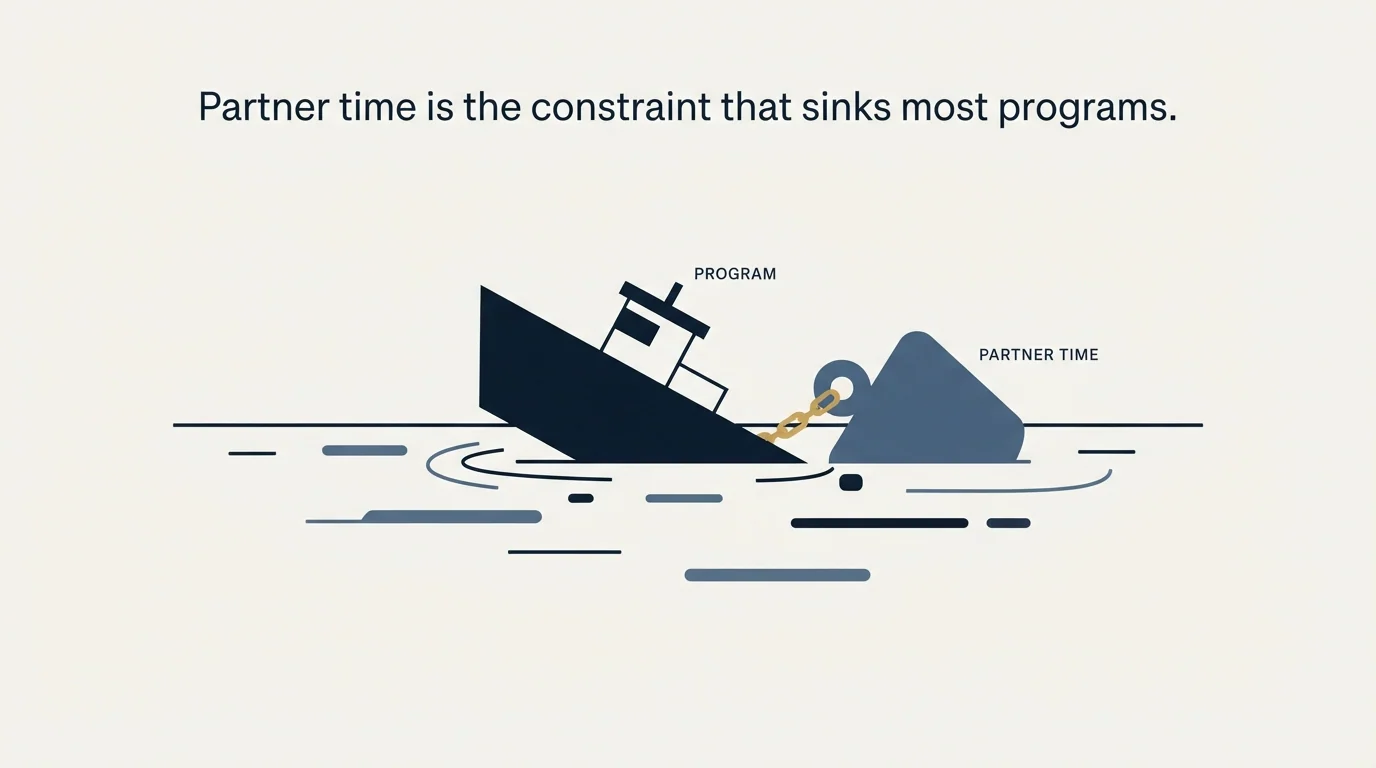
The economics of accounting business development differ from software in one important way: the person who takes the first meeting is usually a fee earner. Their hour has a known and high alternative use, which means a program that produces conversations with the wrong companies is more expensive than it looks.
Two things follow, and both are worth designing around from the start.
Define what makes a meeting worth a partner's hour before anything runs. Size band, service line, the trigger that must be present, and who from the prospect's side must be on the call. Written down in advance, that definition settles the question of whether the program is working. Left undefined, it becomes an argument between the partner who took a bad meeting and whoever booked it. The general shape of that agreement is covered in appointment setting versus lead generation and in qualified lead generation services.
Then decide who actually takes first meetings. Many firms discover that a manager or a business development hire can run the first conversation, with the partner brought in when the opportunity is real. Firms that insist every first meeting is partner-led usually end up doing fewer of them, which is the constraint that quietly caps the whole program.
The arithmetic of what a first conversation can be worth, and therefore what you can afford to spend acquiring one, is set out in cost per lead in B2B.
How the outreach itself should run
We send one message per campaign, built on one premise, and we do not stack further messages under it. If a later approach is worth making, it is a separate campaign with a different premise, aimed at a different trigger, a different service line or a different role.
For accounting firms that constraint fits the market unusually well. Professional services reputation is local and durable, and a firm known for persistent unsolicited email pays for it in a way that a software company does not. More practically, the discipline forces the campaign to be built on one of the triggers above rather than on a size filter, because a single message has to earn its reply on the strength of being relevant rather than on being repeated.
It also sets expectations correctly. A campaign built this way runs a smaller list and is measured in qualified conversations rather than in messages sent. Firms comparing providers should treat volume quoted as a headline number as a signal about what is being sold. What to ask a provider is covered in B2B lead generation services.
Where to start

Take the list the firm already has and test it against the trigger checklist. If no row carries a reason to believe something has changed at that business, the list describes prospects rather than opportunities, and no amount of rewriting the message will fix that.
Then pick one service line and one trigger, and build a campaign for that combination alone. A campaign that says something specific to companies who have just opened in a new state is a different proposition from a campaign about accounting services, and only one of them has a reason to exist in the reader's inbox.
Expect the first useful output to be a small number of real conversations rather than a volume of interest. A practice adding two or three good clients a quarter through a channel it controls has changed its trajectory, and that is a realistic ambition for a firm that targets triggers properly. It is also a much smaller number than the volume language used in most lead generation marketing, which is worth knowing before signing anything.
The firms that stay with this tend to be the ones that treated the first quarter as list building rather than as a test of whether outreach works. Trigger data has to be assembled before it can be used, and a practice that spends busy season quietly building that layer starts the post-deadline window with something to say.
If you want that built against your own market and service lines, see what a first campaign looks like.
Frequently asked questions.
Frequently asked questions- Does cold outreach work for accounting firms?
- It works when the list is built on switching triggers rather than industry and revenue filters. A business will not absorb the disruption of changing firms because a message asked it to, so the campaign has to find companies whose circumstances have already changed: growth, funding, a new jurisdiction, a new finance leader, a first audit requirement, or a departing partner.
- When is the best time of year for an accounting firm to prospect?
- Immediately after a filing deadline, when a client's memory of their current firm under pressure is freshest. Deep in busy season is poor timing for switching conversations but good for research and list building. Mid year suits advisory and planning discussions, and the run-up to year end is when firms get appointed for the year ahead.
- Which service should we lead with in outreach?
- Usually a specialist niche service rather than the whole practice. Compliance work competes head-on with an incumbent and invites price comparison early. Specialist engagements such as R&D credits, transaction support or an industry specialism can be taken as a one-off with no disruption, which is a far lower bar for a first conversation and often becomes a wider relationship.
- Should partners take every first meeting?
- Firms that insist on it usually end up doing fewer meetings, which caps the whole programme. A manager or a business development hire can run first conversations with the partner brought in once an opportunity is real. Either way, define in advance what makes a meeting worth a fee earner's hour: size band, service line, the trigger present, and who attends.
About the author.

Ben Carden is CRO at RevenueFlow, which builds and operates outbound revenue engines for B2B companies. Previously at Gartner Enterprise. Studied at London School of Economics.
Ben Carden · CRO
Connect on LinkedIn →Explore more.
Ready to scale your outreach?
We build GTM engines that book real meetings. See the receipts.
Related articles.
Two Agencies, One Target List: Who Owns Which Accounts
Two outbound suppliers on one market will contact the same companies unless the buyer splits it first. How to cut the list, run the exclusion feed and check the overlap.
HR Lead Generation: The Renewal Clock and Who Signs
An HR buyer who agrees with every word still cannot act outside their own renewal window. Which triggers are observable, and who signs.
IT Lead Generation: The Buyer Runs Your Playbook
Technology buyers evaluate outbound for a living, and their purchases carry a security review nobody in your meeting owns. Which triggers are real.
5 ABM Campaign Examples and How Each One Is Built
Five worked account-based campaign examples, each built on the same five fields: account set, tier, plays in order, owner and handoff, and the exit condition.
Last Outbound Agency Did Not Deliver: Locating the Failure
The leads were bad names a symptom and no stage. Four places an outbound engagement fails, the counts that separate them, and what to change in the next purchase.
When Outbound Stops Scaling: What Breaks First
Doubling the budget rarely doubles the meetings. The five constraints that bind in order, the signature each one leaves in the numbers, and what actually buys more.