B2B Lead Generation Services: Five Delivery Models
Retainer, per seat, per outcome and two hybrids, with published price anchors and a clear answer to who carries the risk when a month goes badly.
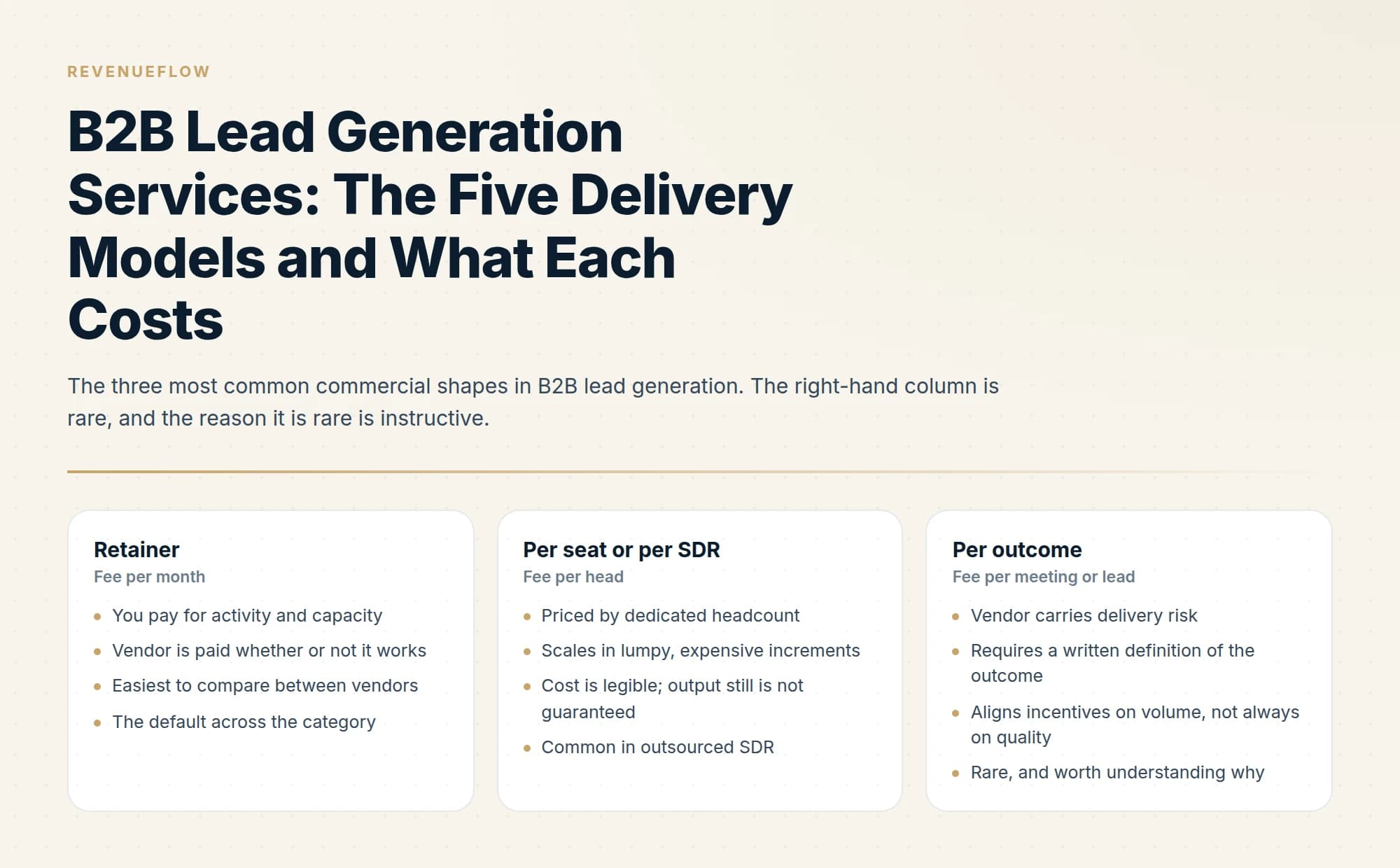
The pricing and guarantee models B2B lead generation firms offer for booked demos come in five shapes: a monthly retainer, a price per dedicated SDR, a setup plus managed fee, a price per lead, or a price per qualified meeting. Guarantees come as hybrids, and the written definition of a booked, held meeting decides whether one is worth anything.
Key takeaways
- Five delivery models cover almost every proposal: retainer, outsourced SDR, setup plus managed, pay per lead and pay per qualified meeting.
- Published anchors: Sopro from around £3,000 a month, SalesRoads $11,950 per four weeks for one SDR, CIENCE $7,499 for the first month.
- On a retainer or per seat the client carries a bad month; on a per-outcome model the vendor does, and the definition becomes the contract.
- CIENCE publishes a per-meeting fee mechanism, calculated from an agreed ROI goal of typically 4x, rather than a per-meeting price.
Reviewed and updated September 19, 2026
Three published price pages answer what pricing or guarantee models B2B lead generation firms offer for booked demos in three different ways. CIENCE publishes a first month at $7,499, made up of a $5,000 one-time GTM setup, a $2,000 a month strategic team and a $499 a month platform licence, with SDR capacity quoted separately. SalesRoads publishes a base price of $11,950 per four-week period for one SDR, and $16,750 for two. Sopro says pricing "starts at around £3K per month" and explains on the page why it lists no tiers.
Three vendors, three genuinely different commercial shapes. The category is usually described by what firms do, which is roughly the same everywhere. The useful distinction is what the fee is attached to, because that determines who carries the risk when the programme underperforms.
The same question decides software purchases, where submissions counted per form or per account separates two builders that look alike on their entry rates.
Outsourced lead generation services are sold under at least five different delivery models, and the fee only means something once you know which one you are buying.
What pricing or guarantee models do B2B lead generation firms offer for booked demos?
Five pricing models, whatever the vertical, healthcare included: a monthly retainer, a price per dedicated SDR, a setup fee plus a managed monthly fee, a price per lead, and a price per qualified meeting. Guarantees arrive as hybrids on top: a setup fee plus a per-meeting rate, a smaller retainer plus a per-meeting bonus, or a retainer with a meeting floor credited when missed.
What changes in a vertical such as healthcare is the definition of a booked demo rather than the commercial shape, and two published pages show how much that definition carries. SalesRoads separates appointment setting, which "books a specific date and time with calendar invites", from lead generation, which secures a follow-up window such as a call back, a webinar invite or a roundtable. CIENCE prices held meetings with a per-meeting fee "calculated from the agreed ROI goal, typically 4x ROI". A demo guarantee is only as good as the contract's words for booked, held and qualified.
The five models
Buyers who find the lead generation model confusing are usually comparing service descriptions, which are close to identical across the category by design; the five shapes below are the thing that actually differs, and once the fee is attached to one of them the proposals become readable.
Retainer, per seat and per outcome are the three common shapes, and two more complete the set of five this page compares.
Enterprise lead generation is not a sixth model. It is these same models under a longer cycle, and the difference lands in the contract rather than in the method. A per-meeting price computed on a segment that answers within a fortnight does not survive a segment whose buying committee takes two quarters, so the unit being bought has to name the role and the account, and the review window has to be long enough for one of those meetings to reach a decision.
1. Retainer agency. A monthly fee for a defined scope: list building, copy, sending infrastructure, campaign management, reporting. Sopro's model, and Belkins', where the retainer includes the tooling. The fee buys capacity and expertise, and it is indifferent to results within any given month.
2. Outsourced SDR. You rent people, and this is the partner type that runs outbound discovery and qualification and hands meetings to your closers. SalesRoads publishes this shape clearly: dedicated SDRs plus a client strategist, an SDR performance coach, an optimisation specialist and a research and data team, at a base price of $11,950 per four-week period, with two SDRs at $16,750 and a stated cost per rep of $8,375.
3. Setup plus managed growth. A one-time build followed by a smaller recurring fee, which is CIENCE's published structure: $5,000 setup, then $2,000 a month for the team and $499 a month for the platform, with SDR capacity optional and quoted.
4. Pay per lead. A price per contact meeting agreed criteria. Cheap-looking, and the model where definitional disputes are most common, because a "lead" can mean a verified contact record or a person who expressed interest, and those differ by an order of magnitude in value.
5. Pay per qualified meeting. A price per attended meeting meeting a written definition. This is the model we run, and the definition is the whole product.
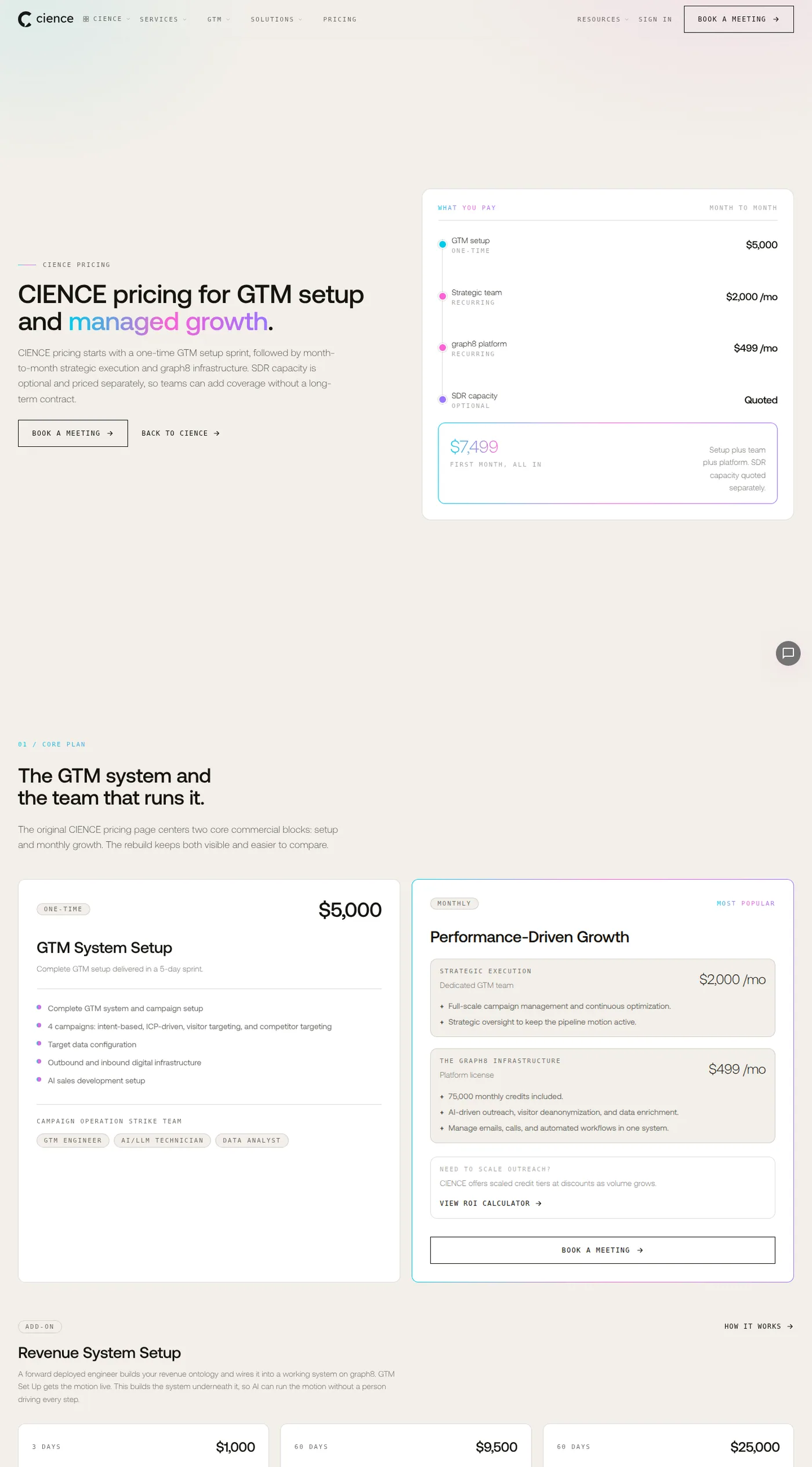
CIENCE's published pricing structure: a one-time setup, then recurring team and platform fees.
What each model actually costs
Published anchors, all from the vendors' own pages.
| Model | Published example | Entry cost |
|---|---|---|
| Retainer | Sopro | From around £3,000 a month |
| Outsourced SDR | SalesRoads | $11,950 per 4 weeks for one SDR; $16,750 for two |
| Setup plus managed | CIENCE | $5,000 setup, then $2,499 a month; $7,499 first month |
| Pay per lead | Rarely published | Quoted per lead, varies with definition |
| Pay per meeting | CIENCE, as a fee mechanism | Per held meeting, from an agreed ROI goal, typically 4x |
Two observations from assembling that table.
The three published anchors run from CIENCE's $2,499 a month after setup to SalesRoads' $11,950 per four weeks for one SDR. Sopro's figure sits between them at around £3,000 a month, and the gap between the ends is mostly the price of dedicated headcount.
The outcome-based models rarely publish a number, which is not evasion so much as arithmetic. CIENCE is the partial exception: its pricing page publishes the mechanism, a per-meeting fee "calculated from the agreed ROI goal, typically 4x ROI", rather than a figure. A price per meeting depends on your ICP, deal size and how hard your buyers are to reach, and a vendor quoting it blind is either guessing or protecting themselves with a definition you will not like.
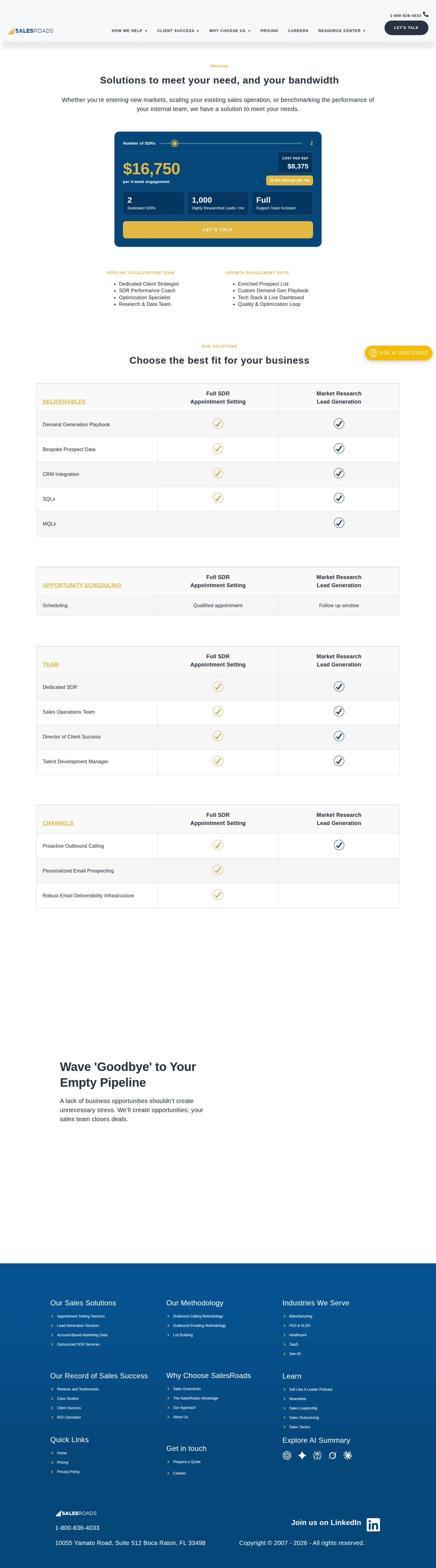
SalesRoads' published engagement pricing, shown at two SDRs.
Who carries the risk in each
Asking how much risk is involved in outsourcing lead generation is really asking which of these columns you are signing, because the model decides who absorbs a bad month before anybody has had one.
This is the question the fee structure answers, and it is the one worth deciding before you shortlist.
On a retainer, you carry it. If the campaign underperforms, you have paid for the months regardless, and your recourse is to leave. That is not unreasonable: the vendor genuinely incurs the cost of building and running the programme whether or not your market responds.
On per-seat, you carry it too, in a more legible form. You know exactly what a rep costs and you still do not know what they will produce.
On per-outcome, the vendor carries it, and the consequence is that the definition of the outcome becomes the contract. A vendor paid per meeting has an incentive to book meetings, so the qualification criteria are doing all the work of keeping those meetings worth attending.
That is why we publish ours rather than negotiating it per deal. A meeting is billable when the company is in the pre-approved audience, the participant has reasonable responsibility for or influence over the relevant area, they agree to a relevant business conversation, they attend and participate, and they were not disclosed as an existing customer or active opportunity before outreach. Budget, timing and decision authority are deliberately not conditions, because they are not knowable before the conversation and making them billing conditions turns every invoice into a dispute.
A meeting is billable when:
The company is in the pre-approved audience 1
The participant has reasonable responsibility for, or influence over, the relevant area
They agree to a relevant business conversation, then attend and participate
They were not disclosed as an existing customer or active opportunity before outreach 2
Not conditions: budget, timing, decision authority 3
- 1Published rather than negotiated per deal, because on a per-outcome model the definition is the contract.
- 2Customers and live deals are named before launch, so they can never be billed.
- 3Not knowable before the conversation; as billing conditions they turn every invoice into a dispute.
Choosing between the models
The honest selector is not budget. It is what you are actually short of.
Firms with several service lines describe the problem as scaling lead generation across service divisions, and the selector above resolves it one division at a time: each line is usually short of a different thing, so a single retainer covering all of them is buying one shape for several problems.
Short of expertise and infrastructure points at a retainer or a setup-plus-managed deal. You are buying a working system and the knowledge of how to run it, and the monthly fee is the price of not building it.
Short of hours points at outsourced SDR. You know what to do and there is nobody to do it, so renting a trained person with management around them is the direct fix.
Short of certainty points at per-outcome. If you cannot justify spend against an unknown return, moving the risk to the vendor is exactly what the model is for, and you pay a premium per unit for it.
Short of nothing except volume points at doing it in house, which is a real option that the category rarely mentions. Our guide to building an outbound engine from scratch covers what that involves, and the lead generation agency cost guide covers the comparison in more depth.
How each model behaves in a bad month
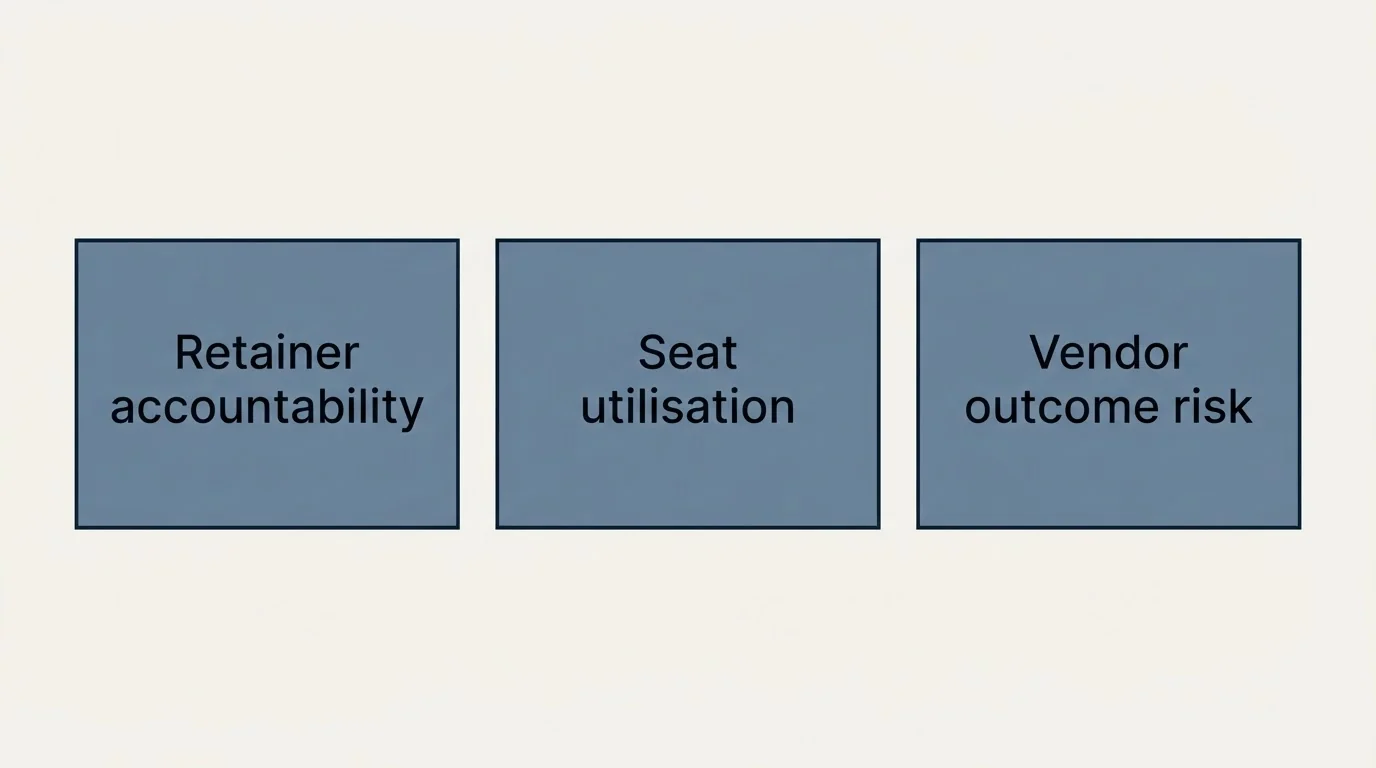
Every engagement has one. What the models do differently is what happens next, and that is worth thinking through before you pick one.
On a retainer, a bad month is a conversation. You raise it, the vendor proposes changes, and you both continue paying and working. The risk is drift: three bad months can pass as optimisation because nothing forces a decision.
On per-seat, a bad month is a utilisation question. The rep exists and costs the same, so the discussion becomes whether they are working the right list rather than whether the programme works. That is sometimes the right question and sometimes a distraction from a targeting problem.
On per-outcome, a bad month costs the vendor. That produces fast reaction, which is the model's real advantage. It also produces pressure on the edges of the definition, which is why the criteria and the rejection window have to be settled before the first invoice rather than during the first dispute.
The practical consequence: on a retainer, set a review point with a written success condition in advance, because the model will not force one. On per-outcome, spend the diligence effort on the definition rather than on the price.
Hybrids, and the one that usually works
Most real contracts are hybrids, and the common shapes are worth naming.
Setup fee plus performance. A build fee covering infrastructure and list work, then a per-meeting rate. This is usually the fairest structure available, because the vendor's genuine upfront costs get covered while the ongoing risk stays with them.
Reduced retainer plus per-meeting bonus. Splits the risk. Workable, and the bonus has to be large enough to matter or it changes nothing.
Retainer with a performance floor. A minimum number of meetings or the next month is credited. Simple, and only as good as the definition of the thing being counted, which puts you back in the same place.
The shape to avoid is a full retainer with a guarantee attached that has no teeth, because it reads as risk-sharing while being a retainer with marketing on top. Ask what specifically happens if the floor is missed, and whether the remedy is credit against future months, which only has value if you intend to stay.
What the fee usually excludes
Three costs sit outside most quotes and appear later.
Sending infrastructure. Domains, inboxes and warmup. Some retainers include tooling, and Belkins advertises the tools as part of the retainer, but many do not, and the line item is real.
Data. Contact data and verification, either as a pass-through or as your own contract. Ask which, because a vendor absorbing data cost has an incentive to use cheaper data.
Your own time. Copy approval, meeting attendance, feedback on quality. A programme where the client never responds underperforms regardless of the model, and it is the most commonly underestimated input. The vendor-selection side of this, including the six diligence questions worth asking before any of it, is covered in B2B lead generation companies.
The short version
Compare vendors by what the fee attaches to rather than by service description, since the descriptions are nearly identical and the risk allocation is not. The three published anchors run from about £3,000 a month for Sopro's retainer to $11,950 per four weeks for one dedicated SalesRoads SDR, and outcome-based pricing is rarely published as a number because it depends on your market. If you go outcome-based, the written definition of the outcome is the product, so settle it before the first invoice rather than after.
If a per-qualified-meeting arrangement with the definition agreed up front is the shape you want, you can see what a campaign would look like for your market.
Pricing and features are taken from the vendors' own pages. Verify current terms with the vendor before relying on them.
Sources: CIENCE pricing, SalesRoads pricing, Sopro pricing, Belkins pricing
Frequently asked questions.
Frequently asked questions- What pricing models do lead generation firms offer for booked demos?
- Five: a monthly retainer, a price per dedicated SDR, a one-time setup plus a managed monthly fee, a price per lead, and a price per qualified meeting. Guarantees are added as hybrids, such as a setup fee plus a per-meeting rate, a smaller retainer plus a meeting bonus, or a retainer with a meeting floor that is credited when missed.
- Do healthcare lead generation firms use different pricing models?
- The commercial shapes are the same in healthcare as in any other B2B vertical. What changes is the definition of a booked demo: which roles at which organisations count, whether the meeting has to be held rather than booked, and what can be rejected. On an outcome-based contract that definition decides what you pay for, so settle it in writing first.
- How much do outsourced SDR services cost?
- SalesRoads' pricing page lists a base price of $11,950 per four-week period for one dedicated SDR and $16,750 for two, a stated cost of $8,375 per rep. CIENCE's page lists a $5,000 setup, then $2,000 a month for its team and $499 for its platform, with SDR capacity priced separately.
- Who carries the risk in a pay-per-meeting agreement?
- The vendor carries delivery risk, because it is paid only for meetings that meet the written definition. That moves the pressure onto the definition itself: the qualifying criteria, the rejection window and the valid rejection reasons need to be agreed before launch. Budget, timing and authority should not be billing conditions, since none of them is knowable before the conversation.
About the author.

Ben Carden is CRO at RevenueFlow, which builds and operates outbound revenue engines for B2B companies. Previously at Gartner Enterprise. Studied at London School of Economics.
Ben Carden · CRO
Connect on LinkedIn →Explore more.
Ready to scale your outreach?
We build GTM engines that book real meetings. See the receipts.
Related articles.
B2B Lead Generation Companies by Pricing Model: 15 Vendors
Nine of fifteen B2B lead generation vendors publish a dollar figure and six publish none. The five pricing models behind the numbers, each figure cited to its page.
Typeform Alternatives: Read the Response Meter First
Typeform meters responses with a hard ceiling and counts seats inside the plan. What Tally, Fillout, Formbricks and Jotform count instead, from their own pricing pages.
PartnerStack Pricing: One Published Number
PartnerStack quotes its three platform plans and publishes the whole model for its self-serve product. What each tier gates, and the choice forced at the entry tier.
Foleon Pricing: No Published Price, a 24-Month Term
Foleon publishes no rate on its plans page and publishes the whole commitment behind it. The term, the notice window and what happens to the Docs after.
Webflow Pricing: The Four Lines on a Real Bill
Webflow bills a site plan, a workspace plan, seats and metered add-ons. What each line pays for, read from the vendor's own pricing page in September 2026.
eWebinar Pricing: Two Meters and a Level That Moves
eWebinar does not ask you to pick a plan. Published webinars set the level and registrants set the overage, and the two directions do not move on the same schedule.