B2B Lead Generation Companies: Compare on Pricing and Risk
Capability lists all read the same, so compare vendors by commercial shape and risk instead. The six diligence questions and how to design a pilot that decides something.
Sort candidates by commercial shape first, since retainer, per-seat and per-outcome vendors are not comparable to each other. Then establish who does the work, whose sending infrastructure it runs on, what the deliverable is defined as, and what happens when results are flat. Run a paid pilot with a written success condition.
Key takeaways
- Vendor capability descriptions converge, so the real differences are commercial shape and who carries delivery risk.
- Some vendors publish real numbers: CIENCE lists $7,499 for a first month all in, and SalesRoads lists one SDR at $11,950 per four weeks.
- A pilot needs six to eight weeks to include held meetings, and a success condition written before it starts rather than judged afterwards.
- Suppression, the offer and fast reply handling are inputs no vendor can supply, and an unowned one of these is the most common cause of a failed engagement.
Reviewed and updated September 21, 2026
Sopro's pricing page explains why it does not list tiers: "We offer a tailored service. Your business is unique. Your audience is unique." It then gives a number anyway, "around £3K per month", and adds "no minimum contract".
That combination, an honest floor plus an honest reason for not publishing more, tells you more about a vendor than any capabilities deck. Most of this category will not give you either. Here is how to run the selection so you find out what you need to know before signing rather than in month three.
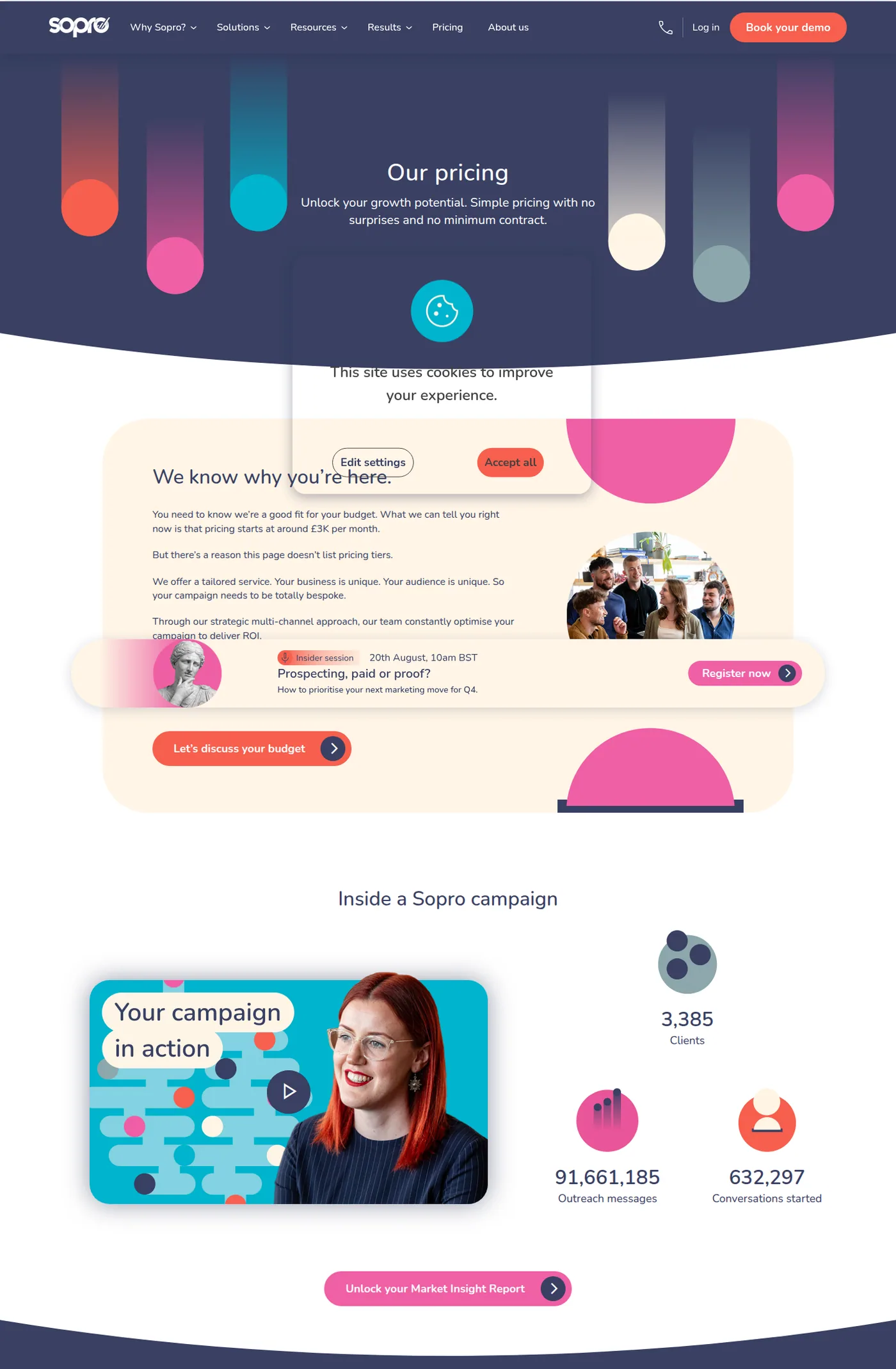
Sopro's published pricing page, captured mid-2026.
Geography changes the shortlist more than it changes the method: a United Kingdom buyer is choosing between UK agencies and US ones under UK and EU data rules, so add jurisdiction to the questions below rather than treating it as a separate exercise.
Searches for lead generation USA return the same shortlist question with a border drawn round it, and the border changes very little: the pricing models below, the guarantees and the way a retainer is structured are the same on either side of the Atlantic, so the useful comparison is the one that ignores geography and reads the commercial terms.
Geography changes less about this decision than the search suggests. Queries for lead generation companies in a named market, South Africa among the most common, return the same directory-and-agency mix with a border drawn round it, and the commercial terms below travel unchanged. The one difference worth pricing is delivery location rather than buyer location: an agency selling offshore calling capacity into the UK or US is a different cost structure from a local one, and the guarantee and reporting questions below are where that shows up.
Shortlist by shape, not by capability list
Buyers who are pitched daily by outbound vendors do not have an information problem, they have a comparison problem: the capability lists arrive already identical, so the shortlist has to be cut on commercial shape and risk before anybody is invited to a call.
The plural noun people actually type is lead generators, and it names three different purchases: a person you hire onto the team, an agency you contract, and a piece of software you subscribe to. The comparison below is for the second of those, and the first and third are decided elsewhere.
The software route is priced on a meter worth reading first, and ClickFunnels counts contacts and emails rather than visitors, so traffic volume does not choose the tier.
Every vendor in this category describes the same activities: research, list building, copy, sending, qualification, reporting. Comparing those descriptions is close to useless because they converge.
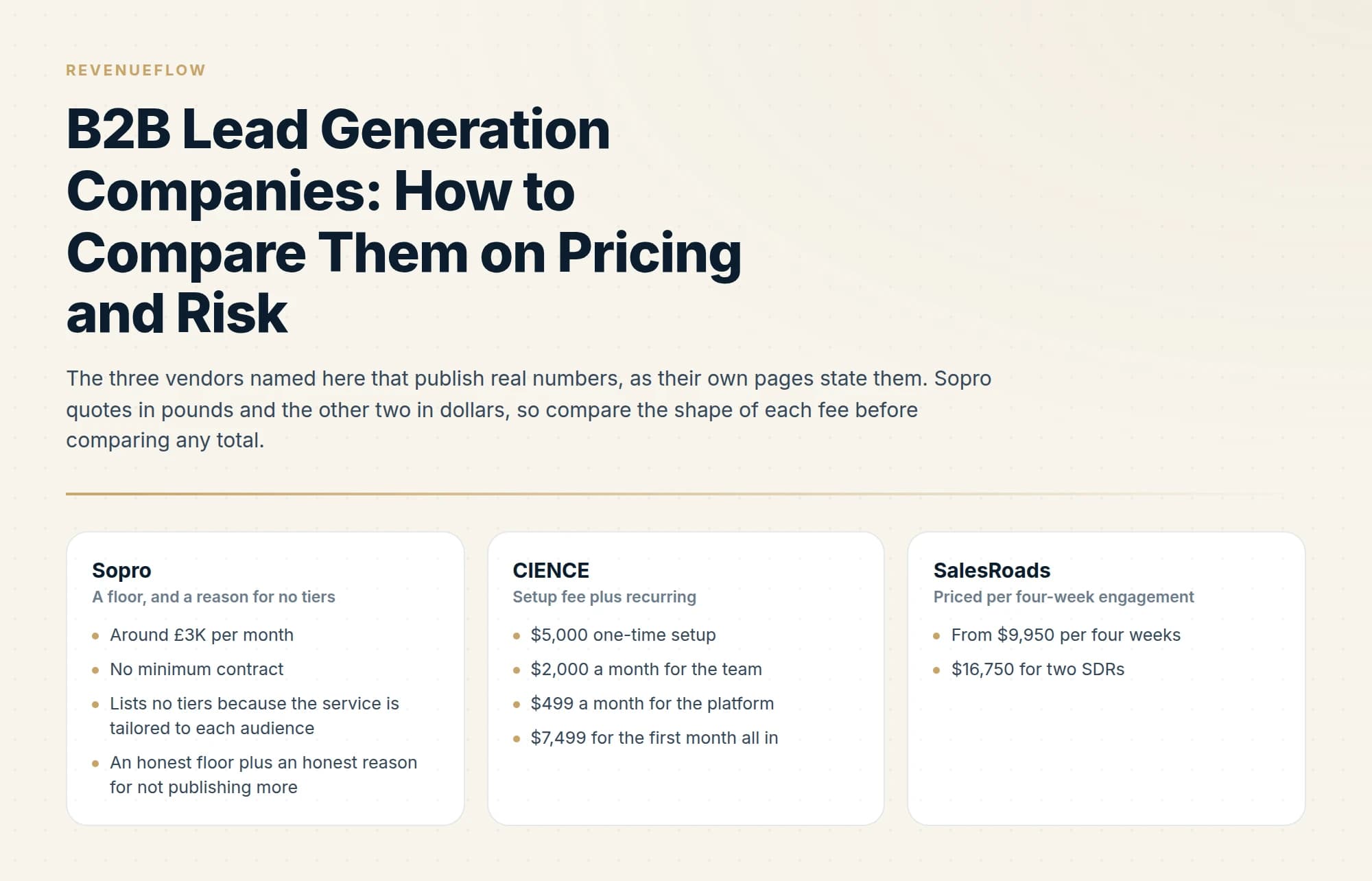
What actually differs is commercial shape. Some publish real numbers: CIENCE lists a $5,000 one-time setup plus $2,000 a month for the team and $499 a month for the platform, $7,499 for the first month all in. SalesRoads lists one SDR at $11,950 per four weeks and $16,750 for two. Others quote everything.
Buyers comparing these figures against industry benchmarks should first check what those published lead figures actually count before treating any of them as comparable.
- Around £3K per month
- No minimum contract
- Lists no tiers because the service is tailored to each audience
- An honest floor plus an honest reason for not publishing more
- $5,000 one-time setup
- $2,000 a month for the team
- $499 a month for the platform
- $7,499 for the first month all in
- Recurring fees listed as month to month
- One SDR $11,950 per four weeks
- $16,750 for two SDRs
Sort your shortlist into retainer, per-seat and per-outcome before you take a single call, because those three are not comparable to each other and a call comparing them will not make them so. The models and their economics are covered in B2B lead generation services.
That sort is the whole of the advice on comparing several agencies side by side, and it is also how to find them in the first place. A shortlist assembled from directory listicles is a list of whoever invested in ranking, so treat the source as a starting population rather than a recommendation, and expect to remove most of it on shape alone. Two or three vendors inside one commercial shape produce a decision. Six across three shapes produce a spreadsheet with incomparable columns and a choice made on impression.
Prospects reasonably ask who our main competitors in lead generation are, and the useful answer is a method rather than a list: sort any shortlist by commercial shape first, because a retainer, a per-seat quote and a per-outcome quote are not comparable to each other however the capability descriptions read.
The six diligence questions
Choosing between outbound sales agencies comes down to these six answers rather than to which proposal reads best, because a proposal is written to be persuasive and a diligence answer is written under the risk of being checked later.
These are ordered by how often the answer changes a decision.
Buyers arrive tired of constant solicitations from lead generation vendors, which makes the diligence questions above worth more than any capability deck: a supplier who answers all six is separating themselves from the population that produced the fatigue in the first place.
1. Who actually does the work, and where do they sit? Some firms deliver with in-house teams; many subcontract research, copy or sending. Subcontracting is not disqualifying, and not knowing about it is. Ask directly which parts are theirs.
2. Whose sending infrastructure is used, and who else is on it? If your campaigns share domains and IPs with other clients, another client's bad list can damage your deliverability. Ask whether infrastructure is dedicated, and if it is shared, what happens when a neighbour causes a problem.
3. What is the ramp to first send, week by week? Domain warmup alone takes weeks if new domains are involved. A vendor promising sends in week one is either using aged infrastructure, which is fine and worth confirming, or is about to burn something.
4. What does the data cost and who owns it? Whether contact data is a pass-through, included, or your own contract determines the vendor's incentive on data quality, and it determines whether you keep the list when you leave.
Buying that data directly raises its own questions, and testing a hundred companies from your own segment settles a database purchase better than any published record count.
5. What is the actual definition of the thing you are buying? For a lead, is it a verified contact or a person who replied. For a meeting, what makes it qualified. Get it in writing before pricing, not after.
Teams selling into commercial construction face an even sharper version of that question, where targeting the project instead of the company determines who gets contacted at each phase.
6. What happens when it does not work? Not the guarantee language, the process. Who reviews it, on what evidence, at what point, and what changes. A vendor with no answer beyond "we optimise" has no diagnostic process.
- Step 1Sort by commercial shape
Retainer, per seat or per outcome. Only compare within a group.
- Step 2Run the six questions on a first call
Subcontracting, infrastructure, ramp, data, definitions, failure process.
- Step 3Ask for account-level reporting from a live client
Names removed. A document, not a dashboard tour.
- Step 4Run a paid pilot with a written success condition
Small, time-boxed, and defined before it starts rather than judged afterwards.
- Step 5Check the exit terms before you sign
Notice period, data ownership, and what you keep.
Designing a pilot that tells you something
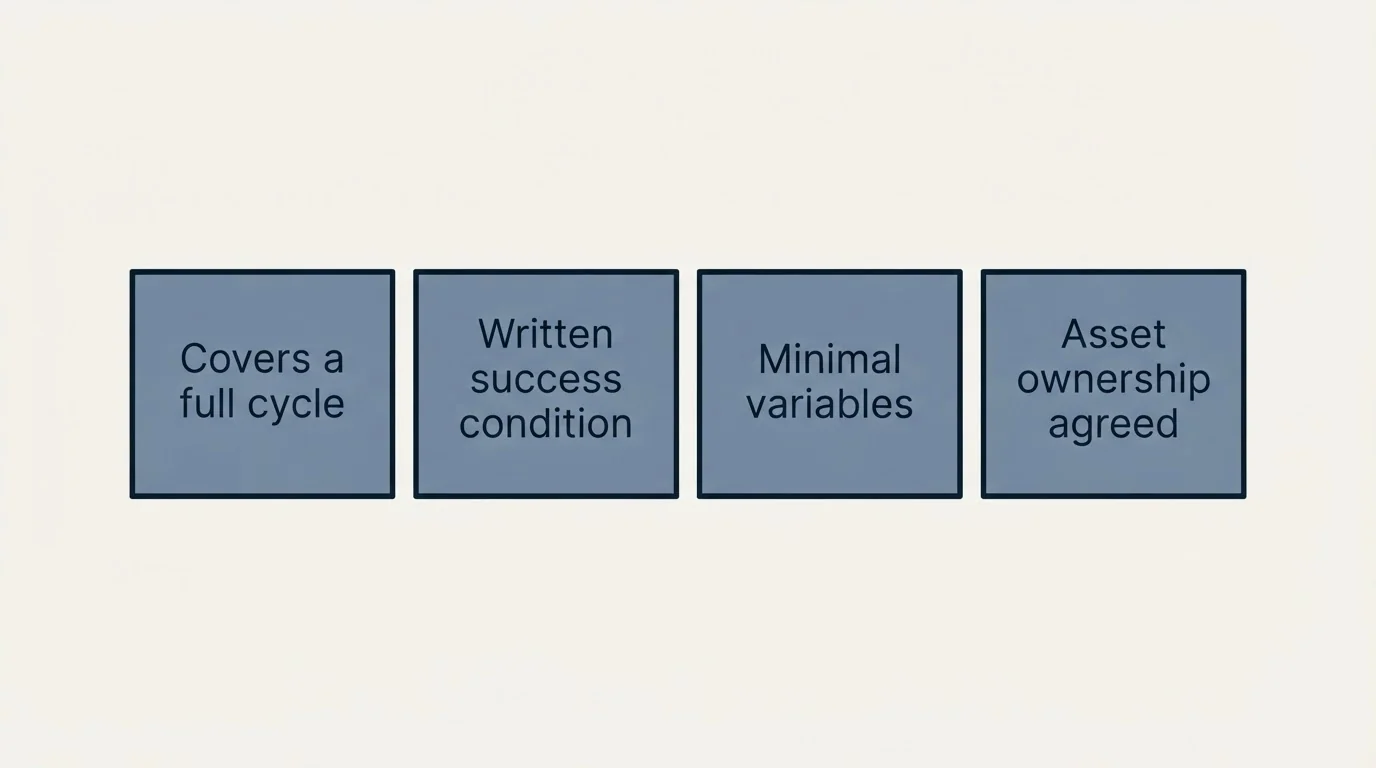
A pilot exists to reduce uncertainty, and most are designed so they cannot.
Make it long enough to include a full cycle. Outbound has a lag: build, warm, send, wait for replies, book, hold. A four-week pilot on a market with a three-week reply-to-meeting lag measures the build and nothing else. Six to eight weeks is usually the minimum that includes held meetings.
Define the success condition in writing before it starts. Not "see how it goes". A number of held meetings meeting the agreed definition, or a reply rate threshold, decided in advance. A pilot judged afterwards is judged by whoever argues best.
Keep the variables down. One ICP, one offer, one channel. A pilot testing three segments produces three underpowered samples and no conclusion.
Agree what happens to the assets. Who owns the list, the copy and the domains when the pilot ends is a cheap question before and an expensive one after.
Reading the reference call
Reference calls are usually theatre because the vendor picks the reference. Two questions make them useful anyway.
Ask the reference what the first two months were like, specifically. Every engagement has a rough start; a reference who cannot describe theirs is either unusually lucky or not being candid.
Then ask what the vendor does badly. A reference who says nothing has told you the call is scripted. A reference who says something small and specific, and then explains how it was handled, has told you what working with the vendor is genuinely like.
How long the vendor has been in business is the other question buyers reach for at this stage, and it is a weaker signal than it feels. Years in business tells you the firm survived, which is real and is mostly a statement about their own sales rather than their delivery. The version of the question that carries information is how long they have run this specific motion into a market like yours, and how long their average engagement lasts, because a firm with a decade of history and a four-month average tenure has told you something the founding date did not.
- Yes: They publish a starting price, or state one on the first call
- Yes: They can describe their diagnostic process when results are flat
- Yes: They ask about your suppression list before you raise it
- Yes: They tell you which parts they subcontract without being pushed
- No: The proposal guarantees meetings without defining a qualified meeting
- No: Reporting is a dashboard tour rather than a document they send
- No: They recommend follow-up sequences as the main lever
The last row is our own bias made explicit, and it is worth stating for that reason. We run one message per campaign and no bumps, so a vendor whose plan for a flat campaign is more follow-ups is proposing something we would not do. Judge that as our position rather than as a neutral standard, but ask what else they would change, because "send more" is a volume answer to a relevance problem.
The contract terms that matter
Three clauses decide how much a bad decision costs.
Notice period. Monthly rolling versus a twelve-month commitment is the difference between a cheap mistake and an expensive one. Sopro advertises no minimum contract, and CIENCE lists its recurring fees as month to month, so short commitments do exist in this category.
Data ownership. Whether you keep the enriched list, the suppression list and the campaign history on exit. This is frequently silent in the contract, which means it is negotiable.
Domain and inbox ownership. If the vendor bought sending domains for you, whether they transfer matters, because the warmup history has real value.
Red flags in a proposal
Five patterns that predict trouble, in rough order of how reliably they do.
A guaranteed number of meetings with no definition of a meeting. The guarantee is doing marketing work rather than commercial work. Without criteria, the vendor decides what counts, and they decide it while being paid per unit.
A projection with no assumptions attached. Any meetings forecast rests on assumed list size, reply rate and booking rate. A proposal showing the output without the inputs cannot be evaluated, and cannot be held to anything later.
No questions about your existing relationships. A vendor who does not ask for a suppression list before proposing has not thought about the most obvious way to damage a client, which is contacting their current customers.
Volume as the answer to every problem. More sends, more sequences, more channels. Sometimes correct, and as a first instinct it indicates a vendor without a diagnostic process.
Reluctance to name the team. Who specifically writes the copy and manages the campaign, and how many other accounts they carry. Vague answers usually mean a shared pool at a ratio you would not accept if stated.
What you have to do yourself regardless
Three inputs no vendor can supply, and the engagement fails without them.
The suppression list. Current customers, live opportunities, partners, competitors, and anyone a rep is protecting. Only you have this, it must exist before launch, and it is the single cheapest way to prevent the most damaging kind of mistake.
The offer. What you are actually asking a prospect to do and what they get. A vendor can sharpen the wording; they cannot decide your commercial proposition, and an engagement that stalls on this stalls entirely.
Fast reply handling. Whether the vendor books meetings or hands you replies, someone on your side has to answer quickly. A reply answered four days later is frequently a meeting lost, and no amount of vendor performance compensates.
Agree who owns each of these in writing at kickoff. The most common cause of a disappointing engagement is not vendor incompetence; it is one of these three sitting unowned while both sides assume the other has it.
Where an agency genuinely beats in house
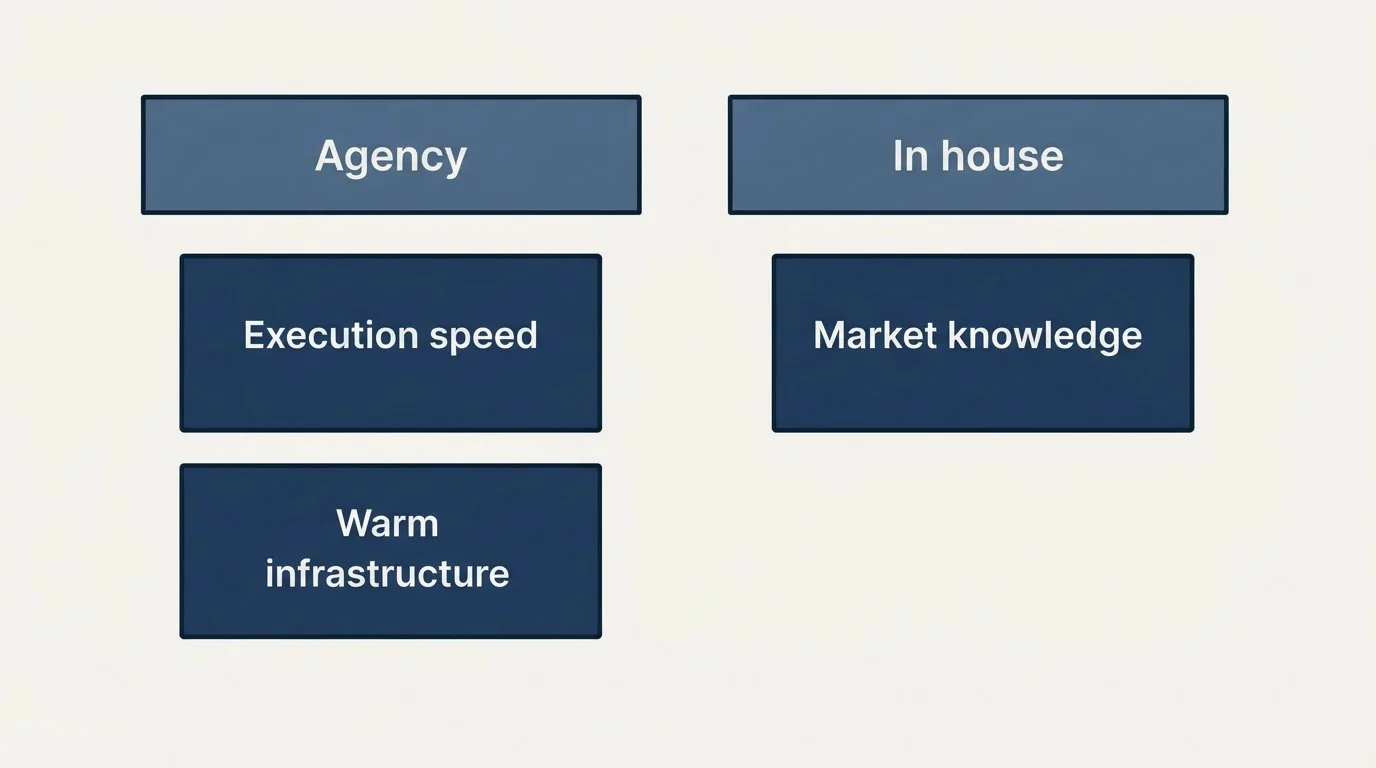
Worth being clear about, because the comparison rarely gets made properly.
A vendor has run this motion across many markets, holds infrastructure already warm, and has production capacity idle between clients. That is genuine leverage on execution speed and on avoiding the specific mistakes that cost weeks.
Where they have least leverage is knowing which companies are worth contacting and what will persuade them, because that depends on your market and your won deals. An agency can structure and challenge that knowledge; it cannot originate it. Our guides to defining an ideal customer profile and lead generation agency cost cover both halves.
The short version
Sort the shortlist by commercial shape before comparing anything, then use the six questions to establish who does the work, whose infrastructure it runs on, and what the thing you are buying is actually defined as. Run a paid pilot long enough to include held meetings, with a written success condition set in advance. Check notice period and data ownership before signing, because both are usually negotiable and neither is negotiable afterwards.
If a per-qualified-meeting arrangement with the definition agreed up front is what you are looking for, you can see what a campaign would look like for your market.
Vendor pricing and contract terms verified against each company's own pages as of mid-2026. Verify current terms with the vendor before relying on them.
Sources: Sopro pricing, CIENCE pricing, SalesRoads pricing
Frequently asked questions.
Frequently asked questions- How do I choose a B2B lead generation company?
- Sort the shortlist by commercial shape before comparing anything, because retainer, per-seat and per-outcome pricing are not comparable. Then ask who actually does the work, whose sending infrastructure is used, what the ramp to first send is, who owns the data, how the deliverable is defined, and what their process is when results are flat.
- How long should a lead generation pilot run?
- Six to eight weeks at minimum, because outbound has a lag: build, warm, send, wait for replies, book, then hold the meeting. A four-week pilot measures the build and little else. Set the success condition in writing before it starts, keep it to one ICP and one offer, and agree who owns the assets afterwards.
- What are the warning signs in a lead generation proposal?
- A guaranteed meeting count with no definition of a qualified meeting, a projection with no stated assumptions, no questions about your suppression list, volume offered as the answer to every problem, and reluctance to name who specifically will write the copy and run the campaign.
- Do lead generation companies publish their pricing?
- Some do. Sopro states pricing starts at around £3,000 a month and explains why it lists no tiers, CIENCE publishes a setup fee plus recurring team and platform fees, and SalesRoads publishes four-week engagement pricing. Outcome-based pricing is rarely published because it depends on your market and buyers.
About the author.

Ben Carden is CRO at RevenueFlow, which builds and operates outbound revenue engines for B2B companies. Previously at Gartner Enterprise. Studied at London School of Economics.
Ben Carden · CRO
Connect on LinkedIn →Explore more.
Ready to scale your outreach?
We build GTM engines that book real meetings. See the receipts.
Related articles.
Last Outbound Agency Did Not Deliver: Locating the Failure
The leads were bad names a symptom and no stage. Four places an outbound engagement fails, the counts that separate them, and what to change in the next purchase.
Already Contracted With a Lead Generation Vendor: Run Two
Two vendors collide because neither can see the other's send queue. How to split by account, hold one suppression list, and run a bake-off that decides something.
B2B Lead Generation Companies by Pricing Model: 15 Vendors
Nine of fifteen B2B lead generation vendors publish a dollar figure and six publish none. The five pricing models behind the numbers, each figure cited to its page.
Lead Generation as a Service: What the Service Part Changes
Most vendors selling lead generation as a service have productised the scope and kept the price bespoke. What that trade buys you, and how to tell which half is fixed.
Lead Verification: What Each Check Actually Proves
Lead verification covers two different jobs. One asks whether a mailbox will accept mail, the other asks whether the person behind the row is real and lawful to contact.
5 ABM Campaign Examples and How Each One Is Built
Five worked account-based campaign examples, each built on the same five fields: account set, tier, plays in order, owner and handoff, and the exit condition.