ClickFunnels Pricing: The Meter Is Contacts, Not Traffic
Four published tiers, and visitors are unlimited on every one of them. What ClickFunnels actually meters, and the tier where webhooks and the API appear.
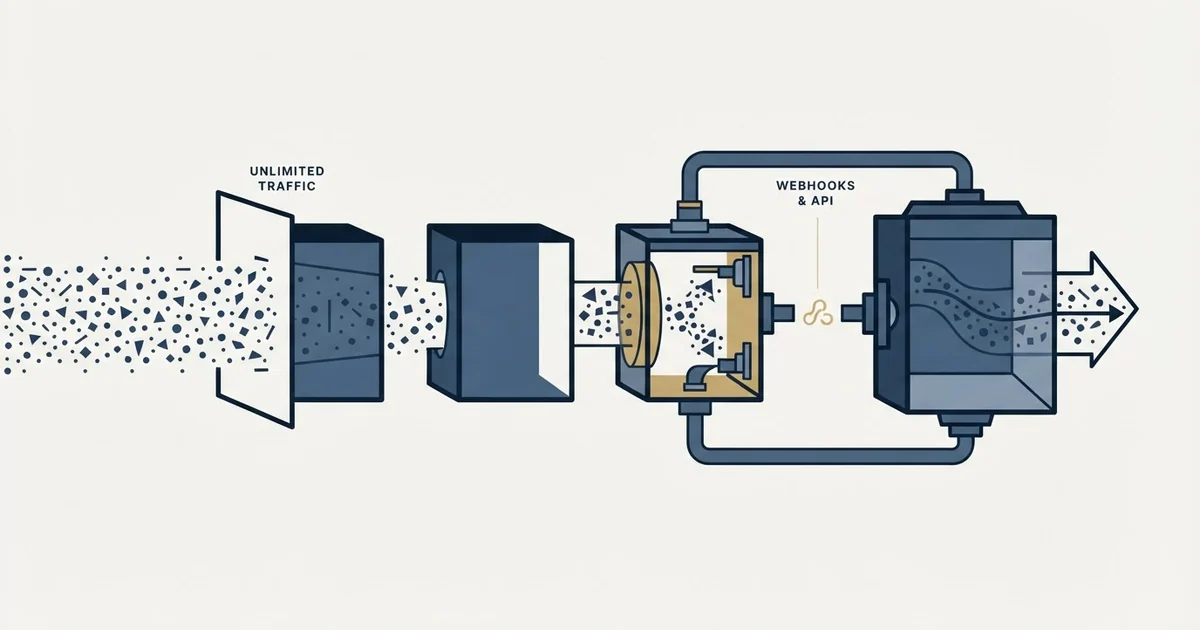
ClickFunnels publishes four tiers: Launch at $97 a month or $81 billed annually, Scale at $197 or $164, Optimize at $297 or $248, and Dominate at $5,997 a year, annual only. The meters are contacts and emails; visitors, funnels and pages are unlimited on every tier.
Key takeaways
- ClickFunnels' Launch plan costs $97 a month or $81 billed annually, Scale $197 or $164, Optimize $297 or $248, and Dominate $5,997 a year with no monthly option.
- The tiers meter contacts and emails, from 10K contacts and 50K emails on Launch to 400K and 1.2M on Dominate, while visitors, funnels and pages stay unlimited.
- Fourteen matrix rows are dashed on Launch, including the custom code editor, automations and, on the plan cards, webhooks and full API access, which start at Scale.
- The pricing page contradicts itself on API access: one matrix row ticks API and webhooks on every plan, while the plan cards and another row start it at Scale.
Reviewed and updated September 21, 2026
A demand generation lead reads ClickFunnels pricing for a campaign landing page, sees an entry plan and budgets for it, then discovers three weeks in that the integration into the CRM needs webhooks, and webhooks live one tier up. The page went live on schedule. The data never left the platform.
No fee is hidden. The whole matrix sits on the pricing page under a heading reading "Here's what's included in each plan", plan by plan. The mistake is a reading error, and it happens because the plan names describe ambition rather than capability, and because the meter this product bills on is not the meter its category normally bills on.
Here is the published ladder, what each tier actually unlocks, and the specific question a B2B team fed by outbound should ask before any of it matters.
ClickFunnels pricing: the published ladder, in both billing states
Two figures per self-serve tier are rendered on the pricing page, with the difference labelled plainly: under Scale's lower figure the line reads "Billed annually (Save $394/year)". Both numbers are live in the same document, so quoting one without the other is how a comparison goes wrong.
| Plan | Price | Contacts and emails |
|---|---|---|
| Launch | $97 a month, or $81 billed annually | 10K contacts, 50K emails a month |
| Scale | $197 a month, or $164 billed annually | 75K contacts, 300K emails a month |
| Optimize | $297 a month, or $248 billed annually | 150K contacts, 750K emails a month |
| Dominate | $5,997 a year, annual only | 400K contacts, 1.2M emails a month |
The pricing page states the annual saving per tier as $194, $394 and $594 a year on Launch, Scale and Optimize respectively. Dominate is labelled an "Annually only plan" and carries no month to month figure at all, which is worth noticing before a finance team asks for a monthly line item.
The page also answers two questions that decide the real cost of a funnel platform. On hosting it says "All ClickFunnels plans include secure, unlimited hosting for all your digital content" and that "We use 40 Edge servers all around the world". On transaction fees it asks "Does ClickFunnels take a percentage of my sales?" and answers "You'll keep every penny you make". The guarantee line reads "Yes, we have a 30-day money back guarantee", and an account without a custom domain gets a free subdomain on myclickfunnels.com.
What the meter counts, and what it does not
Read down the feature matrix and the same word appears on every tier: Unlimited. Funnels are unlimited on all four plans, marked "Limited Time" on the page itself. Site pages are unlimited on all four. Landing pages are unlimited on all four.
Visitors are unlimited on all four.
That last one is the whole story of this product's economics, and it is the opposite of how the neighbouring category prices. A landing page builder normally meters the people who arrive, and the ladder on Unbounce steps a traffic ceiling upward tier by tier, so the plan you need follows how much traffic you send. Here the equivalent row reads "Unlimited Visitors" on all four plans, and that dimension is not priced at all.
What it prices instead is the database and the sending. Email contacts step 10K, 75K, 150K and 400K. Emails per month step 50K, 300K, 750K and 1.2M. Brand workspaces step 1, 5, 10 and 20, team members step 2, 5, 10 and 20, and stores step 1, 5, 10 and 20 on the same rungs.
For an outbound programme this inverts the usual sizing exercise. Traffic to a campaign page fed by email and LinkedIn is bounded by the size of the list that was contacted, and traffic is the number that would normally decide the tier and here decides nothing. The number that does decide it is how many contacts the platform is holding and how much mail it is sending on your behalf, and a team already sending from a dedicated cold email stack may be paying for a sending capability it will never use.
The capability boundary sits between Launch and Scale

Fourteen matrix rows carry a dash against Launch, and three of them decide most integration projects: the custom code editor, webhooks and full API access, and automations. Email marketing itself is ticked on every plan; the automations row below it starts at Scale. Advanced workflows are absent on Launch and Scale both, appearing first on Optimize. The Affiliate Center follows the same pattern. Calendars are absent on Launch entirely and then step 5, 10 and 20.
So the ladder is not one product at four volumes. The practical consequence is the one in the opening: a team that intends to move form fills into a CRM, or to fire anything on a webhook, is buying Scale whatever the Launch figure says, and the difference between those two published month to month rates is a hundred dollars a month rather than a small step.
One row further down the same matrix, API & Webhooks, carries a tick on all four plans, which disagrees with the Webhooks/API Access row and with the plan cards, where Webhooks/Full API Access is listed from Scale up. The page contradicts itself on exactly the capability most integration projects need, so ask ClickFunnels in writing which applies to Launch before budgeting on it.
Five rows on the matrix carry a mark against Dominate alone: "Dedicated IP (Email)", SSO, "Branding Removal", "Certification Training" and a named account manager. A regulated or security-reviewed buyer should read those rows first, because SSO is frequently a procurement requirement rather than a preference, and on the published ladder it sits on a plan billed annually at $5,997 with no monthly alternative.
Where this lands for a team whose traffic comes from outbound
Funnel software is usually sold on the assumption that the funnel supplies its own demand, because that is the market this category grew up in. Courses, communities, stores and an affiliate centre all sit inside the same subscription, and the plan descriptions talk about launching and scaling a business rather than about supporting one that already sells.
An outbound programme produces a different shape of traffic, and it changes three things.
The volume is small and already qualified. Every visitor arrived from a message that named the offer in advance, so the destination continues a conversation rather than starting one. Benchmarks people judge such a result against were measured somewhere else entirely, which average landing page conversion rate takes apart, and the honest read on any percentage taken from a few hundred visits is set out in conversion rate.
The testing framework has nothing to work with at that volume. A/B testing is listed on every tier here, which is more generous than the neighbouring builders, and generosity does not manufacture a sample. A test needs enough observations to separate a real effect from noise, and below that it returns a confident answer that is often wrong. Running one anyway on a campaign page is the situation A/B testing a landing page when you do not have the traffic exists to describe, and the arithmetic behind the threshold is the same one that governs email testing.
And the binding constraint is usually upstream. Landing page lead generation makes the argument at length: a landing page converts demand that already exists and has no mechanism for creating any, so a thin flow of visitors is a supply problem that no tier addresses.
What you are actually renting

Strip the tiers back and this subscription bundles four things a marketing team would otherwise buy separately: a page builder, an email sending platform, a light CRM with pipelines and calendars, and a commerce layer with checkout and courses.
That bundling is the real decision, and it cuts both ways. For a team with none of those, one subscription replacing four is a genuine saving and a genuine simplification. For a B2B team that already runs a CRM it trusts and a cold email infrastructure it has warmed, much of the bundle is duplicate capability, and the comparison is no longer against other funnel builders at all. It is against the page builder alone, where the four jobs hiding under that category label are separated in landing page optimization tools.
Launch
- One workspace, two team members
- Unlimited funnels, pages and visitors
- No custom code editor or automations
- Webhooks/Full API Access not on its card
Scale
- Webhooks/Full API Access on its card
- Custom code editor and automations
- Five workspaces, five team members
- Advanced workflows still absent
Dominate
- Dedicated IP for email
- Single sign on and branding removal
- Account manager
- Billed annually only, $5,997
How to run the evaluation
Take it in this order rather than by comparing headline figures.
Count the contacts the platform will hold and the mail it will send, because those are the two meters. Traffic is not one of them, so an estimate of monthly visitors tells you nothing about which tier you need.
Then find the row for the capability you cannot do without and read across it. On this ladder the capability boundary and the price boundary do not sit in the same place, and the dash in the matrix is more informative than the number at the top of the column.
Then decide whether you are buying a bundle or a builder. If the CRM, the sending and the commerce layers are already solved elsewhere, much of what separates the tiers here is capability you have already paid for once.
Deciding that turns on what the product actually models, and ClickFunnels as a five stage commerce model places the page builder in only the first stage.
Finally, run the trial against a real page with real traffic and judge it on whether it produced a decision somebody acted on. The wider question of which bottleneck any layer of tooling can actually reach is mapped in sales process optimization tools, and it applies directly: a funnel builder cannot fix an offer, and a checkout cannot fix targeting.
The short version

Four tiers are listed, three with a monthly and an annual figure and the fourth annual only. The meter is contacts and emails, with "Brand Workspaces", team members and stores stepping alongside them. Funnels, pages and "Unlimited Visitors" run across every plan, so traffic volume does not choose your tier. The "Custom Code Editor", automations and, on the plan cards, "Webhooks/Full API Access" start at Scale, though one matrix row ticks API and webhooks on every plan, and SSO, "Dedicated IP (Email)" and "Branding Removal" sit on the annual-only top tier.
Size the plan on your contact list and your send volume, check the matrix for a dash before trusting a tier name, and ask whether you are buying a bundle you need or four capabilities you already own. When the shortage is the supply of qualified conversations rather than the page they land on, see what a first campaign produces against your own market.
Plan names, rates and the plan comparison matrix above were read from clickfunnels.com/pricing, as served and as rendered in a browser, in the currency that page served. Vendor pricing moves. Verify current terms with the vendor before relying on them.
Frequently asked questions.
Frequently asked questions- How much does ClickFunnels cost?
- ClickFunnels lists four plans. Launch is $97 a month, or $81 a month billed annually. Scale is $197, or $164 annually. Optimize is $297, or $248 annually. Dominate is $5,997 a year and is sold annually only. The page offers a 30-day money back guarantee and takes no percentage of your sales.
- What does ClickFunnels charge more for as you go up the tiers?
- Contacts held and emails sent. Launch allows 10K contacts and 50K emails a month, Scale 75K and 300K, Optimize 150K and 750K, and Dominate 400K and 1.2M. Workspaces, team members and stores step 1, 5, 10 and 20. Visitors, funnels, site pages and landing pages are unlimited on every plan, so traffic never decides the tier.
- Which ClickFunnels plan includes webhooks and the API?
- The plan cards list Webhooks/Full API Access from Scale up, and the matrix row Webhooks/API Access carries a dash on Launch. A later matrix row, API & Webhooks, is ticked on all four plans, so the page contradicts itself. If you need to push form fills into a CRM, confirm in writing before buying Launch.
- Does ClickFunnels offer single sign on?
- Only on Dominate. SSO, a dedicated IP for email, branding removal, certification training and an account manager are the five matrix rows ticked on Dominate alone, and Dominate is billed annually at $5,997 with no month to month option. A buyer whose procurement requires SSO should price that tier from the start.
About the author.

Ben Carden is CRO at RevenueFlow, which builds and operates outbound revenue engines for B2B companies. Previously at Gartner Enterprise. Studied at London School of Economics.
Ben Carden · CRO
Connect on LinkedIn →Explore more.
Ready to scale your outreach?
We build GTM engines that book real meetings. See the receipts.
Related articles.
What ClickFunnels Is: A Five Stage Commerce Model
ClickFunnels publishes five named stages rather than a page builder. Two translate to B2B outbound. Three assume a sale that completes on the page.
Webflow Pricing: The Four Lines on a Real Bill
Webflow bills a site plan, a workspace plan, seats and metered add-ons. What each line pays for, read from the vendor's own pricing page in September 2026.
Typeform Alternatives: Read the Response Meter First
Typeform meters responses with a hard ceiling and counts seats inside the plan. What Tally, Fillout, Formbricks and Jotform count instead, from their own pricing pages.
Foleon Pricing: No Published Price, a 24-Month Term
Foleon publishes no rate on its plans page and publishes the whole commitment behind it. The term, the notice window and what happens to the Docs after.
PartnerStack Pricing: One Published Number
PartnerStack quotes its three platform plans and publishes the whole model for its self-serve product. What each tier gates, and the choice forced at the entry tier.
eWebinar Pricing: Two Meters and a Level That Moves
eWebinar does not ask you to pick a plan. Published webinars set the level and registrants set the overage, and the two directions do not move on the same schedule.