Foleon Pricing: No Published Price, a 24-Month Term
Foleon publishes no rate on its plans page and publishes the whole commitment behind it. The term, the notice window and what happens to the Docs after.
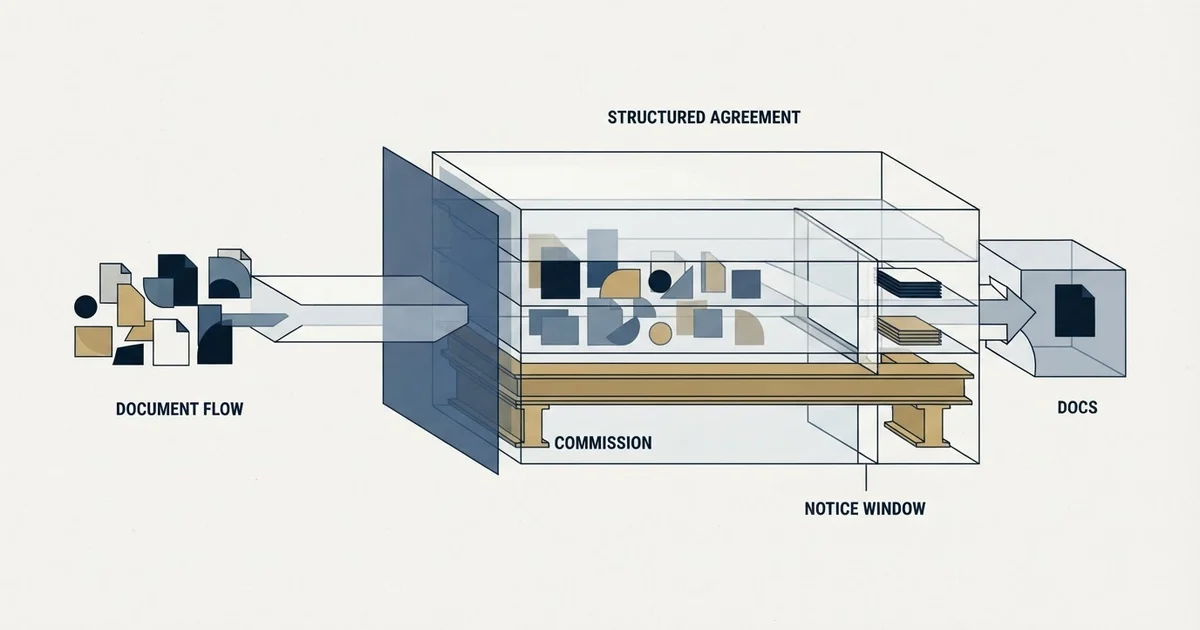
Foleon pricing is quote only: its plans page lists Grow, Scale, Team and Enterprise with "Request a quote" on each and no figure. What it does publish is the commitment: a default 24-month term, invoiced yearly in advance, renewing for the same length unless written notice arrives 90 days before the end.
Key takeaways
- Foleon's plans page lists four tiers, Grow, Scale, Team and Enterprise, each with "Request a quote" and no price in any currency.
- The current general conditions set a 24-month default term that renews for the same length unless written notice arrives 90 days before the end.
- The cancellation deadline, 3 months before renewal, falls a month before the downgrade deadline, and published Docs go offline when the contract ends.
- Vendr's directory page puts the median at $21,000 a year from an unstated number of deals, and its own ten-user range sits above its stated high.
Reviewed and updated September 21, 2026
A demand generation lead shortlists Foleon, books the demo, and gets a quote back with one annual number on it. That number is the only figure anybody discusses. Nineteen months later somebody asks whether the gated content programme should move to a cheaper builder, and finds two things on the vendor's own website that were never in the quote: the contract runs for twenty four months rather than twelve, and the window for saying no to the next twenty four closed the previous week.
None of that was hidden. It sits in plain language on two pages a buyer rarely reads before signing, one of which says plainly that "subscriptions are 2-year contracts". What Foleon does not show on its plans page, in its conditions or in its FAQ is a rate.
That combination inverts the usual shape of this question. The rate is unknowable until you talk to sales. The commitment behind the rate is knowable this afternoon, and it is the part that decides what the purchase costs.
What Foleon is, and what you are buying a licence to
Foleon's own knowledge pages answer the identity question directly. Its intro page states that "Foleon is an all-in-one content creation platform", and describes the output as Foleon Docs, built on HTML5, CSS and JavaScript, linear in format rather than navigable like a website, and readable across devices at whatever pace the reader chooses. The same page says its drag and drop editor "empowers people across your company to create high-impact content without design experience", which names the buyer as much as the product does.
The content types its site navigation lists say who this is sold to, among them proposals, reports, brochures, white papers, microsites, content hubs, landing pages, pitch decks and benefits guides, and its use case routes include brand, demand and customer marketing, buyer enablement and partner enablement. This is a platform for the gated report, the sales proposal and the account specific microsite.
The thing being licensed is worth naming precisely, because it changes the renewal maths later. You are renting a platform that both builds the asset and hosts it, and the Docs are served by Foleon for as long as the contract runs.
Platforms that build and host bill in more than one line, and Webflow's price is four lines rather than one, counting sites, workspaces, seats and metered add-ons apart.
Foleon pricing: four tiers and no figures

Foleon's plans page carries four self serve tiers named Grow, Scale, Team and Enterprise, plus a separate Agency plan and a professional services offer. Every one of the four carries the same call to action, "Request a quote", and the page's visible text holds no currency symbol and no ISO currency code, so Foleon pricing is a quote in every case.
What the page does publish is composition, and the units are unusual enough to be worth naming. Grow is the entry point, with content templates, the Content Studio for designers, audience analytics, integrations and a Brand Kit. Scale adds unlimited Foleon Docs, the Content Builder for non designers, advanced personalisation, Global Content Modules, custom domains, an extra Brand Kit and, in the page's own words, "Up to 20 reviewers". Team adds dedicated workspaces, a shared media library, unlimited reviewers, extra seats for standard users and "Up to 5 Brand Kits". Enterprise adds "Up to 20 Brand Kits", locked Doc settings, secure API access, SCIM 2.0 user management and account specific service level agreements.
Read those ladders together and the meter becomes visible without a single price. Foleon steps a buyer up on three axes at once: how many people can create, how many brands the account covers, and how much central control the organisation has over what those people publish. Two extensions, Foleon DataViz and Foleon Video, sit outside the tiers and are sold as modular additions, so a quote for the platform is not a quote for its charting and video hosting.
The vendor also runs a return on investment calculator as a pricing surface, and the direction it points is worth noticing. Its description on Foleon's own site invites a visitor to "See how much your current content processes are costing you", which is a calculator of your cost rather than of theirs.
The commitment is published even though the price is not
This is the part that repays ten minutes on the general conditions page. The default contract length is stated outright. Foleon's general conditions, in the version its legal page marks as current (3.2, effective 1 August 2024), say that "Unless otherwise specified on the Order Form, the Subscription Term shall be for a fixed period of twenty-four (24) months", and the customer facing FAQ says the same thing in buyer language, that "subscriptions are 2-year contracts". The same conditions state that a customer cannot end a subscription term early except under their sections on termination for cause and the performance warranty.
Renewal is automatic and rolls for the same length again. The conditions require "written notice of non-renewal at least ninety (90) days before the end of the then-current Subscription Term", and they are explicit about what a late notice does. If the notice arrives inside that window, then per the same document "the subscription shall renew as defined in Section 9.4 (Renewals) and the termination shall commence at the end of the renewed Subscription Term". A missed ninety day window on a twenty four month contract costs another twenty four months. Foleon's FAQ restates the rule as "You can cancel your account up to 3 months before your renewal date", and names the address that a valid notice has to reach, which is notice@foleon.com rather than an account manager.
Terms sitting below a price change what the price means, and CallHippo reserves the right to reprice accounts showing call centre volume under its fair usage policy.
One window a buyer would reasonably assume matches does not. The FAQ states that "You can downgrade your subscription up to 2 months before the end of a billing cycle", a different deadline from the three month cancellation one, so the last date to shrink the contract and the last date to leave it are a month apart.
Two more published terms change the cash shape. Invoicing runs in yearly blocks in advance, since the conditions state that "The Service(s) is invoiced for a 12-month period at the beginning of the Subscription Term", with payment due fourteen days net. And Foleon reserves the right to change its prices at a new or renewed term, having told existing customers "at least one hundred and twenty (120) days in advance". That notice lands four months before renewal and one month before the cancellation window shuts.
What happens to what you published

The last row of that timeline is the one most likely to change a renewal decision, and it is answered plainly in the FAQ. On cancellation, "Your Foleon Docs will remain online until the end of your contract date", and after that they are taken offline. The FAQ adds that the Docs stay inside the account for a further ninety days, so a change of mind inside that period finds them intact.
That is normal for hosted content and it is worth pausing on for the assets teams put into this category. A gated report, a set of sales proposals and an account specific microsite are things other pages link to, sales emails point at and paid campaigns land on. Leaving the platform means those addresses stop resolving unless the content has been rebuilt first, and the FAQ notes that downloading a Doc for hosting elsewhere depends on the plan. The switching cost includes rebuilding whatever is still in circulation, which is an argument for treating the asset map as part of the pricing question.
The third party estimates, and why they disagree
Because the vendor publishes nothing, the top of this search result is held by procurement and software directory sites publishing estimates instead. The most prominent of them comes with three problems a buyer should see.
Vendr's Foleon marketplace page states that the "Median buyer pays $21,000 per year", with a low of $6,485 and a high of $26,090. The page attributes those figures to anonymised Foleon deals in its own dataset and does not state how many deals that is, which is the first thing worth knowing about a median.
The same page then disagrees with itself. Its comparison table gives a typical annual cost for ten users of $25,000 to $50,000, which sits entirely above the $26,090 it names as the high of its own observed range. Both numbers are on one page and neither is marked as superseding the other.
The third problem concerns the contract rather than the number. That page describes how buyers usually structure the agreement as "12-month terms with annual prepayment", where Foleon's own FAQ says its subscriptions are two year contracts and its general conditions set a twenty four month default. The same page names the tier ladder as Grow, Premium and Enterprise, where Foleon publishes Grow, Scale, Team and Enterprise. A source with the term length and the tier names wrong against the vendor's current pages is a weak basis for the one number it is read for.
That does not make the estimate useless. It makes it a named third party's figure with an unstated sample behind it, which should be carried into a budget conversation with that label attached.
Ceros, the other platform in this category that will not name a price

The same question asked about Ceros, the nearest platform of the same kind, returns the same answer in a different shape.
Ceros's pricing page carries three tiers named Starter, Growth and Enterprise, and its visible text holds no currency token either. Starter offers a free start, and both Growth and Enterprise route to "Talk to sales".
What Ceros publishes instead of prices is a seat model built on four roles, and it is genuinely clearer than most. Starter carries "1 Creator (design & publish)", three editors who can edit only, unlimited reviewers and one workspace; Growth carries three creators and ten editors on the same unlimited reviewer basis; Enterprise makes all of those custom. Its FAQ closes two questions a buyer would otherwise have to ask, stating that "All Ceros packages include unlimited publishing" and that "Ceros does not charge per visitor or per page view". The meter is the number of people who can design, and traffic to what they design is free.
Ceros's terms leave the length to the paperwork, defining the initial term as the one specified on the Order Form, and its renewal clause says only that "This Agreement may be renewed or extended by the mutual agreement of Ceros and the Customer or as otherwise specified in the applicable Order Form". No default length and no notice period appear on that page. It does state that "All payment obligations are non-cancelable and all amounts paid are non-refundable", which is the term to carry into the conversation.
| Foleon | Ceros | |
|---|---|---|
| Rate | None; every tier says "Request a quote" | None; Starter starts free, the others say "Talk to sales" |
| Meter | Creators, brands and control | Creators; publishing unlimited, no traffic charge |
| Default term | 24 months, in the conditions and the FAQ | Left to the Order Form |
| Renewal | Same length again unless 90 days' notice reaches a named address | By mutual agreement or as the Order Form says |
| Payment | Yearly in advance, 14 days net | Non-cancelable and non-refundable |
Pricing it before you talk to sales
You cannot get the rate without the conversation, so the work worth doing beforehand is on everything except the rate.
Count the people who need to create rather than the people who need access. On both platforms the expensive seat is the one with creator rights, and reviewer access is unlimited, so an honest count usually shrinks the quote. Count the brands as well, because Foleon's ladder steps on Brand Kits and a company with several product brands crosses a tier boundary on that axis alone.
Then decide the term before the first call rather than after the quote, because a twenty four month default is easier to argue with before a number is on the table. If the term stays, the notice deadline belongs in a shared calendar rather than in one person's memory.
Last, price the exit. Ask what happens to published content, whether an export is available on the tier being quoted, and where the assets would live afterwards.
The short version

Four quote-based tiers sit on Foleon's plans page with no rate against any of them, and almost everything else about the deal is on the vendor's own site. The default subscription runs for "a fixed period of twenty-four (24) months" in the conditions' own words, invoices in yearly blocks in advance, and renews for the same length again unless written notice reaches a named address ninety days out. The cancellation window closes a month before the downgrade window, and the Docs go offline when the contract ends. Ceros, the nearest platform of the same kind, also declines to publish a rate, publishes a clearer seat model built on four roles, and leaves its term and renewal to the Order Form.
The directory estimates filling this search result are named third party figures rather than prices, and the most prominent one contradicts the vendor on the contract length and contradicts itself on the range. Use them to test a quote against, never as the quote.
If this platform is on the shortlist because gated content is not producing enough qualified conversations, the constraint sits upstream of the tooling: the lead magnet trade is the place to look first and account based distribution is the other half. Where the page rather than the asset is the question, landing page optimization tools covers the meters that category bills on. When the shortage is conversations rather than content, see what a first campaign produces.
Plan structure, contract terms and FAQ answers above were read from foleon.com and ceros.com, from stored snapshots of the served and rendered pages, and the third party figures are Vendr's own claims about its own dataset. Neither vendor shows a rate. Verify current terms with the vendor before relying on them.
Sources: Foleon plans, Foleon general conditions, Foleon FAQ, What is Foleon, Ceros pricing, Ceros terms and conditions, Vendr, Foleon
Frequently asked questions.
Frequently asked questions- How much does Foleon cost?
- Foleon publishes no price. Its plans page lists Grow, Scale, Team and Enterprise, each with a Request a quote button. Vendr's directory page reports a median of $21,000 a year, with a low of $6,485 and a high of $26,090, but it does not say how many deals that covers and it contradicts itself elsewhere on the page.
- How long is a Foleon contract?
- Twenty-four months by default. Foleon's current general conditions set a fixed 24-month subscription term unless the Order Form says otherwise, and its FAQ states that subscriptions are 2-year contracts. The term renews for the same length again unless written notice of non-renewal arrives at least 90 days before it ends.
- How do I cancel Foleon?
- Send written notice to notice@foleon.com at least three months before the renewal date, which is the address and deadline Foleon's FAQ names. A notice that arrives later does not stop the renewal: under the general conditions the subscription renews and the termination takes effect at the end of the renewed term.
- What happens to Foleon Docs after cancelling?
- According to Foleon's FAQ, published Docs stay online until the contract end date and are then taken offline. They remain in the account for a further 90 days, so renewing within that period brings them back. Whether a Doc can be downloaded for hosting elsewhere depends on the plan.
About the author.

Ben Carden is CRO at RevenueFlow, which builds and operates outbound revenue engines for B2B companies. Previously at Gartner Enterprise. Studied at London School of Economics.
Ben Carden · CRO
Connect on LinkedIn →Explore more.
Ready to scale your outreach?
We build GTM engines that book real meetings. See the receipts.
Related articles.
Typeform Alternatives: Read the Response Meter First
Typeform meters responses with a hard ceiling and counts seats inside the plan. What Tally, Fillout, Formbricks and Jotform count instead, from their own pricing pages.
PartnerStack Pricing: One Published Number
PartnerStack quotes its three platform plans and publishes the whole model for its self-serve product. What each tier gates, and the choice forced at the entry tier.
BrightTALK Pricing: What the Vendor Does Not Publish
Six BrightTALK surfaces carry no price at all. The $500 figure filling that gap is a 2022 scrape on a listing the vendor says it does not manage.
eWebinar Pricing: Two Meters and a Level That Moves
eWebinar does not ask you to pick a plan. Published webinars set the level and registrants set the overage, and the two directions do not move on the same schedule.
Webflow Pricing: The Four Lines on a Real Bill
Webflow bills a site plan, a workspace plan, seats and metered add-ons. What each line pays for, read from the vendor's own pricing page in September 2026.
Jotform Pricing: Four Meters, One Seat
Every Jotform plan card carries four separate ceilings, two of them about submissions. The larger one reads like the monthly limit, and it is not.