CallHippo Pricing: Five Ladders, One Fair Use Cap
CallHippo publishes five separate price ladders on one page, and the cheapest one carries fair-usage clauses that rule out bulk outbound calling.

CallHippo pricing is five ladders on one page. Core Calling runs $0, $18, $30 and $42 per user per month billed yearly, with a two-user minimum on Starter, and High-Volume Outbound Calling is $35 or $200. Its fair-usage policy bars auto and predictive dialing on the office plans and caps calls to one number at ten an hour.
Key takeaways
- CallHippo's Core Calling ladder publishes Basic at $0, Starter at $18, Professional at $30 and Ultimate at $42 per user per month on yearly billing, plus local taxes.
- Bulk outbound belongs on the separate High-Volume Outbound Calling ladder at $35 or $200 per user per month, not on the office plans.
- The fair-usage policy bars auto and predictive dialing, caps calls to one number at ten an hour and keeps parallel calls under 30% of capacity.
- The served page mixes US dollars and Indian rupees in adjacent blocks, so check the symbol on every figure you copy.
Reviewed and updated October 1, 2026
CallHippo's pricing page is not one price list. It is five, stacked down a single page under five headings beneath a banner reading "The complete communication platform for every team", and the cheapest of them sits above a fair-usage policy that forbids the thing an outbound team would buy it for.
That combination is the whole story of this vendor's pricing, and none of the comparison pages ranking for the query mention the second half of it.
What follows is read from CallHippo's own pricing page, with the plan names and the fair-usage text taken from that page. The page carries a currency selector offering US dollars, Australian dollars, Canadian dollars, euros, pounds and Indian rupees, a monthly and yearly toggle labelled "Save 3 Months' Cost", a phone-number region selector and a team-size selector. Every currency below is named because the served page rendered more than one at the same time.
CallHippo pricing: five ladders on one page
The five headings are Core Calling for Business Teams, Scaled Calling with Visibility, High-Volume Outbound Calling, One Shared Inbox for Customer Communication and Automated Voice Support for Sales and Service, with an AI Copilot block beneath them.
The heading "Core Calling for Business Teams" sits over the ladder people mean when they quote a CallHippo price, described as "Ideal for small teams managing low to moderate call volumes and seeking reliable, day-to-day business calling". On the yearly state, in US dollars, that ladder publishes Basic at $0 per user per month, Starter at $18, Professional at $30 and Ultimate at $42. Starter carries a note reading "Minimum 2 users". Every paid tier carries a 10-day free trial alongside a Contact Sales button, and a line beneath the ladder reads "Local taxes will be applicable in addition to the listed prices".
The paid tiers differ first on minutes. Starter includes 1,000 calling minutes within the US and Canada, while Professional and Ultimate list unlimited calling minutes within the US and Canada, which the fair-usage policy below then bounds.
The Enterprise tier of that same ladder rendered in Indian rupees on the page served to us, at 16,468 per user per month, with "Custom pricing" printed directly beside it. The Scaled Calling with Visibility ladder rendered its paid tiers in rupees too, at 1,300 for Bronze, 1,900 for Silver and 3,200 for Platinum and Enterprise, while its own Basic tier rendered in dollars at zero.
The page's third heading, "High-Volume Outbound Calling", introduces a parallel dialing product "Built for sales teams that need to reach more prospects in less time and maximize agent productivity" in two tiers, Basic at $35 and Ultimate at $200 per user per month, each with unlimited calling within the US and Canada and a Contact Us button rather than a checkout. The AI Copilot block prices its Pilot Plan at $10 per user per month, while the add-on list lower down prints AI Copilot at $0.12 per user per month, the same figure as the Branded Calling add-on beside it, so that line is one to confirm with sales. The AI Voice Agent is $45 per agent per month on the latest read, with 100 free minutes, five concurrent calls per agent and calling billed separately at $0.25 per minute. An earlier read rendered that block in rupees, so its currency moves and the symbol has to be read on the day. A newer Outcome-Based AI Voice Agent is billed per demo booked, and the page prints no rate for it.
| Ladder | Paid tiers | Currency served |
|---|---|---|
| Core Calling | $18 to $42, Enterprise custom | Dollars, Enterprise in rupees |
| Scaled Calling | 1,300 to 3,200 | Rupees, free tier in dollars |
| High-Volume Outbound | $35 or $200 | Dollars |
| Shared Inbox | $20 or $28 yearly | Dollars |
| Voice Support | $45 an agent, or per demo | Dollars |
CallHippo labels the yearly toggle "Save 3 Months' Cost", which is a nine-months-for-twelve discount. Only the yearly figures, $18, $30 and $42, render in the served document; the monthly figures are fetched when the toggle is clicked, so confirm them in the product before comparing states. The inbox and AI blocks carry a different toggle reading "20% Discount", and the inbox figures bear it out: Bronze is $20 yearly against $25 monthly and Silver $28 against $35, so the two halves of the page do not even discount the same way. Quote whichever state you will actually buy, and say which one it is.
The fair-usage policy is the real specification
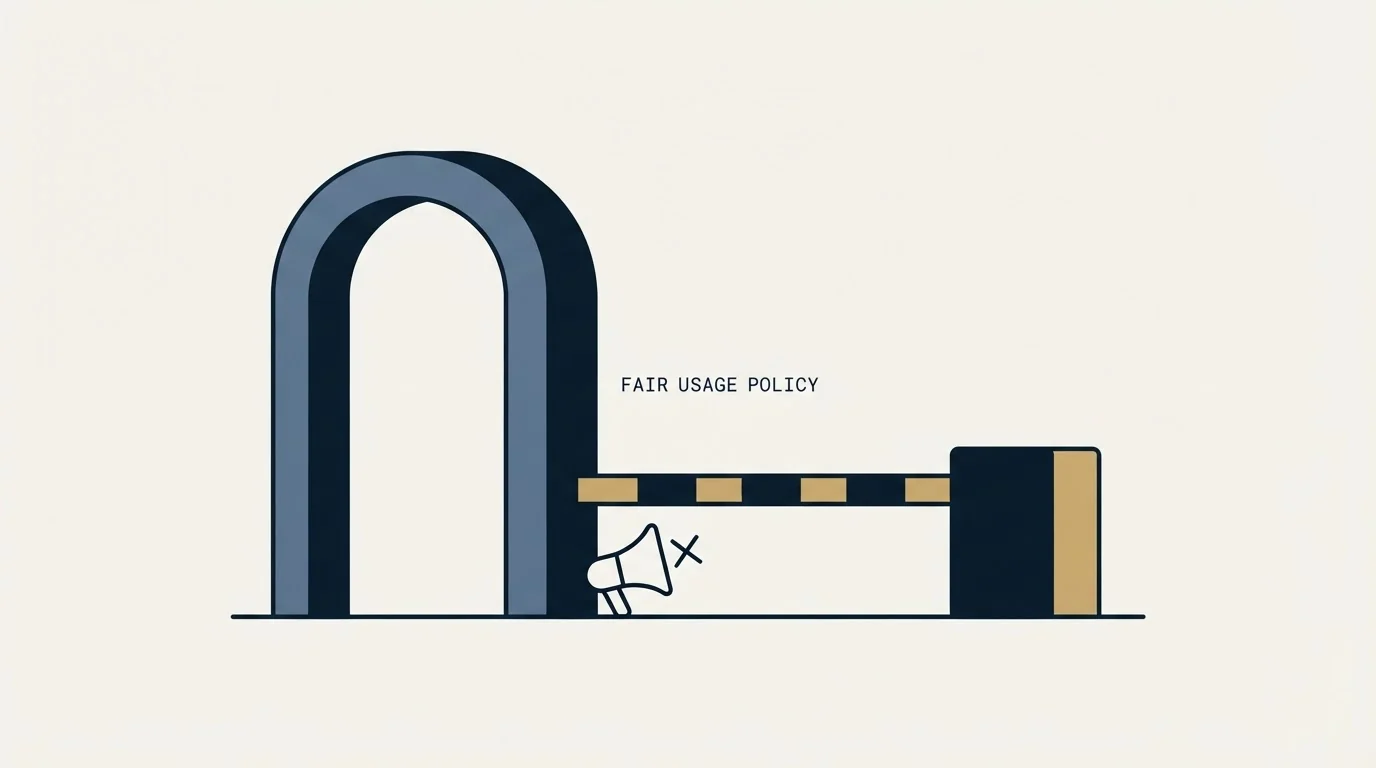
Ten numbered clauses sit at the foot of that page under the heading Fair Usage Policy, and four of them decide whether this product fits an outbound motion at all.
The second reads: "Customers are prohibited from using the service for auto-dialing, predictive dialing, trunking, traffic pumping, or access stimulation." It adds that a CallHippo number may not be forwarded to systems supporting multiple simultaneous calls.
The third opens "The Office Phone System is designed for small business use" and continues that if usage indicates call-centre-level bulk calling activity, "CallHippo reserves the right to change your plan, apply standard call center rates, or suspend your account", and may migrate accounts exceeding fair-usage limits to call centre plans.
CallHippo's ninth clause reads "Outgoing calls to the same number may not exceed 10 calls per hour", and adds that exceeding it may result in automatic number blocking until a valid unblock request is submitted.
The tenth clause on that page reads "Parallel calls may not exceed 30% of total call capacity within the Office Phone System".
Read together, those clauses say the cheap ladder is a business phone system and the vendor intends to enforce that. A team buying the published Starter tier at $18 per user per month to run outbound calling volume is buying a plan whose own terms describe that pattern as grounds for a repricing or a suspension. The separately priced High-Volume Outbound Calling product exists precisely because the fair-usage clauses carve that use out of the cheaper one.
Two further CallHippo clauses set the boundary of the word unlimited: "Unlimited calling applies only to domestic calls within the United States and Canada", and it does not apply to premium or toll-free numbers, with excluded destinations listed on a separate exemption page and international calls billed at current rates.
Settle before signing
- Which of the five ladders your usage belongs to
- The currency symbol on every figure you copy
- The billing state, since the page discounts two ways
- Local taxes, which sit on top of listed prices
- Whether your destinations count as unlimited
Do not assume
- Bulk outbound on the cheap ladder, since clause 2 bars auto and predictive dialing
- More than ten calls an hour to one number
- That the free Basic plan stays free after six months
The currency problem, stated plainly
On the page as served to us, on the first read and again on the latest, the Core Calling ladder rendered in US dollars while the Enterprise tier of the same ladder, the paid tiers of the Scaled Calling ladder and most of the add-on list rendered in Indian rupees. The dollar and rupee figures sat inside one document, in adjacent blocks, with nothing announcing the switch.
The practical consequence is sharp. A reader scanning that page and collecting the numbers gets a Starter at eighteen and an Enterprise at sixteen thousand four hundred and sixty-eight, and unless they notice the symbol changed they will conclude something dramatic and wrong about the top of the ladder.
Pages that serve readers different content produce the same disagreement elsewhere, and three versions of one pricing page explain why independent guides quote different overage rates.
This is a harder version of a known trap. Several vendors geolocate a single currency onto a whole pricing page with nothing announcing it. Rendering two currencies into different blocks of the same page is the same failure with the tell removed, because the page looks internally consistent. Check the symbol on every figure you take off a pricing page, not just the first one.
What the seat rate leaves out

As in the rest of the category, the seat is the floor. CallHippo's own add-on block prices the elements separately: a dashboard user, a caller ID name registration as a one-time setup cost, SMS services from a monthly minimum with a one-time setup fee of $20 per account, a spam remediation service per number, a spam monitoring service per number per month for US and Canadian numbers, and a bundle of a thousand United Arab Emirates calling minutes. Call recording on that page adds $0.005 per minute, and the same page puts additional incoming minutes on standard numbers at $0.02 per minute once bundled free minutes are exhausted. Branded calling, which shows the business name and call reason before the recipient picks up, is $0.12 per call.
Another vendor in the category prices that separation explicitly, where three outbound add-ons priced per user cost several times the seat before any minutes are billed.
None of those is unusual for the category, and the point is not that they exist. It is that the comparison pages ranking for this vendor's price quote the four-tier ladder and stop, so a budget built from those pages is missing the layer where the variable cost lives. The same gap opens up between a marketing page and a help article on Pipedrive's calling surfaces: one covers the assembled system, the other covers what the base product contributes.
The free tier deserves one line of its own. CallHippo's eighth fair-usage clause reads "The Basic plan is provided free of charge for the first 6 months from signup", after which users must upgrade to Starter to continue using the service. That is a six-month trial rather than a free tier, and it is a materially different thing to plan around.
Where this lands for an outbound team
The honest summary for a sales team is that the relevant CallHippo product is not the one in the headline. If the motion is high-volume outbound, the ladder that applies is the one CallHippo heads "High-Volume Outbound Calling", at $35 or $200 per user per month, plus whichever AI add-ons the workflow depends on, plus per-minute charges. If the motion is a small team taking and making ordinary business calls with CRM logging, the published Core Calling ladder at $18 to $42 per user per month is the right read and the fair-usage clauses are not a constraint.
The mode decision that sits underneath all of this is covered in dialer modes and what a seat costs, and the specific trade in dialing several lines at once is in parallel dialing, where the line count changes the economics more than any seat rate does. For the same read on a vendor with two line counts on its page and no rate beside them, see the Kixie PowerDialer.
Our own motion is email and LinkedIn rather than phone, so this is a documentation read rather than an operating account. The discipline that does transfer is about repetition. A ten-calls-per-hour cap on one number is a vendor putting a number on something we treat as policy: repeated contact reaches the people who already chose not to answer, and the cost of that lands on the identity doing the contacting. We send one message per campaign, with no bumps and no thread replies.
The short version
Five separate ladders sit on one CallHippo pricing page. The one usually quoted is Core Calling at $0, $18, $30 and $42 per user per month on the yearly state in US dollars, with a two-user minimum on Starter and "Local taxes will be applicable in addition to the listed prices".
The fair-usage policy beneath it prohibits auto-dialing and predictive dialing, caps outgoing calls to one number at ten an hour, keeps parallel calls under a third of capacity, and reserves the right to reprice or suspend accounts showing call-centre-level volume. The separately priced product CallHippo heads High-Volume Outbound Calling, at $35 or $200 per user per month, is where that volume is meant to sit.
The served page rendered US dollars and Indian rupees in different blocks at the same time, so check the symbol on every figure rather than the first one.
Unlimited means domestic United States and Canada, excluding premium and toll-free numbers, and the free Basic plan is free for six months rather than indefinitely.
If the question underneath the tooling is how many conversations the motion needs rather than what each one costs, see what a first campaign produces.
Pricing, plan names and fair-usage terms are from CallHippo's own pricing page, with a dated snapshot retained. Currencies are named per figure because the page rendered more than one. Prices change; check the page before you buy.
Frequently asked questions.
Frequently asked questions- How much does CallHippo cost?
- CallHippo's Core Calling ladder lists Basic at $0, Starter at $18, Professional at $30 and Ultimate at $42 per user per month on yearly billing, with a two-user minimum on Starter and local taxes on top. Enterprise is custom-quoted. The page carries four more ladders, including High-Volume Outbound Calling at $35 or $200 per user per month.
- Is CallHippo's free plan really free?
- Only for a while. CallHippo's eighth fair-usage clause says the Basic plan is free for the first six months from signup, after which users must upgrade to Starter to keep using the service. Basic also charges for phone numbers, so it is closer to a six-month trial than a permanent free tier.
- Can I use CallHippo's cheaper plans for outbound calling campaigns?
- Not for bulk outbound. The fair-usage policy prohibits auto-dialing and predictive dialing, caps outgoing calls to one number at ten an hour, keeps parallel calls under 30% of capacity, and lets CallHippo reprice or suspend accounts showing call-centre-level volume. The High-Volume Outbound Calling ladder exists for that use.
- Why does CallHippo's pricing page show prices in rupees?
- The page served to us rendered the Core Calling ladder in US dollars but its Enterprise tier, the Scaled Calling paid tiers and most add-ons in Indian rupees, in adjacent blocks with nothing announcing the switch. A currency selector offers six currencies, so pick yours and check the symbol on every figure.
About the author.

B2B cold email experts helping companies generate qualified leads through done-for-you outreach campaigns.
RevenueFlow Team
Explore more.
Ready to scale your outreach?
We build GTM engines that book real meetings. See the receipts.
Related articles.
Twain Pricing: Credits per Lead, Three Research Modes
Twain sells credits, not seats, and a lead costs 1 to 14 of them depending on the research mode. The two ladders, the four expiry clocks and the cap.
Snitcher Pricing: The $49 Table Is the Annual Rate
Snitcher's visible price table is the annual-billing ladder. The ten bands at both billing states, the unique-company meter, and the rules on a help page.
Autobound Pricing: One-Time Credit Packs, Not Seats
Autobound's pricing page sells one-time credit packs for a signal data API, not seats. The six packs, the per-endpoint meter, and what a company costs.
TexAu Pricing: Four Tiers, Billed Only on a Match
TexAu charges credits only when a lookup succeeds. The four tiers at both billing states, the rollover cap, and three places the page disagrees with itself.
Lavender Pricing: Two Products, No Pricing Page
Lavender has no pricing page. The Email Coach ladder per seat at both billing states, the free routes, and the separate per-agent price for Ora.
Airscale Pricing: Three Plans, One Credit, Four Rates
Airscale prints a different credit cost on every plan, and its advertised per-email price belongs to the custom one. The dated ladder and the rollover rules.