Ringover Pricing: The Seat Is Not the Bill
Ringover publishes a $15 seat, and three published add-on rates an outbound team needs sum to $147 per user per month on top of it, before any minutes.
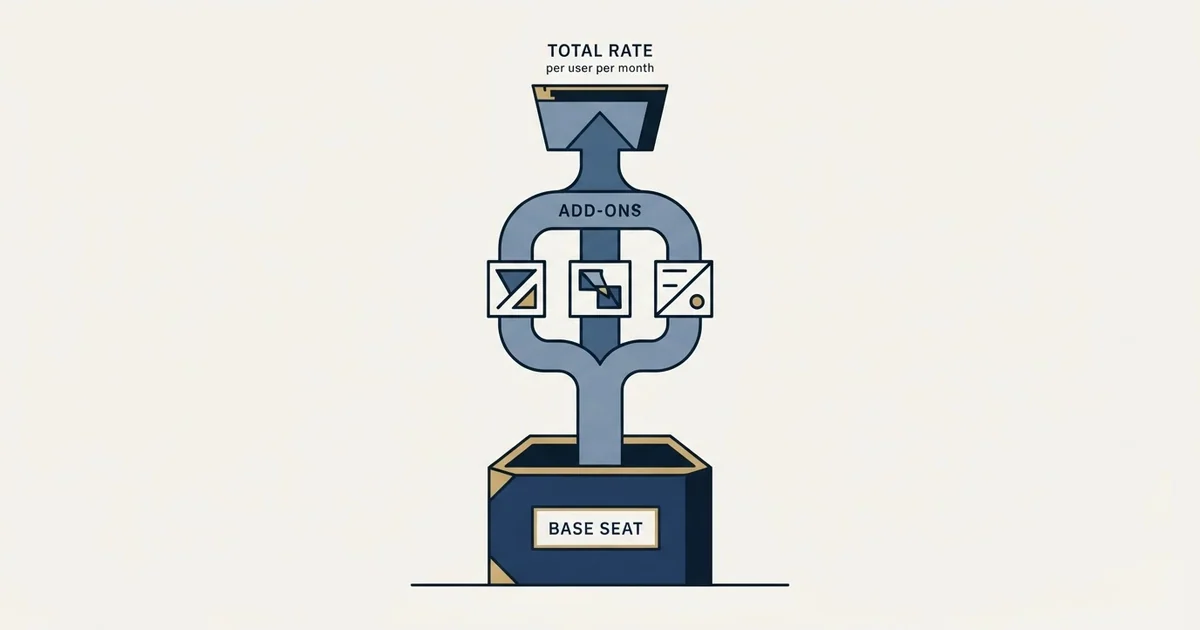
Ringover publishes TALK at $15 and BUSINESS at $47 per user per month excluding taxes, on the annual state in the 3-300 user segment as published on 1 September 2026, both with a three-user minimum and a twelve-month commitment. Its add-ons page prices the outbound configuration separately.
Key takeaways
- Ringover's published plans in the 3-300 user segment are TALK at $15 and BUSINESS at $47 per user per month annually, with ADVANCED unpriced.
- The add-ons page prices an outbound configuration separately: a parallel dialer at $49, Cadence at $59 and conversation analysis at $39 per user or licence per month.
- Add-on commitments extend to the end of the customer's contract term once subscribed, which the add-ons page states in its own footnotes.
- The pricing page carries a company-size selector, a currency selector and a billing toggle, so a quoted figure means nothing unless all three states are named.
Reviewed and updated October 1, 2026
Ringover's plan card shows a seat at $15 per user per month, and the plan an outbound team actually buys is $47. Add the three instruments such a team would run, and the add-ons cost more than three times that seat before a single minute is billed.
That total is arithmetic on Ringover's own rate cards rather than a figure the vendor puts anywhere, so here it is in full: the Parallel Dialer at $49 per user per month, plus Cadence at $59 per user per month, plus Empower conversation analysis at $39 per licence per month, sums to $147 per user per month on top of whichever seat you buy. Each of those three rates comes off a Ringover page and is dated below. Only the sum is mine.
Both pages are the vendor's own, both were fetched on 1 September 2026, and the gap between them is the entire point of pricing this product. The seat buys a phone. The outbound configuration is assembled from add-ons, each priced individually, each committed for the length of the contract.
The published plans
Four controls sit above the plan cards on that page, under a banner reading "It's time to power up with Ringover": a company-size selector offering 1-2 users, 3-300 users and 300+ users, a currency selector offering US dollars and euros, and a billing toggle offering Monthly or Annual with a minus 25 percent badge. The state served on 1 September 2026 was the 3-300 user segment in US dollars, and every card in it carried the annual figure as its headline with the monthly figure beside it in the page's own markup.
Ringover puts TALK at $15 per user per month excluding taxes on the annual state, with $24 as the alternate monthly figure. Its card is described as "Simple, flexible telephony tailored to small business needs", carries a Web only label with the note "This plan is available for online purchase only", and adds "3 users minimum" and "12-month commitment".
Ringover puts BUSINESS at $47 per user per month excluding taxes on the annual state, with $57 as the monthly figure, and repeats the same three-user minimum and twelve-month commitment. Its card describes "An AI-powered, omnichannel and fully integrated communication solution for Sales, Support and HR teams", and its feature list adds local numbers from 65 countries, advanced call routing, integrations across a catalogue described as more than 100, double listening and whispering, and a power dialer.
The Ringover ADVANCED card carries no figure at all. It offers "A fully customizable, global and scalable AI communication platform" and routes to a demo instead of a rate.
That gap between a printed ladder and a quoted one recurs, and a video platform pricing one tier of four leaves the plan most teams buy behind a sales conversation.
A plan comparison table further down lists four columns rather than three: Talk, Smart, Business and Advanced. SMART has no priced card in the segment served to us, which is a real gap in the ladder rather than an omission on our side, and it is why third-party pages quoting a Smart tier at $29 or $21 are not describing the same view.
Company size, currency and billing period, and each one changes what is shown
Talk, Smart, Business and Advanced, though Smart has no priced card in the served segment
Alongside a twelve-month commitment on each
With direct numbers, a reception number and a cloud phone system during it
The add-ons page is the real rate card

A dedicated Ringover add-ons page sits beside the plans, introduced on the pricing page with "Enhance your experience with our add-ons", and it is the more informative of the two documents. Every figure below excludes taxes, as fetched on 1 September 2026.
A second document often carries the number that decides the bill, and a per-seat overage rate published beside each tier can land a team on a cheaper plan than the page suggests.
On calling, that page prices the Parallel Dialer at $49 per user per month, offering to "Call multiple numbers at once to boost call performance and reach more prospects", available in the United States, United Kingdom and Spain only. The same page prices fastest dispatch at $5 per licence per month. That page prices local number bundles at $200 per bundle per month, offering to "Buy bundles of 100 numbers from the 100 largest cities in the US", for US customers only, and prices an additional outbound channel at $10 per user per channel per month, described as "Get an extra outbound call channel (for simultaneous transfers) on top of the two channels already included".
On messaging and workflow, the same page prices omnichannel messaging at $29 per licence per month with a three-user minimum. That page prices additional call campaigns at $5 per licence per month for five more concurrent campaigns, team activity analytics at $6 per licence per month, and CRM Autofill at $5 per licence per month. That page also prices single sign-on via Azure or SAML at $2 per licence per month, and user archiving at $100 per archived licence to "Keep a deleted user's data for 1 year".
On AI, that page prices Empower conversation analysis at $39 per licence per month, the AI Voice Agent AIRO from $0.19 per minute, and an AI website assistant at $99 per website per month. Cadence, the prospecting automation product, is not on the add-ons page at all: the pricing page prices it at $59 per user per month, offering to "Automate your prospecting, personalize outreach, and never miss an opportunity".
Two conditions appear in that page's own footnotes: "Add-on subscription is available for commitment-based contracts", and "Once an add-on is subscribed to, its commitment extends until the end of the customer's contract term". Some add-ons apply to all licences and some to selected users, marked with asterisks against each line.
- TALK, the entry plan, on the annual state excluding taxes
- A three-user minimum and a twelve-month commitment
- Unlimited national calls and one company number
- Online purchase only, per its own Web only label
- No parallel dialing, no cadence, no conversation analysis
- BUSINESS rather than the entry plan
- The Parallel Dialer, charged per user per month
- Cadence, charged per user per month
- Empower conversation analysis, charged per licence per month
- Roughly four times the plan card, before minutes and numbers
The arithmetic in that second column is invented for illustration and describes no real purchase, and it is the one claim on this page that is mine rather than the vendor's, so it is set out rather than asserted. BUSINESS at $47 per user per month, plus the Parallel Dialer at $49 per user per month, plus Cadence at $59 per user per month, plus Empower conversation analysis at $39 per licence per month, sums to $194 per user per month. That is roughly four times the $47 on the card Ringover describes as "An AI-powered, omnichannel and fully integrated communication solution for Sales, Support and HR teams", before a minute or a number is billed. All four of those rates come off Ringover's own pages and are dated above; only the total is mine.
The variable layer
Beneath the seats and the add-ons sit the usage charges, and more of them appear here than in most of the category.
One line on the pricing page reads "For calls made via call automation systems, there is an additional cost of" $0.08 per minute. That page also prices WhatsApp by destination, per conversation over a 24-hour period, ranging from $0.02 in India and $0.04 across North America to $0.19 in the Netherlands. The same page prices MMS at $0.05 per message sent or received on Business and Advanced plans. Carrier fees for US messaging fill a further table on that page, including a brand application fee, a campaign vetting fee, and penalties running from $10 per message for route abuse to $1,000 per violation for sending illegal content.
Those carrier fees are levied by the carriers rather than by the vendor, and the table names the charging party against each line. They are still part of the bill, and setting them out is more transparency than this category usually offers. The unlimited-calling definition is scoped in the same spirit: unlimited applies to numbers located within the European Economic Area and named European countries, and to US and Canadian numbers depending on the plan, with out-of-plan destinations pointing to a rates page.
The trial is seven days. Ringover's own pricing FAQ puts it as "You can test our plans free of charge for 7 days", with direct numbers for employees, a main reception number and the ability to set up a cloud phone system during it.
- Yes: Price the add-ons you need beside the seat, not after it
- Yes: Note that add-on commitments run to the end of the contract term
- Yes: Check whether an add-on applies per licence or to selected users
- Yes: Confirm your destinations are inside the unlimited definition
- Yes: Add the per-minute charge for calls placed by call automation systems
- Yes: Budget the US messaging registration and carrier fees separately
- No: Compare the cheapest seat against another vendor's fully featured tier
- No: Assume the parallel dialer is available in your country
Why the third-party figures disagree

Third-party pages report a Smart, Power and Advanced ladder at $29, $54 and $64, with Smart at $21 on annual billing; Emitrr's Ringover pricing guide carried all four figures when read on 2 September 2026. The vendor page served on 1 September 2026 in the 3-300 user segment shows TALK, BUSINESS and ADVANCED instead, at $15, $47 and no figure at all.
Both readings can be honest. Different cards appear depending on which company-size segment is selected, and the comparison table still names a Smart plan with no priced card in the segment we were served. Anyone reading a different segment, or reading before the ladder changed, ends up with different plan names at different rates without being wrong about what they saw.
The lesson is procedural rather than about this vendor. Where a page offers a segment selector, a currency selector and a billing toggle, a figure means nothing unless all three settings are named. Ours are: 3-300 users, US dollars, annual. The same trap in a milder form runs through CallRail's pricing, where one page served several variants at once, and through Pipedrive's, where a large share of the figures in circulation belong to retired plans.
Where it fits for an outbound team
Ringover's own site organises its solutions by team, naming Sales, Staffing and Recruiting, and Customer Service, and its add-on catalogue reflects that: a parallel dialer, a cadence tool, call campaigns, local presence and conversation analysis are all outbound sales instruments rather than general telephony.
So the product genuinely reaches an outbound buyer, and the honest read of the rate is that it reaches them at the BUSINESS tier with add-ons rather than at the TALK tier that ranks. A team comparing this against a dedicated sales dialer should compare the assembled configuration, not the plan card, and should check the geography constraint first, because the parallel dialer is offered in three countries.
The decision underneath the vendor choice is the dialing mode, and what a dialer seat costs across the category sets out the per-seat bands and the billing-state trap. The specific trade in dialing several numbers at once, and why the line count decides more than the rate does, is in parallel dialing.
How we read a rate card like this
We run email and LinkedIn outbound rather than phone, so this is a documentation read rather than an operating account of the product. Two habits transfer.
The first is that we price the configuration we will actually run, not the entry tier, because entry tiers are built to be compared and configurations are built to be used. The second is restraint about repetition. A parallel dialer makes another attempt on the same list trivially cheap, in the same way a sequence builder makes a follow-up trivially cheap, and cheap repetition burns the list and the identity sending to it. We send one message per campaign, with no bumps and no thread replies.
The short version
In the 3-300 user segment, in US dollars on the annual state as fetched on 1 September 2026, TALK is $15 per user per month excluding taxes and BUSINESS is $47, both with a three-user minimum and a twelve-month commitment, and ADVANCED carries no figure. The monthly-state figures beside them are $24 and $57.
The add-on rates are where an outbound configuration is actually priced: a parallel dialer at $49 per user per month, conversation analysis at $39 per licence, omnichannel messaging at $29, a set of smaller per-licence items, and Cadence at $59 per user per month on the pricing page rather than the add-ons page. In Ringover's own words, "Once an add-on is subscribed to, its commitment extends until the end of the customer's contract term".
Usage sits on top of both, all of it published on the same pages: $0.08 per minute for calls placed by call automation systems, a per-destination WhatsApp rate card, MMS at $0.05, and a separate table of US carrier registration fees and penalties.
Third-party pages quoting a Smart, Power and Advanced ladder are describing a different page state. On a page with three selectors, name the segment, the currency and the billing period with every figure.
If the harder question is how many conversations the motion needs before any of this is bought, see what a first campaign produces.
Rates, add-on prices, commitment terms and trial terms verified against Ringover's own pricing and add-ons pages, fetched on 1 September 2026, with dated snapshots retained. Figures are US dollars excluding taxes, on annual billing, in the 3-300 user segment. The configuration total is illustrative arithmetic on those rates. Verify current terms with the vendor before relying on them.
Frequently asked questions.
Frequently asked questions- How much does Ringover cost per user?
- In the 3-300 user segment in US dollars on the annual state, as published on 1 September 2026, TALK is $15 per user per month excluding taxes and BUSINESS is $47, with monthly-state figures of $24 and $57 printed beside them. Both carry a three-user minimum and a twelve-month commitment. ADVANCED is quoted rather than published.
- What do Ringover add-ons cost?
- Its add-ons page publishes a parallel dialer at $49 per user per month, Empower conversation analysis at $39 per licence, omnichannel messaging at $29 per licence, local number bundles at $200 per bundle, and smaller items including analytics at $6 and single sign-on at $2 per licence. Cadence is priced separately on the pricing page at $59 per user per month. All figures exclude taxes.
- Why do other pages quote a Ringover Smart plan at $29?
- Because the pricing page shows different cards depending on which company-size segment is selected. The 3-300 user segment served on 1 September 2026 showed TALK, BUSINESS and ADVANCED, while the plan comparison table on the same page still names a Smart column that has no priced card in that segment.
- What usage charges sit on top of a Ringover seat?
- Its pricing page publishes an additional $0.08 per minute for calls placed via call automation systems, a WhatsApp rate card priced per conversation by destination, MMS at $0.05 per message on Business and Advanced plans, and a separate table of United States carrier registration fees and penalties charged by the carriers.
About the author.

B2B cold email experts helping companies generate qualified leads through done-for-you outreach campaigns.
RevenueFlow Team
Explore more.
Ready to scale your outreach?
We build GTM engines that book real meetings. See the receipts.
Related articles.
Twain Pricing: Credits per Lead, Three Research Modes
Twain sells credits, not seats, and a lead costs 1 to 14 of them depending on the research mode. The two ladders, the four expiry clocks and the cap.
Lavender Pricing: Two Products, No Pricing Page
Lavender has no pricing page. The Email Coach ladder per seat at both billing states, the free routes, and the separate per-agent price for Ora.
The Real Cost per 1,000 Emails, Verifications and Data Credits in 2026
Unit prices computed from verified vendor plans: $1.00 per 1,000 emails sent, $2.00 per 1,000 verifications and $19.60 per 1,000 enrichment credits.
Snitcher Pricing: The $49 Table Is the Annual Rate
Snitcher's visible price table is the annual-billing ladder. The ten bands at both billing states, the unique-company meter, and the rules on a help page.
Autobound Pricing: One-Time Credit Packs, Not Seats
Autobound's pricing page sells one-time credit packs for a signal data API, not seats. The six packs, the per-endpoint meter, and what a company costs.
TexAu Pricing: Four Tiers, Billed Only on a Match
TexAu charges credits only when a lookup succeeds. The four tiers at both billing states, the rollover cap, and three places the page disagrees with itself.