CallRail Pricing: Four Plans and Three Page Versions
CallRail publishes four plan prices and then meters numbers, minutes and API calls on top of them. Its pricing page also ships three versions of itself.

CallRail's pricing page published four plans on 30 August 2026 at $50, $95, $150 and $195 a month, each including 5 local numbers, 250 local minutes and 25 texts. Numbers, minutes, texts, form submissions and transcription minutes are metered past those allowances, and API usage above 1,500 calls a month carries its own separate charge.
Key takeaways
- CallRail's four published plans were $50, $95, $150 and $195 a month on 30 August 2026, and every tier card carries the words plus additional usage underneath the figure.
- API usage is billed separately on tiers the pricing page never mentions: free to 1,500 calls a month, $80 a month to 12,000, and $200 a month to 300,000, invoiced on the previous month.
- Each call rounds up to a whole minute before minutes are summed, so short inbound calls consume the 250-minute allowance far faster than their actual duration suggests.
- The served pricing document contains three experiment variants that disagree on the local-minute overage rate and on an add-on threshold, so any figure from it belongs on a quote.
Reviewed and updated October 1, 2026
CallRail's pricing page does not serve one price list. The document fetched on 30 August 2026 carries three complete versions of the page, wrapped in containers named vwo-pricing-a, vwo-pricing-b and vwo-pricing-c, and those versions disagree with each other about what an extra minute costs. One version of the page prices an additional local minute at "$0.06 ea." and calls the metered transcription unit "Analysis minutes". Another version of the same page prices that minute at "$0.05 ea." and calls the unit "Call transcription minutes". The four plan prices are identical in all three. The meters are not.
That is worth knowing before comparing anything, because it explains a pattern that is otherwise baffling: the independent guides ranking for this query disagree with each other on the overage rate, and each is quoting a page it fetched accurately. They were served different versions of it.
Everything below comes from CallRail's own surfaces, read on 30 August 2026. The pricing page returns a client-rendered shell to an ordinary fetch, so it was read through a headless browser; the API charges came from CallRail's help centre, which returns 403 to a scripted request and serves the same article as JSON through its support platform's own endpoint.
What the four plans cost
The pricing page publishes four tiers under the heading Lead Engagement Plans, and every one of them carries the same three words underneath the number: "plus additional usage".
As published on CallRail's pricing page on 30 August 2026, Lead Tracking is $50 a month, Lead Tracking Complete is $95, Lead Conversion is $150 and Lead Conversion Complete is $195. The billing control above them is a two-state toggle labelled Yearly and Monthly, and the page advertises "Save up to 10% with a yearly plan".
Two things about that toggle matter more than the numbers. Its markup sets the data-selected attribute to annual and marks the yearly radio as the selected one, so the state the page opens in is the yearly state beside the words "Save up to 10% with a yearly plan". And only one set of figures is rendered into the served document at all, which means the monthly-billed prices are not recoverable from the page: they are computed after the toggle is clicked. Because the page opens in the yearly state, a guide that copies those four figures without reading the toggle will present $50, $95, $150 and $195 as the monthly rate, with annual billing taking up to ten percent off. The page states those four figures with the annual control already selected. Treat the two readings as unresolved rather than picking one, and settle it on a quote.
The ladder itself is straightforward, in the page's own words. Lead Tracking carries "Call recording and routing" and "Call transcription and analysis". Lead Tracking Complete adds form tracking, a custom form builder and "Multi-touch CPL reporting". Lead Conversion swaps the form half for what CallRail brands "Premium Conversation Intelligence", described there as call summaries, sentiment analysis, conversation trend reports and automatic conversion tagging. Lead Conversion Complete carries both. What separates the tiers is which analysis you get, not how much tracking you get.
The plan fee is a floor, and four meters sit on top of it
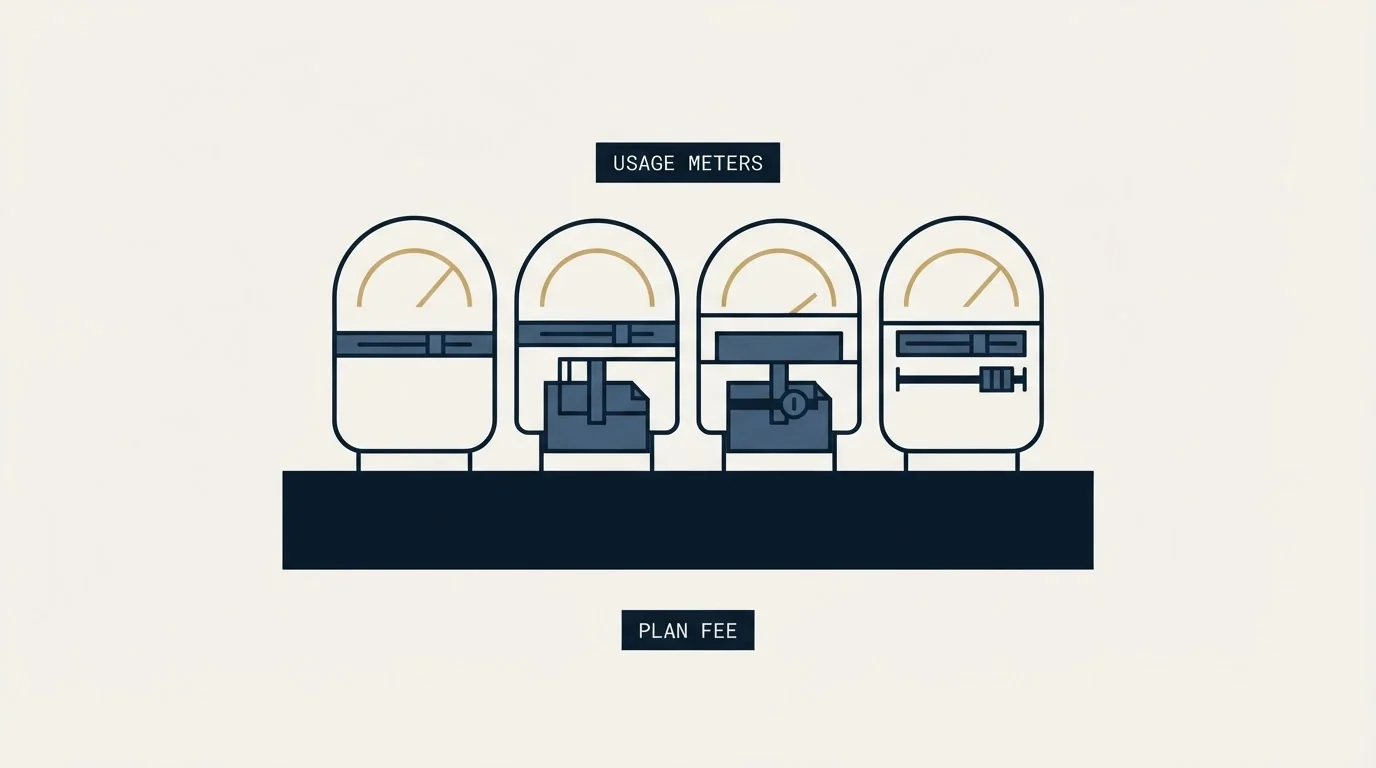
Every tier includes the same base allowance: 5 local numbers, 250 local minutes and 25 text messages. Form submissions and analysis minutes appear only on the tiers that carry those features, at 1,000 and 10,000 respectively.
Past those allowances the page publishes per-unit rates for numbers, local minutes, toll-free numbers, toll-free minutes, text messages, form submissions and transcription minutes. Four of those rates hold steady across every version of the page. CallRail prices an extra local number at "$3 ea." A toll-free number is published at "$5 ea." The same page charges "$0.08 ea." for a toll-free minute. A text message is published at "$0.03 ea."
The local-minute rate is the one that moves between versions of the page, and it is the rate most likely to matter, because minutes are the meter a busy month actually pushes. One version publishes it as "$0.06 ea." The other publishes the same unit at "$0.05 ea." according to its own comparison table. Which of the two you see is decided by which version you are served, not by anything you choose.
Three mechanics in CallRail's own FAQ decide how quickly those rates accumulate, and none of them is visible in the plan cards.
Minutes round up. The FAQ states that "Minutes are calculated by rounding each call up to the nearest minute and then summing the minutes". A business taking a hundred forty-second enquiries a month is billed for a hundred minutes, not for seventy. On a tracking product bought precisely because inbound calls are short and frequent, the rounding rule is a larger effect than the per-minute rate.
Overages are not refundable. The FAQ says the additional fees "are not refundable under any circumstances but you can always upgrade your pricing plan as your business grows". Whatever a bad month produces is spent.
Annual billing does not prepay usage. The FAQ separates the two: an annual customer pays the base fee for the coming twelve months up front, and "Additional usage for each previous month will be automatically billed to your form of payment on the same day each month". So the discount applies to the part of the bill you could already predict, and the part that varies still arrives monthly, in arrears.
- Step 1Base fee
The plan tier, charged for the coming period. Annual billing prepays this part and nothing else.
- Step 2Allowances
Numbers, local minutes, texts and, on the relevant tiers, form submissions and transcription minutes.
- Step 3Overage
Anything past the allowance, billed per unit, with each call rounded up to the nearest whole minute.
- Step 4Arrears
Usage from the previous month is invoiced on the same day each month, whichever billing term you chose.
The API is billed separately, and the pricing page never mentions it
This is the line item worth the price of reading the help centre. CallRail publishes API charge tiers in a support article last updated 29 July 2026, stating that it "will charge for monthly API usage based on the following tiers", and they appear nowhere on the pricing page fetched the same day.
The published tiers are Free at 0 to 1,500 API calls a month at no charge, Premium at 1,501 to 12,000 calls at $80 USD a month, and Platinum at 12,001 to 300,000 calls at $200 USD a month, as that page states them. Billing is retrospective, in its own example, "you will be billed in February for API activity in January", and the tier is not fixed: "You will be charged the appropriate tier based on your usage each month".
The boundary of what draws the charge is drawn carefully, and it is the useful part. Calls made through integrations CallRail built and lists in its own library do not count, and the article names Google, Meta and HubSpot as examples. Calls made with your own API key do count, and the article's example is connecting to Lawmatics. Custom calls added on top of a native integration also count, and the article's example is custom data pushed to Salesforce, while "The standard Salesforce API calls, however, will not."
Metered APIs reward the same arithmetic elsewhere, and dividing a search allowance into a per-thousand rate is the number the vendor's own page leaves out.
One capability gate sits in the same article. Using the API to export transcripts is available only on the Premium Conversation Intelligence plan, so a team that wants its transcripts in a warehouse is choosing a tier rather than choosing an integration. The same article is the reason the API question and the price question are one question, which is why the general shape of connecting a tracking tool to a CRM is worth settling before the plan is chosen rather than after.
- Yes: Which version of the pricing page you were shown, since the metered rates differ between them
- Yes: Whether your quote is the annual or the monthly rate, since only one set is rendered into the page
- Yes: Your expected monthly call minutes, rounded up per call rather than summed
- Yes: Whether anything in your stack will call the API outside a native integration
- Yes: Whether you need transcript export, which is gated to one tier
- No: Assuming the plan fee is the bill, when every tier says plus additional usage
The AI add-on, and a footnote that argues with itself

The page sells an AI Voice Assistant separately, under the heading "Turn missed calls into revenue". The page states that it "Starts at $95/month", and its footnote sets out two conditions: "All plans include Lead Tracking starting at an additional $55" and a per-call charge above a threshold.
That threshold is where the document contradicts itself again. In two of the three versions of the page the footnote reads "Additional $1/call after 50 Voice Assist calls over 15 seconds". In the third it reads "after 55 Voice Assist calls over 15 seconds". Same page, same fetch, same session.
Neither figure is large enough to change a purchase on its own. The reason to name it is that it is the second independent instance of the same pattern, and together they say something about how to read this page: it is under active experimentation, so a number quoted from it is a number quoted from one variant on one day. That is a good argument for putting any figure that matters into the order form rather than into a comparison spreadsheet.
Who this product is actually for

CallRail's own integration library, which invites you to "Put your marketing and conversation data to work" across other apps, sorts its connectors into categories including "Home services", Healthcare and Legal, and the named integrations there are field-service and practice platforms: Housecall Pro, Jobber, ServiceTitan. The pricing FAQ offers a business associate agreement for healthcare clients. Country coverage runs to the United States, Canada, the UK and Australia, with separate pricing pages for the last two, so a figure read from the US page is a US figure.
The centre of gravity is a local or multi-location services business, and the marketing agencies that run their advertising. That is the buyer the metered model is designed around, and it is why the numbers-and-minutes line matters so much: an agency running twenty client accounts is buying twenty allowances and paying per number past each one. If that is the shape of your business, the same arithmetic applies to what you charge for it, which is the question worked through in marketing agency pricing models.
The purchase is inbound attribution. It answers which advertising produced the phone call, and it produces analysis of calls that already happened. That is a genuinely different job from creating conversations that did not exist, and the two get confused at budget time because both arrive labelled as lead generation.
- Attributes an inbound call to the campaign that produced it
- Records, transcribes and scores the conversation
- Improves what you learn from the calls you already get
- Priced per number, per minute and per analysed minute
- Creates no conversation that was not already coming
- Cannot improve a channel that is producing nothing
- Reports a zero the same way whether demand or tracking is missing
- Bought most often in a quarter when the number is being missed
If the analysis half is what you are really buying, the tier names on this page are worth reading against the category rather than against each other, because what a recording layer can and cannot tell you applies to every product in it. The same is true of the attribution half: assigning a call to one campaign is a modelling choice with known failure modes, set out in the last-touch attribution model. For a comparable read of how a per-unit meter behaves once the add-ons are counted, Avoma's pricing is built on the same structure.
Where we differ from standard practice
RevenueFlow runs cold email and LinkedIn outbound. We do not run phone channels and we do not sell call tracking, so this page is an outside read of a product we do not operate.
One house position is worth stating because it bears on how any conversation tool gets used. We send one message per campaign, with no bumps and no thread replies. Meetings are qualified against criteria agreed in writing before launch. None of that is a criticism of a tracking product, which sits on a different side of the funnel entirely. It is the reason a supply problem and an attribution problem should be diagnosed separately: the tooling that measures conversations cannot manufacture them.
The short version
CallRail publishes real prices, which puts it ahead of most of the category. As published on its pricing page under the heading "Lead Engagement Plans" on 30 August 2026, the four plans are $50, $95, $150 and $195 a month, each including "5 numbers and 250 minutes" plus 25 texts, with the billing toggle defaulting to the yearly state and the monthly figures absent from the served document.
The plan fee is a floor, and every tier card on the page says so in three words: "plus additional usage". Numbers, minutes, texts, form submissions and transcription minutes are all metered past their allowances, every call rounds up to a whole minute, overages are non-refundable, and annual billing prepays only the base fee. The API carries its own published charge tiers of $80 and $200 a month above 1,500 calls, set out in a help-centre article rather than on the pricing page, and transcript export through it is gated to one plan.
Marketing automation is packaged the same way, and five meters sitting outside an Ontraport plan put the same distance between a card price and a bill.
And the page is being tested. Three versions of it ship in one fetched document, each carrying its own comparison table under the same "Lead Engagement Plans" heading, and they disagree on the per-minute rate and on an add-on threshold. Any figure taken from it belongs on a quote before it belongs in a budget.
If the problem you are pricing is that not enough conversations are happening rather than that the ones happening are poorly attributed, that is a different purchase. See what a campaign built on your ICP would produce.
Plan prices, allowances, metered rates, billing mechanics and API charge tiers verified against callrail.com/pricing and CallRail's help centre as of 30 August 2026, from snapshots fetched that day. The pricing page renders three experiment variants into one document and they disagree on two figures, both reported above. The page's own billing FAQ states that "we may change our fees at any time by posting a new pricing structure" to the site or the account. Verify current terms with the vendor before relying on them.
Sources: CallRail pricing, CallRail's API, help centre, CallRail integrations library
Frequently asked questions.
Frequently asked questions- How much does CallRail cost per month?
- CallRail's pricing page published four tiers on 30 August 2026: Lead Tracking at $50 a month, Lead Tracking Complete at $95, Lead Conversion at $150 and Lead Conversion Complete at $195. Each includes 5 local numbers, 250 local minutes and 25 texts. Every card adds plus additional usage, so those figures are a floor rather than a bill.
- What does CallRail charge for going over your minutes?
- The page publishes per-unit rates past each allowance: $3 for an extra local number, $5 for a toll-free number, $0.08 a toll-free minute and $0.03 a text. The local minute rate is shown as either $0.06 or $0.05 depending on which version of the page you are served. Overages are stated as non-refundable.
- Does CallRail charge for API access?
- Yes, and separately from the plan. A help-centre article updated 29 July 2026 sets three tiers: no charge to 1,500 API calls a month, $80 a month from 1,501 to 12,000, and $200 a month from 12,001 to 300,000. Calls made through CallRail's own native integrations do not count toward it, but custom calls added to them do.
- Is annual billing cheaper with CallRail?
- The page advertises saving up to 10 percent with a yearly plan, and its billing toggle opens in the yearly state. The discount applies to the base fee only. The billing FAQ states that an annual customer pays twelve months of base fee up front while additional usage is still billed monthly for the previous month.
About the author.

B2B cold email experts helping companies generate qualified leads through done-for-you outreach campaigns.
RevenueFlow Team
Explore more.
Ready to scale your outreach?
We build GTM engines that book real meetings. See the receipts.
Related articles.
Snitcher Pricing: The $49 Table Is the Annual Rate
Snitcher's visible price table is the annual-billing ladder. The ten bands at both billing states, the unique-company meter, and the rules on a help page.
What Cold Email and Sales Tools Actually Cost in 2026: Pricing Data From 386 Vendors
RevenueFlow's verified dataset of 386 sales tools puts the median starting price at $39.98 a month. Here is the spread by category, tier and billing model.
TexAu Pricing: Four Tiers, Billed Only on a Match
TexAu charges credits only when a lookup succeeds. The four tiers at both billing states, the rollover cap, and three places the page disagrees with itself.
Autobound Pricing: One-Time Credit Packs, Not Seats
Autobound's pricing page sells one-time credit packs for a signal data API, not seats. The six packs, the per-endpoint meter, and what a company costs.
Twain Pricing: Credits per Lead, Three Research Modes
Twain sells credits, not seats, and a lead costs 1 to 14 of them depending on the research mode. The two ladders, the four expiry clocks and the cap.
Lavender Pricing: Two Products, No Pricing Page
Lavender has no pricing page. The Email Coach ladder per seat at both billing states, the free routes, and the separate per-agent price for Ora.