Marketing Agency Pricing Models: Retainer to Performance
Five pricing models are in common use and each one fails in a specific way. The structure decides who is out of pocket when the work turns out to be harder than expected.
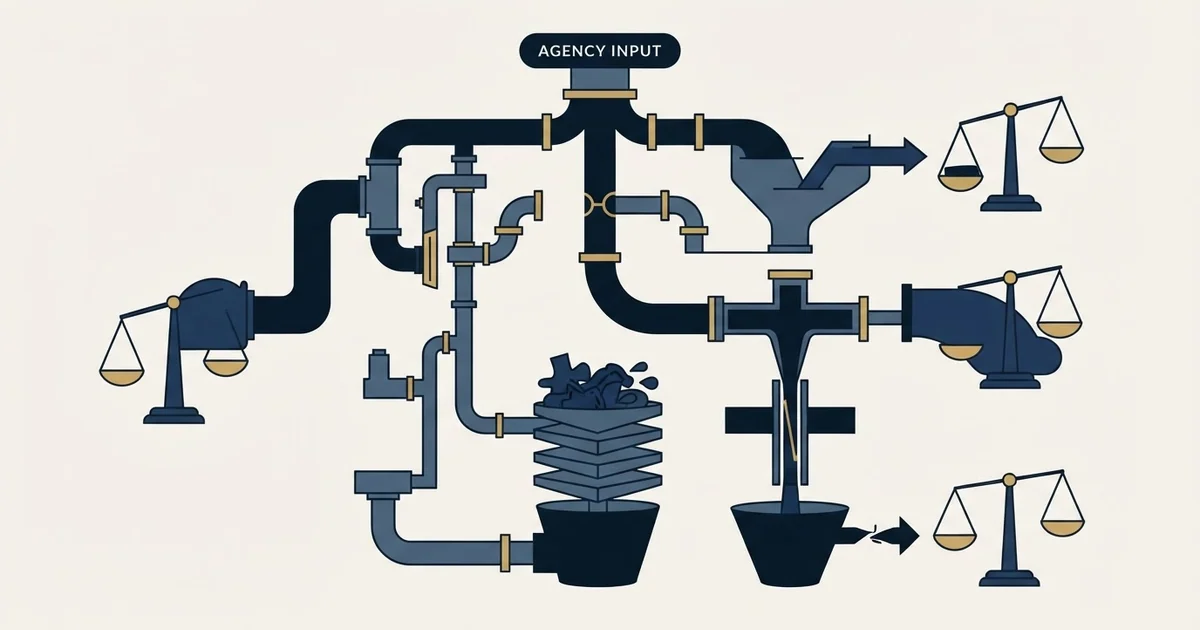
Marketing agencies, web development agencies included, price in five models: monthly retainer, project fee, hourly rate, percentage of media spend and outcome pricing. A site build is usually a project fee and the ongoing work a retainer. Each model fails in a specific way, so compare who carries the risk, not the number.
Key takeaways
- Five models are in common use: monthly retainer, project or fixed fee, hourly or day rate, percentage of media spend, and outcome pricing, plus hybrids of them.
- Web work splits at the finish line: a build prices as a project, and what follows launch moves to a retainer for a defined scope.
- Quotes compare only in the same unit, and a four-week billing cycle bills thirteen times a year, about 8% more than the same figure monthly.
- Outcome pricing moves delivery risk to the agency but depends entirely on a written definition of the outcome and who adjudicates a dispute.
Reviewed and updated September 19, 2026
Web development agencies use the same pricing models as the rest of marketing, and the monthly retainer is only one of them: a site build is usually a fixed project fee, and the ongoing work after launch (maintenance, conversion work, content) moves to a monthly retainer for a defined scope. Five models are in common use, and each fails in a specific way, so the structure matters more than the headline number.
Send the same brief to three marketing agencies and you will often get three quotes that cannot be compared. One arrives as a monthly retainer, one as a fixed project fee, one as a percentage of the media budget you have not decided on yet. The numbers look like the point. The structure is the point, because the structure decides who absorbs it when the work takes twice as long as anyone expected.
There are five pricing models in common use, plus hybrids of them. Each one is a reasonable answer to a real problem, and each one fails in a specific and predictable way. Knowing which failure you are buying is most of the skill in this purchase.
A disclosure, since it shapes what follows. RevenueFlow is an agency, and we are paid on attended qualified meetings, which is the performance model described below. We have tried to state the weaknesses of that model as plainly as the others, because a buyer who only hears its strengths is being sold to rather than informed.
Web Development Agency Pricing Models: Project Fee, Then a Monthly Retainer
The split in web work follows the finish line. A build has one, so it prices well as a project: a specified scope, a fixed fee, and the scope document doing the work that trust cannot. What follows a launch does not, so it moves to a monthly retainer, and the useful test of that retainer is the one for any other: whether the invoice alone shows what changed between a good month and a bad one.
B2B content agencies price their monthly retainers the same way, by a defined output (a number of articles, assets or hours a month) or by an allocation of named people, and the difference matters. An output retainer tells you what arrives; an allocation retainer tells you who is working and leaves the output to be argued about.
Conversion-rate agencies are the one discipline where all three structures are common. A retainer buys a testing programme, a project buys an audit, and a performance deal ties the fee to a lift in a named metric, which only works if the metric, the baseline and the test method are written down before the first test runs.
The five models
Monthly retainer. A fixed fee buys a defined scope, or an agreed allocation of a team, every month. It is the default in this industry for good reasons: revenue is predictable on both sides, the agency can staff properly, and the relationship survives a slow month without a renegotiation. It fails when scope is loose. A retainer with a vague deliverable list quietly becomes a subscription to availability, and the honest test is whether you could tell, from the invoice alone, what changed between a good month and a bad one.
Project or fixed fee. A defined piece of work for a defined price. Excellent for anything with a real finish line, such as a website, a campaign build, a brand refresh. It fails on anything continuous, and it creates a hard incentive at the margin: once the fee is fixed, every additional hour is the agency's loss, so scope discipline becomes the whole relationship. That is not a failing of the agency, it is arithmetic, and the fix is a properly specified scope rather than trust.
Hourly or day rate. Time billed as spent. The most transparent model on paper and the one that ages worst. It prices input, so it rewards slow work and penalises the agency that has done this eighty times and can do it in a morning. Most agencies have moved away from it for exactly that reason, and buyers who insist on it often end up paying a padded estimate instead of a rate.
Percentage of media spend. The fee is a share of the advertising budget being managed, common in paid media. It scales naturally with the size of the account and requires no renegotiation as spend grows, which is genuinely convenient. Its weakness is stated in its own definition: the agency earns more when you spend more, and the moment the right advice is to spend less, the model is arguing against the advice. Good agencies manage that tension openly. It is still there.
Performance or outcome-based. The fee is tied to a defined result: a qualified meeting, a lead, a booked demo, sometimes a share of revenue. It moves delivery risk onto the agency, which is the point. It fails in one specific place, and it is worth being blunt about it since it is our own model: everything depends on the written definition of the outcome. A performance deal with a loose definition is worse than a retainer, because now both parties have a financial stake in interpreting an ambiguous sentence in their own favour.
Hybrids are the norm, not the exception

Most real agreements combine two of these, and the combinations are usually where the interesting terms live. A one-time setup fee followed by a monthly retainer is a hybrid. A base retainer plus a per-outcome bonus is a hybrid. A tiered subscription where the tier is set by output volume is a retainer wearing a performance costume, since the volume is a capacity commitment rather than a result.
The published pricing pages of B2B lead generation agencies show the pattern clearly, and they are worth reading even if you are buying a different service, because they are among the few agencies in any discipline that publish figures at all. CIENCE publishes a one-time setup fee of $5,000, two recurring line items ($2,000 a month for a strategic team and $499 a month for its graph8 platform) and SDR capacity quoted separately, which is three models stacked in one quote. Belkins publishes a starter configuration from $5,000 with 100 guaranteed appointments a year on its appointment setting page, which is a retainer carrying an output commitment. Callbox publishes a monthly band per unit of service, an estimated $15,000 to $30,000 a month for one campaign pod, with a pod defined as a dedicated outreach unit for one market segment or persona.
Read three of those side by side and the useful realisation arrives quickly: the number is downstream of the unit. Per month, per project, per pod, per SDR, per appointment and per percentage point are six different things, and a quote is only comparable to another quote once both have been converted into the same unit.
The unit does the same work in software pricing, where Mouseflow meters sessions rather than visitors, which decides more than the cost does.
The billing period is part of the price
One mechanical trap catches people every year. Some agencies bill per four weeks rather than per calendar month. Four-week periods make thirteen billing cycles in a year rather than twelve, so an apparently identical monthly figure is about eight percent more expensive over twelve months. It is not a trick, it is just a different unit, and it is invisible unless you check. We have worked the arithmetic through with real published figures in outsourced SDR pricing and B2B appointment setting.
Contract length hides a similar effect. A twelve-month commitment at a lower monthly rate and a rolling monthly agreement at a higher one are not really the same purchase at a discount. You are buying an option in the second case and selling one in the first, and the right choice depends on how confident you are that this will work, which in a first engagement is usually less confident than the pitch implies. A shorter term costs more per month and is often worth it, because the expensive outcome in this market is not paying a slightly higher rate. It is spending nine further months proving something you already suspected in month three.
The same care applies to what the fee does and does not include. Software licences, data, sending infrastructure and media budget sit inside the fee at some agencies and outside it at others. A quote that excludes tooling will always look cheaper than one that includes it, and the comparison is meaningless until both are on the same side of the line.
Where we differ from standard practice

Much of the advice on this page reflects how outbound is commonly run. We run it differently, and since this page sits on our site it is worth saying where the difference is and what it costs us.
Standard practice: a sequence
- A sequence of messages to each prospect over several weeks
- Later messages often land in the same email thread
- Every contact is reached more than once, so a distracted reader gets another chance
- The later messages go only to people who did not answer the first
- Reputation cost accrues on the sending domain across everything else it sends
What we do: one message per campaign
- One message, then that campaign is finished for that contact
- No thread replies and no bumps
- A non-responding audience becomes a new campaign with a genuinely different premise, not a reminder
- More of the work moves into targeting and into the one message
- We reach each contact less often, and that is the cost we accept
The reasoning is mechanical rather than moral. A follow-up arrives underneath a message the recipient has already seen and chosen not to answer, so it is delivered to the population most likely to mark it as spam, and the reputation cost of that lands on the sending domain across every campaign running on it. We set that cost against the replies a sequence recovers and decided the trade was not worth it. The full argument, with the numbers from our own campaigns, is in why we stopped using follow-ups.
That is relevant to pricing rather than a detour from it. Outbound retainers are frequently metered in activity units, and an activity unit is a pricing decision that carries a practice inside it. If a quote is denominated in something the agency controls entirely, the agency can always hit the number, and you are paying for compliance with a spreadsheet. Prefer units that require the market to agree: a reply, a booked meeting, an attended one.
Choosing, in practice
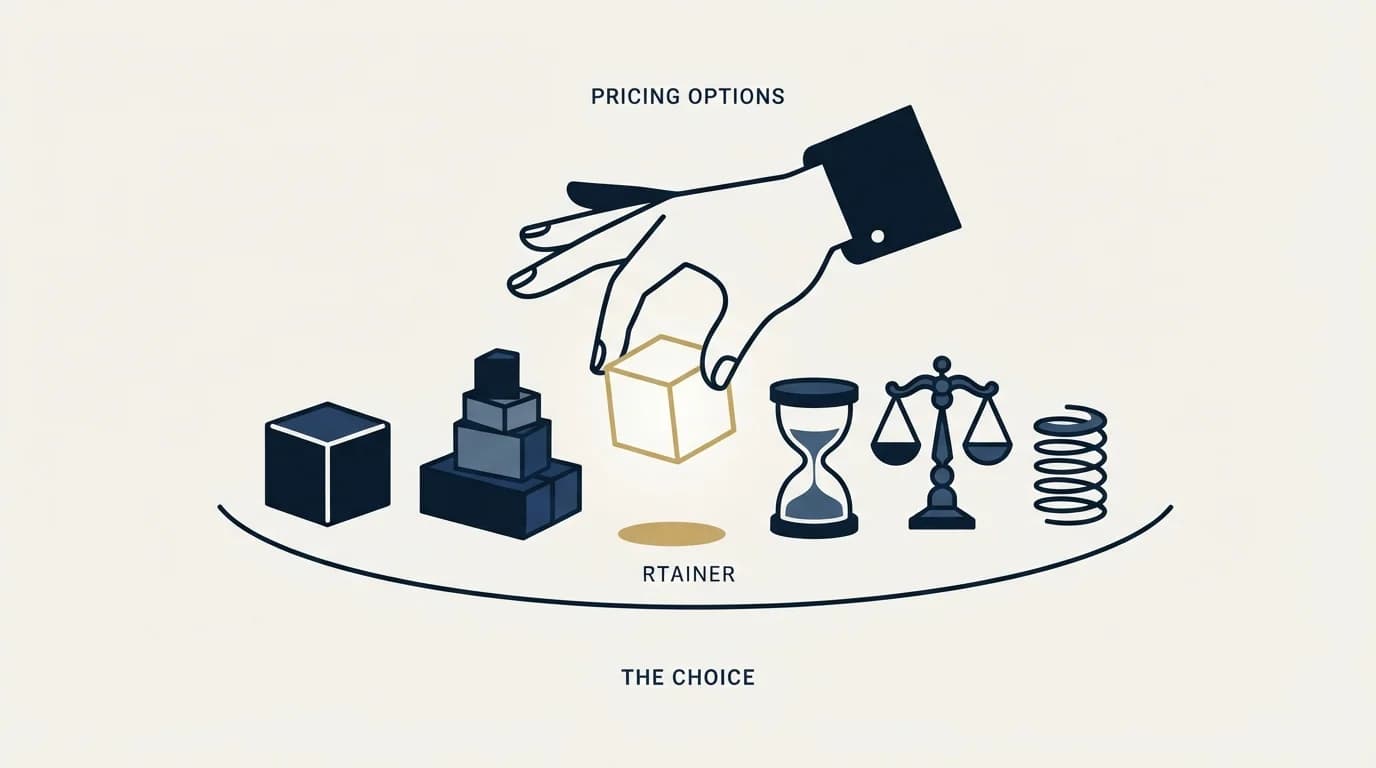
The right model depends less on your budget than on two things: how well the outcome can be defined, and how much variance you can absorb.
If the outcome is crisply definable, performance or outcome pricing puts the risk where it belongs and is worth paying a premium for. If it genuinely is not definable, which is common for brand, content and creative work, a retainer with a specified deliverable list is the honest answer, and dressing it up as performance pricing against a proxy metric usually makes things worse. If the work has a real end, use a project fee. If you are buying paid media management and the percentage model bothers you, ask for a flat fee at your current spend level and see what happens to the quote.
| Settle | Why it matters |
|---|---|
| The unit of the price | Quotes compare only in the same unit |
| Calendar month or four weeks | Thirteen invoices a year, not twelve |
| Tools, data and media | Inside the fee at some agencies, outside at others |
| The written outcome definition | And who adjudicates a disputed one |
| Month one | Costs incurred before anything is produced |
| Avoid: a one-sentence outcome | Both sides then profit from reading it their way |
Two specialised cases have their own economics and their own pages. If you are buying social media management, the rate cards and the variables that move a quote are covered in social media marketing agency pricing. If you are an agency reselling another agency's delivery, or buying from one that does, the stacked margin changes the arithmetic completely, and that is set out in white label marketing agency pricing.
The last thing worth saying is the least commercial. The pricing model is not what makes an engagement work. A clear scope, a named accountable person on each side and an agreed definition of success will rescue an imperfect commercial structure, and no structure survives their absence. Get those three right, then pick the model that puts the risk on whoever is better placed to manage it. Our own terms, and the definition we are held to, are on the free campaign page.
Frequently asked questions.
Frequently asked questions- How do web development agencies price their work?
- Mostly in two models. A site build has a finish line, so it is usually a fixed project fee against a specified scope. The work after launch, such as maintenance, conversion testing and content, moves to a monthly retainer for a defined scope or a named team. Check that the retainer's invoice shows what changed month to month.
- How do B2B content agencies price monthly retainers?
- By a defined output, such as a number of articles, assets or hours a month, or by an allocation of named people. An output retainer tells you what arrives each month; an allocation retainer tells you who is working and leaves the output open to argument. Ask which one the quote is before comparing prices.
- Retainer, project or performance pricing for a CRO agency?
- All three are common. A retainer buys an ongoing testing programme, a project buys an audit or a defined set of tests, and performance pricing ties the fee to a lift in a named metric. The performance version only works if the metric, the baseline and the test method are written down before the first test runs.
- Why do agency quotes look similar but cost different amounts?
- Because the unit differs. Per month, per project, per pod, per SDR, per appointment and per percentage point of media spend are different things, and some agencies bill every four weeks, thirteen times a year. Tools, data and media budget also sit inside some fees and outside others. Convert every quote to one unit first.
About the author.

B2B cold email experts helping companies generate qualified leads through done-for-you outreach campaigns.
RevenueFlow Team
Explore more.
Ready to scale your outreach?
We build GTM engines that book real meetings. See the receipts.
Related articles.
Win Rate Benchmarks: Which Figures State a Population
A catalogue of the published average sales win rates, sorted by whether the page names the population behind its own number. Most do not.
Sales Kickoff Agendas: Five Published, Session by Session
Five publishers print a sales kickoff agenda. They agree on four blocks and disagree on session length, rehearsal and where the agenda comes from.
Sales Cycle Length Benchmarks: What Each Figure Counts
The published B2B sales cycle benchmarks, sorted by what each page says it counted. The same number means two different things in two of them.
Sales Enablement Charters: What the Published Ones Ask For
Six publishers set out what a sales enablement charter should contain. Five describe a document nobody can check, and one writes a definition with inspection in it.
Sales Comp Plan Design: What the Publishers Prescribe
Four publishers set out how to design a sales compensation plan. Here are their procedures, their components, and which of their ratios carry a population.
B2B Lead Lists for Aviation Companies: Build or Buy
Aviation is one of the few industries whose accounts are published by its regulator, which changes what is worth buying and what is worth downloading yourself.