B2B Appointment Setting: What a Good Meeting Costs
How B2B appointment setting runs end to end, where each stage fails, and how to derive a defensible cost per attended meeting from any quoted monthly fee.
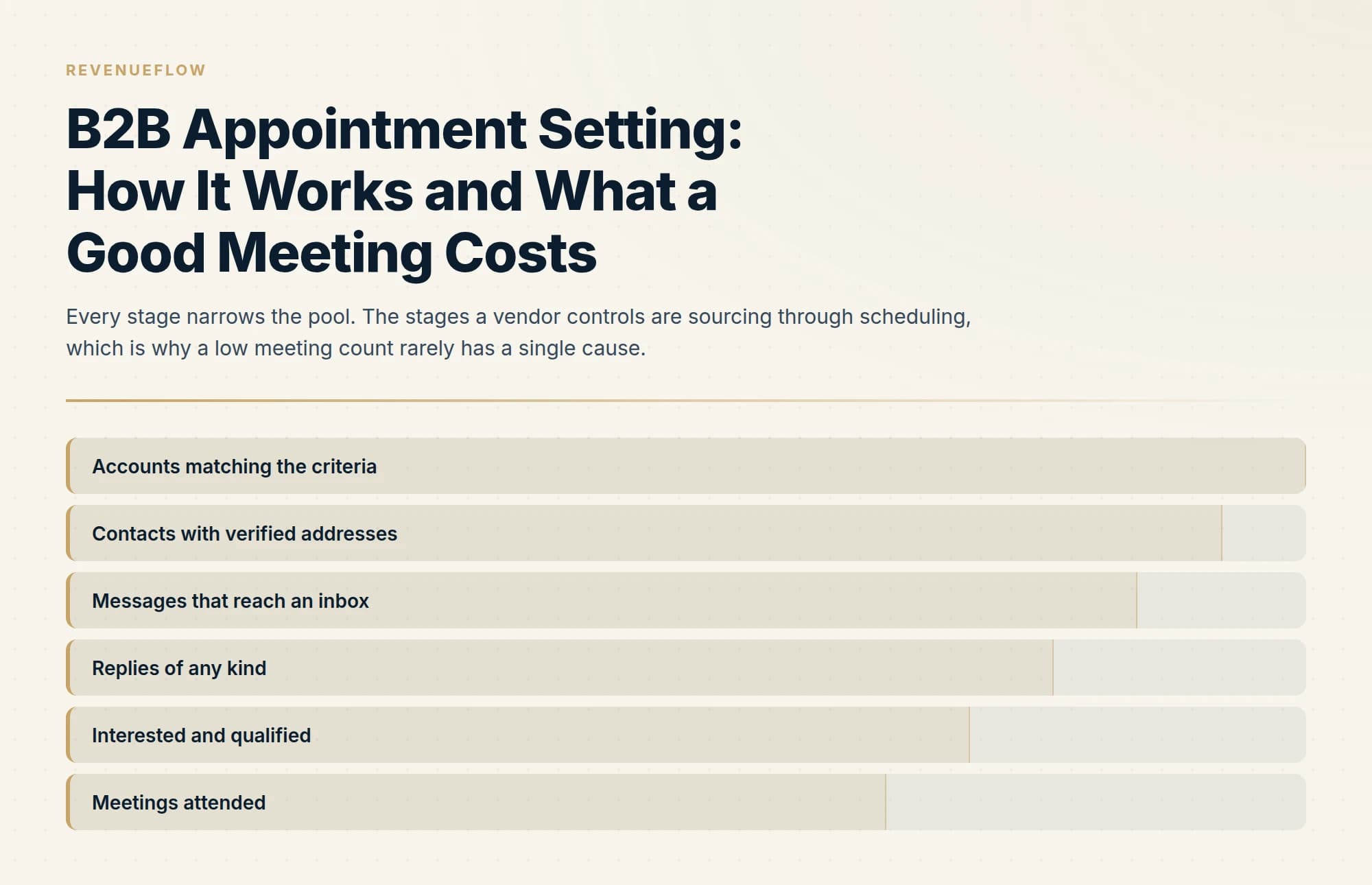
B2B appointment setting is eight stages from target definition to the closer's brief, and reply handling is where the labour sits. To price it, annualise the quote with the billing unit checked, divide by any committed output, then adjust for the gap between a booked appointment and an attended meeting with the right person.
Key takeaways
- A four-week billing cycle is thirteen invoices a year, so SalesRoads' $11,950 base price per 4-week period comes to $155,350 a year.
- Belkins lists an average starter price from $5,000 with 100 guaranteed appointments a year; read as monthly, that is $600 per guaranteed appointment, a floor.
- Pay per appointment moves risk to the vendor only as far as its definition of an appointment reaches: booked, attended, or attended and qualified.
- Reply handling and qualification are the human stages; sourcing, verification, infrastructure and sending are machine work.
Reviewed and updated September 21, 2026
A B2B appointment setting quote usually arrives in one of two shapes: a monthly number with a promised count of meetings, or a pay per appointment price with no retainer at all. Sitting behind either one is a chain of eight distinct pieces of work, each with its own failure mode, and almost all of it is invisible from outside the engagement. When the meeting count comes in low, the question you need to answer is which link broke, and you cannot answer it without knowing what the links are.
So here is the whole machine, stage by stage, followed by the only defensible way to turn a monthly fee into a cost per meeting.
B2B appointment setting is the work of finding companies that match agreed criteria, reaching the right person inside them, qualifying the interest that comes back, and putting a meeting on a calendar somebody else will run.
The chain, end to end
Buyers asking about the process from targeting to booking meetings are asking what happens between campaign setup and a calendar invite, and the eight stages below are that answer in order.
Criteria as ranges, buyer titles, and the accounts that must never be contacted.
Source contacts against the criteria, then check the mailboxes exist.
Separate domains, authenticated mailboxes, warmed before real volume.
Paced against per-mailbox capacity, not against the meeting target.
Sort interest from noise, then check it against the written criteria.
Hold the slot, cut no-shows, and brief whoever takes the call.
Stage 1: ICP and target definition
Everything downstream inherits this. Write the criteria as things a stranger can check: employee count ranges, revenue bands, named industries, geographies and buyer titles. Adjectives like "mid-market" and "growing" feel like agreement at kickoff and become an argument in month three.
For an ERP vendor or implementation partner the checkable criteria are the tier the vendor serves, a published lifecycle date and no channel partner on the account, worked through in appointment setting for ERP vendors.
The other half of this stage is exclusions. Existing customers, live opportunities, current vendors, partners, competitors, and any account your team is already working. That list has to be loaded before anything sends. Applying it as a review step afterwards is not a control, because by then the message has gone out.
Assembling those exclusion lists from scattered systems is a data problem, and a warehouse-native customer data platform keeps the records in your own warehouse rather than a vendor's.
What goes wrong: criteria written as adjectives, and a suppression list that arrives in week four.
Stage 2: contact sourcing and verification
Once the criteria exist, someone has to find real people who match them and real addresses that reach those people. Contact databases decay continuously as people change jobs, so a record that was correct last year may not be now.
Verification separates a competent operation from an expensive one. Every address is checked before use, and the ones that do not resolve are dropped. Accept-all domains return an ambiguous verdict, so those addresses need a separate decision rather than being treated as valid. Email verification tools differ in what their checks actually test, so ask which one the vendor uses.
What goes wrong: sending to an unverified list. Bounces damage the sending reputation that stages 3 and 4 depend on, and the damage outlasts the campaign that caused it.
Stage 3: sending infrastructure and warmup
Outbound does not send from your primary domain. It sends from separate domains bought for the purpose, each carrying its own mailboxes, its own authentication records, and its own reputation. That keeps an outbound reputation problem away from the domain your invoices come from.
New mailboxes are warmed first with small quantities of mail that gets opened and replied to, building the sending history receiving servers use to place your mail. That takes weeks and cannot be bought faster. Authentication has to be in place across every sending domain, and it has to be monitored rather than configured once. The cold email deliverability guide covers the maintenance side of this, which is continuous.
What goes wrong: real volume on cold mailboxes in week one. It produces early activity numbers that look encouraging and a domain that never recovers.
Stage 4: outreach
The send itself is the simplest stage and the one buyers focus on most. Volume is capped by how much each mailbox can carry safely, which means the way to send more is more mailboxes, not more messages per mailbox. A vendor promising a step change in volume without a matching step change in inbox count is proposing to spend your reputation.
Vendors differ on whether they follow up. A second message lands underneath the first one in the same thread, directly beneath the message the prospect already saw and chose not to answer. On LinkedIn that is unavoidable by construction, since every message sits in one conversation. We send one message per campaign.
What goes wrong: treating volume as the lever when the reply rate is the problem. More sends against a message that is not working produces more of nothing, at a cost to the domain.
Stage 5: reply handling and qualification
This is where most of the labour and nearly all of the skill sits, and it is the stage that separates appointment setting from list supply. We drew that boundary in detail in appointment setting versus lead generation.
This is also the honest answer to whether appointment setting is done by technology or by people, which is the question most buyers are really asking. The stages above divide cleanly. Sourcing, verification, infrastructure and sending are machine work, and a vendor doing them by hand is charging you for inefficiency. Reply handling, qualification and the judgement about whether a specific conversation is worth a closer's calendar are human work, and a vendor automating them is selling you volume rather than meetings. A proposal that will not say which side of that line each stage sits on is describing a process it has not decided yet.
Replies do not arrive as yes or no. They arrive as autoresponders, as referrals to a colleague, as requests to come back later, as questions to answer before anyone commits to a call, as replies from a different address, and as clear negatives that must suppress the whole account at once. Somebody has to read each one and judge it.
Qualification is the judgement call that follows. An interested person is not automatically a qualified meeting. They are checked against the criteria written in stage 1, and someone decides whether this specific conversation is worth a slot on a closer's calendar.
What goes wrong: slow replies and loose qualification. Response speed is a large, controllable factor in whether an interested person converts into a held meeting, and loose qualification inflates the count while degrading every number downstream of it.
An appointment setting campaign run in house is these same eight stages with the labour on your own side of the line, and this is still the stage that decides the meeting count rather than the one that sends.
Stage 6: scheduling
Getting agreement is not getting a meeting. Someone has to convert a yes into a specific slot, across time zones, against a calendar they cannot see. A booking link puts the work on the prospect; two proposed times fail when neither fits.
One shortcut belongs in this stage and we do not use it. A cold calendar invite, meaning a meeting placed directly into a prospect's calendar before they have agreed to anything, removes the scheduling step by removing the agreement it depends on. Some calendar systems add an unanswered invitation to the diary by default, so the recipient finds a meeting they never accepted and has to clear it. It also breaks the stage boundary above, since a slot held by somebody who never said yes is not a booked meeting and will not be a held one. Where a vendor's booking numbers look unusually strong for the volume, this is one of the mechanisms worth asking about.
What goes wrong: delay. Every hour between agreement and confirmed slot loses some of them.
Stage 7: no-show recovery
Some booked meetings do not happen. That is a fact of the category rather than a defect, and the useful question is what the vendor does about it. Reminders before the call, a same-day nudge, and a rebooking attempt afterwards all change the outcome. Whether a no-show is rebooked, credited, or billed is a contractual question, and every vendor should have an answer to it.
What goes wrong: nobody owning the gap between booked and attended, so the vendor reports bookings and you experience attendance.
Stage 8: handoff to the closer
The last stage is a briefing. Whoever takes the call needs to know what the prospect actually said, which message they replied to, which criteria were checked and how, and anything the setter promised on the way to the booking. A meeting with no context wastes the first minutes and sometimes the whole call.
What goes wrong: no brief, or a brief that overstates the prospect's intent so the closer walks in expecting a buying conversation.
Run in house the last two stages are called the SDR to AE handoff, and they fail in exactly the same two places: the gap between booked and attended belongs to whoever owns stage seven, and the brief the closer reads is stage eight whatever the job titles on either side of it are.
That handoff is also the boundary of what an appointment setting engagement covers, and it answers the two scope questions buyers ask before signing one: who handles the objections that arrive in the reply thread before any meeting exists, which is stage 5 and belongs to the setter, and whether the provider will move deals through the rest of the cycle, which it does not, because the closer carries it from the handoff onward.
Where the volume goes
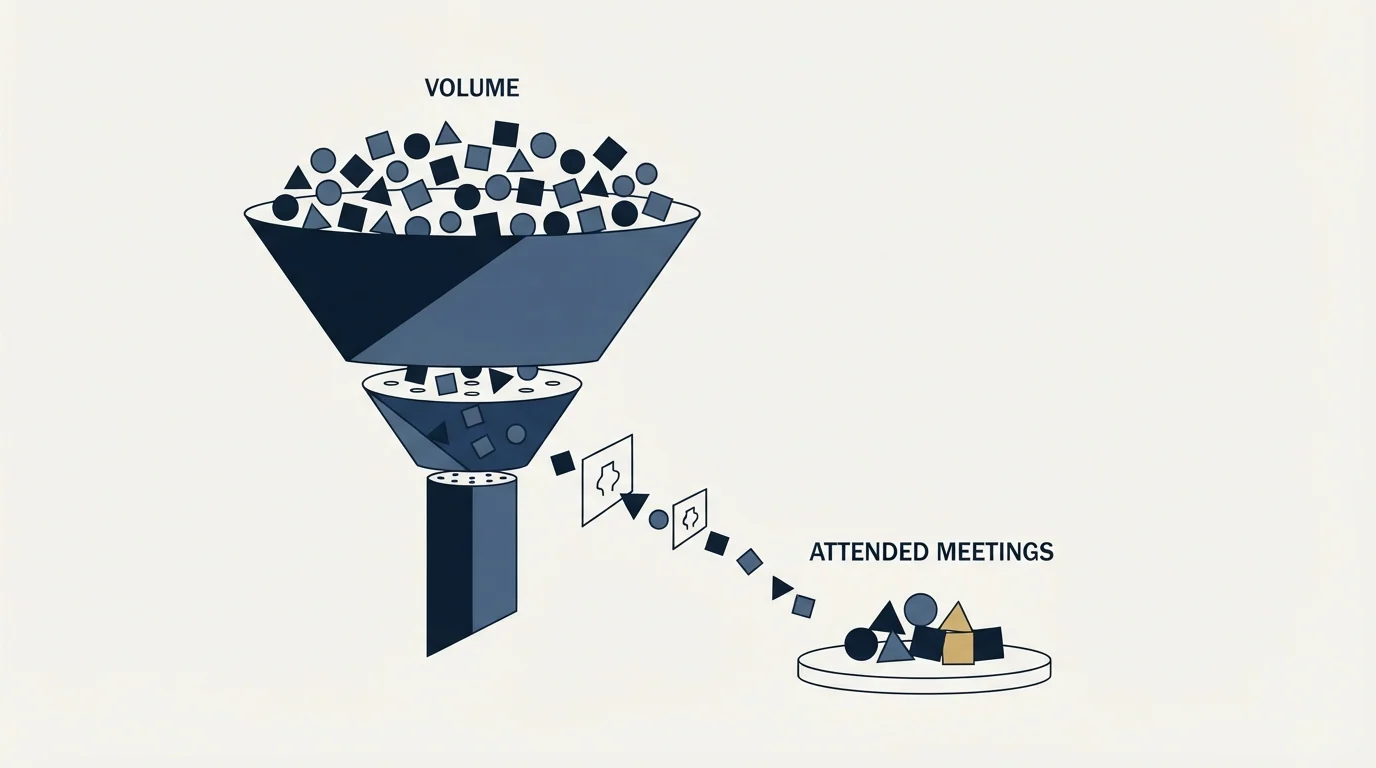
When a buyer asks what the approach to getting those meetings booked actually was, the eight stages above are the whole answer, and the stage that surprises people is reply handling rather than sending.
B2B appointment setting: pay per appointment or a monthly retainer?
Pay per appointment moves the risk of a quiet month from the buyer to the vendor, but only as far as the definition of an appointment reaches. A booked slot, an attended call and an attended call with somebody matching your written criteria are three different units, and a per-appointment price is only comparable to a retainer once you know which one it pays for. A monthly retainer buys the work whatever it produces, so the arithmetic below is what turns it into a unit price. Ask for the definition in writing before comparing any two quotes.
What a meeting actually costs
This is the arithmetic to run when a competitor offers guaranteed meetings and upfront pricing, which reads as the safer purchase and frequently is not. A guarantee is only as strong as the definition of the unit being guaranteed, so convert the commitment to a cost per attended qualified meeting first and compare the definitions second.

A monthly fee is not a price per meeting, and converting one to the other takes three steps.
Step one: annualise, and check the billing unit. Some vendors quote per calendar month and some per four weeks. A four-week cycle is thirteen billing periods a year rather than twelve, so reading a four-week price as though it were a monthly one understates the annual cost by about eight percent. SalesRoads publishes a base price of $11,950 per 4-week period, which is $155,350 a year, or about $12,946 a month in annual terms.
Step two: find the denominator. This is the committed output, and only some vendors publish one. Belkins publishes an average starter price "from $5,000" beside 1,500 leads a month and 100 guaranteed appointments a year; the price itself names no period, but its enquiry form asks for a monthly budget from $5,000, and read as monthly the annual figure is $60,000 and the arithmetic is available. SalesRoads' pricing page states no guaranteed meeting count, so at signing there is no denominator at all.
Step three: adjust for the gap between the guaranteed unit and the unit you care about.
| Belkins starter | SalesRoads | |
|---|---|---|
| Published price | From $5,000, read as monthly | $11,950 per 4-week period |
| A year | 12 x $5,000 = $60,000 | 13 x $11,950 = $155,350 |
| Committed output | 100 guaranteed appointments a year | None stated |
| Per unit | $600 per guaranteed appointment, a floor | Cannot be computed at signing |
| Terms | Includes booking and no-show recovery | No long-term commitment, cancel anytime |
The $600 figure is arithmetic on published numbers, and it is not the same thing as a cost per attended qualified meeting. Three adjustments stand between them.
A guaranteed appointment is whatever the contract says an appointment is. If the definition counts a booking rather than an attendance, no-shows come out of your side of the ledger, and the real cost per attended meeting is the $600 divided by your show rate. If the definition does not require the attendee to match your buyer criteria, some of the hundred will not be meetings you wanted.
The published number is a floor. "From $5,000" describes an entry configuration, and the configuration matching your actual market, geography and volume is quoted separately.
Your own cost belongs in the total: a closer's hour and its preparation scale with meeting count, not with the retainer. A cheaper meeting that is worse qualified is not cheaper.
Where a vendor publishes no committed output, the honest entry is unknown, not an estimate borrowed from a case study, which is a selected result. For what each of the better-known vendors actually publishes, we went through the pricing pages in appointment setting companies, and the terms to score them on are in how to compare B2B appointment setting companies.
If the comparison you are actually running is against hiring rather than against another vendor, the fully loaded arithmetic is in outsourced appointment setting versus in-house.
The short version
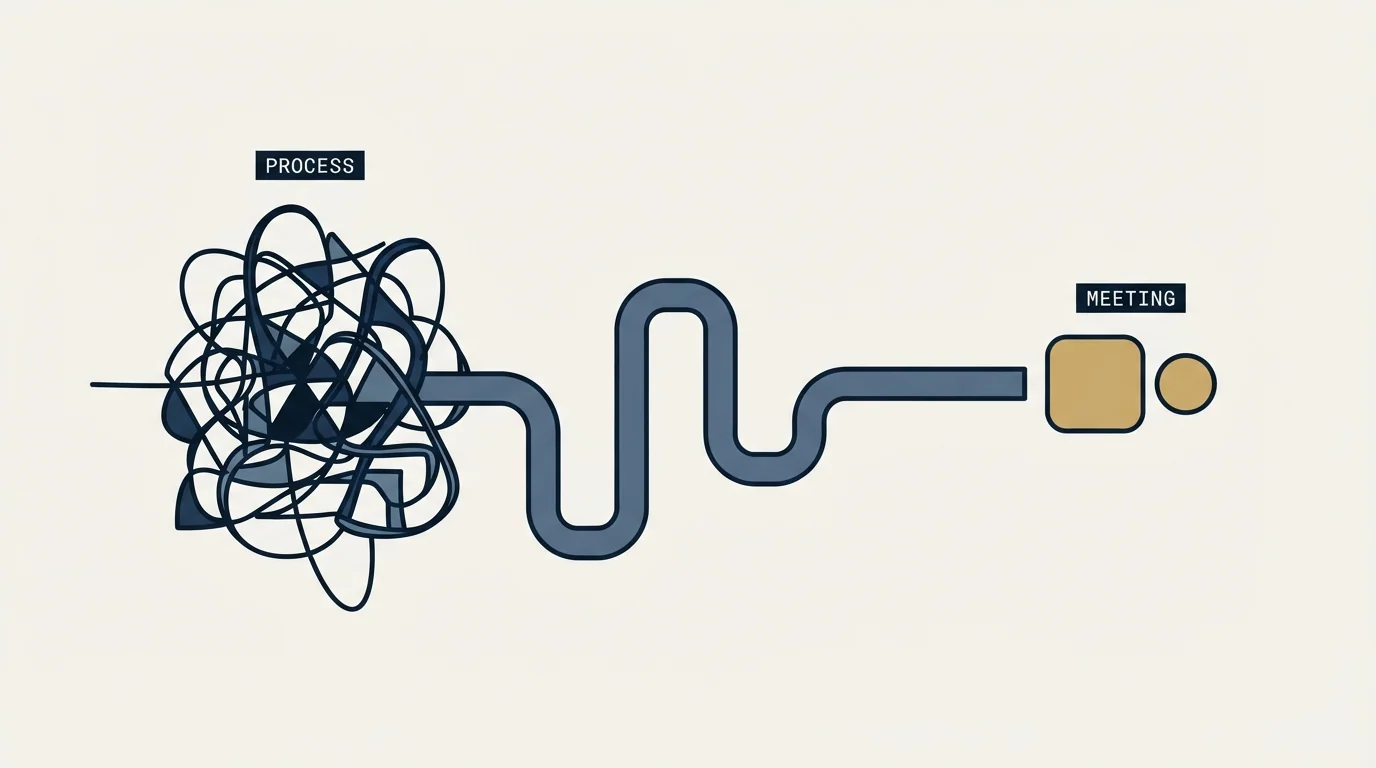
Appointment setting is eight stages: define the target, build and verify the list, prepare and warm the sending infrastructure, send, handle replies and qualify, schedule, recover no-shows, and brief the closer. Reply handling is where the labour concentrates, and infrastructure is where the irreversible damage happens. To price it, annualise the quote with the billing unit checked, divide by the committed output where one is published, and then adjust for the distance between the vendor's definition of an appointment and an attended meeting with the right person.
RevenueFlow has no retainer and no setup fee: clients pay only for qualified meetings booked and actually attended, against a definition agreed in writing before work starts, which removes the third adjustment from the arithmetic. You can see what a campaign would look like for your market.
Vendor pricing read from the vendors' own pages. Terms change; confirm current pricing directly before contracting.
Frequently asked questions.
Frequently asked questions- What is pay per appointment in B2B appointment setting?
- It is a pricing model where the buyer pays for each appointment delivered instead of a monthly retainer. Its value depends on the definition: a booked slot, an attended call, or an attended call with someone matching criteria agreed in writing. Compare quotes only after getting that definition in writing, because the three units carry very different costs.
- How much does B2B appointment setting cost?
- Published prices vary by model. SalesRoads lists a base price of $11,950 per 4-week period, which is $155,350 a year across thirteen periods. Belkins lists an average starter price from $5,000 with 100 guaranteed appointments a year. Most vendors quote a custom configuration, so treat a published figure as a floor.
- Is appointment setting done by technology or by people?
- Both, and the split is clean. Sourcing, verification, sending infrastructure and the send itself are machine work. Reading replies, qualifying interest against written criteria and deciding whether a conversation deserves a closer's calendar are human work. A vendor that cannot say which side of that line each stage sits on has not decided its process.
- Why do booked meetings not turn into held meetings?
- Some no-shows are normal in any programme. The gap narrows with reminders before the call, a same-day nudge and a rebooking attempt afterwards, and with qualification that checks each person against written criteria before a slot is offered. Ask every vendor whether a no-show is rebooked, credited or billed, because the contract decides who pays for it.
About the author.

Ben Carden is CRO at RevenueFlow, which builds and operates outbound revenue engines for B2B companies. Previously at Gartner Enterprise. Studied at London School of Economics.
Ben Carden · CRO
Connect on LinkedIn →Explore more.
Ready to scale your outreach?
We build GTM engines that book real meetings. See the receipts.
Related articles.
5 ABM Campaign Examples and How Each One Is Built
Five worked account-based campaign examples, each built on the same five fields: account set, tier, plays in order, owner and handoff, and the exit condition.
Two Agencies, One Target List: Who Owns Which Accounts
Two outbound suppliers on one market will contact the same companies unless the buyer splits it first. How to cut the list, run the exclusion feed and check the overlap.
Last Outbound Agency Did Not Deliver: Locating the Failure
The leads were bad names a symptom and no stage. Four places an outbound engagement fails, the counts that separate them, and what to change in the next purchase.
IT Lead Generation: The Buyer Runs Your Playbook
Technology buyers evaluate outbound for a living, and their purchases carry a security review nobody in your meeting owns. Which triggers are real.
HR Lead Generation: The Renewal Clock and Who Signs
An HR buyer who agrees with every word still cannot act outside their own renewal window. Which triggers are observable, and who signs.
When Outbound Stops Scaling: What Breaks First
Doubling the budget rarely doubles the meetings. The five constraints that bind in order, the signature each one leaves in the numbers, and what actually buys more.