How to Compare B2B Appointment Setting Companies
A scoring framework for any appointment setting shortlist: the meeting definition, the counting source, the dispute mechanism, and outcome versus activity promises.

Compare appointment setting companies on the written meeting definition, who owns the counting source, the dispute window and valid rejection grounds, and whether the guarantee covers outcomes or activity. These terms determine results far more than the headline price does.
Key takeaways
- A meeting definition is only usable if someone who was not on the call can check it, which rules out adjectives and requires ranges and named lists.
- Whoever owns the counting source effectively owns the invoice, so agree what system counts meetings before agreeing the rate.
- An outcome guarantee and an activity commitment are different promises, and comparing them as though they are equivalent flatters the activity commitment.
- A dispute window with reasons that map to written criteria protects both sides, because it also rules out unfalsifiable complaints about how a call felt.
Reviewed and updated September 1, 2026
Five B2B appointment setting companies on a shortlist will produce five proposals that sound close to identical. Each one describes a dedicated team, a multi-channel approach, rigorous qualification and a focus on your ICP. None of that predicts anything. The terms that decide whether the engagement works are the written meeting definition, who counts the meetings, how disputes are resolved, and what happens when someone does not show up, and none of those four appear on a pricing page.
What follows is a way to score any vendor on those terms. It is deliberately not a vendor list. If you want what the major vendors actually publish, including the two that put a starting price on the page, that comparison is in appointment setting companies.
Score five terms, and treat one of them as a veto
The five terms below are not equally weighted, because they are not equally recoverable. A vague dispute process is annoying. A meeting definition nobody can check makes every other term unenforceable, because there is no fact of the matter to dispute.
| Term | Weight | What a top score looks like |
|---|---|---|
| Written meeting definition | Veto | Every clause checkable by someone who was not on the call |
| Counting source | High | One named system, visible to you, exportable |
| Dispute window and valid reasons | High | Stated number of business days, reasons mapped to the definition |
| No-show treatment | Medium | Stated in the contract as rebooked, credited, or billed |
| Commitment type | Medium | Outcome, activity or none, each with a stated remedy |
Score each vendor zero, one or two on the four scored rows, and gate on the veto row. A vendor who will not put a checkable definition in writing does not get a score, because there is nothing to compare. This sounds harsh and it removes a surprising number of candidates from a shortlist in one pass.
The veto term: is the definition checkable
The contents of a workable qualified-meeting definition are a settled question, and we set them out in appointment setting versus lead generation. The evaluation question is different and narrower. Read the vendor's proposed definition clause by clause and ask one thing of each clause: could a person who was not on the call decide whether it was met, using evidence that exists somewhere?
- Yes: Firmographics stated as ranges and named industries, so the answer is lookup rather than opinion
- Yes: Buyer titles or a described scope of responsibility, checkable against a profile
- Yes: Attendance, evidenced by a calendar record or a call recording
- Yes: Exclusions named in advance, so a breach is a list lookup
- No: The prospect was 'genuinely interested' or 'a good fit'
- No: Budget, timeline or purchasing authority as a condition of billing
- Depends: Qualifying questions specific to your product, layered on top of the base criteria
The two rows scored no are the ones to argue about.
Adjectives like "genuinely interested" cannot be adjudicated. When the first disagreement arrives, both sides will read the same word differently and there is no evidence that settles it, so the argument resolves on whoever is more stubborn. That is a bad way to run a commercial relationship.
In a trade where the meeting is a confidential conversation with an owner who will sell once, the checkable definition has three parts of its own, and appointment setting for business brokers sets them out.
Budget, timing and authority as billing conditions look like buyer protection and function as the opposite. A first conversation is where budget and timing get discovered, so requiring them beforehand restricts the vendor to people already in an active buying cycle. That is a small slice of any market and not the slice outbound reaches well. It also gives you an unfalsifiable rejection reason for any meeting you did not enjoy, which sounds useful until you notice it destroys the vendor's ability to price the work, and the price they quote you reflects that.
The row scored maybe is genuinely optional. Product-specific qualifying questions are good practice where the fit criterion is not visible from firmographics. They layer on top of the base definition rather than replacing it.
The counting source, and who owns it
Every meeting-based engagement runs on a number, and the number lives in a system. Ask which one, and ask early, because the answer is often that nobody decided.
- One named system of record
- You can see it without asking
- Records are exportable
- Disputes reference specific records
- Reconciliation is a check rather than a rebuild
- You receive a periodic report
- You cannot see the underlying records
- Ask for the export format up front
- Verify against your own calendar independently
- Most common arrangement in the category
- The number appears on the invoice
- No agreed system of record
- Every dispute becomes two spreadsheets
- Nobody can reconstruct a past month
Three follow-up questions make the difference between a counting arrangement that holds and one that produces an argument in month four. Can you export the records, or only view them. Is the reconciliation cadence agreed, so the numbers are compared before the invoice rather than after it. And when your calendar and their system disagree, which one is authoritative for billing.
That last question has no universally right answer, and the point is that it needs an answer written down before the disagreement, not during it.
The dispute window
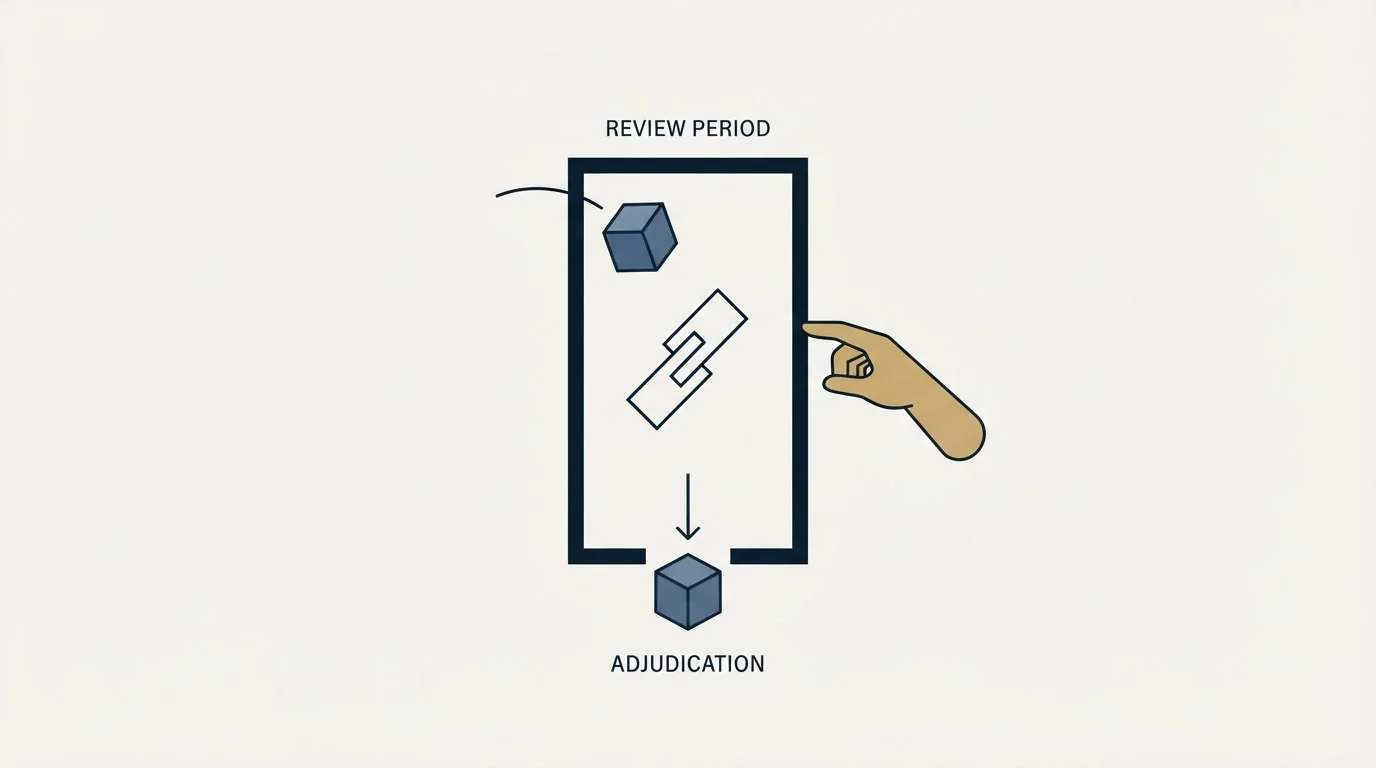
A dispute window converts a potential argument into a process. Three properties matter.
The length, in business days, from the meeting. Long enough that a busy sales leader can actually review meetings, short enough that nobody relitigates a quarter. Any stated number beats no number.
The valid reasons, mapped to the definition. A rejection is valid when it maps to a clause in the written criteria: wrong firmographics, wrong title, an agreed exclusion, a failed qualifying question, no attendance. Subjective quality complaints are not valid rejections against a written standard. "The call went poorly" and "they were not engaged" describe outcomes, and the definition covers whether the right person turned up for a real conversation.
Who reviews. Name a person on your side. An unnamed reviewer means rejections arrive late, arrive inconsistently, or do not arrive at all while resentment accumulates.
Notice that the window protects both parties. It protects you from meetings that technically qualified and obviously should not have counted, and it protects the vendor from being marked down on how a conversation felt. A vendor who proposes a dispute window unprompted has run this relationship before.
No-shows
Some booked meetings do not happen, and the contract has to say what that means. Three treatments are all defensible and they price differently.
Rebooked. The vendor attempts to rebook and it counts once attended. This is the arrangement that aligns incentives best, because it makes attendance the vendor's problem.
Credited. The no-show does not count and is deducted from the period's total. Clean, and it puts the recovery effort where the vendor chooses to put it.
Billed. The booking counts regardless of attendance. Defensible only if the price reflects it, and worth converting: if you are billed on bookings, your real cost per attended meeting is the quoted price divided by your show rate, which is a number you should be measuring anyway.
Ask separately whether the vendor actually does no-show recovery as part of the service, since a policy on how no-shows are billed is not the same as an effort to prevent them. Some vendors do state this on the page: Belkins lists appointment booking and no-show recovery among the things its package includes, which is the right shape of disclosure and is rarer than it should be.
For scoring purposes, what you want is a stated treatment plus a stated recovery effort. A vendor with neither scores zero on this row whatever their price. The contract-level detail behind both this term and the dispute window, including how the billing unit itself behaves as a contract term, is covered in B2B appointment setting services.
Comparing an outcome guarantee against an activity commitment

Vendors commit to different kinds of thing, and the word "guarantee" gets used for all of them. Guarantees in this category fall into three shapes: a committed appointment count, stated volumes of activity such as prospects targeted and emails sent, or no commitment at all combined with cancellation on notice.
- Step 1Classify the commitment
Outcome count, activity volume, or none plus flexibility. These are three different products.
- Step 2Convert to money at risk
Committed spend over the minimum term, including any pilot period, divided by the committed output where one exists.
- Step 3Ask what the remedy is
If the commitment is missed, what happens? Service credit, extended term at no cost, refund, or nothing.
- Step 4Mark unknowns as unknown
Where no output is committed, leave the cost per meeting blank rather than filling it from a case study.
Step three is the whole game. A guaranteed appointment count with no stated remedy for missing it is a forecast wearing a stronger word. Ask what specifically happens if the number is not hit, get the answer in writing, and check whether the remedy is proportionate or symbolic. A commitment with a real remedy attached is worth paying more for, and a commitment without one should be scored the same as no commitment.
The three shapes are not ranked. An outcome commitment transfers delivery risk to the vendor and is priced accordingly. A cancel-anytime retainer transfers flexibility to you and leaves the delivery risk where it was. What you must not do is score them as though they were the same promise, which is the most common error in a shortlist spreadsheet. How that interacts with the underlying pricing model is a separate question, covered in pay per appointment B2B.
Running the framework across a shortlist
Send the same four questions to every vendor in writing, before any of them quote you: the meeting definition, the counting source and your access to it, the dispute window and valid reasons, and the no-show treatment. Written answers, not call answers, because a written answer is one someone had to think about.
Then score, gate on the veto term, and compare price only across the vendors still standing. This sequence matters. Comparing prices first anchors you on the cheapest number and makes it harder to disqualify the vendor attached to it. If you also need the underlying process to interrogate the answers, the stage-by-stage mechanics are in B2B appointment setting, and the comparison against hiring is in outsourced appointment setting versus in-house.
The short version

Score appointment setting companies on five terms and treat one as a veto. The written meeting definition must be checkable clause by clause by someone who was not on the call, which rules out adjectives and rules out budget, timing and authority as billing conditions. Then score the counting source and your access to it, the dispute window with reasons mapped to the definition, the no-show treatment, and the type of commitment with its remedy attached. Compare price last, across the vendors that survived.
RevenueFlow agrees the meeting definition in writing before launch and is paid on attended meetings that meet it, which is this framework applied to ourselves. You can see what a campaign would look like for your market.
Vendor package details verified against the vendor's own page in mid-2026. Terms change; confirm current terms directly before contracting.
Sources: Belkins appointment setting
Frequently asked questions.
Frequently asked questions- How do I choose between appointment setting companies?
- Score them on the terms that decide outcomes rather than on price: whether the meeting definition is checkable by an outsider, who owns the counting source, whether there is a dispute window with valid rejection grounds, and whether their guarantee covers outcomes or activity volumes.
- What is a qualified meeting definition?
- A written standard specifying the company profile in ranges, the attendee's responsibility for the relevant area, agreement to a business conversation, actual attendance, and named exclusions. Budget, timing and decision authority should not be billing conditions, because a first conversation is where those get discovered.
- Who should count the meetings?
- Agree it explicitly, because whoever owns the counting source effectively owns the invoice. A shared record both parties can inspect works best. A vendor-owned dashboard with no export is the weakest arrangement, since disputes then turn on a number only one side can see.
- Is an appointment guarantee worth paying for?
- Only if the definition behind it is tight. A guaranteed count against a loose definition transfers volume risk to the vendor while leaving quality risk with you, which is the worst of both. Read the definition first, then decide what the guarantee is actually worth.
About the author.

B2B cold email experts helping companies generate qualified leads through done-for-you outreach campaigns.
RevenueFlow Team
Explore more.
Ready to scale your outreach?
We build GTM engines that book real meetings. See the receipts.
Related articles.
Appointment Setting for Business Brokers: The Seller Meeting
What a bought meeting with a business owner has to be for a brokerage: the three-part qualification, the confidentiality rules, the licence line and the owner's reasons.
B2B Lead Lists for Aviation Companies: Build or Buy
Aviation is one of the few industries whose accounts are published by its regulator, which changes what is worth buying and what is worth downloading yourself.
LinkedIn Outreach for Banks: A Regulated Message
How a bank's relationship managers use LinkedIn to reach business owners: what the FFIEC guidance, FINRA's notices and LinkedIn's own rules require, and where to stop.
Cold Calling for PPC Agencies: What You Can See First
A paid media prospect is partly readable before the call and has already been told by the platform what to do when a stranger rings about its ads.
LinkedIn Outreach for Utilities: Selling to the Sector
How a vendor selling to utilities uses LinkedIn next to a published sourcing process: the three ownership models, the registration gate and what a message may ask.
SDR Outsourcing for Logistics Companies: The Brokerage Line
What an outside sales development team may do in a freight company's name, the calling and email rules it inherits, and which arrangement survives a bid-shaped market.