B2B Appointment Setting Services: The Buyer's Checklist
The negotiable terms in an appointment setting contract are mostly not the price. Commitment length, billing units, no-shows, disputes and who keeps the domains.
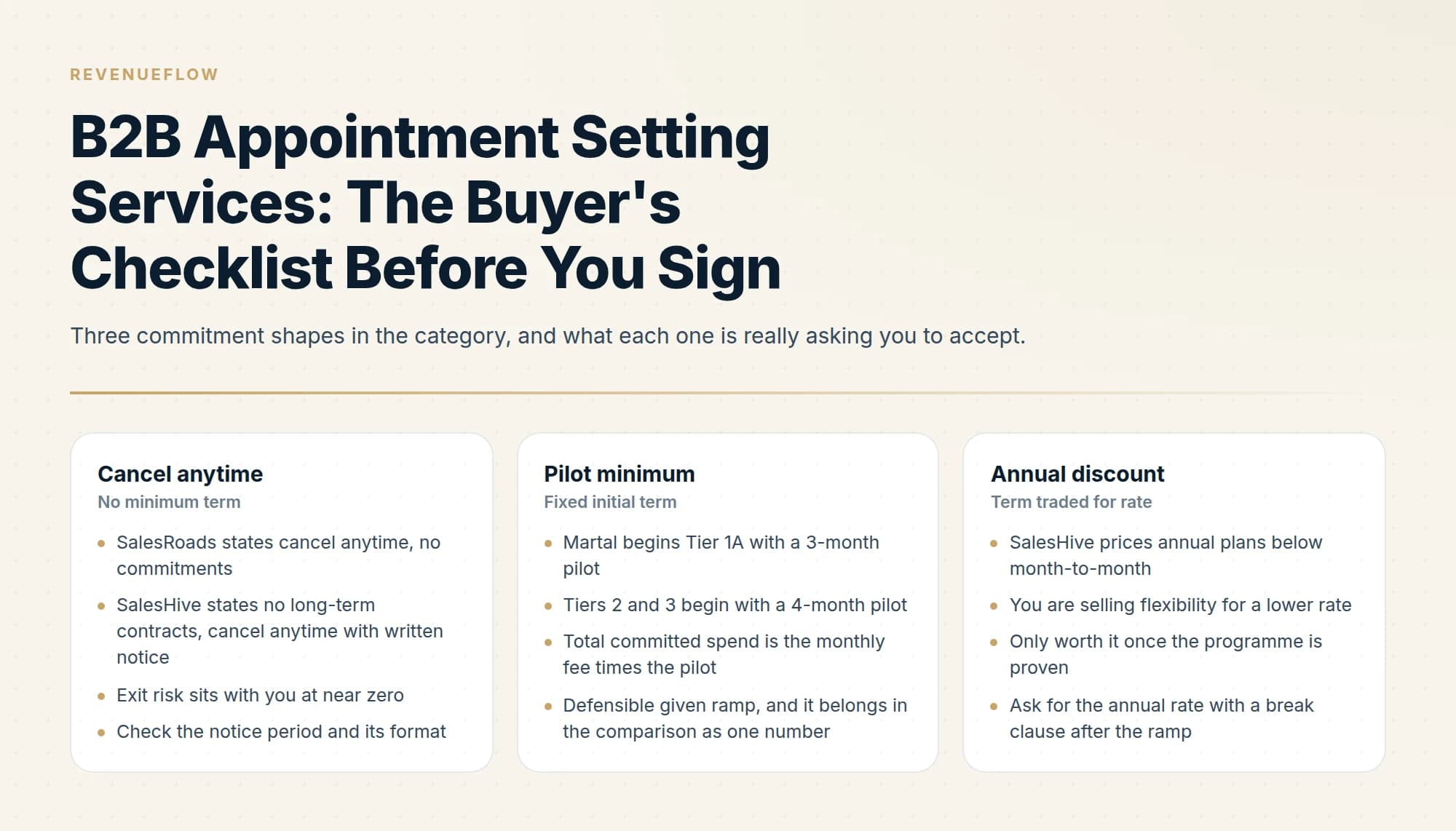
Before signing an appointment setting contract, settle the written meeting definition, the commitment length and any pilot minimum, the billing unit, what a no-show costs, the dispute window and valid rejection grounds, and who owns the sending domains and data when the engagement ends.
Key takeaways
- Commitment length ranges from cancel-anytime to a four-month pilot, so compare total committed spend rather than the monthly figure.
- A four-week billing unit is thirteen periods a year, not twelve, which understates annual cost by roughly eight percent against a monthly quote.
- Domain ownership at termination is the term buyers forget: if the vendor bought and warmed the sending domains, leaving can mean starting again from cold.
- A dispute window stated in business days, with rejection reasons that map to written criteria, prevents nearly every argument these engagements produce.
Reviewed and updated September 21, 2026
Most negotiations with a B2B appointment setting vendor spend their energy on the monthly number, which is the term least likely to move. The terms that decide how the engagement actually goes are further down the document, they are rarely discussed before signature, and almost all of them are negotiable because nobody ever asks.
Commitment length, the billing unit, what a no-show costs, how long you get to reject a meeting, who owns the sending domains when it ends. None of that appears on a pricing page. All of it appears in an invoice dispute.
Commitment and exit
Buyers ask what pricing after the trial ends looks like, and the clause to read is what happens on the last day: a pilot that silently rolls into an ongoing subscription is a different commitment from one that requires a positive decision to continue.
The category ranges from no commitment at all to a four-month minimum, and vendors are generally upfront about which they are once you ask.
- SalesRoads states no long-term commitment, cancel anytime
- SalesHive states no long-term contracts, cancel anytime with written notice
- Exit risk sits with you at near zero
- Check the notice period and its format
- Flexibility is priced in, so the monthly rate reflects it
- Martal begins Tier 1A with a 3-month pilot
- Tiers 2 and 3 begin with a 4-month pilot
- Total committed spend is the monthly fee times the pilot
- Defensible given ramp, and it belongs in the comparison as one number
- Ask what happens at the end: rollover, renegotiation, or notice
- SalesHive prices annual plans below month-to-month
- You are selling flexibility for a lower rate
- Only worth it once the programme is proven
- Ask for the annual rate with a break clause after the ramp
- Never take the annual rate on a first engagement
The clause to read carefully in the cancel-anytime column is the notice mechanism. Written notice with a stated period is normal and reasonable. What you are checking is whether notice given mid-cycle ends the billing at the end of that cycle or triggers another full one, and whether notice by email counts or a specific address and format is required.
For a pilot minimum, ask one extra question: what happens on the last day. A pilot that silently rolls into an ongoing subscription is a different commitment from one that requires a positive decision to continue, and both are common.
The other thing a pilot needs is a written success criterion, agreed before it starts. A pilot without one is just the first few invoices, and the decision at the end gets made on whoever argues best in the room. Write down what you will be measuring, which month you will measure it in, and what result means continue. Measuring month one is the standard mistake, because month one measures setup work rather than the programme, so a three-month pilot judged on its first invoice will kill engagements that were on track.
The billing unit is a contract term
Some vendors in this category quote per four weeks rather than per month, and SalesRoads is explicit about it. Four-week periods produce thirteen billing events a year rather than twelve, so a figure quoted per four weeks is roughly eight percent higher in annual terms than the same figure quoted monthly. Applied to SalesRoads' published $11,950 for one SDR, that is about $12,946 a month once annualised.
That is disclosed rather than hidden, and it still causes problems, because approvals get raised against the monthly figure. Two fixes, both trivial to ask for. Have the agreement state the annual total alongside the periodic rate. And confirm which unit any minimum term is counted in, since a three-month pilot billed in four-week periods is not three invoices.
What a no-show costs

A booked meeting that nobody attends is the most common source of friction in these engagements, and there are three defensible answers to who absorbs it: the vendor rebooks at no charge, the meeting is credited against the next invoice, or it is billed as delivered because the vendor's obligation was to book it.
Any of those works. What does not work is discovering which one applies after it happens. Settle four things in writing: whether the vendor rebooks and how many attempts, whether a rebooked meeting counts once or twice, what happens when the prospect attends a rescheduled slot in the next billing period, and whether the vendor runs confirmation and reminder steps at all. That last one is a scope question with a direct effect on the no-show rate, and it is covered in the scope ladder in appointment setting services.
The dispute window and what counts as valid
This is the clause that prevents the largest category of argument, and it is the one most often left out entirely.
Two components. A stated number of business days after a meeting during which you can reject it, with a named person on your side who does the rejecting. And a definition of what makes a rejection valid, written before launch, against which any specific rejection can be checked by someone who was not on the call.
- Yes: The company falls outside agreed firmographic criteria, written as ranges
- Yes: The attendee has no responsibility for or influence over the relevant area
- Yes: The account was on the suppression list or named as an exclusion before launch
- Yes: The prospect did not attend
- No: The prospect had no budget approved
- No: The prospect is not buying this quarter
- No: The call went poorly or the prospect seemed disengaged
The three no lines are where vendors and buyers most often disagree, and the buyer is usually wrong to push on them. Budget, timing and decision authority are things a first conversation exists to discover. Making any of them a billing condition means the vendor can only get paid for people already in an active buying cycle, which is a thin slice of any market and not the slice outbound reaches well. You end up paying agency rates for a very expensive way to find people who were already shopping.
The last no line matters just as much in the other direction. A subjective view of how a call felt is not checkable, so it cannot be a valid rejection against a written standard. The trade is symmetrical: the vendor is protected from unfalsifiable criticism, and you are protected from meetings that technically qualified and obviously should not have. A held meeting counts unless it is flagged inside the window with a reason that maps to the criteria.
Set the window in business days and make it short enough to be useful, since a rejection raised six weeks later arrives after the invoice and after everyone's memory of the call has faded.
Suppression, exclusions and who loads them

Your suppression list is a contract item, not an onboarding nicety. Get three things written down.
First, that the list is loaded before the first send rather than applied as a review step afterwards, because review after sending means the message already went to your largest customer. Second, that you can add to it mid-engagement with a stated turnaround, since a new opportunity opened last week needs to be excluded this week. Third, what the vendor does with a lead that appears on both your suppression list and their existing outreach: it should be stopped, and you should be told.
Name the exclusions that live in nobody's CRM as well: competitors, companies in litigation with you, accounts a board member sits on, and any partner relationship your team is protecting. Those are usually known by three people and are never in an export.
A related limitation applies to voicemail messaging: the difference between dialer drops and ringless voicemail decides whether consent is legally required.
Domains, data and the end of the engagement
The termination clause is written when everybody is optimistic and read when nobody is, so it is worth thirty minutes now.
- SignatureCommitment shape locks
Pilot length, notice period, billing unit and annual total are fixed here and rarely reopened.
- Before the first sendSuppression and exclusions
The list has to be loaded now. Applied later, it is a review step over messages already delivered.
- First invoiceBilling unit and definitions surface
Four-week periods, counting rules and what a booked meeting means all become concrete at once.
- First disputed meetingWindow and valid reasons
If the standard was not written before launch, this is negotiated under pressure with money attached.
- TerminationDomains, data and work in flight
Who keeps the warmed sending domains, who keeps the contact and reply records, and what happens to meetings already booked.
Domains are the one buyers consistently forget. If the vendor bought and warmed the sending infrastructure, walking away can mean losing the warmed domains your results were built on and starting again from cold somewhere else, which is a real cost measured in weeks rather than dollars. Agree upfront whether the domains transfer, and if they do, that they transfer with their DNS records intact. The reason this matters is covered in the cold email deliverability guide, and the authentication side is in the SPF, DKIM and DMARC setup guide.
Data is the second. Ask who owns the contact records, the enrichment, the reply history and the call notes, and in what format they are delivered on exit. A CSV within ten business days of termination is a reasonable ask and is almost never refused when it is in the agreement.
Be explicit that this covers the records which did not convert as well as the ones that did. The contacts approached, the replies received, the negatives and the not-nows are the expensive part of what the engagement produced, since they encode which segments answered and which did not, and a clause naming only booked meetings hands back the smallest and least reusable slice. Ask for the whole worked list with its outcomes attached, and settle separately whether the vendor may retain any of it for its own use afterwards, which is a different question from whether you receive a copy.
Work in flight is the third and least discussed. On the day notice takes effect there will be meetings booked into future weeks, replies mid-conversation and sequences part-sent. Settle who honours those bookings, whether meetings held after termination are billable, and whether outreach stops immediately or completes the current wave. Where commission on closed revenue is part of the deal, settle the post-termination attribution window too, since that is the single most contested number in any of these agreements.
Ask for the numbers behind the promise
Buyers who ask how they will track attendance and attribute closed deals are asking for two things the agreement has to name, since attendance decides what is billable and the post-termination attribution window is the most contested number in any of these arrangements.

One procurement habit worth keeping. Where a vendor states an outcome or an activity level, ask for it in the agreement rather than on the website, and ask what happens if it is missed. Some commit to an appointment count, some to activity volumes, and some to neither while offering cancel-anytime flexibility instead. Those are genuinely different products and the differences are set out in appointment setting companies. The incentive each pricing structure creates is in pricing models and what each one hides.
The short version
The price is the term least likely to move, so spend the negotiation elsewhere. Normalise the billing unit and get the annual total written down. Convert any pilot minimum into a total committed spend figure. Decide what a no-show costs before one happens. Agree a dispute window in business days with a named reviewer, and a written standard where budget, timing and authority are never billing conditions and a held meeting counts unless it is flagged with a reason that maps to the criteria.
Load suppression before the first send, not as review afterwards. And write the termination clause while everyone is still optimistic: domains, data, and the meetings already sitting in next month's calendar.
RevenueFlow agrees the qualified-meeting criteria in writing before anything sends and is paid on attended meetings that meet them. You can see what a campaign would look like for your market.
Vendor commitment terms and pricing structures verified against the vendors' own pages in mid-2026. Contract terms vary by deal; confirm current terms directly before signing.
Sources: SalesRoads pricing, SalesHive pricing, Martal pricing
Frequently asked questions.
Frequently asked questions- What should be in an appointment setting contract?
- The written qualified-meeting definition, the commitment length and any pilot minimum, the billing unit and what it covers, no-show treatment, a dispute window with valid rejection grounds, suppression list handling, and ownership of sending domains and contact data at termination. Price is the least negotiable item on that list.
- How long are appointment setting contracts?
- It varies widely. SalesRoads and SalesHive both state no long-term contract and cancellation at any time, while Martal begins with a three-month pilot for its outbound tier and four months for tiers including commission. Convert any minimum into total committed spend before comparing monthly rates.
- Who owns the sending domains after the engagement ends?
- Settle this before signing. If the vendor purchased and warmed the domains your campaigns ran on, walking away can mean losing warmed infrastructure and restarting from cold elsewhere. Domains you own and lend to the vendor avoid the problem entirely and cost nothing extra to arrange up front.
- What counts as a valid reason to reject a meeting?
- A reason that maps to the written criteria: wrong company profile, wrong buyer role, an agreed exclusion such as an existing customer, or a failed qualifying question. Subjective complaints about how a conversation felt are not valid rejections against a written standard, which protects both sides.
About the author.

B2B cold email experts helping companies generate qualified leads through done-for-you outreach campaigns.
RevenueFlow Team
Explore more.
Ready to scale your outreach?
We build GTM engines that book real meetings. See the receipts.
Related articles.
Appointment Setting for Business Brokers: The Seller Meeting
What a bought meeting with a business owner has to be for a brokerage: the three-part qualification, the confidentiality rules, the licence line and the owner's reasons.
B2B Lead Lists for Aviation Companies: Build or Buy
Aviation is one of the few industries whose accounts are published by its regulator, which changes what is worth buying and what is worth downloading yourself.
LinkedIn Outreach for Banks: A Regulated Message
How a bank's relationship managers use LinkedIn to reach business owners: what the FFIEC guidance, FINRA's notices and LinkedIn's own rules require, and where to stop.
Cold Calling for PPC Agencies: What You Can See First
A paid media prospect is partly readable before the call and has already been told by the platform what to do when a stranger rings about its ads.
LinkedIn Outreach for Utilities: Selling to the Sector
How a vendor selling to utilities uses LinkedIn next to a published sourcing process: the three ownership models, the registration gate and what a message may ask.
SDR Outsourcing for Logistics Companies: The Brokerage Line
What an outside sales development team may do in a freight company's name, the calling and email rules it inherits, and which arrangement survives a bid-shaped market.