Appointment Setting Services: What's Included by Price
Appointment setting names anything from a list vendor to a full outsourced SDR function. The scope ladder, and what actually gets added as the price rises.

Appointment setting services range from list building alone to a fully outsourced SDR function covering research, sending infrastructure, copy, reply handling, booking and no-show recovery. Price differences across vendors mostly reflect how much of that ladder is included rather than differences in quality.
Key takeaways
- The term covers wildly different scopes, so two quotes at the same price can include entirely different amounts of work.
- Reply handling is the rung where cost rises sharply, because it is labour that cannot be automated away and requires judgment on every message.
- Bundled offers like SalesHive's single fee covering SDR team, strategist, platform, data and tools are easier to compare internally but harder to compare against unbundled quotes.
- Volume tiers priced by daily touches measure activity, not outcomes, so confirm what the tier guarantees beyond the number of touches.
Reviewed and updated September 2, 2026
A verified contact list and a fully outsourced SDR function are both sold as appointment setting services, and the quotes for them are nowhere near each other. Neither vendor is misrepresenting anything. The phrase covers a ladder of work that starts at data and ends at a team running your entire top of funnel, and most of the price difference between quotes reflects where on that ladder the vendor stops.
Which means the useful question when a quote arrives is not whether it is expensive. It is which rungs are inside the number, which rungs you are expected to cover yourself, and what your own team's time costs to cover them.
Vendor checks matter as much as scope, and a firm whose pages now return errors shows how little a search listing guarantees.
The scope ladder
- Step 11. List building
Contacts sourced and verified against your criteria. The deliverable is data. You do everything after that.
- Step 22. Outreach execution
Sending infrastructure, sequences and volume. Replies land in an inbox somebody on your side has to read.
- Step 33. Reply handling and booking
Someone answers the replies, qualifies them and puts meetings on a calendar. This is where the price steps up.
- Step 44. No-show recovery
Chasing, rebooking and confirming. Unglamorous, and the difference between meetings booked and meetings held.
- Step 55. Multichannel
Phone and LinkedIn alongside email. Each added channel adds cost per contact rather than spreading it.
- Step 66. Strategy, audit and copywriting
Positioning work, offer testing and message development, usually bundled at the top tiers rather than sold separately.
The ladder is cumulative in practice. Vendors rarely sell rung four without rungs one through three, so a quote is best read as a height rather than a menu.
The bottom two rungs: data and sends
At the bottom of the ladder you are buying contacts. The variable that matters is how the list was built. A list assembled by running your firmographic filters against a database is a different product from a list researched by a person against your qualification criteria, and both get described as verified.
Buying the list without the outreach is a real option at this rung, and it is what a buyer is asking for when they want the phone numbers to work themselves. Two things to settle before treating it as the cheap version. Whether contact data is a pass-through, included, or bought on your own contract decides who owns the list when the engagement ends, and it decides the vendor's incentive on data quality. And phone numbers specifically are priced separately from email addresses by most data suppliers, so a quote that covers one does not necessarily cover the other.
Belkins is explicit that its research is manual and validated against the client's own qualification criteria, which is the expensive version. When a cheaper quote also says verified, the word usually refers to email deliverability rather than fit, and those are unrelated properties. A contact can be perfectly deliverable and entirely wrong.
Rung two adds the sending. This one is systematically undervalued by buyers because it looks like software. Domains, mailbox warming, deliverability monitoring, authentication records and blocklist recovery are continuous work rather than a setup task, and learning them on your primary domain is the expensive way to learn them. The surface area is covered in the cold email deliverability guide. If a vendor at this rung includes domains and warmed mailboxes in the fee, that is real value that will not appear in a feature comparison.
What rung two leaves you is the reply inbox. Every positive reply, every question, every "not now, try March", every out-of-office naming a colleague. That is a daily obligation rather than a weekly one, because a reply left until Thursday is answered into a context the prospect has moved on from, and the person who wrote it has since had every other inbox in their week land on top of it.
Rung three: the jump

Reply handling and booking is where the price steps up, and it is the rung most worth paying for.
Nothing above it in the ladder requires much judgment. Sourcing and sending are process work that scales predictably. Reply handling is a series of small decisions made under time pressure: is this person worth a slot, is this a real objection or a brush-off, is the colleague they named the actual buyer, does this reply need a human answer today. It is also the rung with the most labour per unit of output, which is why the price behaves the way it does.
- Vendor delivers contacts and sends messages
- Your team monitors the reply inbox daily
- Your team qualifies and schedules
- Your team chases no-shows or absorbs them
- Lower invoice, real internal time cost
- Works when you have SDR capacity sitting idle
- Vendor delivers contacts and sends messages
- Vendor handles replies within its own response window
- Vendor qualifies against agreed criteria and books
- Vendor confirms and rebooks no-shows
- Higher invoice, minimal internal time
- Works when closers are the constraint
The comparison people fail to run is the second line of each column against a real hourly cost. Reply monitoring is not a scheduled task that can wait for Thursday. It is an interrupt, it lands on whoever is best at answering it, and that person is usually one of your better salespeople.
Rung three is also where the vendor starts speaking to your market in real time, which changes what you need from them. A sender can be judged on volume and deliverability. A reply handler is representing you in a conversation, so tenure and experience start to matter. SalesRoads states that its SDRs average five to ten years of sales and appointment setting experience, and that claim is aimed squarely at this rung rather than at the sending work below it.
Where reply handling quality is hard to judge from a rate card, it helps to see how one vendor structures its offer around what counts as a qualified lead.
Rung four, no-show recovery, sounds like a detail and behaves like a scope item. Booked and held are different numbers, and confirmation sequences, reminders and rebooking are what separates them. Belkins bundles no-show recovery into its package explicitly. Where a vendor does not, the gap lands on you, and it lands as calendar admin performed by someone expensive.
The top rungs: channels and thinking
Multichannel is priced as an addition rather than a reallocation. Adding phone or LinkedIn to an email programme means more hours per contact, different tooling and different skills, so a multichannel quote at the same price as an email-only quote is usually reaching fewer contacts. Belkins states three outreach channels in its starter package, and SalesHive prices phone-only differently from phone plus email, which is the honest way to structure it.
One caution on the LinkedIn leg. A second message to someone who ignored the first lands directly beneath it in the same thread, so it reads as a bump whatever the campaign structure claims. Treat a multichannel proposal that leans on LinkedIn follow-up volume with more scepticism than one that treats LinkedIn as a single first touch.
The top rung is strategy and copy. Belkins bundles a full sales audit and strategy mapping alongside copywriting and continuous refinement. SalesHive bundles a strategist along with the SDR team, the platform, data and tools into a single flat monthly fee. In both cases the thinking is inside the fee rather than beside it, and neither vendor prices it as a line item you could remove.
Content and newsletters sit outside the ladder entirely, which is worth saying because buyers regularly ask whether a lead generation vendor also runs them. They are a different purchase with a different clock: a newsletter is a permission-based programme to an audience that opted in, and the ladder above describes cold outreach to an audience that did not. A vendor offering both is running two functions rather than a wider version of one, and the two should be scoped and priced separately even where one supplier delivers them.
That bundling is worth understanding before you negotiate. Asking a top-tier vendor to strip out strategy to reduce the price usually fails, because the strategy is what makes their delivery model work at all.
Volume is a scope dimension too
Buyers ask what volume of outreach to expect per day, and the honest answer is a scope decision rather than a capability: the daily touch band is the dial that moves a quote most once the depth is fixed, and more of it is not automatically better.

Two quotes at the same height on the ladder can still differ by a lot, because scope has a volume axis as well as a depth axis.
SalesHive prices by daily touch volume in bands of 150, 250 and 500 or more, alongside team model and channel mix. Martal states an entry tier targeting 3,000 to 5,000 prospects and sending 9,000 to 12,000 emails a month. Those are the same kind of dial, and it is the dial that moves a quote most once the depth is fixed.
More volume is not automatically better. Volume against a small addressable market exhausts it, and an exhausted list produces a quiet quarter that looks like a vendor problem. Where your total addressable market is a few thousand accounts, buying depth beats buying touches, because you get one pass at those accounts and the message quality decides the outcome.
What is almost never included
Buyers routinely ask for visibility on the activity rather than only the meeting, which is a scope question rather than a reporting preference: who was reached, what was sent and what came back are deliverables that either sit inside the fee or do not.
- Depends: Sending domains and warmed mailboxes provided by the vendor
- Depends: List built to your qualification criteria rather than pulled from a database
- Depends: Copywriting and message iteration inside the fee
- Depends: No-show confirmation and rebooking
- Depends: Meetings written into your CRM rather than emailed to you
- Yes: Your suppression list loaded before launch rather than applied as review
- No: Your own sales team's follow-up after the meeting is booked
Two of those deserve a note. CRM logging is small and constantly missed, and its absence turns into a reconciliation exercise at invoice time when nobody can agree how many meetings happened. Suppression is marked yes because it is the one item on the list that is genuinely non-negotiable: your existing customers, live opportunities and current vendors have to be excluded before the first send, since a review step after sending means the message already went.
Why the cheap tier often costs more
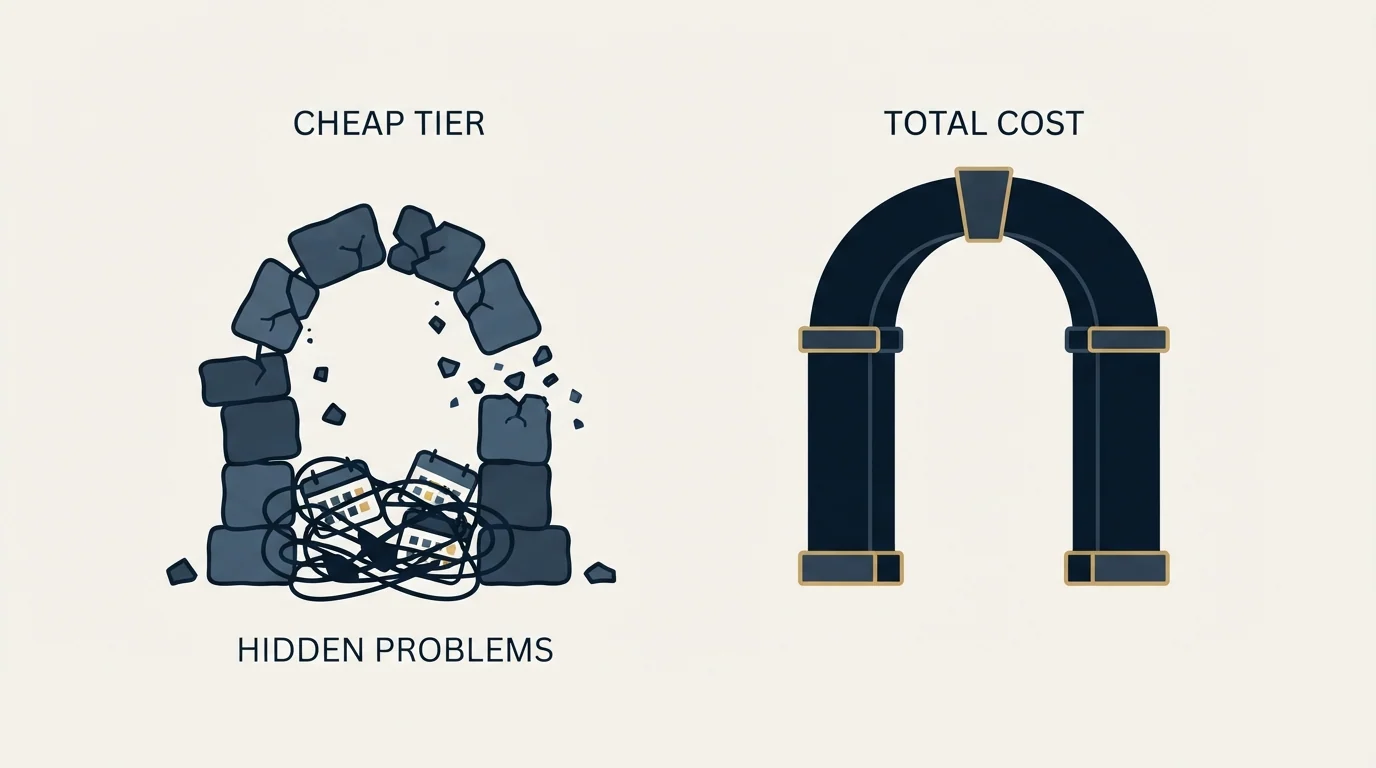
A rung-two quote at a third of the price of a rung-four quote is only cheaper if the two rungs it omits cost you less than the difference. Work that out with real numbers before deciding, using the hours your team will actually spend on reply monitoring, qualification, scheduling and no-show chasing, priced at what those people cost.
A serviceable method takes an afternoon. Estimate the reply volume the sending tier will generate, multiply by the minutes each reply consumes across reading, qualifying, scheduling and confirming, add the daily monitoring overhead, and price the total at the loaded cost of whoever will really do it. Then account for the replies that will go cold before anyone gets to them, which never appear in the spreadsheet and show up instead as meetings that were never booked. Compare that total against the difference between the two quotes.
The answer genuinely goes both ways. A team with idle SDR capacity and a working qualification process should buy low on the ladder and keep the judgment work in house. A team whose closers are doing their own scheduling should buy high, because the internal time being consumed is the most expensive time in the building. Where the question is whether to buy any of it or hire instead, the arithmetic is laid out in SDR outsourcing.
What decides it is where your bottleneck sits, which is the same question underneath appointment setting versus lead generation. The pricing model wrapped around whichever height you choose is a separate decision, and it is worked through in pricing models and what each one hides. Once you have chosen a height and a model, the terms to settle before signature are in the buyer's checklist.
The short version
Appointment setting names a ladder rather than a service. Rungs one and two deliver data and sends and leave the reply inbox with you. Rung three, reply handling and booking, is where the price steps up and where the judgment lives. Rung four, no-show recovery, is the difference between meetings booked and meetings held. Rungs five and six add channels and thinking, and they are bundled rather than optional at the top tiers.
Volume is a separate dial from depth, and against a small market depth wins. Price the rungs a vendor leaves out at what your own team costs to cover them, because that is the comparison that decides whether the cheaper quote is actually cheaper.
RevenueFlow runs the full ladder and is paid on attended meetings that meet criteria agreed in writing before launch. You can see what a campaign would look like for your market.
Vendor inclusions and pricing structures verified against the vendors' own pages in mid-2026. Scope varies by contract; confirm what a specific quote covers in writing.
Sources: Belkins appointment setting, SalesRoads appointment setting services, SalesHive pricing, Martal pricing
Frequently asked questions.
Frequently asked questions- What is included in appointment setting services?
- At minimum, a target list and outreach. Fuller services add contact verification, sending infrastructure and warmup, copywriting, reply handling and qualification, calendar booking, and no-show recovery. Belkins publishes a package including a sales audit, manual research to your criteria, copywriting, booking and no-show recovery.
- Why do appointment setting prices vary so much?
- Mostly scope. A vendor supplying a verified list and sending emails is doing a fraction of the work of one that also handles every reply, qualifies the prospect, books the meeting and chases no-shows. Before comparing prices, list which rungs of that ladder each quote actually covers.
- What does a daily touch volume tier mean?
- It is a capacity measure. SalesHive prices by tiers of 150, 250 or 500 plus daily touches, meaning contact attempts across the chosen channels. It tells you how much activity you are buying, not how many meetings result, so pair it with whatever output commitment the vendor is willing to make.
- Do I need multichannel appointment setting?
- Only if your buyers are reachable on more than one channel, which varies by market. Adding channels adds cost and complexity, and a second channel executed poorly performs worse than one channel executed well. Start with the channel where your buyers demonstrably respond and add later on evidence.
About the author.

Ben Carden is CRO at RevenueFlow, which builds and operates outbound revenue engines for B2B companies. Previously at Gartner Enterprise. Studied at London School of Economics.
Ben Carden · CRO
Connect on LinkedIn →Explore more.
Ready to scale your outreach?
We build GTM engines that book real meetings. See the receipts.
Related articles.
Lead Verification: What Each Check Actually Proves
Lead verification covers two different jobs. One asks whether a mailbox will accept mail, the other asks whether the person behind the row is real and lawful to contact.
5 ABM Campaign Examples and How Each One Is Built
Five worked account-based campaign examples, each built on the same five fields: account set, tier, plays in order, owner and handoff, and the exit condition.
Two Agencies, One Target List: Who Owns Which Accounts
Two outbound suppliers on one market will contact the same companies unless the buyer splits it first. How to cut the list, run the exclusion feed and check the overlap.
Last Outbound Agency Did Not Deliver: Locating the Failure
The leads were bad names a symptom and no stage. Four places an outbound engagement fails, the counts that separate them, and what to change in the next purchase.
HR Lead Generation: The Renewal Clock and Who Signs
An HR buyer who agrees with every word still cannot act outside their own renewal window. Which triggers are observable, and who signs.
IT Lead Generation: The Buyer Runs Your Playbook
Technology buyers evaluate outbound for a living, and their purchases carry a security review nobody in your meeting owns. Which triggers are real.