SalesBread: A Lead a Day and No Published Price
One qualified lead a day, twenty or more a month, or your money back. The promise is unusually specific, and the definition underneath it carries all the weight.
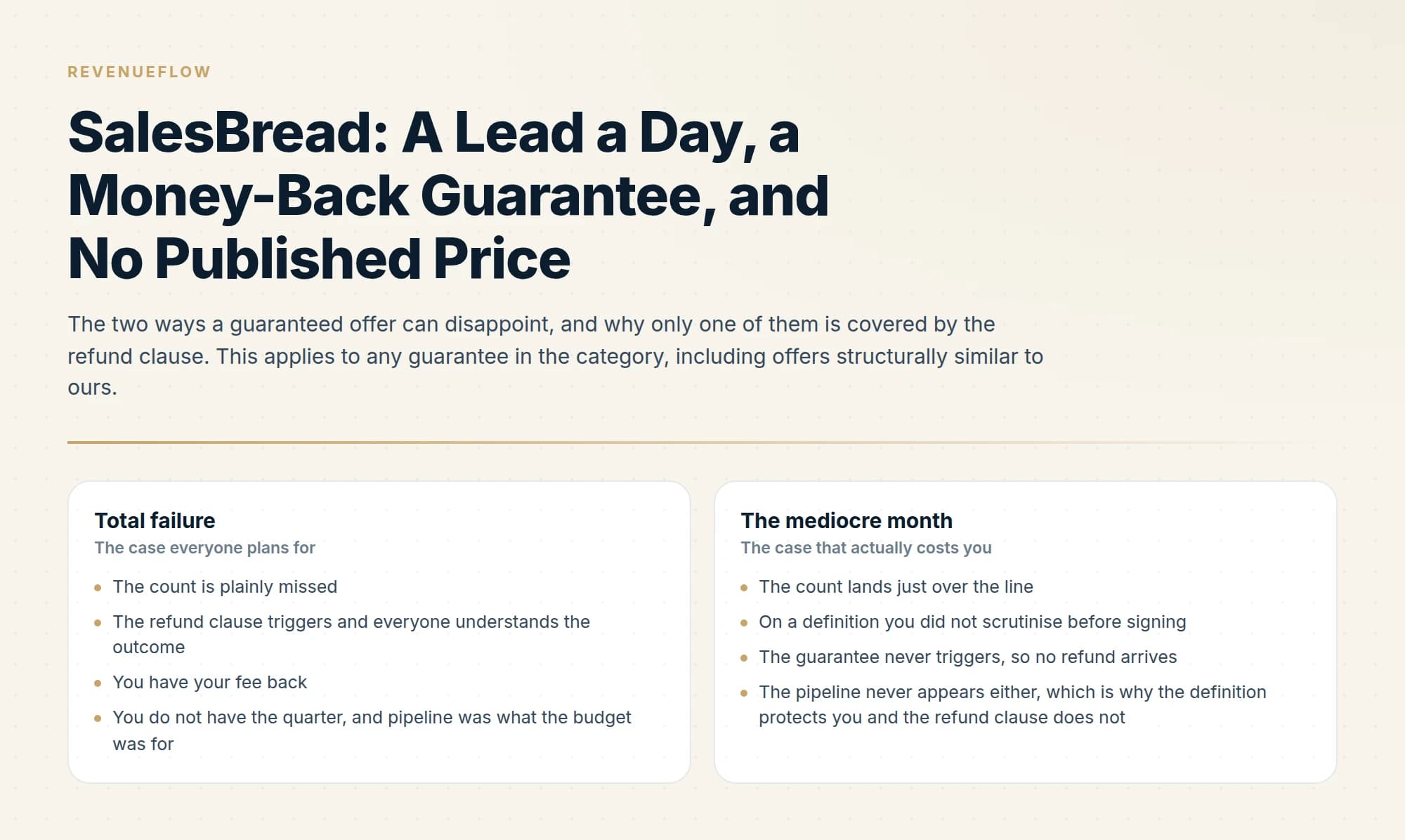
SalesBread promises one qualified lead a day, twenty or more sales-qualified leads a month, from hand-personalised LinkedIn messages and warm emails, backed by a money-back guarantee. No price appears anywhere on its site. The offer rests entirely on how a sales-qualified lead is defined, so get that definition in writing.
Key takeaways
- SalesBread's site carries no pricing page in its navigation and no figures on the homepage or service section, so the rate has to be requested and put in writing.
- Manual personalisation for every prospect caps volume by construction, which makes a promise of twenty leads a month internally consistent with the method.
- The published client figures, including 294 leads at a 41% average reply rate for Purple.AI, are SalesBread's own claims about small hand-worked lists.
- A refund returns the fee and never the quarter, so the mediocre month landing just inside a loose definition is the outcome worth guarding against.
Reviewed and updated September 1, 2026
SalesBread sells one number: a lead a day. Its homepage promises twenty or more sales-qualified leads a month from ultra-personalised LinkedIn and email outreach, and attaches a money-back guarantee to it. That is an unusually specific commitment for an outbound agency, and it shapes everything else about how the company operates.
A disclosure first, since we are a competitor. RevenueFlow is an outbound agency working the same channels, and we are paid on attended qualified meetings rather than a monthly fee. We think the guarantee model is interesting and we think the definition underneath it is where all the weight sits. Everything below is from SalesBread's own site rather than from directories or roundups.
What the company commits to
The promise is stated plainly and repeatedly: one qualified lead per day, twenty or more sales-qualified leads a month, via ultra-personalised LinkedIn messages and warm emails, or your money back.
Nothing on the site states a price. There is no pricing page in the navigation, which runs Home, Articles, Work With Us, About and Contact, and no figures appear on the homepage or the service section. Third-party sites quote monthly rates; those are not SalesBread's own numbers and we are not repeating them. Ask directly, and ask for it in writing.
That absence is worth noting rather than criticising. A guarantee model is harder to price publicly, because what the agency is underwriting depends heavily on how reachable your market is. An agency promising a fixed output into an easy market and a hard one at the same price would be pricing badly.
The stated process
SalesBread publishes six steps, and the ordering tells you where the work sits.
- Step 1Campaign strategy session
A stated 60-minute session to set the campaign before any list is built.
- Step 2Look-a-like list building
Lists modelled on existing customers rather than assembled from broad filters.
- Step 3Research and copywriting
Sales research feeding the message, rather than a template with merge fields.
- Step 4Manual personalisation
Per-prospect personalisation done by hand, which is the constraint on volume.
- Step 5Multi-channel outreach
LinkedIn and email combined, with leads delivered daily.
Manual personalisation for every prospect is the defining choice, and it explains the shape of the offer. Hand-written outreach cannot run at tens of thousands of sends, so a promise of twenty leads a month rather than two hundred is internally consistent with the method. It also implies a relatively small, tightly defined list, which is the correct way to run that approach.
The look-a-like list construction is the other notable element. Building the audience from the profile of existing customers rather than from broad firmographic filters is a meaningfully better starting point when a company has enough customers for the pattern to be real, and it is a weaker one for a company launching into a market it has not sold to yet.
The case studies, as published

SalesBread publishes client outcomes with named companies and specific figures. These are the company's own claims, and they are presented here as such rather than as verified results.
The site cites 294 leads generated at a 41% average reply rate for Purple.AI, 62 leads in the first 60 days for Echtus, and 85 leads in 8 weeks for DigiPli, described as a company working in anti-money-laundering controls.
A 41% average reply rate is very high for cold outreach by any standard. It is not implausible for hand-personalised messages to a small, well-modelled list, which is exactly what the process describes, and it is the kind of number that does not survive being scaled. Read it as evidence about the method at low volume rather than as a rate you would expect on a broad programme.
The guarantee is only as good as the definition
This is the section that matters most, and it applies to every guarantee in this category including offers structurally similar to ours.
- Yes: What specifically counts as a sales-qualified lead, in writing, before launch
- Yes: Whether a positive reply counts, or only a booked meeting, or only an attended one
- Yes: What the refund actually is: full fee, partial, or credit against future months
- Yes: Who adjudicates a disputed lead, and within what window
- Yes: Whether the guarantee survives you rejecting leads as poor fit
- No: Assuming a lead means a meeting on your calendar
The gap between a lead and a meeting is where most disappointment in this category lives. A positive reply, a booked call and an attended call are three very different things, and a monthly count of the first can coexist with almost none of the third. None of that makes a lead-based guarantee dishonest; it makes the definition the entire substance of the offer.
Our own position is that meetings should be qualified against criteria agreed in writing before launch, and that budget, timing and decision authority should never be billing conditions. That standard is worth applying to any provider you are evaluating, including us. If a definition cannot be written down before money changes hands, it will be argued about afterwards.
What a guarantee actually transfers
Guarantees in this category get read as risk removal. They are better understood as risk conversion, and knowing what they convert into is the difference between a good decision and a disappointed one.
A refund returns your fee. It does not return the quarter. If a programme underdelivers from January to March and you are refunded in April, you have your money and no pipeline from the period, and pipeline is what the budget was for. For a company with a number to hit, the refund covers the smaller of the two losses.
A guarantee also shapes behaviour on the agency side, in ways that mostly favour the client and occasionally do not. Underwriting an output creates a strong incentive to hit the count, which is exactly what you want when the count is defined tightly and exactly what you do not want when it is defined loosely. A vague definition plus a volume commitment is the combination that produces leads technically inside the definition and useless in practice.
So the productive way to evaluate any guaranteed offer, ours included, is to ask what happens in the mediocre case rather than the failure case. Total failure triggers the refund and everyone understands the outcome. The awkward scenario is the month that lands just over the line on a definition you did not scrutinise, where the guarantee never triggers and the pipeline never appears. Tightening the definition is what protects you there, and it is worth more than the refund clause.
- The count is plainly missed
- The refund clause triggers and everyone understands the outcome
- You have your fee back
- You do not have the quarter, and pipeline was what the budget was for
- The count lands just over the line
- On a definition you did not scrutinise before signing
- The guarantee never triggers, so no refund arrives
- The pipeline never appears either, which is why the definition protects you and the refund clause does not
Where our models differ
Both companies charge for outcomes rather than pure activity, which puts us closer to SalesBread than to a retainer agency. The differences are worth naming precisely.
The unit differs. SalesBread commits to qualified leads delivered daily, underwritten by a refund. We invoice on attended qualified meetings, so an unattended booking is not billable. Leads are a higher-volume, earlier-stage unit; attended meetings are fewer and later. Neither is inherently better, and the right one depends on whether your team wants conversations to work or calendar slots to show up to.
The channel philosophy differs. SalesBread's published process is multi-channel LinkedIn and email with leads delivered daily. We run one message per campaign and do not send follow-up sequences or a second LinkedIn message to someone who ignored the first, because on LinkedIn it lands directly beneath the message they already declined. That costs us reach and we accept it.
The volume ceiling differs, and this is the practical one. Manual personalisation caps output by construction, and the site addresses "what if I want more than one lead per day" directly. The published answer is that you supply additional LinkedIn accounts from colleagues and the results multiply, with pricing described on the same page as "scale-friendly".
That mechanic is worth understanding before relying on it, because volume then scales with LinkedIn accounts you provide rather than with capacity the agency adds. Those accounts belong to real colleagues, they carry those people's names and connection histories, and LinkedIn's account-level activity limits apply to each of them individually rather than to the programme as a whole. Growing that way is a decision about how much of your team's personal LinkedIn presence you are willing to commit, which is a different question from buying more hours.
The short version

SalesBread publishes a specific promise, one qualified lead per day or twenty-plus a month from hand-personalised LinkedIn and email, backed by a money-back guarantee, and publishes no pricing anywhere on its site. The process is research-heavy and manually personalised, which makes the modest volume ceiling coherent rather than a limitation. The whole offer rests on the definition of a qualified lead, so get that in writing along with the refund mechanics before you sign. If you want a small number of well-researched conversations and you have customers to model a look-a-like list on, the fit is good. If you need volume, it is not.
For the category, the five delivery models and what each costs sets out the shapes, how to compare providers on pricing and risk covers diligence, and what a lead generation agency actually costs covers the ranges. For the channel itself, LinkedIn lead generation services covers what that side involves.
You can also see what a campaign would look like for your market.
The lead promise, the guarantee, the six-step process, the client figures and the scale-friendly pricing remark are all from https://www.salesbread.com/, read from the rendered page, and are presented as SalesBread's own published claims rather than as independently verified results. The service page at /the-best-done-for-you-lead-generation-service/ was checked separately and carries no pricing either, and the site has no pricing page in its navigation. All re-fetched with cache-busting and verified as of mid-2026. Monthly figures quoted elsewhere on the web are not from SalesBread and are not repeated here.
Frequently asked questions.
Frequently asked questions- How much does SalesBread cost?
- The company publishes no price. Its site has no pricing page in the navigation, and no figures appear on the homepage or in the service section. Monthly rates quoted on third-party directories are not SalesBread's own numbers. A guarantee model is genuinely harder to price publicly, because what is being underwritten depends on how reachable your market is.
- What does SalesBread guarantee?
- One qualified lead per day, stated as twenty or more sales-qualified leads a month from ultra-personalised LinkedIn messages and warm emails, or your money back. Before relying on it, establish in writing what counts as a sales-qualified lead, whether a positive reply qualifies or only an attended meeting, what the refund consists of, and who adjudicates a disputed lead.
- How does SalesBread scale beyond one lead a day?
- The site answers that directly: you supply additional LinkedIn accounts from colleagues and the results multiply, with pricing described as scale-friendly. Volume therefore grows with accounts you provide rather than with capacity the agency adds. Those accounts carry your colleagues' names and connection histories, and LinkedIn's activity limits apply to each account individually.
- Is a 41% reply rate believable?
- It is very high for cold outreach, and SalesBread publishes it as its own result for one client rather than as a verified benchmark. Hand-written messages to a small, well-modelled list can plausibly produce rates of that order, and rates of that order do not survive being scaled. Read it as evidence about the method at low volume.
About the author.

Ben Carden is CRO at RevenueFlow, which builds and operates outbound revenue engines for B2B companies. Previously at Gartner Enterprise. Studied at London School of Economics.
Ben Carden · CRO
Connect on LinkedIn →Explore more.
Ready to scale your outreach?
We build GTM engines that book real meetings. See the receipts.
Related articles.
Unbounce Alternatives: Two Boundaries, Four Meters
Teams leave Unbounce at two published boundaries: the 500 visitor entry ceiling and testing starting on the third tier. Each alternative moves one, both or neither.
Blue Zebra Appointment Setting: The Vendor's Pages Are Gone
Search results still describe a B2B appointment setting firm at this address. The pages themselves return 404 and the domain now serves something else entirely.
Goldcast Belongs to Cvent Now: The Buying Question
Cvent announced its Goldcast acquisition in December 2025 and completed its ON24 acquisition in April 2026. Two shortlist names, one owner, one live contract question.
Multichannel Lead Generation: Coverage or Sequencing
Multichannel covers two decisions that behave nothing alike. One adds people the first channel cannot reach. The other adds touches to people you already contacted.
Belkins Pricing: What the Service Page Publishes
Belkins publishes a starter price and four figures on its service page, and no price at all on its pricing page. Which page a number came from decides what it means.
What Is Callbox? The Campaign Pod Model
Callbox sells outbound in units it calls Campaign Pods, and it is one of the few agencies in the category that puts a monthly price band on its own pricing page.