Two Agencies, One Target List: Who Owns Which Accounts
Two outbound suppliers on one market will contact the same companies unless the buyer splits it first. How to cut the list, run the exclusion feed and check the overlap.
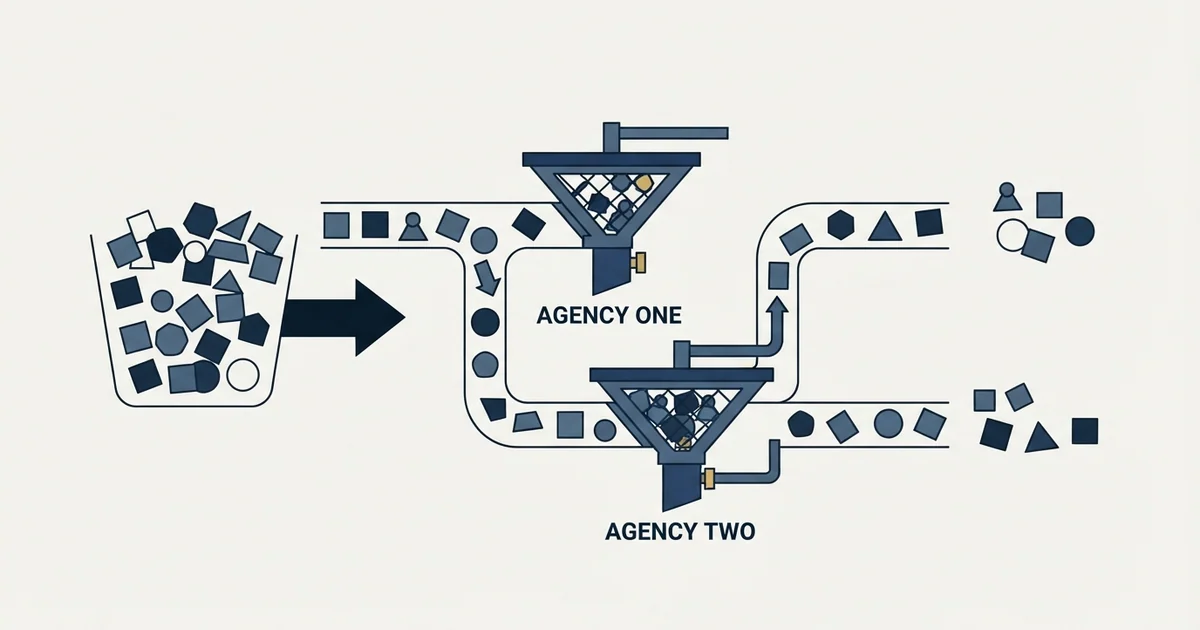
Two outbound suppliers on one market will overlap, because each holds a complete record of its own sends and none of the other's. The buyer has to split the market first, hand each supplier the other's set as a build-time exclusion with a named owner, and reconcile contacted domains monthly.
Key takeaways
- Neither supplier can prevent the overlap alone, because each one's suppression covers its own programme and nothing outside it.
- Split the market by segment, geography or named accounts using a filter both sides can run, rather than by channel against one shared list.
- The exclusion file has to be a build-time input with a refresh cadence, not a spreadsheet emailed once at kickoff.
- Intersecting the two suppliers' contacted domains monthly is the only check that finds an overlap before a prospect reports it.
Reviewed and updated August 28, 2026
A head of sales signs a second outbound supplier in March because the first one is producing meetings and the target is bigger than one supplier can carry. In May a prospect replies to supplier B with a single line saying that somebody from the same company had already been in touch about exactly this, three weeks earlier. Nobody on either side did anything wrong. Both suppliers screened their lists against the exclusions they were given, both ran their own suppression correctly, and the two lists still overlapped by several hundred companies, because nothing in either process could see the other one.
That overlap is the ordinary outcome of pointing two suppliers at one market, and it is worth planning for rather than discovering. The mechanics are not complicated. What makes it recur is that the fix has to be owned by the buyer, and both suppliers reasonably assume somebody else is holding it.
Why neither supplier can solve this alone
A suppression list is the record of instructions a programme has been given about who not to contact, and it works because it is checked automatically at build time by every campaign inside that programme. The argument for enforcing it at the programme level rather than per campaign is set out in suppression list, and the same reasoning runs one level up. Two suppliers are two programmes. Each one holds a complete record of its own sends and no record at all of the other's, so each can honestly report that it never contacted a company twice while the prospect experiences exactly that.
The gap is structural rather than a lapse. Supplier A cannot suppress a company supplier B contacted last week unless somebody tells it, and the only party who can tell it is you.
There is a second-order version of the same problem that catches teams who think they have avoided it. An in-house seller working accounts by hand is a third programme, usually the one with the least visible record, and a supplier told to avoid the accounts your team is working needs that list refreshed rather than collected once at kickoff.
- Every company it has loaded
- Every message it has sent and when
- Replies, bounces and opt-outs from its own sends
- The exclusions it was handed at kickoff
- Nothing at all about a second supplier
- Which accounts each supplier was given
- Which accounts the in-house team is working
- Which companies are live opportunities today
- Which relationships would be damaged by a cold pitch
- The union of all sends across every programme
Split the market before you split the budget
The decision that prevents this is made before either supplier starts, and it is a split of the market rather than a split of the spend. It also depends on the addressable set having been defined once, as filters that return a count rather than as a description, which is the work an ideal customer profile exists to produce. Three splits work, and they fail in different ways.
By segment. Supplier A takes companies in one size band or one vertical, supplier B takes another. This is the cleanest split because the boundary is a filter both sides can run, and it has a useful side effect: the two suppliers stop being comparable on raw meeting count, which removes the incentive to widen a definition quietly. It fails when one segment turns out to be much richer than the other, and the losing supplier starts arguing about the carve rather than about the work.
By geography. Easy to enforce, easy to audit, and the failure mode is a multinational whose buying decisions sit in a country neither supplier was given.
By named-account list. The buyer produces two lists of companies and hands one to each. This is the most reliable split and the most work, and it is the only one that survives a market where segment and geography both cut across the real accounts. The way to build the lists so the boundary is a property of the data rather than a description is the same discipline territory planning applies to internal carves, including its central warning: assignment gets recorded as coverage, and the two are different facts.
What does not work is a split by channel where both suppliers reach the same people. Running one supplier on email and another on LinkedIn against one list means every prospect hears from two strangers about the same thing, and they experience it as one company being disorganised rather than as two channels.
The split is easier to hold when the two suppliers are not selling the same unit. Where one is paid per meeting and the other per month, the comparison between them was never like for like anyway, and the five delivery models in lead generation services is the right read before deciding whether you are buying two of the same thing or two different things.
- Step 1Define the whole addressable set
One list of companies, built once, with the criteria written down so either supplier could rebuild it
- Step 2Cut it, then assign
Segment, geography or named accounts. The cut is a filter both sides can run, not a description in a kickoff deck
- Step 3Load the other side as an exclusion
Each supplier receives the other's set as a suppression input at build time, not as a note in a shared document
- Step 4Refresh on a schedule
Live opportunities and accounts your own team picks up change weekly, so the exclusion file is a feed rather than a handover
- Step 5Reconcile the sends
Ask both suppliers for the domains they contacted in the period and check the intersection is empty
The exclusion file is a build-time gate, not a review step

The most common way a correct split still produces duplicates is that the exclusion arrives as a document rather than as an input. A spreadsheet emailed at kickoff gets read once, applied once, and never consulted again, while the set it describes keeps changing.
Three properties separate an exclusion file that holds from one that only appears to.
It is checked as each campaign is assembled, and a build that cannot reach it stops rather than proceeding. That is the same rule the suppression entry argues for, and the reason is the same: a check that depends on somebody remembering is a check that will eventually not be run, and the failure is silent because everything about the send looks normal.
It lists domains rather than only addresses. A person appears under two mailboxes and moves employer, so an address-level exclusion misses the same company through a second contact. Where the unit that matters is the organisation, the exclusion has to name the organisation.
It has a refresh cadence somebody owns. Live opportunities are the entries that change fastest and matter most, because a cold pitch landing on an account your own seller is mid-conversation with is the version of this failure that costs a deal rather than a reply.
Worth separating two things that end up in the same file. A suppression entry records an instruction you received, such as an opt-out, and it is permanent. An exclusion records a decision you made, such as reserving a segment for one supplier, and it can legitimately be revisited. Storing both undifferentiated makes the reversible thing look permanent and the permanent thing look reversible.
How you find out it is happening
The failure announces itself in one of three ways, and only the third is reliable.
The prospect tells you. This is the most common route and the most expensive, because by then two messages have landed. The reply usually names the other sender, which at least makes the diagnosis quick.
A supplier notices a company already in its own reply history. This catches the case where both suppliers eventually reach the same account and one of them recognises the domain, and it depends on somebody reading rather than on any check.
You reconcile the sends. Ask each supplier for the list of domains it contacted in the period, and intersect the two. The check takes minutes, it is the only one that finds an overlap before a prospect does, and it produces a number you can act on rather than an anecdote. Run it monthly and the trend matters more than any single month: a rising intersection means the carve has drifted, usually because one supplier ran out of accounts inside its own cut and widened the filter to stay busy. That widening has a tell worth knowing, since a list rebuilt from looser filters returns the same accounts every quarter, which is the difference between a filter and a signal showing up as an operational symptom.
- Yes: The addressable set is defined once, with criteria either supplier could rebuild
- Yes: The cut between them is a filter rather than a description
- Yes: Each supplier holds the other's set as a build-time exclusion
- Yes: Live opportunities and in-house accounts reach both suppliers on a schedule
- Yes: Somebody is named as owner of the exclusion feed
- Yes: Contacted domains are reconciled between suppliers monthly
- No: Both suppliers work the same list on different channels
- No: The split was agreed verbally at kickoff and never written down
The commercial half nobody writes down
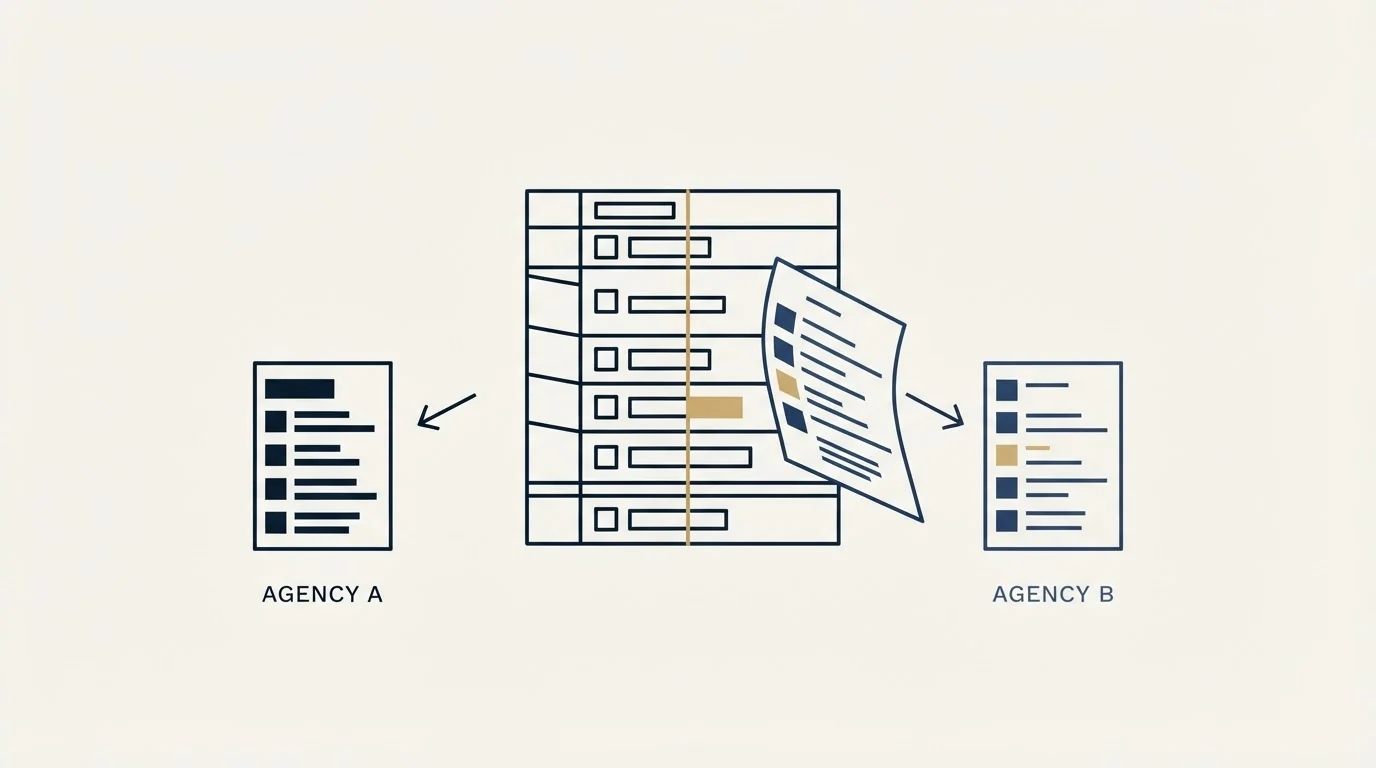
Once two suppliers touch a market, attribution becomes a live question and it is cheaper to settle before the first disputed meeting than after it.
The case that causes the argument is an account both suppliers touched, where one booked the meeting. Any rule works provided it is written: first contact, last contact, or the supplier whose message the prospect replied to. What does not work is deciding after the fact, because by then both parties have a position and the evidence supports whichever rule is chosen.
The meeting definition needs one clause for this specifically. A standard that already excludes a prospect disclosed beforehand as an existing customer, an open opportunity or a suppressed account handles most of it, and qualified appointment sets out why every condition in such a definition has to be checkable by both parties from the same evidence. Add the second supplier's set to the disclosed-and-suppressed category and the clause covers this case without new wording.
Our own position sits upstream of the dispute and is narrow. We agree qualification criteria in writing before a campaign launches, and we run one message per campaign with no bumps and no thread replies, so the count of people who heard from us equals the count of people we contacted. That makes a reconciliation against another supplier's sends arithmetic rather than an investigation, which is the only reason the monthly check above is cheap enough to actually run. The wider operating shape that constraint produces is described in the outbound sales playbook.
When two suppliers is the wrong answer anyway
Sometimes the honest read is that the market does not need two.
Count the addressable set first. If the whole set is a few thousand companies, one supplier running a properly built list covers it, and a second supplier is buying overlap by construction rather than by accident. The arithmetic that decides this is the company count rather than the revenue figure, and serviceable addressable market works through why the count is the number that decides how you reach a market.
Where the set is genuinely large enough for two, the second supplier is worth having for a reason beyond volume: two independent reads on the same market produce a comparison you cannot get from one. That only holds if the cut is clean, because a comparison between two suppliers working overlapping lists measures the overlap rather than the suppliers.
The short version

Two suppliers pointed at one market will contact the same companies unless somebody makes them not, and neither supplier can be that somebody. Split the market before splitting the budget, using a filter both sides can run rather than a description. Hand each supplier the other's set as a build-time exclusion with a named owner and a refresh cadence, keep live opportunities in that feed, and reconcile contacted domains monthly so an overlap surfaces before a prospect surfaces it. Settle attribution and the meeting definition in writing at the start. And check the size of the addressable set first, because a market small enough for one supplier makes the whole problem optional.
If the useful next step is seeing what one properly cut list produces before adding a second supplier to the same market, we will build the campaign and show you the population.
Frequently asked questions.
Frequently asked questions- Can two outbound agencies just share a suppression list?
- Sharing helps and does not close the gap on its own. A suppression list records instructions you were given, such as opt-outs and bounces, and it is permanent. What prevents overlap is a separate exclusion feed carrying each supplier's assigned accounts, live opportunities and the accounts your own team is working, refreshed on a schedule and checked as each campaign is built.
- Is it a problem if both agencies work the same list on different channels?
- Yes, and it is the split most likely to be proposed. A prospect who receives an email from one supplier and a LinkedIn message from another about the same offer reads it as one company being disorganised rather than as two channels. Split the accounts first, then decide channels inside each half.
- How do you decide which agency gets credit for a shared account?
- Agree the rule in writing before the first disputed meeting. First contact, last contact, or the supplier whose message the prospect answered all work provided the choice is made in advance. Deciding afterwards is where the argument lives, because by then both parties hold a position and the evidence fits whichever rule is picked.
- How often should the exclusion file be refreshed?
- Often enough that live opportunities are current, which in practice means weekly for most teams. Live deals are the entries that change fastest and cost the most when missed, because a cold approach landing on an account your own seller is mid-conversation with damages a deal rather than producing a reply. Customer and relationship lists move more slowly.
About the author.

Ben Carden is CRO at RevenueFlow, which builds and operates outbound revenue engines for B2B companies. Previously at Gartner Enterprise. Studied at London School of Economics.
Ben Carden · CRO
Connect on LinkedIn →Explore more.
Ready to scale your outreach?
We build GTM engines that book real meetings. See the receipts.
Related articles.
HR Lead Generation: The Renewal Clock and Who Signs
An HR buyer who agrees with every word still cannot act outside their own renewal window. Which triggers are observable, and who signs.
IT Lead Generation: The Buyer Runs Your Playbook
Technology buyers evaluate outbound for a living, and their purchases carry a security review nobody in your meeting owns. Which triggers are real.
Already Contracted With a Lead Generation Vendor: Run Two
Two vendors collide because neither can see the other's send queue. How to split by account, hold one suppression list, and run a bake-off that decides something.
5 ABM Campaign Examples and How Each One Is Built
Five worked account-based campaign examples, each built on the same five fields: account set, tier, plays in order, owner and handoff, and the exit condition.
Last Outbound Agency Did Not Deliver: Locating the Failure
The leads were bad names a symptom and no stage. Four places an outbound engagement fails, the counts that separate them, and what to change in the next purchase.
When Outbound Stops Scaling: What Breaks First
Doubling the budget rarely doubles the meetings. The five constraints that bind in order, the signature each one leaves in the numbers, and what actually buys more.