Territory Planning: The Carve That Decides Who Never Gets Contacted
Territory planning allocates a market among sellers along geography, segment, named accounts or product lines, and sets the assignment record, the quota allocation and the coverage model. Assignment is not coverage: a plan can show every account owned while most of the market receives no contact in the period.
Key takeaways
- A territory plan produces three separate artefacts: who owns what, how the number is split across those boundaries, and the coverage arithmetic that claims the plan can reach the target.
- Assignment and coverage are different facts, so a plan showing every account owned can still leave most of the market uncontacted for a whole period.
- Seam accounts, meaning those that satisfy two definitions or none, are where losses concentrate, and the ones satisfying none generate no signal that anything is missing.
- Re-carving mid-period resets relationships, moves in-flight opportunities to sellers who did not source them, and converts the map into an internal negotiation.
Territory planning is the allocation of a market among the people who sell into it: which accounts, which geographies, which customer segments and which product lines belong to which seller or team, and for how long. It is normally done once a year ahead of a fiscal period, owned by sales operations or revenue operations, and signed off alongside the quota plan. The output is a map, and most organisations read that map as a fairness exercise.
It is more useful to read it as a decision about who never gets contacted. Every line drawn on a market creates accounts that sit inside somebody's boundary and accounts that sit between two boundaries, and the second group is the one nobody works.
The rep-level version of this, usually called a sales rep territory plan, is the same three artefacts narrowed to one person: the accounts assigned to them, the number attached to those accounts, and the arithmetic that claims one seller can work that population.
That third artefact is what is usually called a sales coverage model: customers assigned to segments, segments assigned to roles, and roles assigned to people, which is a statement about who is responsible rather than a statement about who will be contacted.
Sales territory mapping is the visual half of that same exercise, and the software that draws the map answers only the boundary question, because the carve variables, the capacity number and the tie-break rule all sit outside it, which is why a tidy map and an uncovered market are entirely compatible.
The dimensions a carve is drawn along
Four dimensions do almost all the work, usually in combination.
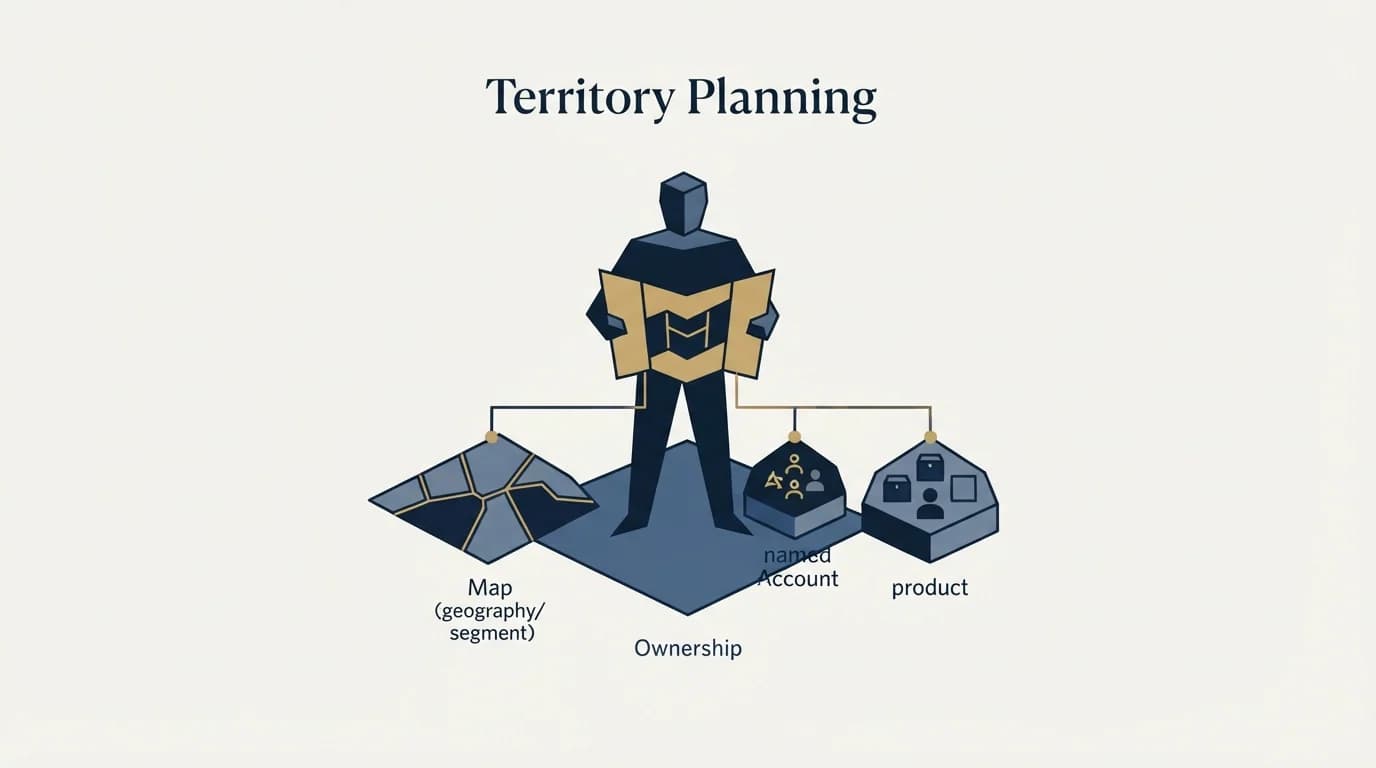
Geography is the oldest and the easiest to administer. Postal codes, states, countries and regions produce boundaries that are unambiguous and cheap to audit. What they do not produce is comparable workloads, because economic activity is not distributed evenly across land.
Segment carves by company size, revenue band, employee count or spend potential. It aligns the selling motion to the buying motion, which is its real argument: an enterprise pursuit and a fifty-person purchase are different jobs and reward different skills. Its weakness is that the firmographic data underneath it is a snapshot, and companies cross bands.
Named accounts assign specific logos to specific sellers, regardless of where they sit. This is the standard shape for strategic selling, and it makes ownership unambiguous for the accounts that are named. It also makes everything unnamed into a residual category whose owner is often nobody in particular.
Product line or vertical splits by what is being sold or by the industry it is being sold into. It concentrates expertise, which raises the quality of any given conversation, and it creates the multi-owner account problem: one buying organisation with three sellers pointed at it and no agreement about who speaks first.
- Unambiguous and cheap to audit
- Aligns to travel and to time zones
- Workload varies with economic density, not with area
- Remote selling weakens the original rationale
- Tends to be kept because it is administratively easy
- Matches the selling motion to the buying motion
- Makes quota setting defensible per band
- Depends on firmographic data that ages quietly
- Companies cross bands and change owner mid-cycle
- Band edges are where accounts get lost
- Ownership is explicit for anything named
- Supports long pursuits and real account knowledge
- Everything unnamed becomes a residual nobody owns
- Naming is a forecast about where value sits
- Lists go stale faster than they get revised
Who owns it, and the three artefacts it produces
Territory planning is rarely owned by the people it governs. In most companies of any size the plan is built by sales operations or revenue operations, priced by finance, reviewed by the sales leadership team, and then handed down. That ownership pattern matters, because the people holding the model have visibility into the whole market and no direct experience of working any single boundary, while the people who feel every seam have no authority to move one.
Three artefacts usually come out of the exercise, and confusing them is the most common source of argument.
The first is the assignment record, which says who owns what. It lives in the CRM, it is machine-readable, and it is the thing most people mean when they say territory. The second is the quota allocation, which distributes the number across those boundaries and is where the exercise becomes political, because a boundary and a number are agreed together and each one is used to justify the other. The third is the coverage model, the arithmetic that claims the plan can produce the target. That third artefact is the one that carries the assumptions worth auditing, and it is usually the one nobody outside the planning team ever reads.
Capacity is the constraint, and the map rarely shows it
A territory is a workload before it is a map, and workload is bounded by something the carve does not contain: how many live conversations one person can genuinely carry at once.
Suppose, purely to make the shape visible, that a seller can hold forty active conversations in a quarter and is assigned a territory of six hundred accounts. The arithmetic is not subtle. Most of that territory will receive no contact at all in the period, and which accounts fall into the worked forty is decided by whatever is easiest to see: inbound activity, an old relationship, a familiar name, the top of an alphabetical list. The carve produced a boundary. It did not produce coverage.
This is why headcount and territory design are the same conversation held twice. Adding sellers to fix a coverage problem is the expensive version of the answer, and the case against reflexively hiring more reps is worth reading before a plan is built around it. The cheaper version is to shrink the assigned population to something a person can actually work, and to move everything else into a motion that does not depend on one seller's attention.
- Step 1Target set
The revenue number the period has to produce, decided before any map exists
- Step 2Carve
Boundaries drawn along geography, segment, named accounts or product
- Step 3Assignment
Every account acquires an owner, which the plan records as covered
- Step 4Worked set
The accounts that receive contact, bounded by one person's capacity
Where the textbook definition breaks

Assignment is recorded as coverage, and they are different facts. A territory plan can show every account owned and zero accounts abandoned while most of the market sees nothing all year. Any review that counts assigned accounts is measuring the map. The number worth having is the count of accounts that received real contact inside the period, and it is almost always a fraction of the first number.
The seams are where the losses concentrate. An account that satisfies two definitions gets worked twice or argued over. An account that satisfies neither gets worked by nobody, and it generates no signal at all, so nothing in the system reports it. A subsidiary whose parent is a named account, a company that grew past a segment boundary in March, a business with head office in one region and buying authority in another: these are ordinary corporate structures rather than edge cases, and they are exactly the population a boundary-based system loses.
A carve encodes last year's understanding of the market. Segment boundaries rest on firmographic data with a refresh cycle nobody in the sales meeting can name. Named-account lists are a forecast about where value will sit, made before the year that tests it. Both age, and neither ages visibly.
Re-carving mid-year costs more than the plan it fixes. Reassignment resets relationships that took months to build, moves in-flight opportunities to sellers who did not source them, and creates a compensation argument for every deal near a boundary. The territory becomes the subject of internal negotiation rather than a background condition of the work, and the attention that goes into that negotiation comes straight out of selling time. This is the strongest argument for carving conservatively at the start of a period and living with an imperfect map.
Coverage models assume the whole territory is workable. The planning arithmetic usually divides the market by seller and stops, which quietly asserts that a person assigned six hundred accounts will work six hundred accounts. No capacity model in the plan says that, and no seller believes it, and yet the coverage number the plan produces depends on it entirely.
- Yes: How many accounts can one seller genuinely work in a quarter, stated as a number
- Yes: Which accounts satisfy two definitions, and who speaks to them first
- Yes: Which accounts satisfy none of the definitions, listed rather than assumed away
- Yes: How old is the firmographic data the segment boundaries rest on
- Yes: What happens to an account that crosses a band mid-period
- Yes: What the plan intends for everything outside the worked set
- Depends: Whether any boundary exists mainly because it is easy to administer
- Depends: Whether the same carve is being used for reporting and for compensation
Reading a territory plan well

The most valuable output of territory planning is not the map. It is the explicit statement of what the organisation has decided to ignore, which most plans never write down because writing it down is uncomfortable.
Start from capacity and work outwards. Decide how many accounts a person can carry, multiply by the number of people, and compare that to the size of the addressable market. A carve that ignores this is also the most common reason quota attainment reads as a people problem when it is an arithmetic one. The difference between those two numbers is the part of the market that needs a motion other than a seller's personal attention. Naming that gap converts a silent failure into a plan, and it is the same arithmetic that a properly built ICP with the sizing attached is supposed to produce. Where the addressable market is genuinely large, building a target list you can actually work is the discipline that keeps the named portion honest.
Treat boundaries as reporting structures rather than as walls. The purpose of a carve is to make ownership and compensation calculable. The moment it starts deciding which real buyers hear from the company, it has been given a job it was never designed for.
Split the market where the buying motion genuinely differs, and nowhere else. Every additional dimension multiplies the seams, and seams are where accounts go missing. A carve with three overlapping dimensions produces more disputed accounts than one with two, and the disputes are handled by people rather than by the plan.
Write down the tie-break rule at the same time as the boundary. Most seam disputes are not hard problems, they are unowned ones: whether the parent or the subsidiary governs, whether the billing address or the decision-making office decides, whether a company that crosses a band moves owner immediately or at the period boundary. Each of those has an obvious answer that nobody minds once it is written, and each of them consumes days of senior attention when it is settled case by case in the middle of a quarter.
Review the plan against outcomes rather than against intent. At the end of a period, the useful question is not whether the boundaries were fair. It is which accounts received contact, which received none, and whether the accounts that closed came from the part of the market the plan predicted they would. A carve that produced revenue somewhere it was not expecting is telling you something specific about the segment boundaries, and it is the only feedback the exercise generates that was not already an opinion when the plan was drawn.
Our own position on the part of the market that sits outside the worked set is narrow and worth stating plainly. Our outbound is built on a single message per campaign: one premise, sent once, and a later approach only as a separate campaign with a reason of its own. That constraint makes the carve consequential in a specific way, because a premise is written for a defined population, and a territory that blends two populations produces a message that fits neither of them well. The longer argument sits in our outbound playbook. If the gap between capacity and market is the problem you are actually solving, our pay per qualified meeting offer prices that coverage by the meeting rather than by the headcount.
Frequently asked questions.
Frequently asked questions- What is the difference between territory planning and account assignment?
- Account assignment is one output of territory planning. The planning exercise also sets the quota split across those boundaries and the coverage model that claims the plan can produce the number. Assignment is the artefact everyone sees in the CRM, while the coverage model carries the assumptions that decide whether the plan was ever realistic.
- How many accounts should one seller be given?
- Start from how many live conversations that person can genuinely carry at once, then work outwards rather than dividing the market by headcount. If the assigned population is far larger than the workable one, the surplus needs a motion that does not depend on a single seller's attention, and the plan should say which motion that is.
- Should territories be carved by geography or by segment?
- Geography is cheap to administer and produces unequal workloads because economic activity is not evenly spread. Segment matches the selling motion to the buying motion but rests on firmographic data that ages quietly. Most teams end up combining them, and every additional dimension multiplies the seams where accounts get lost.
- When is it worth re-carving territories mid-year?
- Rarely, because the cost lands on relationships and in-flight opportunities rather than on the spreadsheet. Reassignment creates a compensation argument for every deal near a boundary and turns the map into a subject of negotiation. The usual alternative is to carve conservatively at the start of a period and handle exceptions by a written tie-break rule.