Account-Based Marketing Strategy: Building the Target List
An account-based strategy is mostly a list strategy. How to size, source, tier and sign off a target list, and the coverage check that reshapes most plans.
An account-based strategy is mostly a list strategy. Size the list against production capacity, derive criteria from deals you actually won, measure contact coverage per account before finalising anything, and get one named person in sales to sign off. Then revise monthly on evidence rather than treating the list as fixed input.
Key takeaways
- Size the target list against production capacity, not market size, because a list longer than capacity is a queue rather than a plan.
- Combine closed-won analysis, firmographic expansion and a sales review, since each of the three covers a different weakness in the others.
- Measure contact coverage per account before the list is final: accounts with no reachable buyer are a data project rather than a target.
- One named person in sales signs off on the list, with recorded reasons for every cut, which is what stops a six-month review concluding that ABM does not work here.
Reviewed and updated September 1, 2026
Almost every account-based programme that gets reviewed as a failure fails in the same place, and it is not the creative or the channel mix. It is a target list that marketing built from filters, sales quietly disagreed with, and nobody revised once the campaign started.
An account-based strategy is mostly a list strategy. The tiering, the channels, and the content plan are all downstream of which companies are on the list and who agreed to them.
Size the list against capacity, not ambition
The first number to decide is how many accounts you can genuinely work, and it comes from your own capacity rather than from the size of the addressable market.
Work backwards from the expensive input. If a one-to-one account needs several hours of research plus bespoke assets, and one person can produce that for a handful of accounts a month, then your one-to-one tier is that handful. If clusters of one-to-few accounts share a single set of assets, capacity is set by how many distinct clusters you can produce for. One-to-many is limited by data and sending capacity rather than by production.
A list larger than your capacity is not ambition, it is a queue. Accounts sitting at the bottom of it get nothing for months and are indistinguishable from accounts you never selected.
The practical shape most mid-market teams land on is a small named tier, a middle tier grouped into a few clusters, and a long tail that gets direct contact and nothing else. That is a real strategy, and it is honest about where the effort goes.
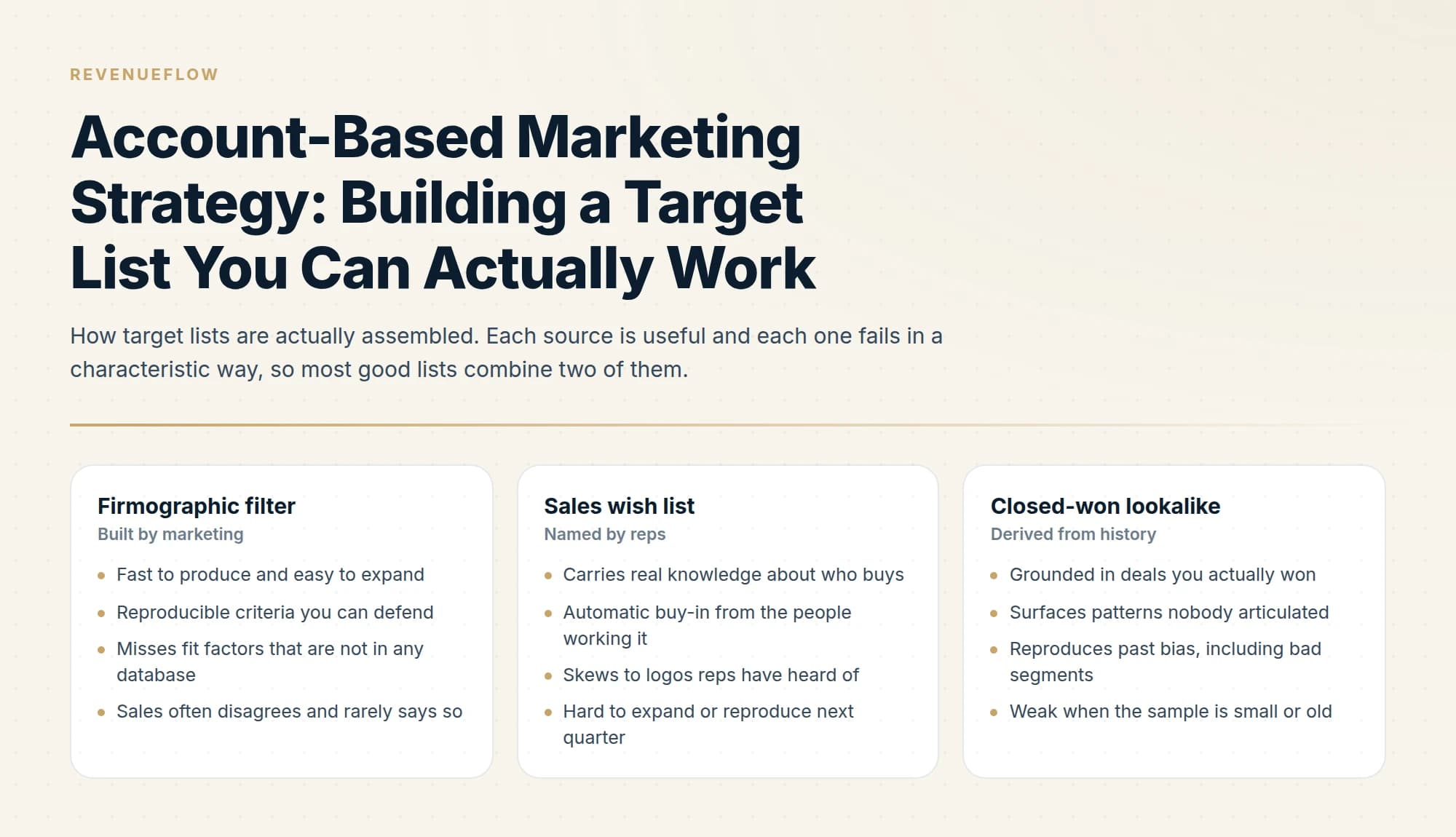
Three ways lists get built, and what each one gets wrong
- Fast to produce and easy to expand
- Reproducible criteria you can defend
- Misses fit factors that are not in any database
- Sales often disagrees and rarely says so
- Carries real knowledge about who buys
- Automatic buy-in from the people working it
- Skews to logos reps have heard of
- Hard to expand or reproduce next quarter
- Grounded in deals you actually won
- Surfaces patterns nobody articulated
- Reproduces past bias, including bad segments
- Weak when the sample is small or old
The combination that works is a closed-won analysis to find the pattern, firmographic filters to expand it into a candidate set, and a sales review to cut it. Each step covers a different weakness.
Start with the pattern. Pull every deal won in the last eighteen to twenty-four months and look for what the buyers shared: size band, industry, structure, the trigger that opened the conversation, and the role that sponsored it. Then look at closed-lost with the same eye, because the segments you consistently lose in are as informative as the ones you win.
Our guide to defining an ideal customer profile covers that analysis in detail. The output you need here is a written set of inclusion criteria specific enough that two people applying them to the same company reach the same verdict.
The sign-off that makes the list survive
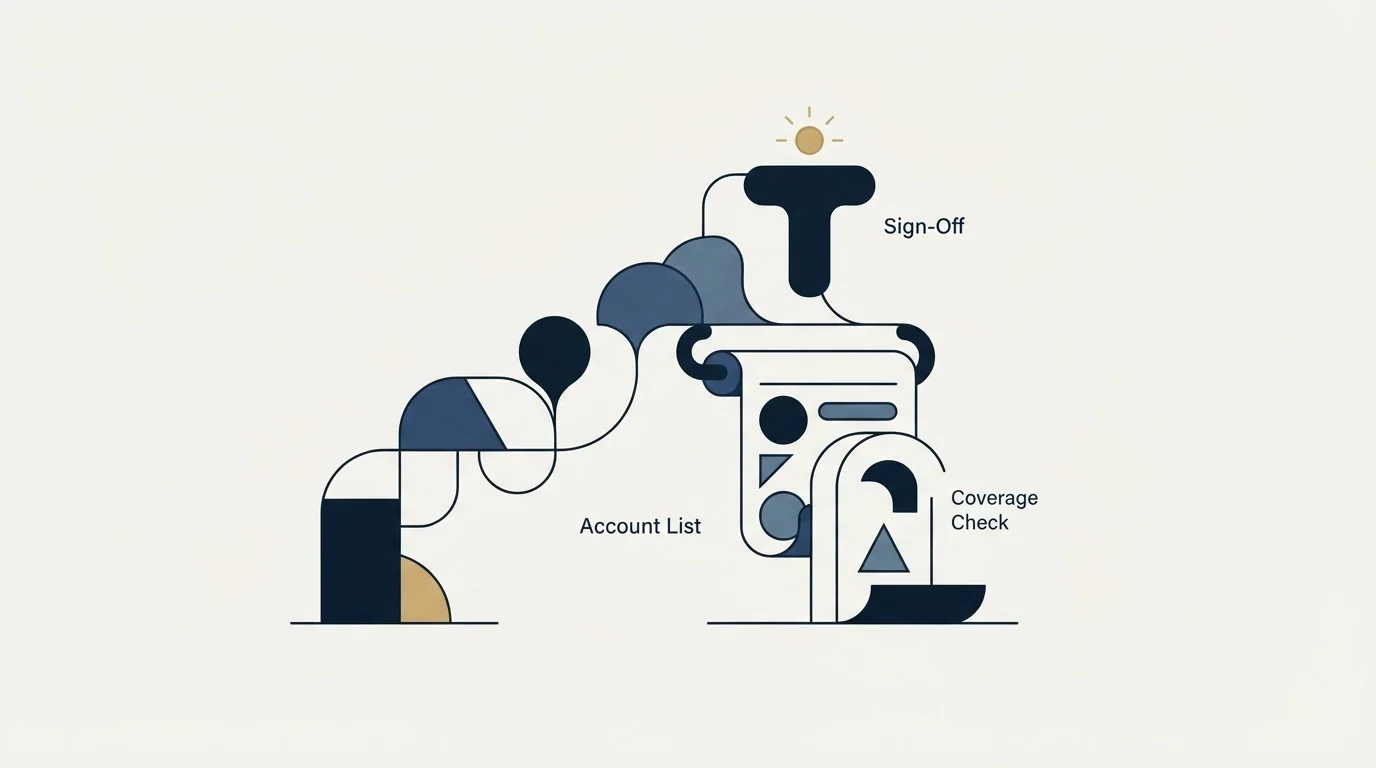
A list with no owner in sales is a list that gets abandoned at the first bad meeting.
Name one person in sales who signs off on the target list and whose sign-off is recorded. Not a committee, not a shared document with comments, one name attached to a version. The value of this is not bureaucratic. It removes the most common failure mode in account-based programmes, which is a six-month review that concludes ABM does not work in your market when what actually happened is that half the list was never believed in.
Give that person a real veto and a real obligation. They can cut accounts, and they have to say why, because the reasons are how the criteria improve. Record the cuts.
- Step 1Derive the pattern
Analyse closed-won and closed-lost for shared attributes and triggers.
- Step 2Write the criteria
Inclusion and exclusion rules specific enough for two people to apply identically.
- Step 3Measure contact coverage
For each candidate account, can you reach the buying group? Coverage caps everything downstream.
- Step 4Review and cut with sales
One named owner, recorded reasons, a versioned list.
- Step 5Set the revision cadence
Decide now how often the list changes and on what evidence.
Coverage is the step that changes the plan
Step three deserves its own section because it is where a good-looking list becomes a real one.
For every candidate account, the question is whether you hold, or can obtain, verified contact details for people in the buying group at the titles that matter. Not a company record. A person you can reach.
Teams planning to reach these contacts through a mainstream ESP should see how Brevo's cold email restrictions treat purchased or scraped lists before building the send.
Run that check before the list is finalised, and the result almost always reshapes the tiers. Accounts with deep coverage can support multi-contact plays. Accounts with one reachable contact can support exactly one. Accounts with none are not targets yet, they are a data project, and pretending otherwise means paying for orchestration against companies nobody can contact.
Coverage also gives you an honest denominator for later reporting. A programme aimed at 200 accounts that can reach buyers at 60 of them is a 60-account programme, and reporting it as 200 makes every rate look worse than it is.
Where the account data comes from
Building the candidate set is a sourcing problem, and the sources have different failure characteristics that are worth knowing before you pick one.
Your own CRM is the best source and the one people skip because it feels like cheating. Closed-lost, disqualified-too-early, churned customers and accounts a rep touched once two years ago are all real companies that passed some version of a fit check already.
Firmographic databases expand a pattern into a candidate set quickly. Their weakness is that employee counts and revenue figures are frequently stale or modelled rather than reported, so a size band filter is noisier than it looks. Treat the output as candidates, not as verified accounts.
Signal sources identify companies doing something you care about right now: hiring for a role, opening a location, adopting a technology, raising money. These produce smaller, better lists, and they date quickly, which is a feature if you work them promptly. Our guide to intent signal APIs for outbound covers the sources.
Manual research by someone who knows the market beats all three on precision and does not scale past a few hundred accounts. Use it on the top tier, where precision is the whole point.
Most good lists use the first source for the pattern, the second for reach, and the third to decide who to work first.
Exclusions belong in the list, not in the review
Build the exclusion set at the same time as the inclusion criteria, and load it as suppression rather than relying on anyone to spot problems later.
Existing customers, unless the play is deliberately expansion. Live opportunities already owned by a rep. Partners, resellers, and anyone with a commercial relationship. Competitors. Accounts a rep is protecting for a reason they can state. Every one of these is cheaper to remove once, structurally, than to catch during a campaign.
This is also the answer to the client or executive who wants to review the whole list before anything runs. The legitimate concern behind that request is almost always relationship risk, and a suppression list answers it completely without a review cycle that delays launch by weeks.
Tier the list, then decide what each tier gets
Mapping every company that could use the service and then splitting it into a first and second tier is the exercise this section describes, and the split only earns its keep if the two tiers get genuinely different treatment rather than the same campaign at two priorities.
Tiering only means deciding how much work each account is worth.
The top tier gets named research and account-specific assets, and it should be small enough that you can list it from memory. The middle tier gets clustered treatment, grouped by a shared trigger or use case rather than by industry alone, because a shared trigger gives you something to say. The bottom tier gets direct contact with a good message and nothing bespoke.
The failure here is buying top-tier treatment for middle-tier accounts. Bespoke research pays back when deal size and win probability fund it, which in practice means a number of accounts you can name in a room. Everything else is a cluster.
Once the tiers are set, what each one actually runs is the next question, and five ABM campaign examples and how each one is built fills in the plays, the ownership and the exit condition at each tier.
What each tier needs in the way of assets is a separate planning problem, and we cover it in ABM content strategy for a 50-account list.
A worked example of tier sizing
Take a team with one marketer producing content and two reps working accounts, and a 300-account candidate set.
The named tier is capped by research and asset production, so it is whatever one person can produce for alongside their other work. Call it six accounts, refreshed quarterly. That is a real constraint and writing a larger number down does not change it.
The middle tier is capped by clusters rather than accounts, because assets are shared. Four clusters at roughly twenty-five accounts each is one hundred accounts served by four sets of assets, which the same marketer can produce in a quarter.
Everything remaining, just under two hundred accounts, sits in the long tail and receives direct contact with a strong segment message and accurate fields. No bespoke production at all.
The instructive part of that arithmetic is where the accounts go: the overwhelming majority sit in a tier that gets no custom assets, and the programme is still coherent. Teams that refuse the long tail end up either cutting the list to fit their production capacity, which discards real opportunities, or promising bespoke treatment they cannot deliver, which stalls the launch.
Revision, or the list rots
Decide the revision cadence before launch, because a list nobody revises is a set of assumptions that hardens into a budget.
Monthly is right for most programmes. Three things trigger a change. An account responds in a way that promotes or demotes it. Contact coverage improves or collapses. Or a criterion turns out to be wrong, which shows up as a whole segment behaving differently from the rest of the list.
That last one is the valuable case and the one that gets missed. If a segment consistently fails to engage, the question is whether the criteria are wrong rather than whether the copy is. Fixing criteria improves everything downstream at once.
- Yes: Inclusion and exclusion criteria are written down
- Yes: One named person in sales has signed off on the list
- Yes: Contact coverage has been measured per account, not estimated
- Yes: Suppression covers customers, live opportunities, partners and competitors
- Yes: Each tier has a defined treatment and a capacity limit
- Yes: A revision cadence and trigger set exist in writing
- No: The list was expanded to hit a round number
Turning the list into motion

A finished list does nothing until something contacts it. The cheapest way to convert a list into information is direct contact across the whole thing, which tells you within weeks which accounts are reachable and which framing lands. The four plays that survive contact with a real pipeline covers the sequencing, and the ABM agency buyer's guide covers what to ask if you are buying the execution rather than building it.
If the direct contact half is the piece you would rather hand over, that is the half we run on a pay-per-qualified-meeting basis, and you can see what a campaign against your list would look like.
The short version
Size the list against production capacity, derive the criteria from deals you actually won, measure contact coverage before you finalise anything, and get one named person in sales to sign the list. Then revise it monthly on evidence. A list built that way survives its first bad month, which is the only real test of an account-based strategy.
Frequently asked questions.
Frequently asked questions- How do you decide which accounts belong on an ABM list?
- Start with deals won in the last eighteen to twenty-four months and find what the buyers shared: size band, industry, structure, trigger and sponsoring role. Turn that into written inclusion criteria specific enough that two people applying them reach the same verdict. Expand with firmographic filters, then let one named person in sales cut it.
- Should the client or sales team review the whole prospect list?
- The legitimate concern behind that request is relationship risk, and a suppression list answers it completely. Load existing customers, live opportunities, partners, resellers and competitors as structural exclusions before launch. That removes the reason for a list review cycle, which is consistently the largest single cause of launch delay.
- How often should a target account list be revised?
- Monthly suits most programmes. Three things trigger a change: an account responds in a way that promotes or demotes it, contact coverage improves or collapses, or a criterion turns out to be wrong. The last case is the valuable one, because fixing criteria improves everything downstream at once rather than one account at a time.
- What is contact coverage and why does it matter?
- Coverage is the share of target accounts where you hold verified contact details for people in the buying group at the titles that matter. It caps everything the programme can do, and it gives you an honest denominator for reporting. A programme aimed at 200 accounts that reaches buyers at 60 is a 60-account programme.
About the author.

Ben Carden is CRO at RevenueFlow, which builds and operates outbound revenue engines for B2B companies. Previously at Gartner Enterprise. Studied at London School of Economics.
Ben Carden · CRO
Connect on LinkedIn →Explore more.
Ready to scale your outreach?
We build GTM engines that book real meetings. See the receipts.
Related articles.
ABM vs ABX: What Demandbase Added to the Model
One of these terms belongs to a vendor. What Demandbase says ABX adds, the three things that genuinely change, and the three that stay identical.
ABM Reporting: Three Readers, Three Cadences
ABM reporting built around who reads it: a weekly operating page, a monthly allocation page and a one-page quarterly board report, each computed from CRM fields.
ABM Metrics: Coverage Decides Every Other Number
Every published ABM metric is a ratio whose denominator somebody chose. Six numbers, the denominator each one needs, and the comparison that settles it.
5 ABM Campaign Examples and How Each One Is Built
Five worked account-based campaign examples, each built on the same five fields: account set, tier, plays in order, owner and handoff, and the exit condition.
Goldcast Belongs to Cvent Now: The Buying Question
Cvent announced its Goldcast acquisition in December 2025 and completed its ON24 acquisition in April 2026. Two shortlist names, one owner, one live contract question.
Lead Generation Statistics: The Denominator Nobody States
One roundup lists the same budget statistic twice in different words, and three list one finding under three different attributions. The genre explains itself.