Account-Based Marketing Agency: What You Get, What It Costs
A buyer's guide to ABM agencies: the five workstreams they own, how retainer and programme pricing really compare, and when in-house beats hiring.
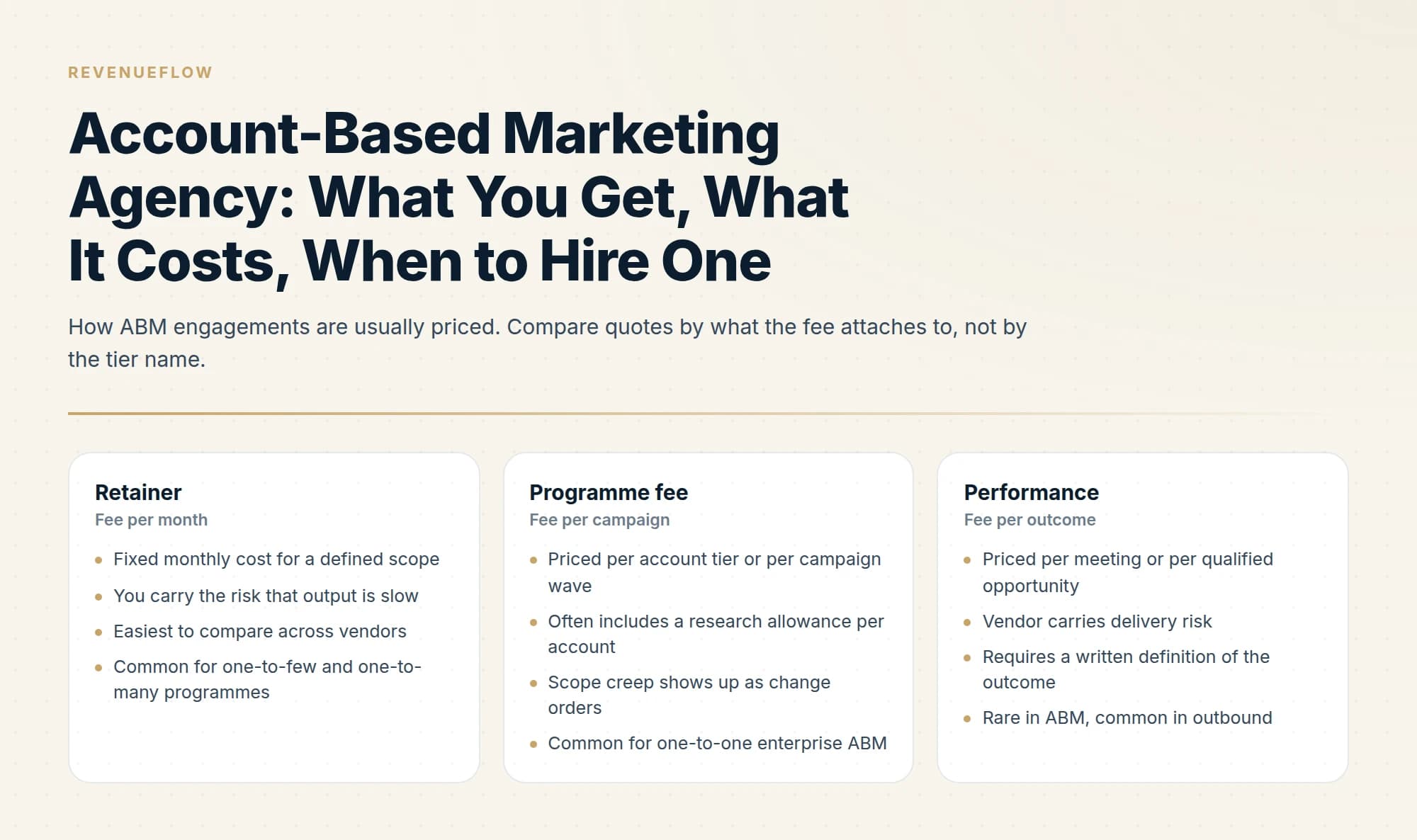
Account-based marketing agency pricing comes in three models: a monthly retainer, a programme fee per campaign or tier, and a rarer performance fee per outcome. Published figures vary widely: WebFX lists paid-media ABM from $525 a month plus ad spend, and Gigawatt Group publishes enterprise ranges from $5,000 to $120,000+ a month.
Key takeaways
- ABM agency fees attach to one of three things: a month of scoped activity, a campaign or account tier, or a defined outcome such as a qualified meeting.
- WebFX publishes paid-media ABM packages at $525, $650 and $825+ a month in management, with ad spend paid to the networks on top and a six-month commitment.
- Gigawatt Group publishes enterprise programme ranges of $5,000 to $15,000 a month for pilots and $40,000 to $120,000+ for one-to-one programmes.
- The biggest cost driver is the tier: one-to-one research and creative per account costs far more per account than one-to-few or one-to-many.
Reviewed and updated September 18, 2026
Most companies that go looking for an account-based marketing agency are trying to solve a problem they have described to themselves wrongly. They have a list of accounts they want, outbound that is not reaching them, and a suspicion that ABM is the missing ingredient. Sometimes it is. Often the actual gap is a target list nobody has agreed on, and no line of agency pricing covers that: an agency will happily bill for six months of orchestration on top of the unresolved question.
Where the real constraint is still unclear, diagnosing the SaaS marketing bottleneck helps identify which discipline needs hiring before any shortlist starts.
This is a buyer's guide to that decision. What an ABM agency does, what the engagement models cost, and the specific conditions under which hiring one beats doing the same work with your existing team.
What is an account-based marketing agency?
An account-based marketing agency is an outside team that runs marketing and sales motion aimed only at a named list of target accounts, instead of attracting a wide audience and qualifying downward. Depending on the agency, it owns some of five jobs: choosing the accounts, researching them, producing the creative, running the channels, and measuring movement inside those accounts.
Account-based marketing inverts the normal demand-generation order. Instead of attracting a wide audience and qualifying downward, you name the accounts you want first, then build coordinated marketing and sales motion aimed only at those accounts. The account list is the campaign.
An agency operating this model typically owns some combination of five workstreams.
The distinction that matters commercially is between agencies that own account selection and agencies that inherit it. An agency that takes your list and runs channels against it is a media and production partner. An agency that builds the list, defends it, and revises it as data comes back is doing the strategy work. The second is more expensive and more often the thing that was actually missing.
Account-based marketing agency pricing: the three models
Account-based marketing agency pricing comes in three models: a monthly retainer for a defined scope, a programme fee per campaign or account tier, and a performance fee per meeting or qualified opportunity. Published figures differ by an order of magnitude because the label covers different products: WebFX lists paid-media ABM management from $525 a month, while Gigawatt Group publishes enterprise programme ranges up to $120,000+ a month.
ABM pricing is not standardised, and the labels agencies use are inconsistent. The useful way to compare quotes is by what the fee is attached to.
A retainer prices activity, and ABM activity is genuinely expensive to produce, so the model is not unreasonable. It does mean the vendor is paid the same whether the account list converts or not, which puts the burden on you to define what progress looks like before month one.
What two agencies actually publish
Two agencies that publish figures are worth reading closely, and their numbers should not be averaged.
WebFX's ABM pricing page lists three packages built on paid media. Try ABM is $525 per month with $850 to $2,500 a month in ad spend paid to the networks, targeting through LinkedIn. Scale ABM is $650 per month with $2,500 to $5,000 in ad spend and adds Google Ads or Bing targeting, and Enterprise is $825+ per month for ad spend above $5,001. The page's table adds an initial one-month campaign investment of $2,500 on Try and $2,800 on Scale, then the monthly management fee on a six-month commitment.
Gigawatt Group, an agency selling enterprise programmes, publishes ranges instead: pilot programmes at $5,000 to $15,000 a month, mid-scale one-to-few programmes at $15,000 to $40,000, and enterprise one-to-one programmes at $40,000 to $120,000+ a month. It describes performance-based pricing as less common and often hybrid.
As illustrative arithmetic on WebFX's own figures, six months of Try ABM is $2,500 plus five months at $525, or $5,125 in management, plus at least $5,100 in ad spend at $850 a month: $10,225 over six months. Six months of Gigawatt's pilot range is $30,000 to $90,000. Both are sold as ABM, and they buy different things: a managed LinkedIn campaign against an account list, or research and personalised creative per account.
| Source | What it prices | Published figure |
|---|---|---|
| WebFX, Try ABM | Management, plus ad spend paid to networks | $525 a month; $850 to $2,500 ad spend |
| WebFX, Scale ABM | Management, plus ad spend | $650 a month; $2,500 to $5,000 ad spend |
| WebFX, first month | Initial campaign investment | $2,500 on Try, $2,800 on Scale |
| Gigawatt, pilot | Limited accounts, initial testing | $5,000 to $15,000 a month |
| Gigawatt, enterprise | One-to-one, full personalisation | $40,000 to $120,000+ a month |
If you want the equivalent breakdown for standard outbound rather than ABM, we published the cost structure separately in our lead generation agency cost guide, and the demand generation agency comparison covers where the two motions overlap.
One-to-one, one-to-few, one-to-many
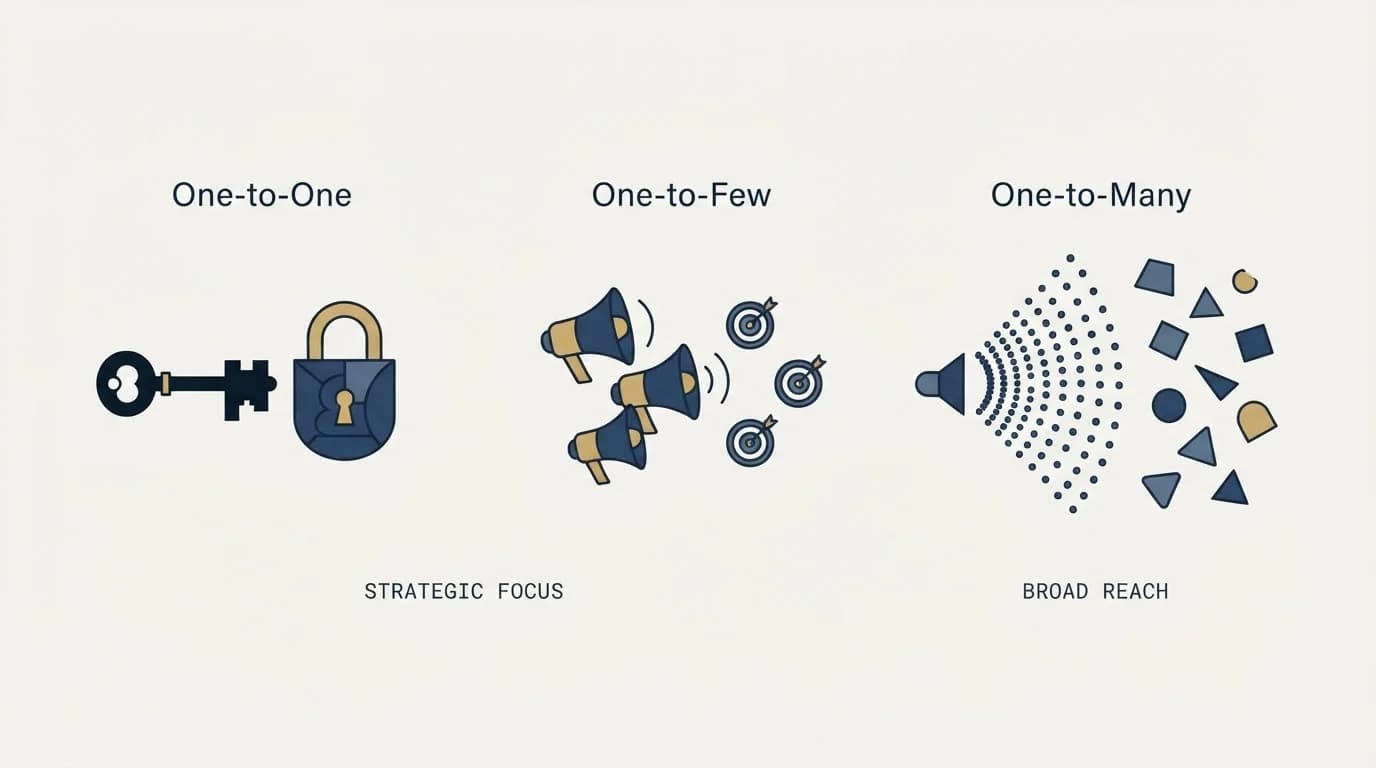
The tiers describe how many accounts share a single piece of creative, and they drive cost more than any other variable.
One-to-one means bespoke research and creative for a single named account, reserved for a handful of strategic targets. One-to-few shares creative across a cluster of accounts with a common trigger, industry or use case. One-to-many applies programmatic personalisation across a large segment and is the closest of the three to conventional demand generation.
Cost per account falls sharply as you move down that list, and so does the depth of the personalisation. The tier decision is really a budget-allocation decision dressed up as a strategy decision.
The failure mode here is buying one-to-one for accounts that do not justify it. Bespoke research per account only pays back when the deal size and win probability are high enough to fund it, which in practice means a small number of accounts you can name in the room. If your target list is 400 companies, you are buying one-to-few or one-to-many regardless of what the proposal calls it.
When hiring an agency is the right call
Hiring one fits when these conditions hold:
- You can name the accounts, or you have the data to build the list credibly.
- Deal sizes justify per-account research spend.
- Sales and marketing already agree on what a qualified account looks like.
- You have creative and content capacity to feed the programme, or are buying it too.
- You do not need the pipeline this quarter.
- Your CRM data is clean enough to measure account engagement.
The pipeline-this-quarter condition is the one that catches people. ABM is a long-cycle motion aimed at accounts with long buying processes, and the honest agencies say so on the first call. If the requirement is meetings inside a quarter, that is an outbound problem, and buying ABM to solve it produces an expensive programme that reports engagement metrics while the pipeline gap stays open.
The CRM condition is the most common silent blocker. Account engagement scoring depends on being able to join web activity, campaign response, and CRM records to the same account. Where that join does not exist, the programme cannot report the thing it is supposed to report, and you get activity summaries instead.
What to ask before signing
Four questions separate the agencies that will move your pipeline from the ones that will produce a well-run programme with no commercial effect.
Who owns the account list, and what happens when it is wrong? Ask how the list gets revised, on what evidence, and how often. An agency with no revision mechanism is treating your list as fixed input, which means any error in it persists for the length of the contract.
What is the reporting unit? Impressions and engagement scores are inputs. Ask to see the account-level reporting they would actually send you, from a live client, with the names removed. If the answer is a dashboard tour rather than a document, the reporting is thinner than the pitch.
Which channels do they own versus subcontract? ABM programmes commonly span paid social, display, outbound email, and sometimes direct mail. Agencies rarely execute all of those in house. Subcontracting is fine. Not knowing it is happening is not.
What is the ramp? Account research, creative production, and audience build all precede the first impression. Ask for the week-by-week plan to first touch and to first reported engagement, and treat a vague answer as a schedule risk you will absorb.
The order is fixed: list signed off, buying-group research, creative production, first touches, then reporting with enough data to revise the list. Press hardest on the creative stage, because first touch has to wait for it.
Measuring a programme that has no leads in it

ABM breaks conventional marketing reporting, because the conventional unit is the lead and ABM does not primarily produce leads. It produces movement inside accounts. Agencies know this, which is why ABM reporting tends to fill up with engagement scores that rise reliably and mean very little.
Four measures carry actual information.
Account coverage. What share of the target list has any known contact in the buying group, with valid contact data. A programme aimed at 200 accounts where you hold usable contacts for 60 is a 60-account programme with a 200-account invoice.
Buying group depth. How many distinct people inside each target account have engaged. Enterprise purchases involve committees, so one engaged contact at fifty accounts is a weaker position than four engaged contacts at fifteen. This number moving up is the clearest early sign that a programme is working.
Meeting rate by tier. Held meetings divided by accounts worked, reported separately for one-to-one, one-to-few and one-to-many. Blending the tiers hides the thing you most need to know, which is whether the expensive tier is earning its premium over the cheap one.
Pipeline created, with the attribution question left open. ABM influence models are generous by construction, because every touch on an account that later buys can be claimed. Ask for pipeline created from target accounts alongside pipeline from non-target accounts over the same period. The comparison is cruder than an attribution model and considerably harder to flatter.
What none of these require is a new platform. Coverage and depth come out of your CRM, and the tier comparison is arithmetic. If an agency says the reporting needs their platform to work, ask what the platform measures that the CRM cannot.
Platform choices inside such a programme can turn on ownership rather than features, and two shortlist names now under one owner are what a webinar evaluation has to weigh.
The in-house comparison nobody runs
Before comparing agency quotes to each other, compare the winning quote to the cost of the same work internally. The components are a person to own the programme, the research time per account, creative production, and media budget. Media budget is the same either way. Research and creative are where agencies have genuine leverage, because they have done it before and have the production capacity idle between clients.
Comparing internal cost against an agency quote raises a related question worth checking against a published example of how retainer tiers price capacity rather than outcomes.
Where agencies have the least leverage is account selection, because that depends on knowledge of your market, your existing customers, and which deals your team actually wins. That knowledge lives in your CRM and in your sales team's heads. An agency can structure it and challenge it. It cannot originate it.
This is why the ideal customer profile work is worth doing before the agency search rather than as the first agency deliverable. You will pay for it either way, and doing it first means you can evaluate proposals against a list you already believe in.
Three ways these engagements go wrong
The list nobody owns. Marketing builds a list from firmographic filters, sales quietly disagrees with half of it, and neither says so out loud because the programme has already started. Six months later the review concludes that ABM does not work in your market. The fix is a named person in sales who signs off on the list and whose sign-off is recorded.
Creative that arrives after the audience does. Media goes live because the contract started, and the account-specific creative is still in production, so the first weeks run generic assets against a targeted list. That is expensive demand generation. Sequence the ramp so that first touch waits for the creative, and accept a later start date.
Reporting that measures the agency instead of the market. Impressions delivered, assets produced, accounts touched: all real, all things the agency controls, none of them evidence that anything changed. If every metric in the monthly report is an input the agency chose, the report cannot tell you whether to renew.
Where ABM and outbound meet

The two motions are frequently sold as alternatives and are better understood as different resolutions of the same problem. ABM narrows the audience and increases the investment per account. Outbound holds investment per account low and widens the audience. The same target list can support both, and on most account lists it should.
The practical version: run outbound against the whole list to find which accounts respond at all, and reserve the expensive per-account treatment for the accounts that show signal. That ordering uses cheap signal to allocate expensive attention, rather than committing the research budget before you know which accounts are reachable. Intent and engagement signals feed the same decision, and we covered the data side of that in the B2B intent data guide.
At RevenueFlow we run the outbound half of that motion on a pay-per-qualified-meeting basis, which means the meeting definition gets agreed in writing before anything sends. If that is the half of the problem you are trying to solve, you can see what a campaign would look like for your market.
The short version
Hire an ABM agency when you have a defensible account list, deal sizes that fund per-account work, and a sales organisation that agrees on what a good account looks like. Buy strategy and research if the gap is knowing who to target, and buy production and orchestration if the gap is capacity. Compare quotes by what the fee attaches to rather than by tier names. And if the requirement is pipeline this quarter, solve that with outbound first, then use what it teaches you to build the account list the ABM programme will run on.
Pricing and features are taken from the vendors' own pages. Verify current terms with the vendor before relying on them.
Frequently asked questions.
Frequently asked questions- What is an account-based marketing agency?
- It is an outside team that runs marketing and sales motion aimed only at a named list of target accounts, rather than attracting a wide audience and qualifying downward. Depending on the agency it owns some of five jobs: choosing the accounts, researching them, producing the creative, running the channels, and measuring movement inside those accounts.
- How does account-based marketing agency pricing work?
- Fees attach to a month of scoped work, a campaign or tier, or an outcome, and the figures depend on what the label covers. WebFX's pricing page lists paid-media ABM management at $525 a month on its Try package, plus $850 to $2,500 a month in ad spend and a $2,500 first month. Gigawatt Group publishes enterprise programme ranges from $5,000 to $15,000 a month for a pilot up to $40,000 to $120,000+ for one-to-one.
- Is an ABM agency better than doing it in house?
- Agencies have real leverage on research and creative, because they have done it before and have production capacity between clients. They have the least leverage on account selection, which depends on your customers and which deals your team actually wins. Doing the ideal customer profile work first lets you judge proposals against a list you already believe in.
- How long before an ABM programme shows results?
- The ramp runs in a fixed order: list and criteria signed off, buying-group research, creative production, first touches, and only then reporting with enough data to revise the list. ABM is a long-cycle motion aimed at accounts with long buying processes, so if the requirement is meetings inside a quarter, that is an outbound problem rather than an ABM one.
About the author.

Ben Carden is CRO at RevenueFlow, which builds and operates outbound revenue engines for B2B companies. Previously at Gartner Enterprise. Studied at London School of Economics.
Ben Carden · CRO
Connect on LinkedIn →Explore more.
Ready to scale your outreach?
We build GTM engines that book real meetings. See the receipts.
Related articles.
ABM vs ABX: What Demandbase Added to the Model
One of these terms belongs to a vendor. What Demandbase says ABX adds, the three things that genuinely change, and the three that stay identical.
5 ABM Campaign Examples and How Each One Is Built
Five worked account-based campaign examples, each built on the same five fields: account set, tier, plays in order, owner and handoff, and the exit condition.
ABM Metrics: Coverage Decides Every Other Number
Every published ABM metric is a ratio whose denominator somebody chose. Six numbers, the denominator each one needs, and the comparison that settles it.
Lead Generation Statistics: The Denominator Nobody States
One roundup lists the same budget statistic twice in different words, and three list one finding under three different attributions. The genre explains itself.
ABM Reporting: Three Readers, Three Cadences
ABM reporting built around who reads it: a weekly operating page, a monthly allocation page and a one-page quarterly board report, each computed from CRM fields.
Lead Verification: What Each Check Actually Proves
Lead verification covers two different jobs. One asks whether a mailbox will accept mail, the other asks whether the person behind the row is real and lawful to contact.