B2B Intent Data: What It Predicts, Which Providers Pay Off
Intent data predicts that an account is researching a topic more than usual. That is the whole signal. What the providers cost, and why most programs disappoint.
Intent data is worth paying for only when outbound already converts, first-party signal is being acted on, and someone can respond within days. It predicts one thing: an account is reading more about a topic than usual. It does not predict revenue alone; revenue follows fast action on ICP-fit accounts.
Key takeaways
- Third-party intent says an account is researching a topic more than usual; which person, budget and timing are inference on top.
- First-party signal, such as pricing page visits, is sharper and cheaper than any co-op feed and should be acted on first.
- Bombora, 6sense and G2 publish no list price for intent data, so the useful figure is the quote divided by the ICP-fit accounts you would act on.
- Each signal needs an action, an owner and a response window, from 24 hours for a pricing page visit to 72 for a topic surge.
Reviewed and updated September 19, 2026
Intent data is worth paying for only when three things are already true: your unprioritised outbound converts at a defensible rate, you act on the first-party signal you already own, and someone can respond to a surge within days. What intent data predicts is narrow: that an account is reading more about a topic than it usually does. It does not predict revenue on its own. Revenue follows when that signal is acted on quickly, on accounts that already fit.
Providers stretch the term well past that, and the intent data definition states plainly what the signal establishes and what it never does. Teams that understand the narrow version get real value from it. Teams that expect it to hand them buyers get a five-figure annual contract and a dashboard nobody opens.
Is Intent Data Worth Paying For?
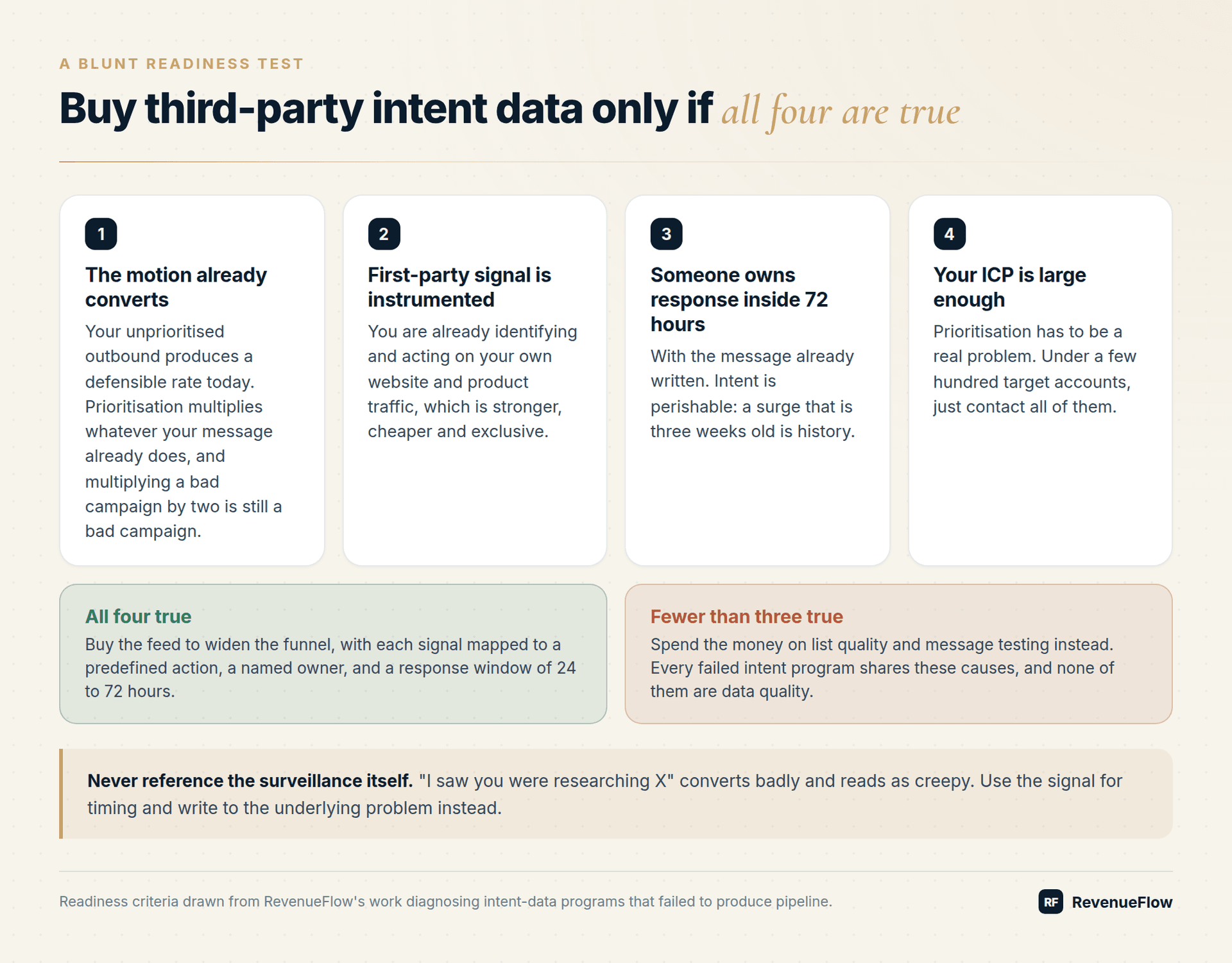
For most teams, not yet. Third-party intent is a timing and prioritisation layer: it tells you which accounts to work first, not who to write to or what to say. It pays when the rest of the motion already works and needs ordering, and it disappoints when it is bought to fix a motion that does not. A blunt readiness test, before any contract:
- Your unprioritised outbound already converts at a defensible rate.
- You have instrumented first-party signal and are acting on it.
- Someone owns response inside 72 hours, with a sequence already written.
- Your ICP is large enough that prioritisation is a real problem. Under a few hundred target accounts, just contact all of them.
If fewer than three are true, spend the money on list quality and message testing instead. The 7-layer GTM AI stack sets out the order these layers should be built in.
Does B2B intent data actually work? It works as far as its signal goes: on ICP-fit accounts, worked within days, it moves the order in which a team spends its time. It does not work as a list source, a targeting method or a substitute for an offer worth answering, and most disappointing programs asked it to be one of those.
What Intent Data Predicts, And What It Does Not
Intent data predicts one thing reliably: that an account has recently consumed more content about a topic than it usually does. Everything else, including which person is interested, whether budget exists and whether anyone is buying this quarter, is inference layered on top by you or by a vendor's model.
So what intent data predicts revenue? The signal closest to your own product predicts best: a person-level visit to your pricing page beats a review-site comparison view, which beats a category surge on a publisher network. The further the signal sits from you, the more it depends on fit and speed to become pipeline.
Marketing data provider is the umbrella term this market is shopped under, and it covers three purchases that behave differently. Audience and firmographic data tells you who exists, intent data tells you who has been reading, and identity resolution tells you who is already on your own site. Contact records are a fourth purchase with its own comparison in the data enrichment tools guide. The newer name for the motion is warm outbound, meaning outreach triggered by a signal rather than drawn from a static list, and the activation problems below are the same ones under the newer label.
First-Party Versus Third-Party Intent
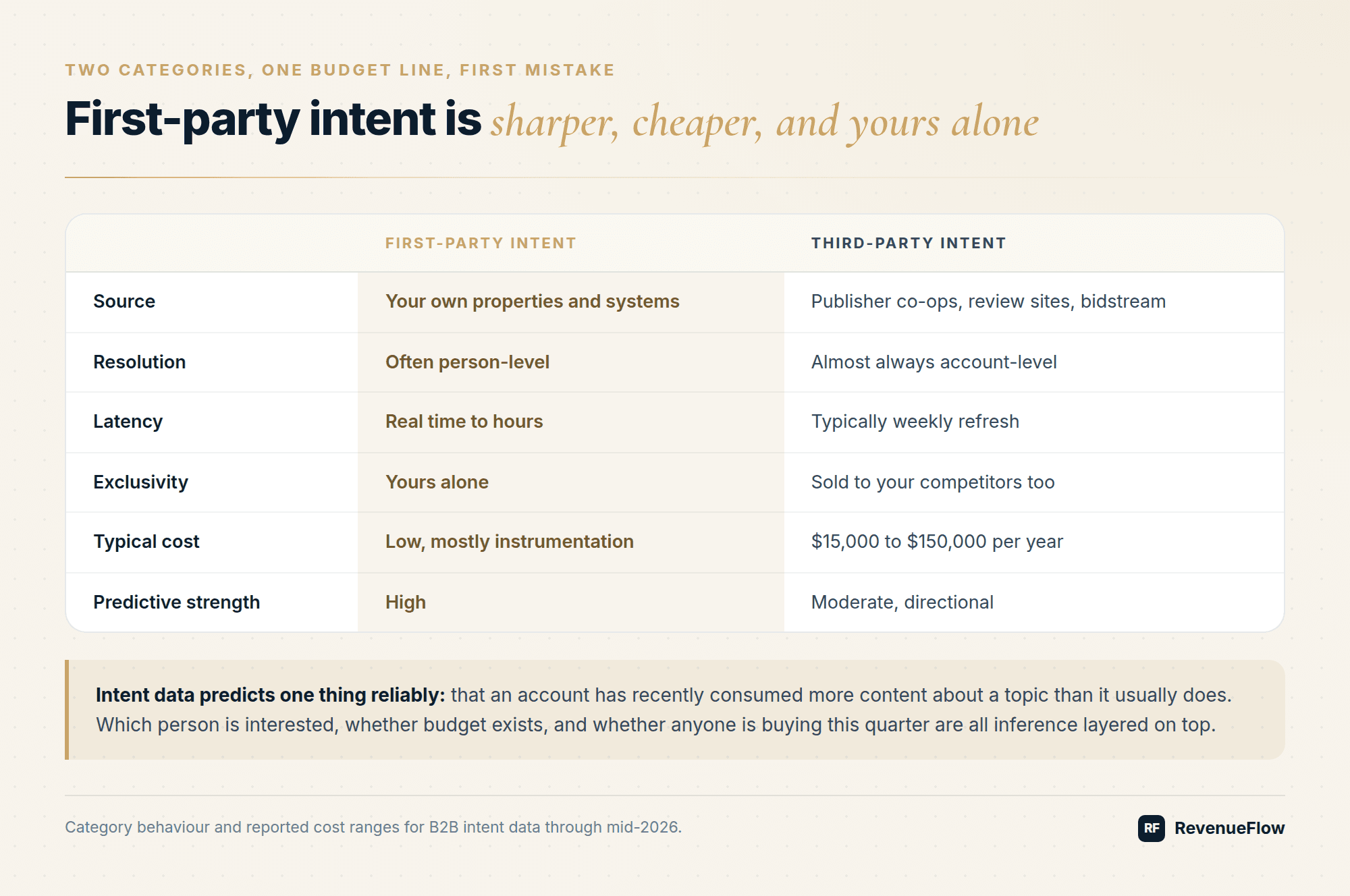
Both spellings describe one purchase: third-party intent data, often written 3rd party intent data, is the account-level feed bought from a publisher co-op or a review site, and the table below is what separates it from the first-party signal you already own. Treating the two as one budget line is the first mistake.
| First-party intent | Third-party intent | |
|---|---|---|
| Source | Your own properties and systems | Publisher co-ops, review sites, bidstream |
| Resolution | Often person-level | Almost always account-level |
| Freshness | Real time to hours | On the provider's refresh schedule |
| Exclusivity | Yours alone | Sold to your competitors too |
| Price | Mostly instrumentation | Quoted by the provider, rarely published |
| Predictive strength | High | Moderate, directional |
First-party intent is your pricing page views, docs and changelog traffic, repeat visits, free-trial behaviour, email engagement, and views of your own review-site listing. It is stronger than anything you can buy, because the account is already looking at you. Most companies underinstrument it and then pay for third-party data to compensate. Platform-native intent signals, such as the buyer intent HubSpot surfaces from its own tracking, are first-party data under another name.
How Third-Party Intent Is Produced
Three mechanisms, and knowing which one you are buying tells you what the data can support.
Publisher co-ops. Bombora's Company Surge is the reference implementation. Bombora's homepage says its Company Surge intent data "reflects real research across 16B+ monthly events and 5M+ company domains", gathered through a co-op of publishers and resolved to companies. The output is a surge score rather than a raw volume. Bombora also lists featured partners that include Apollo, The Trade Desk, Reddit and Adobe, so the same signal can reach you through more than one vendor, and buying two can mean buying one signal twice.
Review and comparison sites. G2's seller site says its verified intent signals "show who's researching your product, category, or competitors in real time", and that the signals can be plugged into Salesforce, HubSpot and Marketo. Narrower coverage than a co-op, and much closer to purchase.
Predictive platforms. 6sense's pricing page puts third-party intent, web visitor identification and a predictive AI model with scores and dashboards inside its packages. You are buying the model and the orchestration, not just the signal.
What The Providers Publish About Price
Shortlists of buyer intent data tools mostly re-rank the same few purchases, so the useful question is not which vendor ranks highest but which mechanism you are buying and whether a platform you already pay for includes it.
| Provider | What it sells | Price on its page |
|---|---|---|
| Bombora | Company Surge co-op intent | None; "Speak to an expert" |
| 6sense | Three packages with intent inside | None; each card books a demo |
| G2 Buyer Intent | Activity on your G2 profile and category | None on its page; free 30-day look back |
| ZoomInfo | Intent beside its contact data | UNVERIFIED: page not readable |
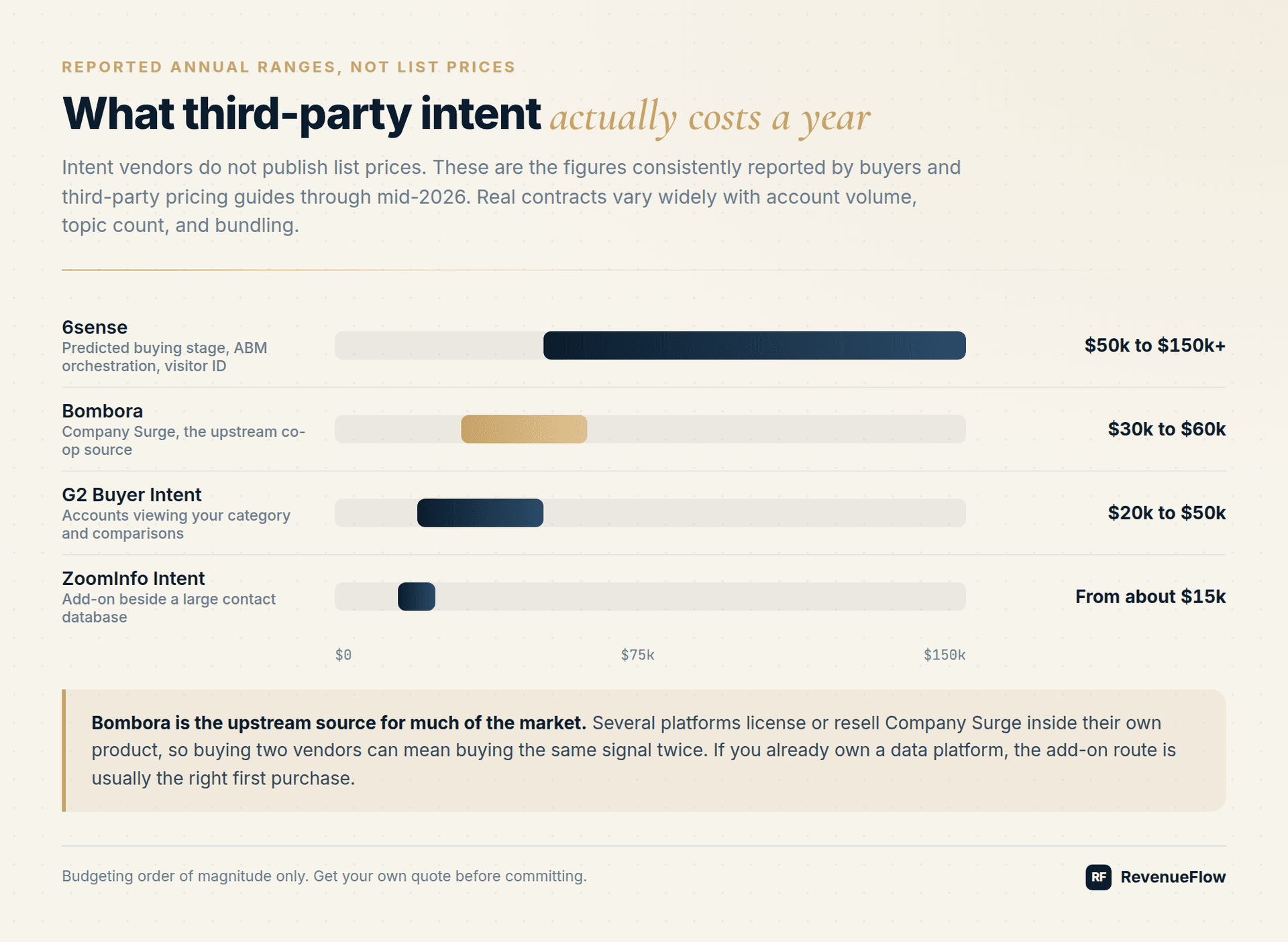
How much does enterprise-grade intent data cost per account, then? No provider above publishes a per-account or per-topic rate, so the honest answer is the quote you get, divided by the number of ICP-fit accounts you would actually act on. That second number is usually far smaller than the account volume the quote is sized on, which is the figure worth negotiating.
The chart below carries the annual ranges this guide has shown since it was published, which were reported secondhand rather than published by any of these vendors. None of them could be checked against a vendor page, so read them as UNVERIFIED orders of magnitude and get your own quote. If you already own a data platform, the add-on route is usually the first thing to price, and best ZoomInfo alternatives compares the underlying data layers.
Why Intent Data Disappoints
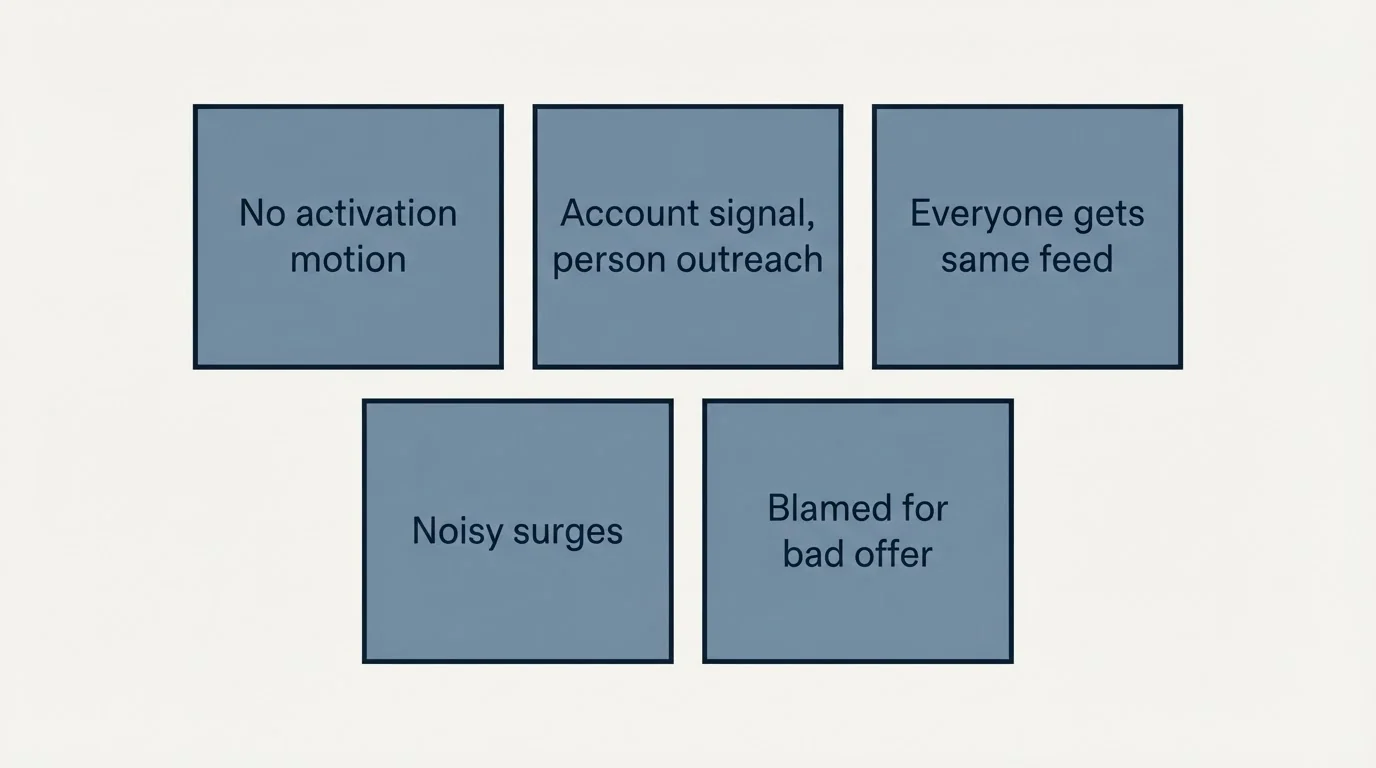
Every failed intent program we have seen shares the same causes, and none of them is data quality.
No activation motion exists. The account list arrives on the provider's schedule and lands in a spreadsheet. Intent data is perishable: a surge that is three weeks old is history. If there is no sequence ready to fire within days, the signal has no way of becoming pipeline.
That activation gap is exactly what sequencing software closes, and sales engagement platforms for SaaS teams compares the options built for fast, multi-channel follow-up.
Account-level signal, person-level outreach. The feed says Acme is researching your category. It does not say who. You still have to pick contacts, and if you pick the wrong five people you get the same reply rate as an unprioritised list. Intent narrows the account set; it does not write the list. Ordering an existing list so the surging accounts get worked first is what the signal supports; building the list from it is not, because the accounts a co-op reports are the accounts it can resolve rather than the accounts that fit.
Everyone gets the same feed. Your competitors buy the same co-op. Being first to a surging account is an operational advantage, not an informational one, and it is won by speed of response.
Surges are noisy. Job seekers, students, analysts, consultants and your own employees all generate content consumption from a corporate IP. Filter to ICP-fit accounts before you look at scores, never after.
It gets blamed for a bad offer. Prioritisation multiplies whatever your message already does. Doubling an illustrative 0.4 percent reply rate is still a bad campaign. Fix the motion first; 4 frameworks that fix broken lead generation covers the diagnosis.
An Activation Model That Works
Intent data pays off when each signal has a predefined action, an owner and a time limit. Write the table before you sign the contract.
| Signal | Action | Owner | Response window |
|---|---|---|---|
| Third-party topic surge on an ICP-fit account | Add to a targeted sequence with a category-relevant angle | Outbound | 72 hours |
| Person-level website visit on a pricing page | Direct outreach referencing the relevant problem, not the visit | AE or founder | 24 hours |
| Repeat visits from multiple people at one account | Multithread across the buying group | AE | 48 hours |
| Competitor comparison page view on a review site | Competitive displacement angle | AE | 24 hours |
| Surge with no ICP fit | Ignore, and exclude the account from scoring | Nobody | None |
Two rules make this work in practice. Never reference the surveillance itself: "I saw you were researching X" converts badly and reads as creepy. And keep the response window short enough that the signal is still true when the message lands. The channel matters less than the speed, which is why we run intent-triggered accounts through both email and LinkedIn outbound at the same time rather than one after the other.
Bottom Line
Third-party intent data is a timing and prioritisation layer, sold by quote, that returns nothing without an activation motion behind it. First-party signal is cheaper, sharper and almost always under-exploited. Build the motion, instrument your own traffic, then buy the co-op feed to widen the funnel.
If you want the motion built before the data spend, get a free campaign plan and we will show you what your current list and message produce first.
Pricing and features are taken from the vendors' own pages. Verify current terms with the vendor before relying on them.
Frequently asked questions.
Frequently asked questions- Is intent data worth paying for?
- Only when three things are already true: unprioritised outbound converts at a defensible rate, first-party signal is instrumented and acted on, and someone can respond to a surge within days with a sequence ready. Under a few hundred target accounts it is rarely worth it, because contacting every account is cheaper than ranking them.
- What intent data predicts revenue?
- The signal closest to your own product predicts best. A person-level visit to your pricing page outranks a comparison view on a review site, which outranks a category surge on a publisher network. Third-party intent predicts reading, not buying, and becomes revenue only when it is acted on quickly for accounts that already fit.
- How much does enterprise intent data cost per account?
- Providers do not publish per-account rates: Bombora, 6sense and G2's buyer intent pages show no list price. The workable figure is the quoted annual contract divided by the ICP-fit accounts your team would act on, which is usually far fewer than the account volume the quote is sized on.
- Does B2B intent data actually work?
- It works as a prioritisation layer: on ICP-fit accounts worked within days, it changes the order in which a team spends its time. It fails as a list source, a targeting method or a fix for a weak offer, which is where most disappointing programs went wrong. Response speed decides more than data quality does.
About the author.

Fernando Cao is CEO at RevenueFlow, which builds and operates outbound revenue engines for B2B companies. Previously at Accenture Strategy. Studied at University of Bath.
Fernando Cao · CEO
Connect on LinkedIn →Explore more.
Ready to scale your outreach?
We build GTM engines that book real meetings. See the receipts.
Related articles.
Old GTM vs New GTM: What Changed in the Last Two Years
Most teams still run the 2019 playbook: buy a list, load a sequencer, hire BDRs. Here is the signal-based model that replaced it, and the honest cost of switching.
What Is a GTM Engineer? The Role, the Stack, the Pay
A GTM engineer builds the systems that produce pipeline. The role, the day-to-day ownership, the stack by layer, verified salary ranges, and how to hire one.
How to Build an ICP That Changes Your Target List
Most ICPs never change the target list. Here is the count test, the five inputs, a worked TAM, SAM and SOM example with full arithmetic, and an eight-field worksheet.
Anthropic's Labour Market Report Is a Management Story
The interesting number is not what the models can do. It is the gap between that and what companies have actually built into how they operate. That gap is an org-design problem, not a talent problem.
The 7-Layer GTM AI Stack for 2026 (The Order Matters)
Your outbound will plateau this year. Not because of the tools you picked, but because of the order you stacked them in. Each layer caps every layer above it.
The 20-Tool Sales Stack That Built a $50M Pipeline
We helped one FinTech founder secure meetings with a $3.25B CEO and build a $50M+ investment pipeline. Here's every tool in the stack, and how they work together.