Intent Data: What the Signal Establishes, and What It Does Not
Intent data shows that content consumption on a topic has risen above normal at an identified account. First-party signal comes from surfaces you own and often resolves to a person; third-party signal is bought, resolves to a company, and is sold to competitors too. It orders a list that is already filtered for fit, and it cannot build one.
Key takeaways
- The signal establishes rising topic consumption at an account, and nothing about who inside it is interested or whether budget exists.
- First-party intent is stronger than anything on sale, because the account is looking at you and nobody else can see it.
- It is a sequencing decision about accounts, not a targeting decision about people: filter for fit first, then order by signal.
- A surge is perishable, so a feed with no response motion behind it is paying for a report.
Intent data is behavioural information about which topics a company or a person has recently been researching, collected from a website you own or bought from a third party, and used to decide who to contact and when. What it establishes is narrow and specific: that consumption of content on a topic has risen above its own normal level, at an identified account.
Everything else people want from it, which person is interested, whether budget exists, whether anyone is buying this quarter, is inference laid on top by a vendor's model or by you. Holding that boundary is the whole difference between a useful signal and a five-figure subscription nobody opens.
The two kinds, which behave nothing alike
The category covers two purchases that share a name and almost no properties.
First-party intent is behaviour on surfaces you own: pricing-page views, documentation traffic, repeat visits, trial activity, email engagement, your own listing on a review site. It is often resolvable to a person, it arrives in close to real time, nobody else has it, and it is the stronger of the two by a wide margin, because the account is already looking at you rather than at your category.
Third-party intent is bought. Publisher cooperatives, review sites and bidstream data are resolved to a company, compared against that company's own historical baseline for a topic, and delivered as a score. It is account-level rather than person-level, it refreshes on a schedule rather than continuously, and your competitors can buy the same feed.
- Often resolves to a named person
- Arrives in close to real time
- Nobody else has it
- Only exists for people already in contact with you
- Mostly an instrumentation cost rather than a licence fee
- Resolves to a company, not a person
- Refreshes on a schedule
- Sold to your competitors as well
- Reaches accounts that have never visited you
- A subscription, priced as one
The asymmetry matters more than it looks. Third-party intent is the half that gets budgeted, and first-party intent is the half that is usually left uninstrumented, so companies routinely buy a weaker signal to compensate for a stronger one they already generate and do not collect.
How a third-party score is produced
Three mechanisms sit behind the feeds on sale, and knowing which one you are buying tells you what the data can support.
Publisher cooperatives aggregate content-consumption events across many B2B publishers, resolve them to companies, and compare each company's reading against its own baseline for that topic. The output is a surge rather than a raw volume, which is why a large enterprise reading normally does not outrank a small company that has suddenly started reading everything about your category. Several platforms license the same upstream cooperative data and sell it inside their own product, so buying two vendors can mean buying one signal twice.
Review and comparison sites report accounts viewing your category, your listing, or a comparison against a competitor. Narrower coverage than a cooperative and considerably closer to a purchase decision.
Predictive platforms layer a model on top of licensed cooperative data, website de-anonymisation and your own history, and output a predicted buying stage per account. What is being bought there is the model and the orchestration around it rather than the raw signal.
Why it matters, and how it fails
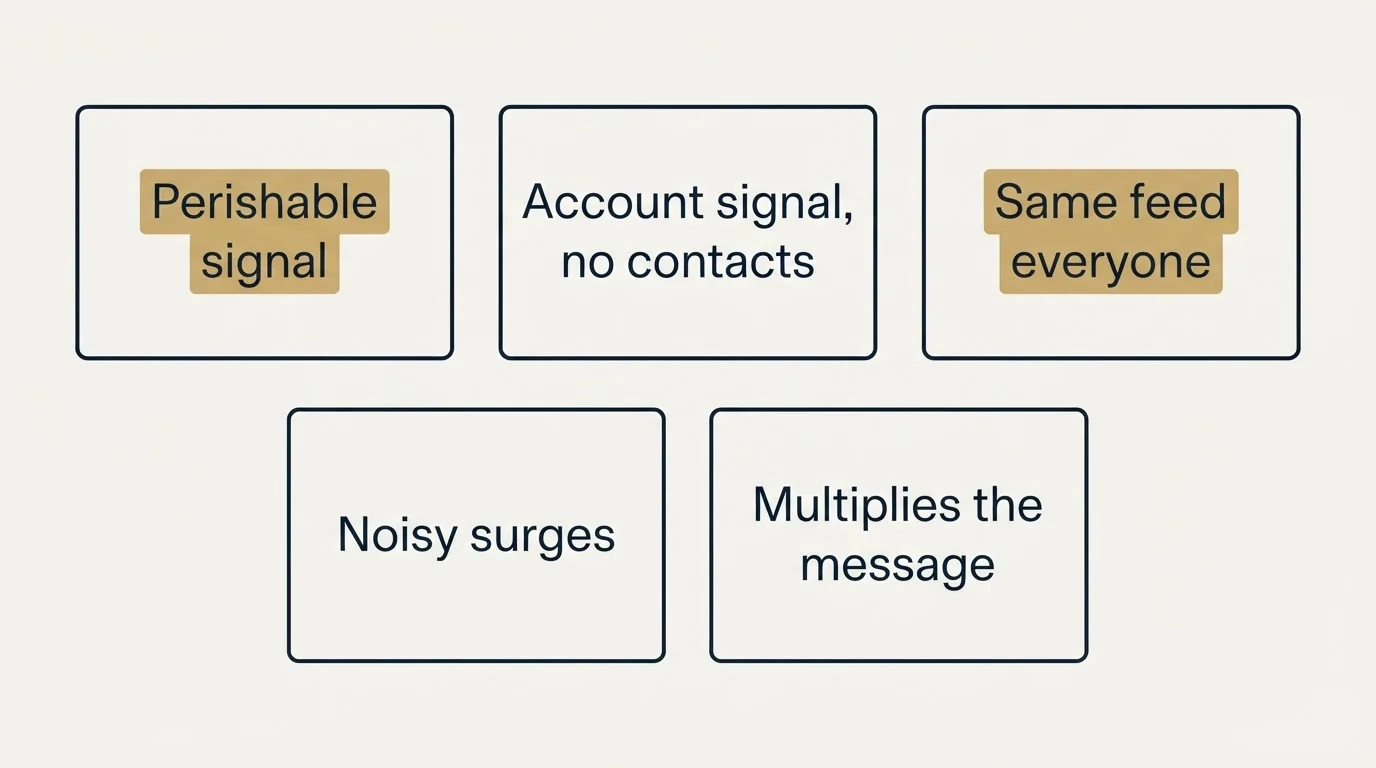
The failure mode is not bad data. It is a signal arriving somewhere with no motion attached to it.
It is perishable, and a weekly file is not a motion. A surge that is three weeks old describes a research burst that has probably finished. If nothing is ready to act within days, the signal has no path to becoming a conversation, and the subscription is paying for a report.
Account-level signal does not write a contact list. The feed says a company has been reading about your category. It does not say who, and picking the wrong five people inside that company produces the same result as not having the signal at all. Intent narrows the account set; the people still have to be chosen, and that choice is where most of the outcome sits.
Accounts surfaced this way get sold as intent leads, and the phrase flatters what the feed actually produced: a lead is a named person somebody can work, and turning a surging account into one means choosing the seats inside it, checking them against the profile, and recording which signal put the account on the list.
The same feed is on sale to everyone in your category. Being early to a surging account is an operational advantage rather than an informational one, and it is won by how fast you respond rather than by what you know.
Surges are noisy. Job seekers, students, analysts, consultants and your own staff all generate content consumption from a corporate address. Filtering to companies that fit before reading any score is the difference between prioritising and chasing.
It multiplies whatever the message already does. Prioritisation applied to a weak offer produces a slightly better weak offer. A programme that is not converting for reasons of fit or positioning does not get fixed by knowing who to send it to sooner, and the diagnosis belongs in the frameworks that fix broken lead generation rather than in a data purchase.
- Depends: Outreach that ignores intent already converts at a rate you would defend
- Depends: First-party signal is instrumented and somebody acts on it
- Depends: A named person owns the response, with copy already written
- Depends: The response window is days rather than weeks
- Depends: The target market is large enough that prioritising is a real problem
- Depends: Accounts are filtered for fit before any score is read
That fifth item deserves its own sentence. Prioritisation only has value when there are more good accounts than capacity. Below a few hundred target companies there is nothing to prioritise, because the honest answer is to contact all of them, and the money is better spent on the list and the message.
How it is used in outbound

Intent data is a sequencing decision about accounts, not a targeting decision about people, and being precise about which of those you are making is the practical difference between the version that works and the version that does not.
Ordering an existing, fit-screened list so that surging accounts get worked first is what the signal genuinely supports, and the speed of that response is a property of the sending machinery rather than of the feed, which is the argument in sales engagement tools for B2B SaaS teams. It costs nothing beyond the feed, it does not depend on the data knowing who inside the account was reading, and it is reversible if the signal turns out to be weak.
Building the list from the signal is not supported. A cooperative reports the accounts it can resolve, which is a different population from the accounts that fit what you sell, and a list assembled that way inherits the vendor's resolution coverage as its targeting logic. Fit comes first, from the criteria in your ideal customer profile, and intent reorders what survives it.
Varying the message by predicted buying stage is the third use and the least defensible at account level, because it assumes the feed knows which person was reading and it does not.
Two rules make the difference in the copy itself. Never reference the surveillance: a message opening with an observation that the reader has been researching your category reads badly and converts worse, whatever the signal says. And keep the response window short enough that the premise is still true when the message lands, which usually means days.
Our own position constrains how we use it, and it is worth stating rather than implying. We run one message per campaign, built on one premise and sent once, so a surge is a reason to build a campaign for that account set now rather than a reason to add a touch to a sequence already running. The signal changes the timing and the audience of a campaign; it does not become a second attempt at somebody who has already had one.
- Step 1Fit first
Filter to companies that match the written profile, before any score is read
- Step 2Order by signal
Sequence the surviving accounts so the surging ones are worked first
- Step 3Choose the people
Pick the seats inside the account deliberately, because the feed cannot
- Step 4Write on a premise
One reason the conversation exists, never a reference to the signal itself
Where the textbook definition misleads
The received description is that intent data tells you who is in market. Three qualifications turn that into something you can act on.
Rising consumption is not intent to buy from you. A company reading about a category may be evaluating, writing a report, hiring into the area, or renewing with an incumbent. The signal is correlated with a purchase and does not observe one.
A score is relative to that company's own baseline, which makes it incomparable between companies. A surge at a company that reads nothing is a smaller absolute quantity of reading than a normal week at a company that reads constantly. That is the design working, and it means a score is a ranking within a feed rather than a measurement of anything.
Exclusivity is the property people assume and third-party data does not have. The reason first-party signal is stronger is not that it is better collected. It is that the account is looking at you, and nobody else can see it.
Related terms
Lead scoring is the model intent signals are usually fed into, and its own entry explains why fit and intent should not be summed into one number. Firmographic data and technographic data are the attribute layers intent sits on top of. Inbound lead is what first-party intent turns into when the person identifies themselves. And lead qualification is the judgment no feed replaces.
The short version
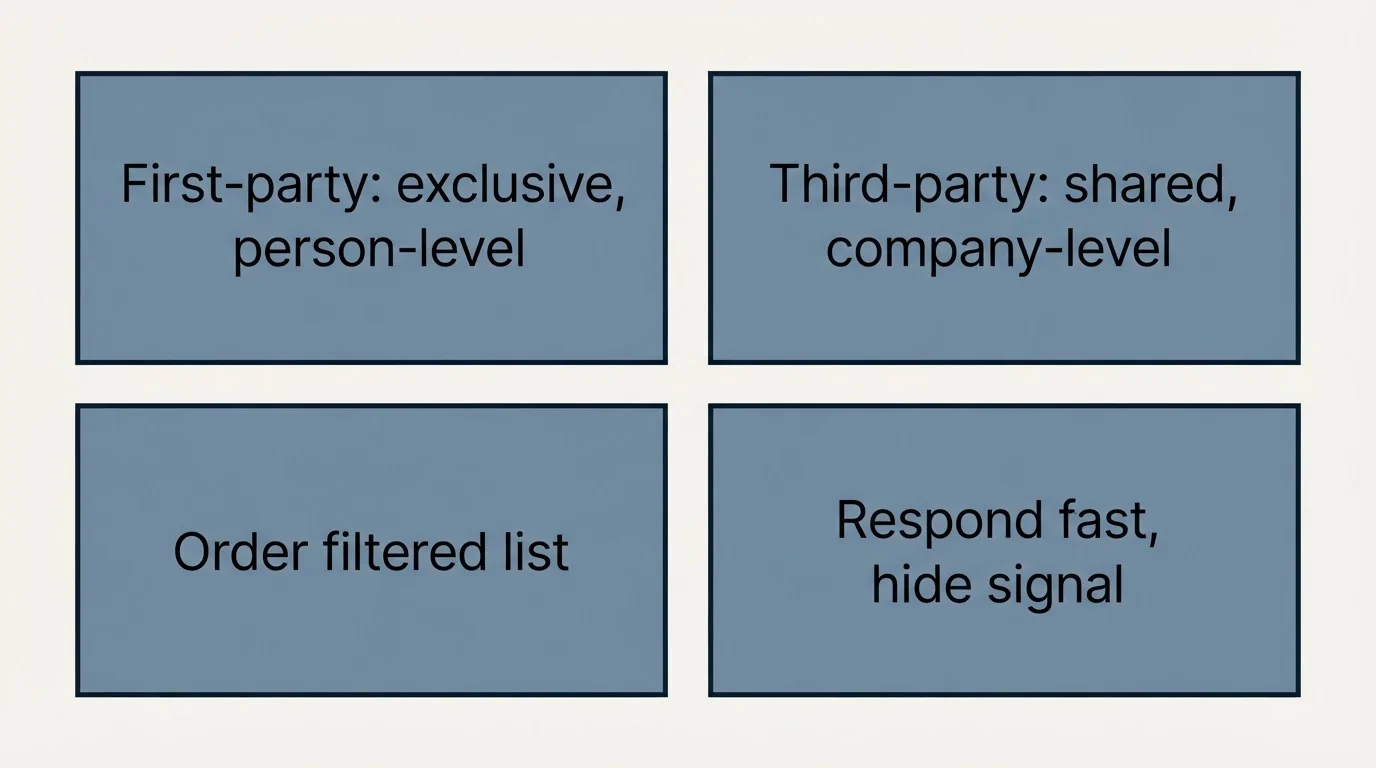
Intent data reports that content consumption on a topic has risen above normal, at an identified account. First-party signal comes from your own surfaces, resolves to a person, and is exclusive to you. Third-party signal is bought, resolves to a company, and is on sale to your competitors.
Use it to order a list that has already been filtered for fit, never to build one. Respond in days rather than weeks, choose the people yourself, and never mention the signal in the message. If outreach without it is not converting, the feed will not fix that, and the money buys more in the list and the copy.
Which providers sell which of the three mechanisms, and what they cost, is set out in our B2B intent data guide. If the constraint is the motion rather than the signal, see what one campaign produces.
Frequently asked questions.
Frequently asked questions- What is the difference between first-party and third-party intent data?
- First-party intent is behaviour on surfaces you own, such as pricing-page views, documentation traffic and trial activity. It often resolves to a person, arrives in near real time, and is exclusive to you. Third-party intent is bought from publisher cooperatives or review sites, resolves to a company rather than a person, refreshes on a schedule, and is available to your competitors as well.
- Can you build a target list from intent data?
- No, and trying to is the common failure. A cooperative reports the accounts it can resolve, which is a different population from the accounts that fit what you sell, so a list built that way inherits the vendor's coverage as its targeting logic. Filter to companies matching your written profile first, then use the signal to decide which of the survivors gets worked first.
- Should you mention the intent signal in the outreach?
- No. Opening with an observation that the reader has been researching your category reads as surveillance and converts badly, whatever the data says. Use the signal to decide timing and audience, then write the message on a premise that stands on its own: something true about their business that would make sense even if the signal had never existed.
- When is intent data not worth buying?
- When the target market is small enough that you can contact all of it, because there is nothing to prioritise. Also when outreach without it is not converting, since prioritisation multiplies whatever the message already does. In both cases the same money buys more in list quality and copy than in a subscription that arrives weekly.