Best Sales Engagement Tools for B2B SaaS Companies (2026)
Top sales engagement tools for b2b saas companies. Compare pricing, features, and recommendations for software companies selling to other businesses.
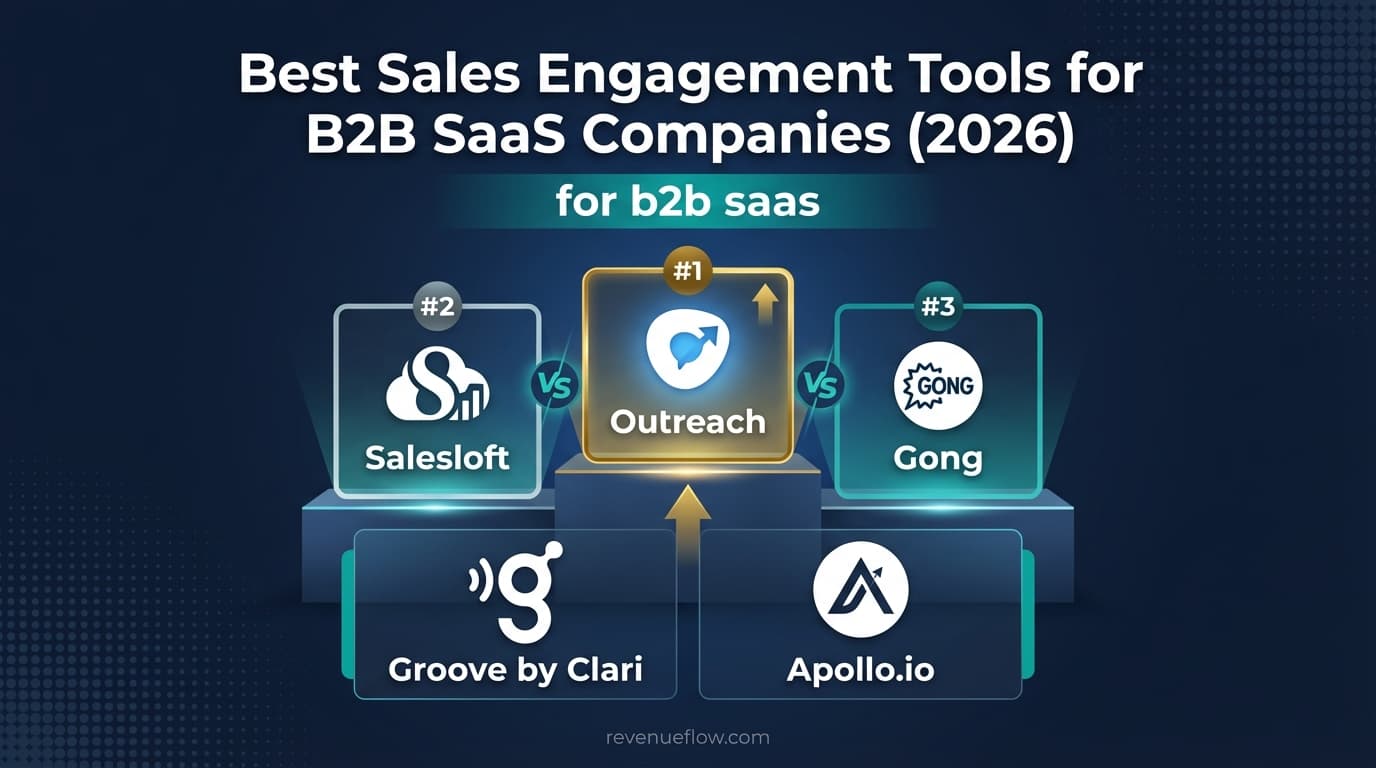
Revenue intelligence tools with the best consumption tracking for B2B SaaS are not on any vendor page fetched for this roster: Apollo, Salesloft and Gong never use the words, and Outreach uses consumption only for its own billing. Of the five tools here, only Apollo ($49 a seat) and Salesforce's Sales Engagement add-on ($50) print a price.
Key takeaways
- Only two of the five tools print a price: Apollo Basic at $49 per seat per month billed annually and Salesforce's Sales Engagement add-on at $50 per user; Outreach, Salesloft and Gong show a form.
- Sequences are not on the entry rung everywhere: Apollo lists them unlimited from Basic with one mailbox and 250 sends a day per seat, and Outreach lists them from Amplify Core, not Essentials.
- No Apollo, Salesloft or Gong page fetched mentions consumption or product usage; Outreach's consumption-based pricing describes how Outreach bills, not a customer-usage feature.
- Groove by Clari has left the shortlist as a new purchase: Clari and Salesloft merged on December 3, 2025, and Groove survives only as a login on Salesloft's site.
Reviewed and updated September 18, 2026
Only two of the five tools on this page print a price, and none of the five vendors' pages answers the search that brings many readers here, revenue intelligence tools with the best consumption tracking for B2B SaaS. Apollo's plan cards read $49, $79 and $119 a seat a month billed annually, and Salesforce's Sales Engagement add-on reads $50 a user a month; Outreach, Salesloft and Gong each show a form where the figure would be. That split is the first thing a B2B SaaS team should know before shortlisting B2B sales engagement software, and it is the frame for this list. The consumption question gets its own section below, answered with what the pages actually say, because no Apollo, Outreach, Salesloft or Gong page fetched for this roster publishes anything about tracking a customer's product consumption.
Since B2B SaaS overlaps heavily with the broader SaaS category, it helps to compare this list against the broader SaaS engagement tool roundup for additional context.
What B2B SaaS Companies Need From B2B Sales Engagement Software
A SaaS sales team runs the same four-job outbound loop as anyone else: build the list, send the message, work the replies, keep the record. What is different is the shape of the buyer. Trials convert or lapse on their own timeline, product usage decides whether an expansion conversation is real, and the CRM is usually HubSpot or Salesforce with the product's own event data somewhere beside it. So the questions to put to a sales engagement vendor are narrower than a feature grid suggests: does it publish a price a finance team can approve this week, on which rung do sequences actually start, what does it write back into the CRM, and does it say anything at all about product usage.
The house doctrine shapes one more question. RevenueFlow sends one message per campaign, with no thread replies and no bump step behind it, so a platform's multi-step cadence engine is mostly unused on a run like that and the list feeding it matters more than the sequencer. Read the five entries with that in mind: the sending side is table stakes on every one of them, and the differences are in packaging, price and what surrounds the send.
Top 5 Sales Engagement Tools for B2B SaaS Companies
1. Apollo.io
Apollo is the one platform on this page that a small SaaS team can price and start from its own page in an afternoon. Its pricing page renders a Free plan at $0 with "900 credits per seat per year, granted monthly" and "2 Sequences", then Basic at $49, Professional at $79 and Organization at $119 per seat per month billed annually, the last with a three-seat minimum. "Unlimited Sequences" arrive on Basic, along with a "Deliverability Suite & Email Warmup", and the compare table names "CRM Integrations (Salesforce, HubSpot, Pipedrive)", so it writes into the CRMs most SaaS teams already run, Salesforce and Pipedrive among them.
The published limit to read before signing is the mailbox row: "1 mailbox per user" and "250 emails" a day on Free and Basic, lifted to unlimited Google and Microsoft mailboxes with unlimited sends on Professional. The data side is metered separately, "Email 1 credit" and "Phone number 8 credits" from the seat's yearly grant, and the site describes its database as "240M contacts & 30M companies".
Deliverability matters just as much as outreach volume, so teams relying on cold email should also review these email warmup tools for consultants to keep sender reputation healthy.
2. Outreach
Outreach publishes four packages and not one price. Amplify Essentials carries "10,000 AI Credits", Core "25,000 AI Credits", Plus "50,000 AI Credits" and Pro "100,000 AI Credits", each behind a "Request pricing" button, and the page explains that "Outreach uses a combination of seat-based pricing and consumption-based pricing powered by AI credits." The word consumption there is about Outreach's own bill, which matters for the section below.
For a SaaS team the rung to notice is Core: "Multi-Channel Engagement & Sequences" first appears there, while the entry package is described as being "For teams that need conversation intelligence at the center of their stack". Pro adds the forecasting suite, "AI Forecast Projection" and a "Forecasting Scenario Planner". One address change is worth knowing: every www.outreach.io path now redirects to www.outreach.ai, so older links and searches land on the new domain.
3. Salesloft
Salesloft prints no plan and no figure on its pricing page or its plans page. Both addresses redirect to a page headed "Talk to sales" with a three-step booking flow, "Quick intro call", "Tailored walkthrough", "Follow up". Earlier versions of this roster listed Advanced and Elite tiers for Salesloft; no page fetched today carries those names, so they are not repeated.
What the site does publish is a product map. For account teams it lists Cadence, "Engage buyers at scale.", Conversation Intelligence, Deals and Rhythm; for revenue leaders, under the heading Revenue Intelligence, it lists Clari Forecast, Inspect and Analytics. That second column is the result of the Clari merger, which Salesloft's newsroom dates "Published: December 3, 2025", and it is why the Groove entry that used to sit fifth on this page reads differently now.
4. Gong
Gong is the revenue intelligence vendor on this list, and it publishes a pricing model rather than a price: "Licenses are priced per user", "There is a platform fee based on the number of users supported", and "You can integrate your existing tech stack for free." The page ends in a form for "a customized proposal". Its homepage lists the products a SaaS team would be buying, Gong Engage for sequencing, Gong Forecast, Gong Enable, Gong Revenue Graph and Gong AI.
Gong's own definition is the useful one for the search that brings people to this page: "Revenue intelligence platforms provide comprehensive visibility into buyer relationships and engagement activity across all touchpoints." Buyer relationships and engagement activity, from conversations and CRM data, is what the page describes capturing.
5. Salesforce Sales Engagement, and what happened to Groove
Groove by Clari held this slot as the Salesforce-native engagement tool. Clari and Salesloft completed their merger on December 3, 2025, the old Groove product address now returns a permanent redirect to Salesloft's sales engagement page, and Groove survives as a "Log in to Groove" entry on Salesloft's login menu rather than as a product page or a price. Salesloft's customer FAQ says there are no current plans for required migrations and that existing contracts and integrations are unaffected, so current Groove customers are not being moved, but a new SaaS buyer cannot read a Groove page or a Groove price anywhere today.
The Salesforce-native option that does publish a figure is Salesforce's own Sales Engagement add-on, priced on its own page at $50 per user per month billed annually under the line "Sell faster from within your CRM.", listing Sales Cadences, Work Queue, Lead Scoring, Einstein Conversation Insights, Buyer Assistant, Einstein Activity Capture and Prospecting Center. For a SaaS team already on Salesforce, that is the number a Salesloft or Outreach quote has to beat.
Which Revenue Intelligence Tools Have The Best Consumption Tracking For B2B SaaS?
None of them, on the evidence of their own pages. Every Apollo, Outreach, Salesloft and Gong page fetched for this roster, pricing pages and product pages alike, was searched for the words consumption and product usage. The only hits are on Outreach's pricing page, and every one of them describes Outreach's own billing: "consumption-based pricing powered by AI credits", "Pay based on actual AI usage", and a FAQ explaining that consumption "is measured based on discrete actions". That is how Outreach charges its customers, not a feature for tracking how a SaaS customer consumes a product.
What the revenue intelligence vendors do describe is engagement data. Gong's definition is visibility into "buyer relationships and engagement activity across all touchpoints", drawn from conversations, email and the CRM. Salesloft's Revenue Intelligence column, Clari Forecast, Inspect and Analytics, is about forecast accuracy and pipeline risk, and its platform page draws the line as "Standard revenue analytics surfaces what happened." Neither page names product telemetry, seat utilisation or feature adoption as an input.
Outreach, pricing page
"consumption-based pricing powered by AI credits". "Pay based on actual AI usage". A FAQ: consumption "is measured based on discrete actions". All of it describes how Outreach charges.
Billing model, not a feature
Gong, Salesloft, Apollo
Zero occurrences of consumption or product usage on any pricing or product page fetched. Gong describes "engagement activity across all touchpoints"; Salesloft lists Clari Forecast, Inspect and Analytics.
Not published
So a SaaS team that needs consumption tracking, meaning which accounts are using which features and how that trends before a renewal, is asking a question these five vendors' public pages do not answer. The honest next step is to put the question to the vendor in writing on a trial, and to plan on the product's own event data or a CRM field carrying that signal into whichever engagement tool is chosen, with the field owner agreed before the first sequence runs.
Comparison Table
| Tool | Price and where sequences start | Revenue intelligence on the page |
|---|---|---|
| Apollo.io | $0 Free, $49 Basic, $79, $119. Sequences: 2 on Free, unlimited from Basic | Not framed that way: data, sequences, dialer, deals |
| Outreach | None, Request pricing on four packages. Sequences from Amplify Core | Named in its nav; forecasting on Pro |
| Salesloft | None, Talk to sales. Cadence, no tier published | Clari Forecast, Inspect, Analytics |
| Gong | None, licences per user plus a platform fee. Gong Engage | Its own category: buyer engagement across touchpoints |
| Salesforce add-on | $50 per user per month, annual. Sales Cadences on the add-on | Einstein Conversation Insights on the add-on |
Recommendation by Budget
Free to start: Apollo's Free plan is $0, with two sequences per team and one mailbox per user, which is enough to prove the list before paying anything.
A published price the finance team can approve this week: Apollo Basic at $49 a seat, or, for a team already on Salesforce, the Sales Engagement add-on at $50 a user, each on annual billing. Move to Apollo Professional at $79 when one mailbox and 250 sends a day per seat no longer fit the wave.
A quote: Outreach from Amplify Core if sequences are the point, Salesloft if the Clari forecasting suite is wanted on the same contract, Gong if conversation capture and revenue intelligence come first and the sequencer second. Go into each conversation knowing the headcount and the published alternative's figure, because that is the number the quote has to justify.
How to Choose
Start with the constraint you can name, because each of the five answers a different one: a thin list, an unpriced budget line, a sending ceiling, disorganised follow-through after the reply, or a forecast nobody trusts. Then read the rung, since the entry price on every ladder here is not the price of the capability being compared; Apollo's sequences start on Basic and Outreach's on Core. Price a realistic year at your seat count rather than a headline, and on the quote-only vendors write the published alternative's figure into the brief before the call. Trial on the accounts you are actually selling to, because coverage and deliverability are properties of a segment, and measure the change in meetings booked against criteria agreed in writing before launch, which is the one number every tool on this page is trying to move.
Final Thoughts
For B2B SaaS companies the shortlist splits on whether a price is published. Apollo and Salesforce's add-on can be budgeted today; Outreach, Salesloft and Gong produce their number on a call, and Groove has left the shortlist as a product anyone new can buy. On consumption tracking, the five vendors' pages are silent, and a team that needs it should say so on the first call rather than assume it is in the box.
Healthcare vendors face extra hurdles like compliance and provider targeting, so it helps to see how tools tailored for healthcare sales stack up.
Recruiting agencies split their outreach between hiring companies and candidates, and sales engagement tools for recruiters treat those two audiences as separate problems.
Start a trial with your top two picks and evaluate them against your daily workflow for at least a week before making a commitment, on your own target list rather than the vendor's sample.
Related Reading
- Best Apollo.io Alternatives in 2026
- Best Salesforce Alternatives in 2026
- Best Pipedrive Alternatives in 2026
If you would rather have this run for you, RevenueFlow books qualified meetings on a pay-per-meeting basis and publishes client results.
Pricing and features are taken from the vendors' own pages. Verify current terms with the vendor before relying on them.
Frequently asked questions.
Frequently asked questions- Which revenue intelligence tools have the best consumption tracking for B2B SaaS?
- On their own pages, none of the five vendors here claims one. Every Apollo, Salesloft and Gong pricing and product page fetched for this roster was searched for consumption and product usage and returned nothing. Outreach's pricing page uses consumption only to describe its own AI-credit billing. Gong defines revenue intelligence as visibility into buyer engagement across touchpoints, which is conversation and CRM data rather than product telemetry.
- What is the best B2B sales engagement software for a SaaS startup?
- For a team that has to prove a list before spending, Apollo's Free plan is $0 with two sequences per team, and Basic at $49 a seat adds unlimited sequences and warmup, with one mailbox and 250 sends a day per seat until Professional at $79. For a team already on Salesforce, the Sales Engagement add-on at $50 a user is the published alternative to a Salesloft or Outreach quote.
- Do Outreach, Salesloft and Gong publish pricing?
- No. Outreach lists four Amplify packages with AI credit allowances from 10,000 to 100,000 and a Request pricing button on each. Salesloft's pricing and plans addresses both redirect to a Talk to sales page with a booking form. Gong's pricing page describes per-user licences and a platform fee based on the number of users, and ends in a form for a customized proposal.
- Is Groove by Clari still a sales engagement tool for Salesforce teams?
- Only for its existing customers. Clari and Salesloft completed their merger on December 3, 2025, the old Groove product address redirects to Salesloft's sales engagement page, and Groove appears on Salesloft's site as a login rather than a product page or price. Salesloft's customer FAQ says no migration is required today. A new Salesforce team looking for a native engagement layer should price Salesforce's own $50 add-on first.
About the author.

B2B cold email experts helping companies generate qualified leads through done-for-you outreach campaigns.
RevenueFlow Team
Explore more.
Ready to scale your outreach?
We build GTM engines that book real meetings. See the receipts.
Related articles.
Outbound Lead Generation Tools, Layer by Layer
Outbound tools do six jobs and price on different units: contacts, credits, seats, sends. Thirteen vendors read from their own pages on 18 September 2026, by layer.
Twain Pricing: Credits per Lead, Three Research Modes
Twain sells credits, not seats, and a lead costs 1 to 14 of them depending on the research mode. The two ladders, the four expiry clocks and the cap.
Lavender Pricing: Two Products, No Pricing Page
Lavender has no pricing page. The Email Coach ladder per seat at both billing states, the free routes, and the separate per-agent price for Ora.
Gong Engage vs Salesloft Cadence: How They Differ
Gong Engage and Salesloft Cadence compared from each vendor's own pages: where each starts, six jobs side by side, and what the pricing pages disclose.
PersistIQ Pricing: A Demo Form Where the Ladder Was
PersistIQ's pricing address serves a demo form and no platform price. What the site does publish, the Luka add-on ladder at both billing states, and how to read a quote.
Salesgear Pricing: Two Ladders Under One Plan Title
Salesgear's page is titled as one plan and carries a Data ladder and an Outreach ladder. Both at both billing states, what each meters, and the two vendor-side conflicts.