Outbound Lead Generation Tools, Layer by Layer
Outbound tools do six jobs and price on different units: contacts, credits, seats, sends. Thirteen vendors read from their own pages on 18 September 2026, by layer.
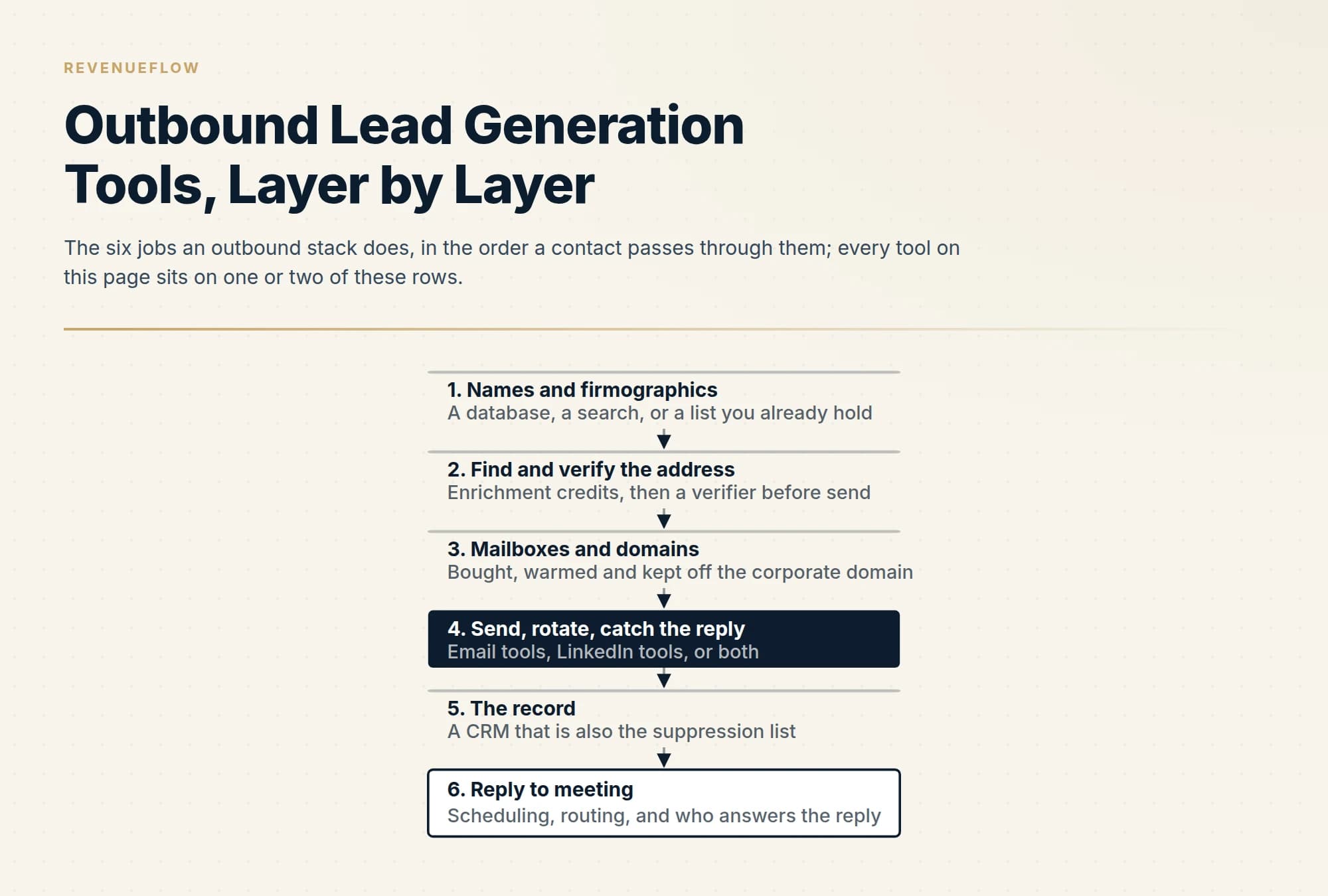
Outbound lead generation tools do six jobs, names, finding and verifying, mailboxes, sending, the record and reply to meeting, and price on different units at each layer, so a tool is only comparable to others doing its job. As published on 18 September 2026, lemlist's Email plan starts at 69 dollars a month monthly. Size the stack from the list.
Key takeaways
- Sending vendors price on different units: lemlist on a workspace or a user, Smartlead and Instantly on contact and send tiers, Email Bison on sends with no per-seat fee, HeyReach and Expandi on LinkedIn senders or seats.
- As published on 18 September 2026, lemlist Email is 69 dollars a month monthly or 55 yearly, Smartlead Base 39 or 32.50, Instantly Growth 47, Email Bison 599 for 500,000 emails, HeyReach Growth 79 per sender, Expandi Business 99 or 79, Close Solo 19 or 9 per user, Attio Plus 34 or 27 pounds per user, Lusha Starter 37.45 billed yearly.
- Verification is a separate step and vendor: MillionVerifier sells bulk verification from 39 dollars and a real-time API, and the order is enrich, verify, then send.
- No tool sells the person with written qualification criteria between the reply and the calendar, which is the step that decides whether a booked meeting is a good one.
Reviewed and updated September 18, 2026
Lemlist's pricing page, read on 18 September 2026, opens with a limited-time banner offering an extended 30-day trial to visitors arriving from one creator's content, and then prints its Email plan at 69 dollars a month or 55 on yearly billing with unlimited users. Smartlead's pricing page, read the same day, prints its Base plan at 39 dollars a month monthly or 32.50 yearly, with 2,000 contacts and 6,000 sends. Email Bison's page prints one plan at 599 dollars a month for 500,000 emails with no per-seat fees. Three sending tools, three units of pricing, seat, contact and send, and a buyer comparing them on the monthly figure is comparing nothing.
That is the reason this page is organised by layer rather than by ranking. Outbound lead generation tools do six different jobs, and a tool is only comparable to the others doing its job. Every vendor fact below is from the vendor's own page on 18 September 2026, with the billing state named; every price is a published list price, not a quote. The channel arithmetic that decides how much of each layer a team needs is in outbound lead generation for B2B SaaS, and the definition of the motion itself is in the outbound lead generation glossary entry.
The six layers
An outbound programme needs a source of names, a way to find and verify an address for each, somewhere to send from, a way to send, a place to record what happened, and a way to turn a reply into a meeting. Some vendors sell two or three of those together; none sells all six well, and the bundling is where much of the confusion in this category comes from.
Layer one: names
Apollo's lead generation page describes a B2B database of 240 million plus contacts with 65 plus filters, a free Chrome extension that surfaces prospect data inside HubSpot, Salesforce, Gmail and company websites, AI lead scoring from CRM and database data, intent signals powered by Bombora, website visitor identification, and sequences with emails and calls. Its plan and rate-limit structure, and where its API sits on the ladder, are read in detail in the Apollo and Clay integration guide in this series.
Lusha's pricing page, which rendered only in a headless browser on 18 September 2026, sells credits granted upfront on yearly billing: Starter at 37.45 dollars a month with 4,800 credits a year and one seat, Pro at 52.45 with 7,200 credits and two free seats plus API and CSV enrichment, Premium at 299.95 with 40,800 credits and five free seats, and a custom Scale tier. Cognism publishes plan names and a credit definition with no figure, as the Cognism and Upcell comparison in this series records. Instantly's pricing page sells a lead database of 450 million plus B2B leads through a credits plan at 47 dollars a month with 1,500 credits, and a Starter bundle that combines it with sending at 94 dollars a month.
The layer-one question is not which database is largest. It is whether the list you need is in any database at all, and for a defined segment it is often cheaper to build a list from a source that names the companies and then find the people.
Layer two: find and verify
Clay's pricing page sells actions and credits rather than seats, lets a team bring its own API keys to any provider on every plan, and prints its Launch tier at 167 dollars a month beside an annual actions allowance, with its FAQ stating a higher monthly figure; the Clay pricing guide walks the ladder. Lemlist's pricing page sells email and phone finding as a rechargeable credit at one cent each, pay per success. Lusha and Apollo both sell finding inside the layer-one subscription.
Verification is a separate step and a separate vendor. MillionVerifier's home page, as read on 18 September 2026, describes bulk list verification with plans from 39 dollars, a real-time API, and an automated daily clean of a connected email service provider, with a stated accuracy claim that is the vendor's own and is not repeated here as a measurement. The rule that matters is the order: verify after enrichment and before the first send, every time, because the bounce rate on an unverified list is paid for in mailbox reputation rather than money.
Layer three: mailboxes and domains
This is the layer the tool lists skip and the one that decides deliverability. Every sending tool on this page sells warm-up; none of them sells the discipline of keeping cold volume off the domain that carries the company's real mail. Smartlead's pricing page bundles private infrastructure on its upper tiers and sells SmartServers with OAuth on its Prime plan. Instantly's Growth plan prints unlimited email accounts and unlimited warm-up at 47 dollars a month with 1,000 uploaded contacts and 5,000 emails a month. Email Bison's page describes an isolated network with dedicated IP pools and private warm-up inside its single plan. Mailshake sells ready-to-use mailboxes as an add-on, per its pricing page as read for the Mailshake and Pipedrive comparison.
What none of those pages says is how many addresses a programme needs, and the answer comes from the daily send ceiling per address and the volume the list justifies, not from a plan tier.
| Vendor | Priced per | First paid tier limits |
|---|---|---|
| Lemlist | Workspace, or user on Multichannel | Emails a month; senders per user |
| Smartlead | Plan tier | Contacts stored, sends a month |
| Instantly | Plan tier, bundles | Uploaded contacts, emails a month |
| Email Bison | Sends a month, one plan | Emails a month, nothing per seat |
| HeyReach | LinkedIn sender | Senders; campaigns unlimited |
| Expandi | LinkedIn seat | One account per seat |
Layer four: sending
Email first. Lemlist's Email plan is 69 dollars a month monthly or 55 yearly with unlimited users and 50,000 emails a month; its Multichannel plan is 109 dollars a month per user monthly or 87 yearly with five senders per user, LinkedIn, SMS and WhatsApp automation and a dialler; Enterprise is custom for teams of five or more. Smartlead prints Base at 39 dollars monthly or 32.50 yearly for 2,000 contacts and 6,000 sends, Pro at 94 or 78.30 for 30,000 contacts and 90,000 sends, Smart at 174 or 144.50 with unlimited contacts and 150,000 sends, and Prime at 379 or 314.60 with 500,000 sends and three SmartServers included. Instantly prints its Growth outreach plan at 47 dollars a month and bundles from 94 monthly. Email Bison prints one plan at 599 dollars a month for 500,000 emails, unlimited leads, workspaces and teammates, with additional monthly buckets above that. Reply's tiers and its CRM sync are read in the Reply and Salesforce guide in this series; the sending layer as a whole is compared in the cold email tools stack guide.
LinkedIn second. HeyReach's pricing page sells unlimited campaigns per sender on a flat fee: Growth at 79 dollars a month per sender monthly, with quarterly and yearly discounts named, 100 enrichment credits per sender, native integrations with Instantly and Smartlead for multichannel sequences, an Agency plan at 999 dollars a month for 25 senders with white label, and an Unlimited plan at 2,999 a month capped at 300 senders under a fair-use policy. Expandi's pricing page prints its Business plan at 99 dollars a month monthly or 79 on annual billing with a seven-day trial, a dedicated country-based IP address per account, profile auto warm-up, limit ranges Expandi will not let an account exceed, and unlimited campaigns.
We run Email Bison and in-house tooling for email and HeyReach for LinkedIn, so those are the two sending vendors on this page we operate; the rest are documented from their pages. One position of ours changes how to read every sending page: we send one message per campaign, no bumps and no thread replies, so the sequence builders every vendor leads with are features we leave off, and we never retarget a LinkedIn non-responder. A non-responder becomes a candidate for a later campaign on a different premise.
Layer five: the record
Close's pricing page, read on 18 September 2026 with monthly and annual states shown, prints Solo at 19 dollars per user a month monthly or 9 annually, limited to one user and 10,000 leads, Essentials at 49 or 35 with unlimited contacts and built-in email, calling and SMS, and Growth at 109 per user monthly, each carrying a monthly AI credit allowance. Attio's pricing page prints, in pounds for a UK visitor, Free for up to three seats, Plus at 34 pounds per user a month monthly or 27 annually for up to ten seats, Pro at 74 or 59 with sequences and call intelligence, and a custom Enterprise tier. HubSpot's CRM product page describes a Starter Customer Platform for small businesses and an Enterprise platform, with pricing on a page that served only a script shell to this network on the day. Pipedrive's plans and gates are in the Mailshake comparison above.
The CRM's job in outbound is narrower than its feature list: it is the suppression list. Before a campaign goes out, everyone with an open deal, a bounce, an unsubscribe or a colleague already in conversation comes off the list, and that only works if the record is one place. The sales tech stack guide puts the CRM in its place among the other layers.
Layer six: reply to meeting
Two products turn a reply into a booked slot from opposite ends. Chili Piper's pricing page prints a per-seat platform with a minimum seat count and a per-user scheduling product, and LeanData prints three editions with no figure; the Chili Piper and LeanData comparison in this series reads both. Lemlist, Reply and Apollo each bundle a dialler or meeting step inside the sending plan.
What none of them sells is the person who answers the reply. In our own stack the reply is read by an agent and answered in the sender's voice against a calendar, and the meeting is qualified against criteria agreed in writing before the campaign launches. A tool at this layer that books meetings faster than the criteria can be checked is booking the wrong meetings faster.
| Row | Names | Find, verify | Mailboxes | Send | Record |
|---|---|---|---|---|---|
| Apollo | Yes | Yes | No | Yes | Partial |
| Clay | Partial | Yes | No | No | No |
| Lusha | Yes | Yes | No | No | No |
| MillionVerifier | No | Yes | No | No | No |
| Lemlist | Partial | Yes | Partial | Yes | No |
| Smartlead | No | Partial | Yes | Yes | Partial |
| Instantly | Yes | Partial | Yes | Yes | Partial |
| Email Bison | No | No | Yes | Yes | No |
| HeyReach | No | Partial | No | Yes | No |
| Expandi | No | No | No | Yes | No |
| Close | No | No | No | Partial | Yes |
| Attio | No | Partial | No | Partial | Yes |
How to choose without a ranking
Start from the list, because the list decides how many addresses, how many sends and how many credits the rest of the stack has to carry. A programme against 800 named companies does not need a 450-million-record database; it needs a finder, a verifier and enough mailboxes to reach 800 companies at a safe daily rate. A programme against a broad segment needs the database first and the rest scaled to what it returns.
Then price each layer in its own unit. A seat price is only comparable to a seat price, a send price to a send price. Lemlist's Email plan and Email Bison's single plan are both flat fees with unlimited users, and they differ by a factor that only makes sense against the send volume each allows. Smartlead's tiers and Instantly's tiers cap contacts and sends together, so the binding constraint is whichever a programme hits first.
Finally, decide who answers the reply before choosing the tool that catches it. Tools that book a meeting from a reply are only as good as the qualification that happens between, and that step is a person or an agent working to written criteria, not a plan feature.
If the constraint is that the companies on the list are not taking meetings rather than which tool sends to them, RevenueFlow books qualified meetings on a pay-per-meeting basis, on its own stack, against criteria agreed in writing before launch.
The short version
Outbound tools do six jobs, and the pricing units differ by layer: contacts and credits at the top, seats and sends in the middle, seats at the record, seats again at scheduling. As published on 18 September 2026, lemlist starts at 69 dollars a month monthly or 55 yearly, Smartlead at 39 or 32.50, Instantly at 47, Email Bison at 599 for half a million sends, HeyReach at 79 per sender, Expandi at 99 or 79, Close at 19 or 9 per user, Attio at 34 or 27 pounds per user, Lusha at 37.45 a month billed yearly. Compare within a layer, size the stack from the list, and put a person with written criteria between the reply and the calendar.
Every plan name, allowance and price is per the named vendor's own pricing or product page as served on 18 September 2026, with the billing state given; Lusha's pricing rendered only in a headless browser and HubSpot's sales pricing page served a script shell. No third-party figure is used. Verify current terms with each vendor before relying on them.
Sources: Apollo lead generation, Lusha pricing, Clay pricing, MillionVerifier, Lemlist pricing, Smartlead pricing, Instantly pricing, Email Bison pricing, HeyReach pricing, Expandi pricing, Close pricing, Attio pricing, HubSpot CRM
Frequently asked questions.
Frequently asked questions- What tools do you need for outbound lead generation?
- One per layer, and some vendors cover two: a source of names, such as Apollo's database or a list you build; a finder and a verifier, such as Clay or Lusha and MillionVerifier for verification; mailboxes and domains kept off the corporate domain; a sender for email, such as lemlist, Smartlead, Instantly or Email Bison, and for LinkedIn, such as HeyReach or Expandi; a CRM that doubles as the suppression list; and a scheduling step between reply and meeting.
- How much do outbound lead generation tools cost?
- It depends on the layer's unit. As published on 18 September 2026, lemlist's Email plan is 69 dollars a month monthly or 55 yearly, Smartlead's Base plan 39 or 32.50, Instantly's Growth plan 47, Email Bison's single plan 599 for 500,000 emails, HeyReach's Growth plan 79 per LinkedIn sender, Expandi's Business plan 99 or 79 annually, Close's Solo plan 19 or 9 per user, and Lusha's Starter 37.45 a month billed yearly.
- What is the difference between Smartlead, Instantly and lemlist?
- By their own pricing pages on 18 September 2026, Smartlead sells tiers capped on stored contacts and monthly sends with private infrastructure on the upper tiers; Instantly sells outreach plans capped on uploaded contacts and monthly emails with unlimited email accounts and warm-up, plus a lead database sold by credits; lemlist sells an Email plan with unlimited users capped on emails a month and a Multichannel plan per user with LinkedIn, SMS and WhatsApp automation.
- Do you need a separate email verifier if the finder already verifies?
- Yes, as a rule of order rather than of vendor. Clay and Lusha sell finding inside the subscription, and MillionVerifier's home page sells bulk verification from 39 dollars with a real-time API and an automated daily clean, as read on 18 September 2026. Verify after enrichment and before the first send, every time, because the bounce rate on an unverified list is paid for in mailbox reputation rather than money.
About the author.

B2B cold email experts helping companies generate qualified leads through done-for-you outreach campaigns.
RevenueFlow Team
Explore more.
Ready to scale your outreach?
We build GTM engines that book real meetings. See the receipts.
Related articles.
Zeliq Pricing: One Seat Rate and a Credit Meter
Zeliq prices one self-serve seat in dollars with a credit meter that never expires. Both billing states, the three credit rates, the top-up ladder and the Custom floor.
Humanlinker Pricing: Euros First, Two Users for One
Humanlinker's Pro plan is priced in euros on a user slider where two users cost the same as one. Every slider step, the annual factor, and how the dollar figure is made.
Salesgear Pricing: Two Ladders Under One Plan Title
Salesgear's page is titled as one plan and carries a Data ladder and an Outreach ladder. Both at both billing states, what each meters, and the two vendor-side conflicts.
La Growth Machine Pricing: Per Identity, Euros First
La Growth Machine prices per identity and loads in euros on annual billing. The full matrix from the page's own script: four periods, three currencies, three plans.
Twain Pricing: Credits per Lead, Three Research Modes
Twain sells credits, not seats, and a lead costs 1 to 14 of them depending on the research mode. The two ladders, the four expiry clocks and the cap.
Lavender Pricing: Two Products, No Pricing Page
Lavender has no pricing page. The Email Coach ladder per seat at both billing states, the free routes, and the separate per-agent price for Ora.