Outbound Lead Generation for B2B SaaS: Channel Mix
Channel choice is a cost-per-touch question. What email, LinkedIn and phone cost per attempt, and how far down that list each deal-size band can afford to go.
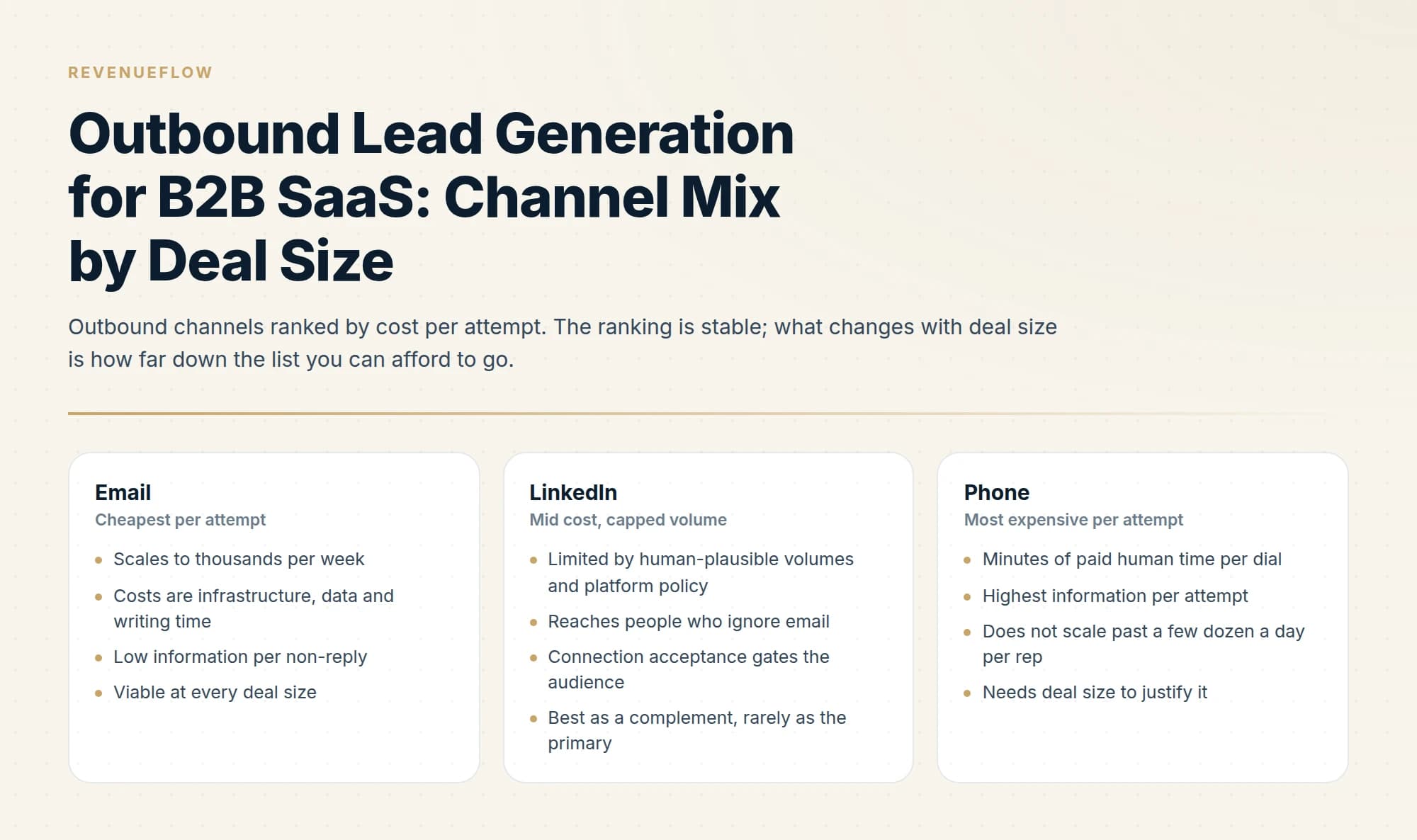
Rank outbound channels by cost per attempt, then let deal size decide how far down the list you can afford to go. Email is cheapest and viable at every size, LinkedIn sits in the middle with capped volumes, and phone costs the most per attempt while returning the most information. Concentration changes more than the mix does.
Key takeaways
- Under $10k ACV, email carries the programme and dedicated phone effort rarely pays back at the dials required per closed deal.
- Between $10k and $50k, email is the volume channel with LinkedIn alongside it and phone reserved for accounts already showing signal.
- Above $50k the channel list barely changes but the concentration does: fewer accounts, more contacts per account.
- Cost per held meeting should be computed per channel rather than blended, because a blended figure hides which channel carries the programme.
Reviewed and updated September 1, 2026
The channel question in outbound is really a cost-per-touch question. Email costs fractions of a cent to send and scales to thousands of people. A phone call costs several minutes of a paid human and scales to dozens. Both work; they are affordable at completely different deal sizes.
So the right mix follows from what one customer is worth. Here is how the arithmetic plays out across three deal-size bands, and which channels stop making sense where.
Start from cost per touch
Rank the channels by what one attempt costs in money and time, because that ranking barely changes and everything else follows from it.
Email is the cheapest at scale. The marginal cost of one more message is negligible; the real costs are infrastructure, data and the human time to write well.
LinkedIn sits in the middle. Volumes per account are limited by what is plausible for a human and by platform policy, so it does not scale the way email does, and it reaches people who ignore email.
Phone is the most expensive per attempt and the highest information per attempt. You learn something on a call you cannot learn from a non-reply.
Events and direct mail are the most expensive per contact by a wide margin, and are justified only when a single deal is worth a great deal.
- Scales to thousands per week
- Costs are infrastructure, data and writing time
- Low information per non-reply
- Viable at every deal size
- Limited by human-plausible volumes and platform policy
- Reaches people who ignore email
- Connection acceptance gates the audience
- Best as a complement, rarely as the primary
- Minutes of paid human time per dial
- Highest information per attempt
- Does not scale past a few dozen a day per rep
- Needs deal size to justify it
Under $10k ACV: email, and almost nothing else
At this deal size, outbound is usually a supporting channel behind a self-serve motion, and the only shape that works is cheap per touch.
Email carries it. LinkedIn can support it for a narrow senior segment where email coverage is poor. Phone almost never pays back, because the number of dials required per closed deal exceeds what the contract value funds.
The discipline at this end is segment quality rather than personalisation depth. A well-argued message to a tightly defined segment outperforms shallow per-account personalisation, and it costs a fraction as much to produce. The temptation to add research per lead is the main way outbound at this ACV becomes unprofitable.
$10k to $50k ACV: email primary, LinkedIn supporting
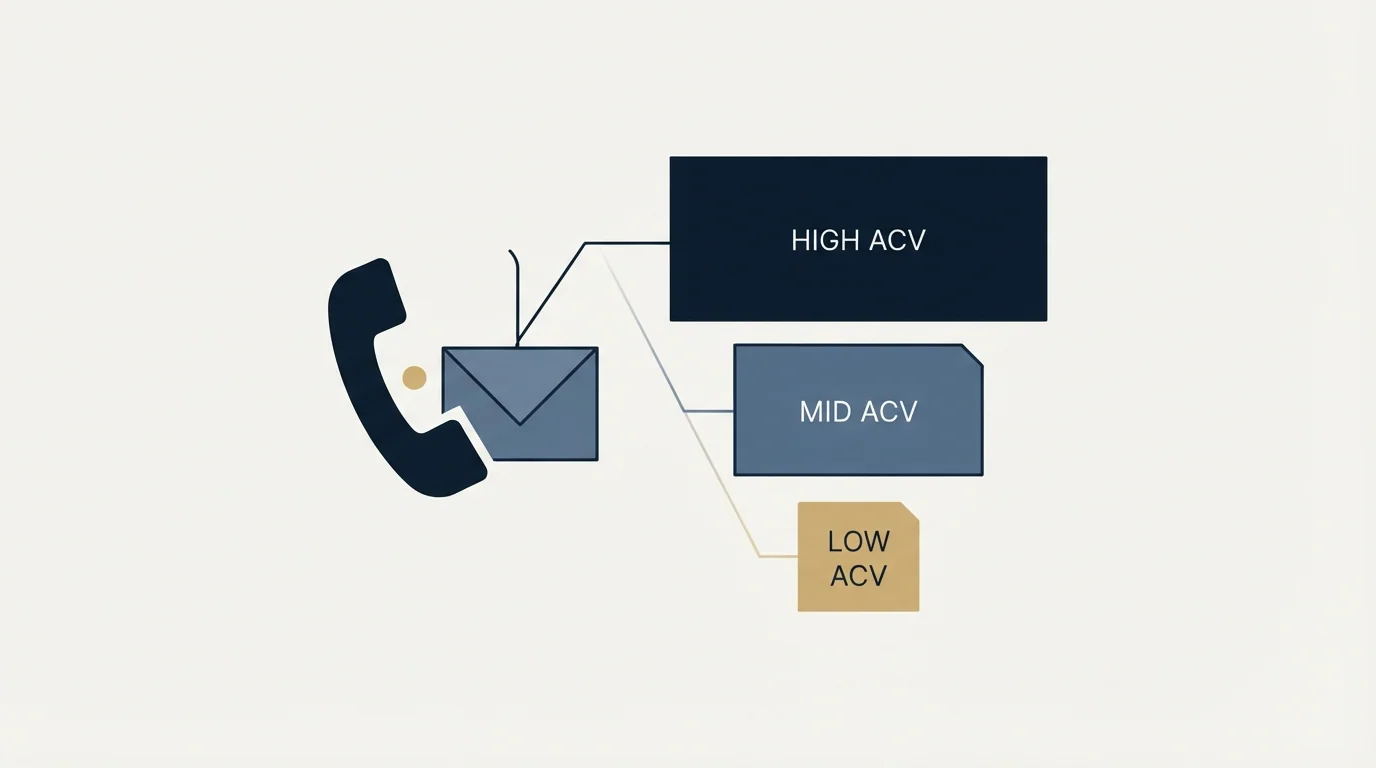
This is the band where most B2B SaaS outbound actually operates, and where the mix genuinely matters.
Email remains the volume channel. LinkedIn becomes worth running alongside it for the same accounts, in the same weeks, so a name arriving in an inbox has been seen elsewhere. Phone starts to make sense for the top of the list, meaning accounts already showing signal, rather than as a cold-first channel.
That is what LinkedIn lead generation for SaaS companies amounts to in practice: a supporting channel chosen by deal size rather than a programme of its own.
What that call sounds like in a software market, from the trial signup call to the first thirty seconds with a stranger, is covered in our guide to SaaS cold calling.
The sequencing principle that matters here: use the cheap channel to find out where to spend the expensive one. Run email across the addressable set, see which segments and titles answer, then apply LinkedIn and phone to the accounts and segments that showed something. Committing expensive channels before that signal exists is how outbound budgets get spent evenly across accounts that were never going to respond.
Teams deciding which accounts showed enough signal to justify the expensive channels can look at how trigger based signals decay before spending against a stale window.
Above $50k ACV: all three, concentrated on fewer accounts
Above this line the list gets shorter and the investment per account rises. Phone becomes rational, multithreading across the buying group becomes necessary, and events and direct mail enter the picture for genuinely strategic accounts.
The channel mix changes less than the concentration does. The same three channels, aimed at a fraction of the companies, with several people contacted at each. A deal with one engaged contact at a large company is fragile regardless of how it was sourced.
- Step 1Email the whole addressable set
Cheapest per attempt, and it produces the signal that allocates everything else.
- Step 2Read what answered
Which segments, which titles, which framing. This is the output that matters, not just the meetings.
- Step 3Concentrate the expensive channels
LinkedIn and phone on accounts and segments that engaged, in the same weeks.
- Step 4Multithread the live accounts
Above $50k, add contacts inside accounts already showing interest rather than sourcing new ones.
What we do not do, at any deal size
No follow-up sequences. We run one message per campaign. A second and third touch into an unresponsive account teaches you nothing the first did not, and it consumes the sending reputation the rest of the programme depends on. Non-repliers go back into the pool for a genuinely different angle later, as a new campaign rather than a bump.
No LinkedIn no-reply retargets. A second LinkedIn message lands in the same thread beneath the one they ignored, so it reads as a bump whatever the campaign structure says. Someone who was never messaged is different, and is a legitimate first touch.
These constraints raise the bar on targeting and message quality, which is the point. A mix planned around follow-up volume is not comparable to one planned without it, so when you compare a vendor's projected numbers, check the assumed touches per person first.
The numbers that decide the mix
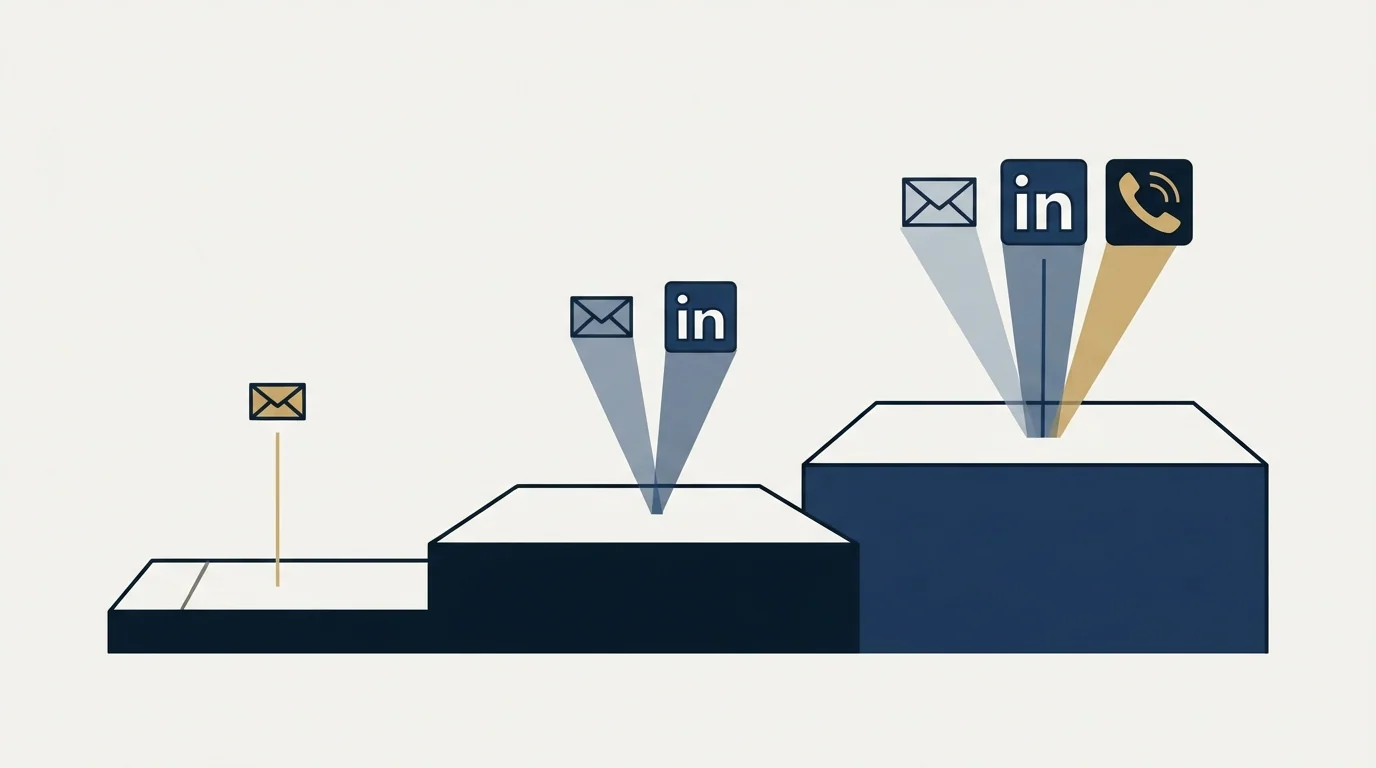
Four figures, all obtainable from your own data, settle the channel argument faster than any benchmark.
Contact coverage per channel. What share of your target list you hold a verified email for, against what share you can reach on LinkedIn. If email coverage is 40% on your segment, email cannot be the whole plan whatever its unit economics.
Reply rate by channel on your ICP. Not published benchmarks, which vary enormously by market. Ours and everyone else's are a starting hypothesis; yours is the fact. Our cold email benchmarks are useful as a sanity check rather than a target.
Meetings per closed deal. This converts a revenue target into a meetings target and therefore into a volume requirement per channel.
Cost per held meeting by channel. The number that ends the debate. Compute it per channel rather than blended, because a blended figure hides which channel is carrying the programme.
- Yes: You know contact coverage separately for email and LinkedIn
- Yes: You have a meetings-per-closed-deal number from your own data
- Yes: Cost per held meeting is computed per channel, not blended
- Yes: Expensive channels are aimed at accounts that already showed signal
- No: The plan depends on multi-step follow-up sequences
- No: Phone at an ACV that cannot fund the dials per deal
- Depends: Events, which need a deal size that justifies the cost per contact
Who you contact changes with the band, not just how
Deal size changes the buying group, and the channel plan has to follow it.
Under $10k, you are usually reaching one person who can decide alone, often the practitioner who feels the problem rather than a manager. One contact per company is normal and multithreading is wasted effort.
Between $10k and $50k, a manager or director typically decides with one other person's agreement. Two contacts per company is a reasonable default: the person with the problem and the person with the budget.
Above $50k, committees. Three or more contacts per account, and the point is coverage of roles rather than volume of people: someone who owns the problem, someone who owns the budget, and someone who will evaluate the technical fit.
The consequence for channel mix is that above $50k your email volume per company goes up while your company count goes down, and the failure to plan for that shows up as a list that is too short to hit the meetings target.
One caution that applies at every band: contacting several people at one company needs care, because visibly identical messages arriving at three colleagues on the same morning is the fastest way to look automated. Different people, different angle, and a reason each one specifically should care.
Testing without fooling yourself
Channel comparisons are easy to run and easy to misread.
Test one variable. Running a new channel and a new segment simultaneously produces a result that cannot be attributed to either.
Give it enough volume to mean something. Reply rates on small samples swing wildly, and a difference between 2% and 4% on a few hundred sends is usually noise.
Compare on held meetings, not replies. Channels differ in the quality of reply they produce. A channel with a lower reply rate and a higher meeting-hold rate is the better channel, and a reply-rate comparison scores it wrong.
Give each channel its proper lag. Email produces replies within days; LinkedIn connection acceptance adds a step and time before any message lands. Judging both at the same moment penalises the slower one on timing rather than on merit.
Infrastructure is the constraint nobody plans for
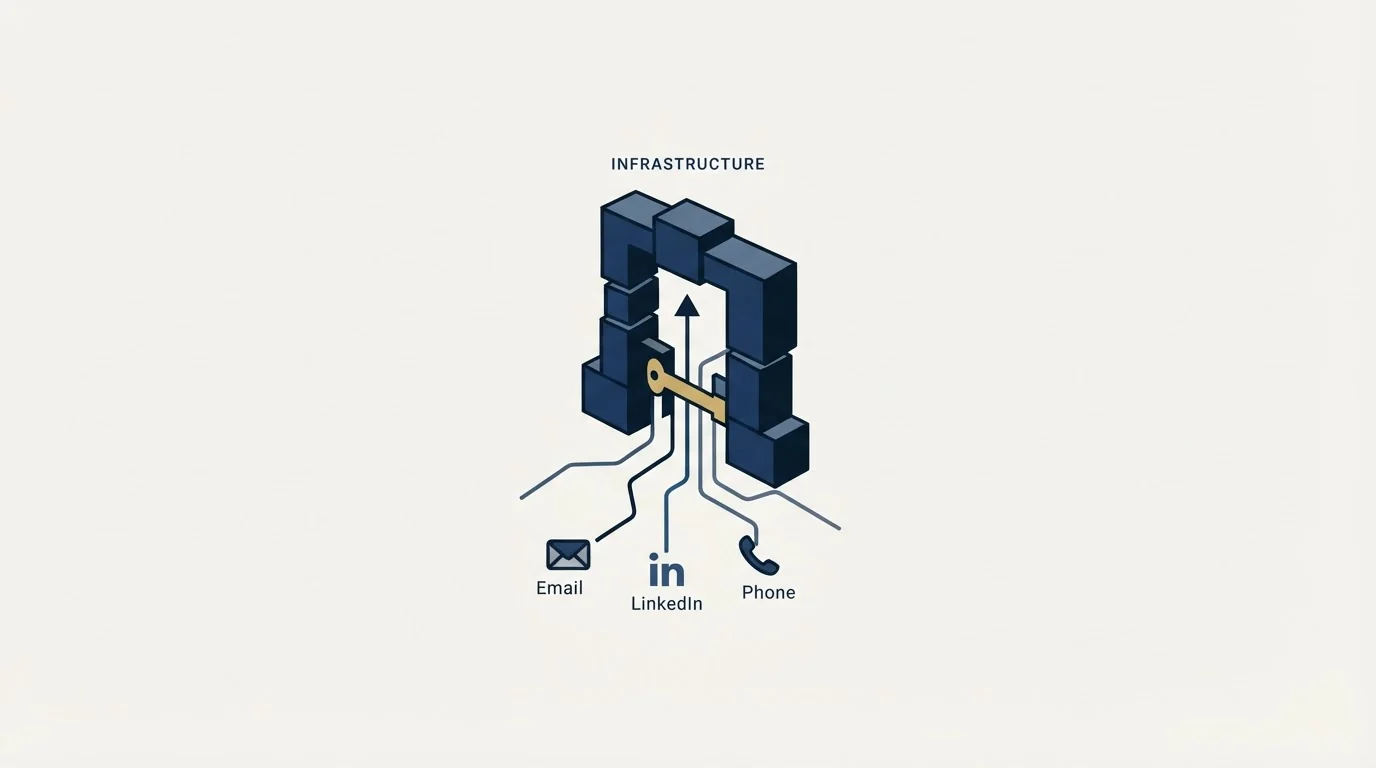
Whatever the mix, email volume is capped by sending infrastructure rather than by ambition. Domains, inboxes and warmup take weeks to prepare, per-inbox daily volumes are limited if you want to stay deliverable, and a plan that assumes a volume the infrastructure cannot support fails in a way that looks like a copy problem.
Because domains and inboxes need proper warmup before volume ramps up, tools for warming up sending inboxes can help protect deliverability during that prep.
Work out the required weekly send volume from your meetings target, then work out how many healthy inboxes that needs at a conservative daily rate per inbox, then check how long that takes to warm. Doing this before the plan is agreed prevents the most common outbound timeline failure. The cold email deliverability guide covers the mechanics.
For the wider programme question, including where inbound and self-serve fit around all of this, see B2B SaaS lead generation above and below $30k ACV. For the LinkedIn policy constraints specifically, LinkedIn lead generation services.
The short version
Rank channels by cost per attempt, then let deal size decide how far down that list you can afford to go. Under $10k ACV, email and segment-level messaging. Between $10k and $50k, email as the volume channel with LinkedIn alongside it and phone reserved for accounts showing signal. Above $50k, the same channels concentrated on fewer accounts with several contacts each. Use the cheap channel first to find out where the expensive ones should point.
If you would rather have the email half run for you, with the meeting definition agreed in writing before anything sends, you can see what a campaign would look like for your market.
Frequently asked questions.
Frequently asked questions- What is the best outbound channel for B2B SaaS?
- Email at almost every deal size, because it is cheapest per attempt and scales. LinkedIn earns a place alongside it for segments where email coverage is poor or buyers are senior. Phone becomes rational as deal size rises, since it costs the most per attempt and returns the most information per attempt.
- When does cold calling make sense for SaaS?
- When deal size funds the dials required per closed deal, which in practice means mid-market and above, and when it is aimed at accounts already showing some signal rather than used as the cold-first channel. Below roughly $10,000 ACV the arithmetic usually does not work.
- How many contacts should we reach per company?
- It tracks deal size. Under $10k, usually one person who can decide alone. Between $10k and $50k, two: the person with the problem and the person with the budget. Above $50k, three or more covering the problem owner, the budget owner and the technical evaluator, with a different angle for each.
- How do you compare outbound channels fairly?
- Change one variable at a time, give each enough volume that reply-rate differences are not noise, compare on held meetings rather than replies since channels differ in reply quality, and allow each channel its own lag. LinkedIn adds a connection-acceptance step before any message lands.
About the author.

B2B cold email experts helping companies generate qualified leads through done-for-you outreach campaigns.
RevenueFlow Team
Explore more.
Ready to scale your outreach?
We build GTM engines that book real meetings. See the receipts.
Related articles.
Outbound Prospecting: When Nobody Raised Their Hand
Going first means supplying the attention, timing, framing and permission that inbound gets free. Where outbound earns its cost, and what it really charges.
Readymode Pricing: The Seat Is Dear for What Is Inside It
Readymode publishes $199 and $249 per licence per month, near the top of the dialer range. What the seat includes that others bill separately, and when that pays.
PhoneBurner Pricing: What the Seat Price Covers
PhoneBurner publishes all three seat prices in both billing states. The metered resource is contact imports, not minutes, and the spam layer is an add-on at every tier.
Koncert Dialers: Line Counts Published, Price Is Not
Koncert publishes the parallel line ceiling on every tier, which most of this category will not. It publishes no price. What its pages state, and what the quote decides.
The Agoge Sequence: What Sam Nelson Actually Built
A documented 15-touch, 27-day cadence built by Sam Nelson at Outreach. What the primary sources say, which part transfers, and where our own practice differs.
Sales Rep Coaching: The Cadence That Survives a Busy Quarter
Coaching that changes behaviour needs an artifact on the table and one named focus. The weekly loop, and the three layers a flat number can be hiding.