B2B SaaS Lead Generation: Below and Above $30k ACV
Contract value decides the motion. Why roughly $30k is the threshold, what changes on each side of it, and why retention moves the line more than anything else.
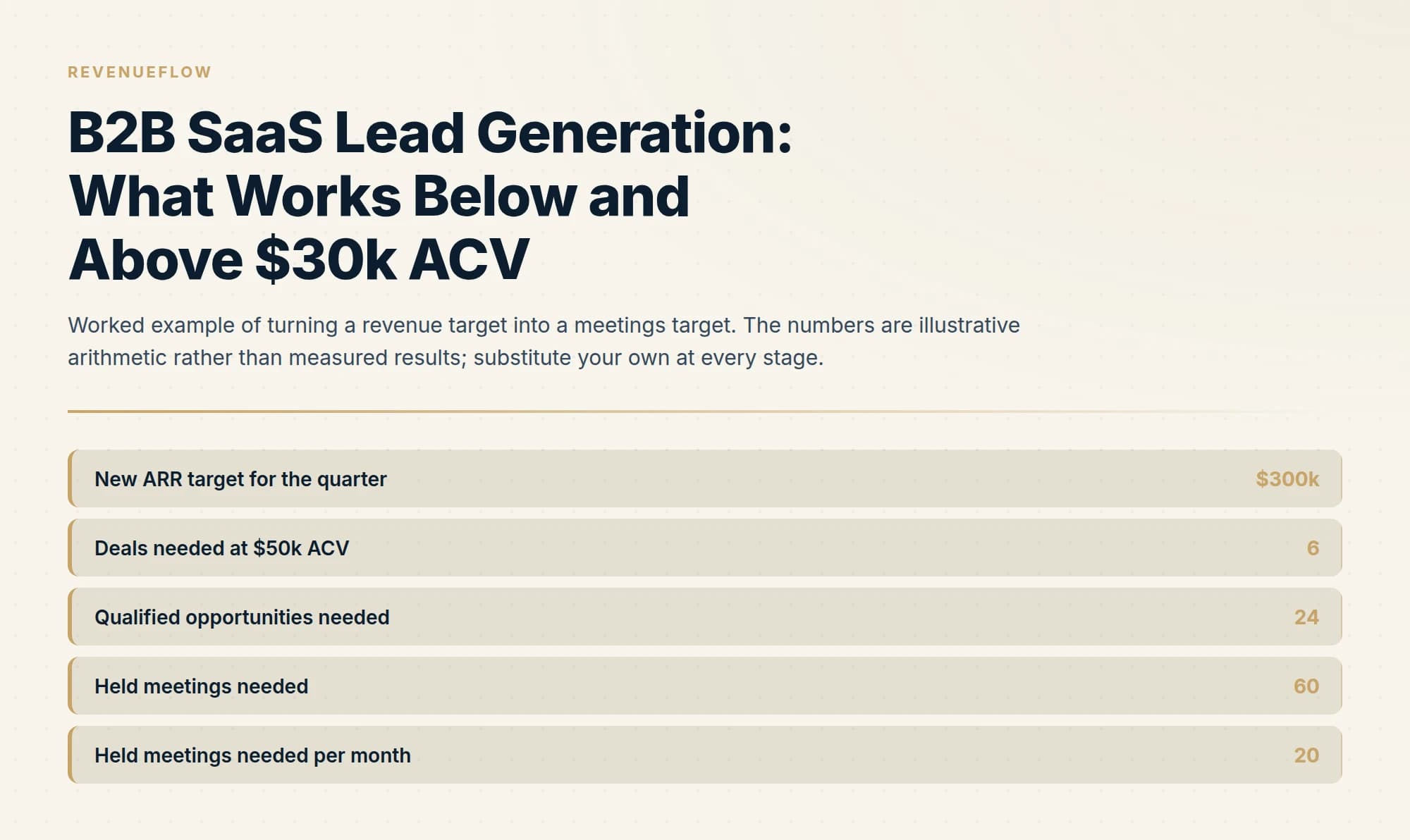
Annual contract value decides the lead generation motion, because it sets what you can afford to spend acquiring a customer. Below roughly $30,000, volume economics favour self-serve with cheap segment-level outbound. Above it, attention economics favour named accounts, multithreading and outbound as the primary channel.
Key takeaways
- Below roughly $30,000 ACV a human touching every deal usually cannot be paid for out of the deals, which is the whole mechanism behind the threshold.
- Allowable acquisition cost comes from lifetime gross profit rather than first-year revenue, so retention moves the threshold more than ACV alone does.
- Below the line the metric is cost per activated trial; above it, meetings held and pipeline created from target accounts.
- The common failure is carrying a low-ACV motion up-market, where signups keep arriving while the conversations that justify the new price never happen.
Reviewed and updated September 2, 2026
A $12,000 ACV product and a $120,000 ACV product are both "B2B SaaS", and almost nothing about how you generate demand for them transfers between the two. The deciding variable is how much you can afford to spend acquiring one customer, and that number sets the channel mix, the team shape, and whether a human should be involved before the trial.
Roughly $30,000 in annual contract value is where the motion flips. Below it, the economics favour volume and self-serve. Above it, they favour named accounts and people. Here is what changes on each side of that line.
Why the threshold exists
The arithmetic is simple and unforgiving. If a sales rep costs a fully loaded six figures and closes a certain number of deals a year, each deal has to carry a share of that cost. Below a certain contract value, a human touching every deal cannot be paid for out of the deals.
The vocabulary for that spectrum, and the rule that decides which accounts still earn a person, is in low-touch sales.
That is the whole mechanism. The threshold moves with your gross margin, your win rate and your retention, so treat $30,000 as a marker rather than a rule. What matters is doing the arithmetic for your own numbers.
Two derived quantities decide almost everything downstream.
Allowable acquisition cost. What you can spend to win a customer while still paying back inside an acceptable period. If your payback target is twelve months and gross margin is 80%, allowable CAC is roughly the first year's gross profit.
Meetings needed per closed deal. Held meetings divided by wins. This turns a revenue target into a meetings target, which is the only form in which a lead generation plan can actually be planned.
What a held meeting has to mean inside a software company, and the three meeting models that decide the quota behind that target, is in appointment setting for SaaS companies.
The number you were given
Target divided by average contract value
At a 25% win rate
At 40% of meetings becoming opportunities
The number the programme is actually planned against
Bar widths are equal here because these stage values are not a single comparable measure.
Run that in reverse with your own rates before choosing any channel. A plan that cannot produce the meetings number is not a plan, and a channel that cannot be scaled to it is not the right channel.
Below $30k ACV
At this end you cannot afford a human before the trial, so the job of lead generation is to produce qualified self-serve volume cheaply.
Product-led motion is the primary channel where the product allows it. A free tier or trial that a buyer can evaluate alone removes the cost that the economics cannot carry.
Outbound is a supporting channel, not the main one, and it has to be cheap per touch. Highly targeted email to a narrow, well-defined segment can work at this ACV. Dedicated SDRs per account generally cannot.
Segments beat individuals. At this price point buyers within a segment behave similarly enough that one strong argument outperforms per-account research. This is the one place where a well-argued generic message genuinely beats weak personalisation.
The number to watch is cost per activated trial, not cost per lead. Leads that never activate are noise at this ACV, and the gap between the two metrics is where most low-ACV marketing budgets disappear.
Above $30k ACV
Above the threshold, a human touching every deal is affordable, and the constraint moves from cost to attention. Your buyers are harder to reach and there are fewer of them.
Named accounts replace segments. You can enumerate the companies worth winning, which makes account-based work rational. What that involves is covered in what ABM is and in building a target list you can actually work.
Multithreading stops being optional. Enterprise purchases are committee decisions, and a deal with one engaged contact dies when that contact changes job. Buying group depth is the metric that predicts win rate.
Choosing software to support that multithreaded outreach gets easier after reviewing sales engagement platforms built for SaaS teams.
Outbound becomes the primary channel for most companies at this level, because the addressable market is small enough that waiting for inbound leaves most of it untouched.
The reporting unit changes. Below the line you count leads and activations. Above it you count accounts engaged, meetings held and pipeline created from target accounts.
- Self-serve or low-touch trial as primary
- Outbound supports, at low cost per touch
- Segment messaging beats per-account research
- Measure cost per activated trial
- Human involvement after the product, not before
- Named accounts, enumerable and prioritised
- Outbound is usually the primary channel
- Multithreading across the buying group
- Measure meetings held and pipeline from target accounts
- Human involvement before anything else
The transition, which is where it goes wrong
Companies moving up-market keep the motion that worked at the lower ACV, and it quietly stops working.
The tell is a pipeline that looks healthy at the top and converts badly. Self-serve signups keep arriving, so the lead numbers look fine, but the deals that would justify the new price point need a conversation nobody is having. Meanwhile the outbound function that would create those conversations does not exist, because it was never needed.
Two changes have to happen roughly together. Someone has to own conversations with named accounts, and the reporting has to change so that the old metric stops reassuring everybody. A team still reporting signups while trying to sell $60,000 contracts will keep concluding that marketing is working and sales is the problem.
The reverse transition, moving down-market, has its own failure: a sales-led motion attached to a price that cannot fund it. That one is more obvious and shows up in the CAC payback figure quickly.
Retention moves the threshold more than anything else
The $30,000 marker assumes a customer stays a while. Change that assumption and the whole calculation moves.
Allowable acquisition cost is a function of lifetime gross profit, not of first-year contract value, so a product with strong net revenue retention can afford a materially more expensive motion at the same headline ACV. A $20,000 contract that expands and renews for years can fund a human touch that the same contract with heavy churn cannot.
This is why two companies with identical ACVs can be right to run completely different motions, and why copying a competitor's playbook is unreliable. If they retain better than you, they can afford things you cannot.
Two practical consequences. Compute allowable CAC from lifetime gross profit with a payback constraint rather than from first-year revenue alone, and re-run it whenever retention moves materially. And treat a retention improvement as a demand generation lever, because it widens what the acquisition motion is allowed to cost.
Where product-led and sales-led actually collide
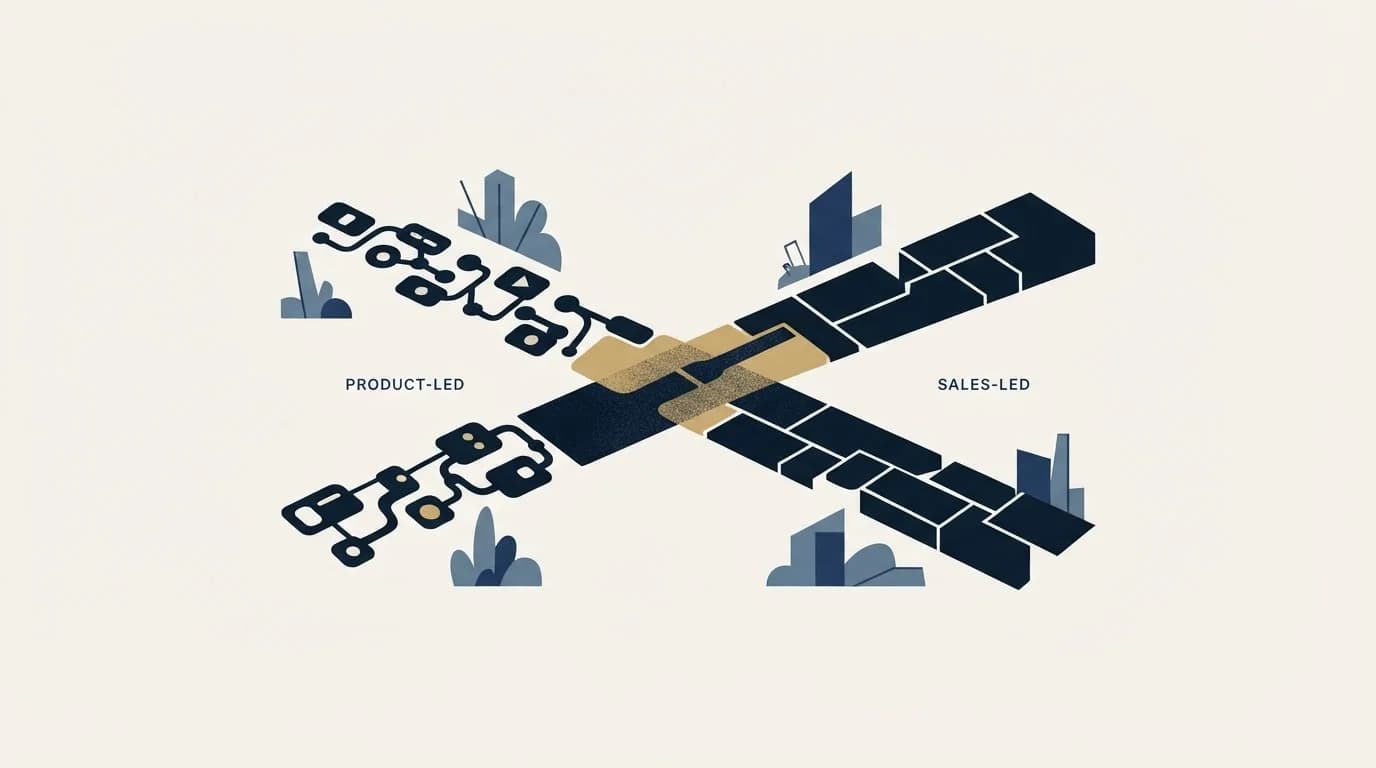
The band around the threshold is where teams try to run both at once, and there is one specific failure worth naming.
A self-serve motion generates signups continuously, and a sales-led motion needs the sales team pointed at the accounts worth a conversation. When both run without a rule for who touches what, reps end up working inbound signups because those are easier and immediately available, and the named-account outbound quietly stops happening. The pipeline looks busy and the deals that justify the new price point never materialise.
The fix is a routing rule set in advance: which signups get a human, which target accounts get outbound regardless of whether they have signed up, and who owns each. Without that rule the cheaper, easier work always wins the day, and the strategic work is the thing that gets dropped.
What both ends share
Three things do not change with ACV.
Contact data quality caps everything. An unreachable buyer is not addressable at any price point, and coverage on your segment is measurable before you spend anything. It is also the input most often assumed rather than checked, which is how a plan built on a 2,000-company list quietly becomes a 700-company programme.
Supply differs by buyer, not just by quality, and a licensed dataset priced for builders withholds contact data from its free tier by design.
The offer matters more than the channel. A clear reason to have the conversation outperforms channel optimisation at every ACV, and it is the cheapest thing to improve.
One message per campaign, no follow-up sequences. We run this at every deal size. A second and third touch into an unresponsive account teaches you nothing the first did not, and it costs sending reputation that the rest of the programme depends on.
Teams relying on cheap outbound touches still need reliable inbox placement, and a roundup of email warmup tools built for SaaS senders can help protect that sending reputation.
- Yes: You have calculated allowable CAC from gross margin and payback target
- Yes: You know how many held meetings a closed deal takes
- Yes: You have measured contact coverage on your target segment
- Yes: Your reporting unit matches your ACV band
- No: You are carrying a motion over from a previous price point
- Depends: Whether the product can support a genuine self-serve trial
Where the two motions meet
Most SaaS companies above the threshold still get inbound, and most below it still need some outbound. The mix is a ratio rather than a choice.
The useful sequencing principle at any ACV is to use the cheap channel to inform the expensive one. Run broad, low-cost contact across the addressable set first, find which segments and messages get answers, then concentrate the expensive per-account effort on what responded. That ordering allocates expensive attention using cheap signal, and it works identically at $10,000 and $100,000 ACV.
For the channel-level detail within outbound, see outbound lead generation channel mix by deal size. For what buying help costs, B2B lead generation services covers the models.
The short version
Calculate allowable CAC and meetings per closed deal before choosing a channel, because those two numbers determine the motion. Below roughly $30,000 ACV, favour self-serve volume with cheap, segment-level outbound support and measure activated trials. Above it, favour named accounts, multithreading and outbound as the primary channel, and measure meetings and pipeline from target accounts. The most common failure is carrying a motion across the line as ACV rises.
If outbound above the line is the half you would rather buy than build, you can see what a campaign would look like for your market.
Frequently asked questions.
Frequently asked questions- What lead generation works for B2B SaaS?
- It depends on contract value. Below roughly $30,000 ACV, self-serve or low-touch trials with cheap segment-level outbound support, measured on activated trials. Above it, named-account outbound with multithreading across the buying group, measured on meetings held and pipeline from target accounts.
- Why does $30k ACV matter?
- Because a fully loaded sales rep closes a limited number of deals a year, and each deal has to carry a share of that cost. Below a certain contract value the arithmetic stops working for a human touching every deal. Treat $30,000 as a marker and run the calculation with your own margin, win rate and retention.
- How many meetings do we need to hit a revenue target?
- Work backwards. Divide the target by average contract value for deals needed, divide by win rate for opportunities, divide by the share of meetings becoming opportunities for held meetings. That converts a revenue number into a meetings number, which is the only form in which a lead generation plan can be planned.
- Can you run product-led and sales-led motions at once?
- Yes, with an explicit routing rule. Without one, reps work the easier inbound signups and the named-account outbound quietly stops, so the pipeline looks busy while the deals that justify a higher price point never appear. Decide in advance which signups get a human and which accounts get outbound regardless.
About the author.

B2B cold email experts helping companies generate qualified leads through done-for-you outreach campaigns.
RevenueFlow Team
Explore more.
Ready to scale your outreach?
We build GTM engines that book real meetings. See the receipts.
Related articles.
SDR Outsourcing for Logistics Companies: The Brokerage Line
What an outside sales development team may do in a freight company's name, the calling and email rules it inherits, and which arrangement survives a bid-shaped market.
SDR Outsourcing for Business Brokers: The Fee Timing
Whether a success-fee brokerage should rent sales development at all: the fee timing, the texts that limit what an outside person may say about value, and who signs.
Appointment Setting for Business Brokers: The Seller Meeting
What a bought meeting with a business owner has to be for a brokerage: the three-part qualification, the confidentiality rules, the licence line and the owner's reasons.
3x3 Research: Three Facts in Three Minutes Before Outreach
3x3 research as Funnel Clarity publishes it: three unique facts in three minutes that the prospect would be surprised you know, the variants, and where it fits.
B2B Lead Lists for Aviation Companies: Build or Buy
Aviation is one of the few industries whose accounts are published by its regulator, which changes what is worth buying and what is worth downloading yourself.
Cold Calling for Food and Beverage Companies: Three Doors
Cold calling for a food or beverage company: who picks up at a chain, a distributor and an independent grocer, where each publishes its door, and when the phone is wrong.