Appointment Setting for SaaS Companies: What a Meeting Means
The SaaS layer of appointment setting: three meeting models and their quotas, what contract value allows, trial users against cold prospects, and where the play fails.
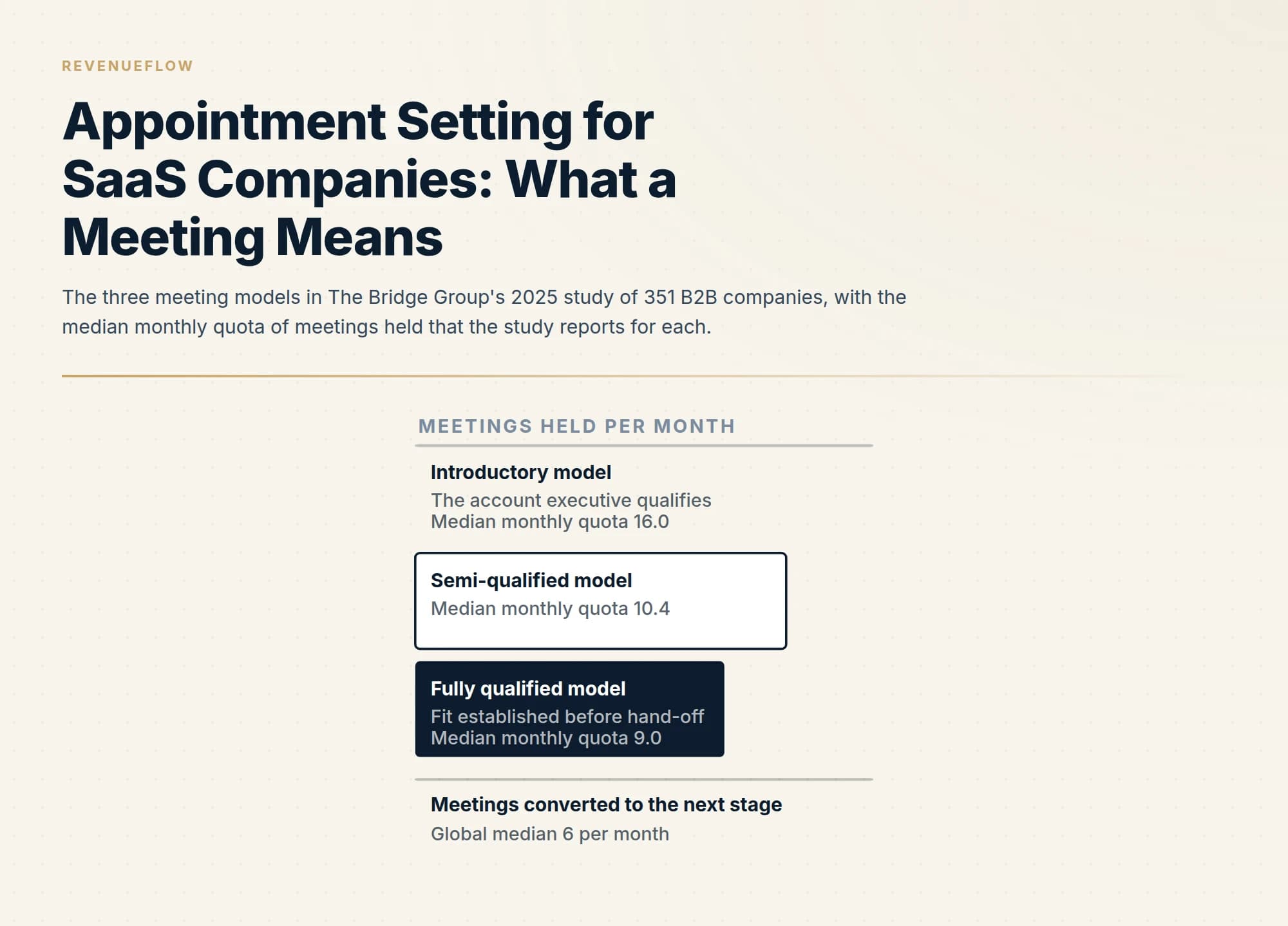
Appointment setting in a SaaS company starts with what a meeting means. The Bridge Group's 2025 study of 351 B2B companies, 83% of them B2B SaaS, reports median monthly quotas of 16.0 meetings held in an introductory model, 10.4 semi-qualified and 9.0 fully qualified. Contract value and a product-led motion decide whether the play fits.
Key takeaways
- The Bridge Group's 2025 study of 351 B2B companies reports a global median monthly quota of 10 meetings held, down 40% since 2018, and separate medians of 16.0, 10.4 and 9.0 for introductory, semi-qualified and fully qualified models.
- Pipeline sourced per sales development representative rose to $3.78 million, which the study attributes to higher average selling prices rather than more meetings, and it labels the figure raw pipeline, not forecast or closed-won.
- SaaS Capital's 2026 survey of private B2B SaaS companies, with over 1,000 respondents, reports a median annual contract value of $24,266, down from $26,265 the previous year.
- ProductLed's benchmark write-up says Sales most commonly owns free-to-paid conversion in product-led companies while adoption of product-qualified leads remains low, so trial users and cold prospects need different handling.
Reviewed and updated September 18, 2026
The best public data on appointment setting in software comes from a study that is mostly about software. The Bridge Group's tenth sales development report, published on 6 February 2025, opens its findings with the sample: "The following findings are drawn from survey responses from 351 B2B companies," of which, it says, "78% are North America-based, 83% are B2B SaaS, with a median revenue of $47M and median ASP of $50K" (The Bridge Group, SDR Models, Motions and Metrics, 10th edition). The Bridge Group's headline number for anyone buying or building appointment setting is a fall: its global median monthly quota for meetings held is 10, down 40% since 2018.
This page is for the SaaS company deciding how first meetings get booked for its own account executives, whether by an in-house team or an outside one. It is not about selling to SaaS companies, which cold email for SaaS covers. It is also not the general guide to the play: what a meeting costs is in B2B appointment setting, and the scope of what a provider does is in appointment setting services. This page is the SaaS layer on top of those: what a meeting has to mean in a software company, and where the play stops working.
What a meeting means, and why the quota depends on the answer
The Bridge Group does not report one meeting quota. It reports three, by what the company has decided a meeting is: "Introductory model: 16.0. Semi-qualified: 10.4. Fully qualified: 9.0." Those are monthly quotas for meetings held, which the report calls Stage 0, and it gives a second measure downstream, meetings converted to the next stage, with a global median of 6, down 43% since 2018.
The three models are the first decision a SaaS company makes about appointment setting, and it is a decision about where qualification happens. The page fetched does not define the models, so this is our reading of their names: in an introductory model the setter books a conversation and the account executive qualifies it, and in a fully qualified model the setter has established fit before the hand-off, and books fewer. Neither is better in the abstract. A company that pays a provider per meeting and has not written down which of the three it is buying has left the most important term of the contract blank. The house view here is that qualification criteria are agreed in writing before launch, and the general version of that argument is in appointment setting versus lead generation.
The study also says why the pipeline number can flatter a programme. Pipeline sourced per sales development representative rose to $3.78 million from $2.83 million in 2022, and the report explains the rise in one line: it reflects higher average selling prices "rather than more meetings." It labels the figure "Raw pipeline, not forecast or closed-won." A SaaS company judging a setter, inside or outside, on sourced pipeline is measuring its own price list.
Contract value decides which model a SaaS company can afford
The model a company can run depends on what a customer is worth, and the private SaaS market publishes that. SaaS Capital's annual survey of private B2B SaaS companies, which it says "includes data from over 1,000 respondents," reports: "Across all companies in the 2026 survey, the median ACV is $24,266, down from $26,265 the previous year" (SaaS Capital, What is the Average Deal Size for Private SaaS Companies?, read 18 September 2026). The Bridge Group's respondents report a median average selling price of $50K. That is a different measure from a different sample, but it is a reminder that companies with dedicated meeting setters are not the median SaaS company.
The consequence is a fit test. A booked meeting is a fixed unit of cost, and a contract value far below the market median leaves little room for it. Where that line falls for outbound in general, and the argument for a threshold, is in B2B SaaS lead generation; this page does not restate it. The SaaS-specific point is narrower: before choosing a meeting model, a company should know its own median contract value and which side of the survey median it sits on.
Where the play stops: the product-led company
Appointment setting assumes that a conversation is the way in. In a product-led company the product is the way in, and the functions are arranged around that. ProductLed's benchmark write-up reports that 58% of the B2B SaaS companies it surveyed had a product-led growth motion, and describes who runs it: "Product (49%) and Marketing (42%) most often lead PLG strategy, but Sales most commonly owns free-to-paid conversion (23%)," while "Customer Success most often supports free users (26%)" (ProductLed, Product-Led Growth Benchmarks, 5 February 2025; the page does not state the number of companies surveyed, and its investment questions refer to 2022).
Read for appointment setting, that says two things. First, a trial user and a cold prospect are different people to book. The trial user already has the product, and the function that most often owns converting that user is Sales, so a meeting booked with a trial user is a sales conversation about an account that exists. The cold prospect has nothing, and a meeting is the first thing the company asks of them. Running both through one setter with one script treats a customer in waiting as a stranger. Second, the same write-up reports that adoption of product-qualified leads remains low, at about a quarter of companies. Most product-led companies are therefore not yet telling their setters which users are worth a call, which is the precondition for booking the right ones.
| Row | Leads PLG strategy | Owns free-to-paid conversion | Supports free users |
|---|---|---|---|
| Product | Yes | No | No |
| Marketing | Yes | No | No |
| Sales | No | Yes | No |
| Customer Success | No | No | Yes |
The clock: ramp, tenure and the quarter
No source fetched for this page states a buying calendar common to SaaS customers, so none is asserted. The clock that the data does describe is the setter's own. The Bridge Group reports an average ramp time of 3.0 months, the lowest since 2010, an average tenure of 1.9 years, and median annual attrition of 40% in 2024. A company building a team is therefore paying for a quarter of ramp on a seat that turns over in about two years, and should plan hiring against that rather than against the month it wants meetings. The comparison of building that team with buying the capacity is made in outsourced appointment setting.
What the rules require of the setter's outreach
The rule on the message is the ordinary one for commercial email. Under the Federal Trade Commission's guide the CAN-SPAM Act "makes no exception for business-to-business email"; each separate email in violation carries a penalty of up to $53,088, and every commercial message needs a valid physical postal address and a clear way to opt out (FTC, CAN-SPAM Act: A Compliance Guide for Business, read 18 September 2026). An email asking a head of operations for twenty minutes is commercial email, whoever sends it, and a company that hires a provider is still the company whose product is promoted. Whether a specific practice is compliant is a question for counsel.
The objections, in the study's own numbers
The first objection to appointment setting inside SaaS companies is that it is getting harder, and the data agrees: The Bridge Group's share of representatives at quota is 60%, which it calls the lowest reported in its history, and The Bridge Group's meetings quota is down 40% since 2018.
The second is that the numbers are not comparable. The Bridge Group says so itself: "This is observational survey data, not a controlled experiment," and "Subgroup comparisons should be interpreted as directional rather than definitive." A provider that quotes the study's medians as a promise has misread it.
The third is alignment. The study reports that 82% of companies align their setters to account executive territories, up from 56% in 2018, and adds: "Just 40% of inbound-only teams align SDRs to AE territories." A setter, inside or outside, who is not tied to the account executive who takes the meeting is an objection waiting in the hand-off.
Channel reality for this play
The study's activity data is the most honest picture of how SaaS meetings are booked. The median setter logs 112 activities a day: 44 by phone, 41 by email, 19 on LinkedIn and 8 by text and other channels. It also compares two kinds of team: "Phone-centric teams average 56 dials and 4.6 QCs per day vs. email-centric teams at 28 dials and 3.4 QCs," where QCs are quality conversations. The phone is a large part of this vertical's practice. That is the vertical's reality, described rather than adopted: RevenueFlow runs email and LinkedIn with one message per campaign and does not cold-call.
| Channel | Median daily activities | The study's comparison |
|---|---|---|
| Phone | 44 | Phone-centric teams average 56 dials and 4.6 quality conversations |
| 41 | Email-centric teams average 28 dials and 3.4 quality conversations | |
| 19 | No comparison reported | |
| Text and other | 8 | No comparison reported |
The play is the wrong one in three cases. It is wrong for a product whose contract value is far below the private SaaS median, where the product and its trial have to do the selling. It is wrong for a product-led company that has not defined which users are worth a conversation, because the setter has no way to tell a customer in waiting from a stranger. And it is wrong when the company has not decided which of the three meeting models it is buying, because every number it is quoted will be for a different one.
Three openers, each grounded in a page the buyer can check
Three sample first lines a SaaS company's setter could send to a prospect, each tied to one fetched source. No result is claimed, no real person is named and no contact details appear.
To a vice president of sales at a company with its own setters. The Bridge Group's 2025 study of 351 B2B companies reports that pipeline per sales development representative rose because selling prices rose, rather than because meetings did. We sell software that measures the second thing. If meetings held per representative is a number you track, twenty minutes is the ask. The finding is the study's own and is stated as the study states it.
To a head of growth at a product-led company. ProductLed's benchmark write-up says Sales most commonly owns free-to-paid conversion while adoption of product-qualified leads remains low. Our product scores trial accounts so a sales team knows which ones to call. If that hand-off is manual for you today, a short conversation is the ask. The two findings are quoted from a published page.
To a revenue operations lead. The Bridge Group reports three different meeting quotas depending on whether a company runs an introductory, semi-qualified or fully qualified model. Our software tracks which model each of your teams is actually running. If your teams define a meeting differently, a short conversation about that is the ask. The three models are the study's.
To: Head of growth, a product-led company
ProductLed's benchmark write-up says Sales most commonly owns free-to-paid conversion while adoption of product-qualified leads remains low. 1
Our product scores trial accounts so a sales team knows which ones to call. If that hand-off is manual for you today, a short conversation is the ask. 2
Postal address and opt-out line in the footer. 3
- 1Two findings from a published page, stated as the page states them.
- 2One hand-off, and a conversation as the ask, not a result.
- 3The postal address and opt-out line the FTC's CAN-SPAM guide requires of every commercial email.
What a SaaS company has to decide
Appointment setting in a SaaS company comes down to four decisions: which of the three meeting models it is running, and therefore what quota is reasonable; whether its contract value leaves room for a booked meeting at all; whether trial users and cold prospects are booked by the same people with the same message; and whether the setter is aligned to the account executive who takes the meeting. Each has a published number behind it, and none of those numbers is a promise.
RevenueFlow books meetings on email and LinkedIn, one message per campaign, against criteria agreed in writing before launch, and is paid on attended meetings that meet them. If the written side of booking is the part you would rather buy than build, you can see what a campaign would look like for your market.
The Bridge Group, SaaS Capital, ProductLed and FTC pages were fetched on 18 September 2026 from the pages linked. The Bridge Group's figures come from 351 B2B companies and are medians or averages as the study notes; it describes its own data as observational and directional. ProductLed's page does not state its sample. Rules change; confirm them at the source. Nothing here is legal advice.
Sources: The Bridge Group, SDR Models, Motions and Metrics, 10th edition, SaaS Capital, average deal size for private SaaS companies, ProductLed, Product-Led Growth Benchmarks, FTC, CAN-SPAM compliance guide
Frequently asked questions.
Frequently asked questions- How many meetings a month should a SaaS appointment setter book?
- It depends on what the company counts as a meeting. The Bridge Group's 2025 study of 351 B2B companies, 83% of them B2B SaaS, reports a global median monthly quota of 10 meetings held, down 40% since 2018, with medians of 16.0 in an introductory model, 10.4 semi-qualified and 9.0 fully qualified. The study calls its own data observational and says subgroup comparisons are directional, so these are reference points and not promises.
- Should a SaaS company judge appointment setting on pipeline sourced?
- With care. The Bridge Group reports that pipeline sourced per sales development representative rose to $3.78 million from $2.83 million in 2022, and attributes the rise to higher average selling prices rather than more meetings. It labels the figure raw pipeline, not forecast or closed-won. A company measuring a setter on sourced pipeline is partly measuring its own price list, so meetings held and meetings converted to the next stage are the cleaner counts.
- Does appointment setting work for product-led SaaS companies?
- Only once the company can tell its setters which users are worth a conversation. ProductLed's benchmark write-up reports that Sales most commonly owns free-to-paid conversion in product-led companies, while adoption of product-qualified leads remains low at about a quarter of companies. A trial user already has the product and a cold prospect has nothing, so booking both with one message treats a customer in waiting as a stranger.
- When is appointment setting the wrong play for a SaaS company?
- When the contract value is far below the private SaaS median, which SaaS Capital's 2026 survey puts at $24,266, because a booked meeting is a fixed unit of cost. When a product-led company has not defined which users merit a conversation. And when the company has not decided whether it is buying introductory, semi-qualified or fully qualified meetings, because every quota it is quoted will describe a different one.
About the author.

B2B cold email experts helping companies generate qualified leads through done-for-you outreach campaigns.
RevenueFlow Team
Explore more.
Ready to scale your outreach?
We build GTM engines that book real meetings. See the receipts.
Related articles.
Sales Outsourcing for SaaS Companies: What to Hand Over
For SaaS companies weighing an outside sales team: what the industry's own survey found, what a third party cannot hold in a software sale, and what can go out.
Sales Strategy for Logistics Companies: Segment, Seat, Cycle
How a broker, forwarder, carrier or 3PL sets its sales strategy: Armstrong's segments and contract terms, the four provider seats shippers keep, and the rate cycle.
Appointment Setting for 3PL Companies: Fit Before the Calendar
For 3PLs, warehousing operators and brokers wanting shipper meetings: the five fit gates, the bid calendar, contract terms, the trade's rules and three openers.
Sales Strategy for Manufacturing Companies: Direct or Reps
How a manufacturer decides whose salespeople carry its line: the published definition of a representative, MANA's agreement clauses and the split commission problem.
Appointment Setting for Manufacturers: Who a Setter May Call
For the manufacturer hiring a setter: the ranked titles to hand over, the rep and distributor map that decides which accounts may be called, and the meeting types.
Lead Generation for Trucking Companies: Three Routes
How a motor carrier finds freight customers: the load board, the broker relationship and the shipper's annual bid, with the calendar and the rules on outreach.