Appointment Setting for 3PL Companies: Fit Before the Calendar
For 3PLs, warehousing operators and brokers wanting shipper meetings: the five fit gates, the bid calendar, contract terms, the trade's rules and three openers.
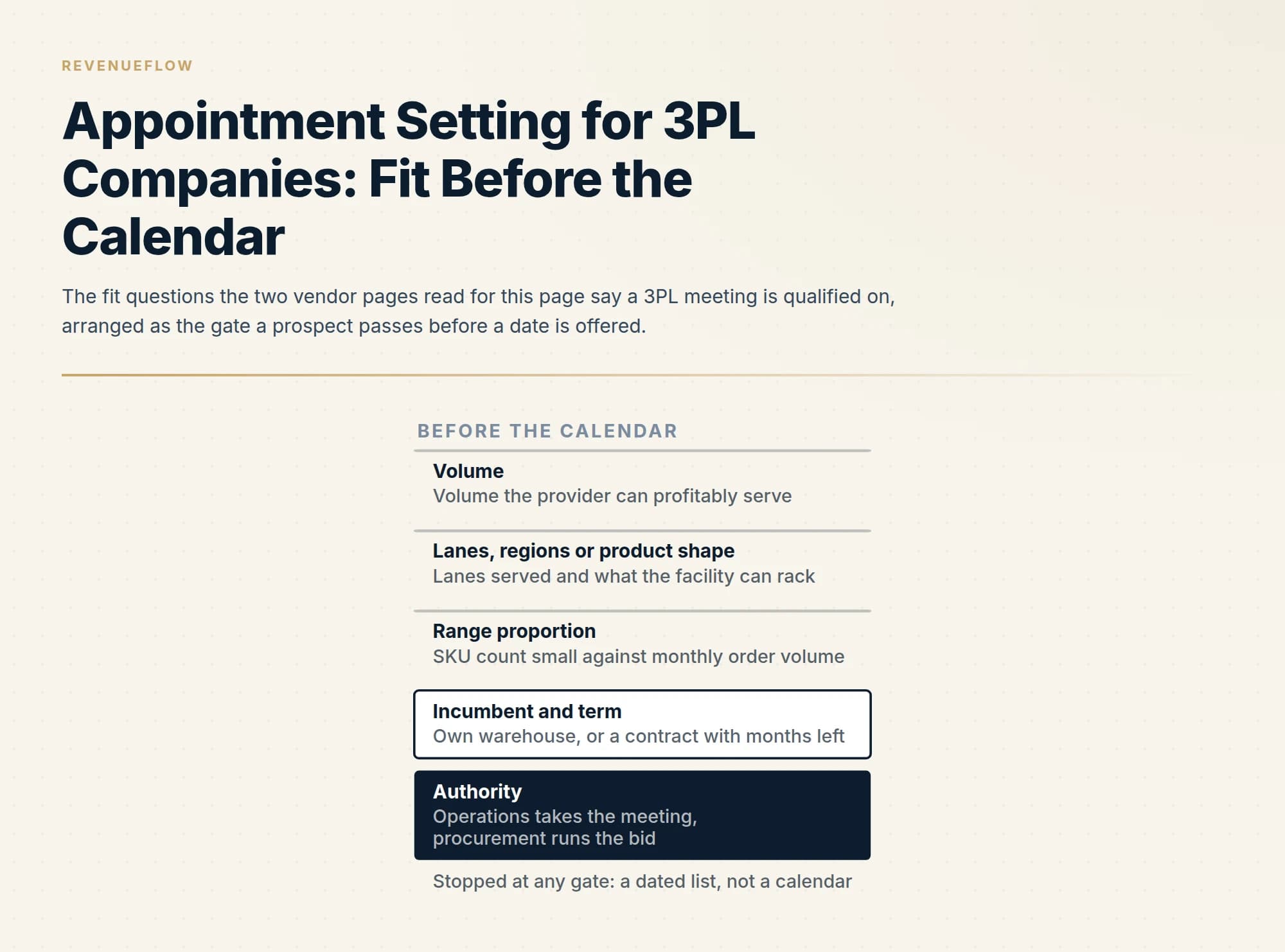
A 3PL meeting is qualified on fit before it is booked: order or freight volume, lanes or product shape the operation can serve, SKU count small against monthly volume, the incumbent and its contract term, and whether the contact can convene procurement. Time the list to shippers' fourth and first quarter sourcing events and to contract end dates.
Key takeaways
- Reexia's 3PL case study set fit as SKU count no more than about 5 percent of monthly sales volume and small products, and reports 12 qualified opportunities and one signed client from three months of calling two days a week.
- Callbox, 17 September 2026, says a credible partner qualifies on freight volume, lanes or regions, provider pain points and true authority, and its COO calls a meeting outside the lanes you can serve profitably wasted calendar time.
- Armstrong and Associates puts the US 3PL market at 323.4 billion dollars in 2025 and describes dedicated carriage terms of one to seven years and warehousing terms of one to three, so a mid-term shipper cannot buy.
- Ryan Transportation describes annual sourcing events in the first or last quarter, and RXO's 2026 RFP guide expects a more adverse capacity environment into 2027, which sets the two timing windows for meetings.
Reviewed and updated September 19, 2026
Appointment Setting for 3PL Companies: Fit Before the Calendar
A contract logistics provider with a 400,000 square foot facility hires an agency to book meetings with online retailers. The agency books twenty in the first month. Fourteen of the retailers sell furniture, which the facility cannot rack; four have order volumes that would fill a corner of one aisle; two are worth the drive. The agency delivered twenty meetings. The provider bought two conversations and eighteen hours of its sales director's time.
This page is for the third-party logistics company, the contract warehousing and fulfilment operator, the freight broker and the managed transportation provider, that wants meetings with shippers. It names its own segment because adjacent ones have their own pages: selling into logistics companies is cold email for warehousing and 3PL and logistics lead generation, and trucking carriers and supply chain software sellers are different readers. Two results on the search page for this phrase, Arrivy and Racklify, are about dock appointment scheduling, the operational meaning of the words, and are not this page's subject. Everything below was fetched on 18 September 2026 from the vertical's own associations, analysts and vendors.
Who takes a 3PL meeting, and who signs
The vendors that book logistics meetings name the seats. Callbox, in a guide dated 17 September 2026, describes the commercial meaning of the phrase as booking qualified sales meetings between a 3PL's reps and logistics decision makers such as VPs of supply chain, directors of transportation or procurement leads. Reexia, a UK agency, writes in its 3PL case study that fulfilment decisions may involve operations, logistics, supply chain or senior management, and that established businesses often already have internal warehousing capabilities or relationships with existing providers.
Callbox's guide relays Gartner's figure of 6 to 10 decision makers on a typical complex B2B purchase and adds its own claim that logistics deals routinely take 3 to 18 months to close depending on contract size; the first is Gartner's number as a vendor cites it, the second is the vendor's own, and both are recorded as such. What the two vendor descriptions agree on is that the person who takes the meeting, usually in operations or transportation, sits beside a procurement function that runs the bid and a senior manager who signs a multi-year commitment.
The commitment is what makes the meeting expensive to get wrong. Armstrong and Associates' market page, read on 18 September 2026, describes dedicated contract carriage agreements as typically having one to seven year terms and value-added warehousing and distribution contracts as typically one to three years, with some extending to ten or more. A shipper mid-way through a three-year warehousing contract is a meeting about something it cannot buy.
Fit is the qualification, and the vertical says so in its own words
Reexia's case study is the clearest statement in the vertical of what fit means. In Reexia's account, its client's preferred model required the number of SKUs to represent no more than approximately 5 percent of monthly sales volume, wanted retailers selling relatively small products that required limited shelf space, and needed significant sales volumes. The agency's conclusion was that the challenge was not simply securing conversations but identifying businesses worth contacting in the first place, and that research on the scale of the retailer, the nature and size of the products, the breadth of the range and likely order volumes was done before prospects entered the campaign. Over three months, calling two days a week, the campaign generated 12 qualified opportunities and one signed client, by the agency's own account.
Callbox's guide reaches the same place from the other side. Its evaluation checklist tells a 3PL to ask for the agency's qualification framework in writing, and says a credible partner qualifies on freight volume, lanes or regions served, current provider pain points and true decision-making authority, not just job title. Its chief operating officer, Rebecca Matias, is quoted on the page telling buyers not to be sold on raw appointment volume, because in logistics a meeting with a company whose freight volume or lanes do not match what the provider can profitably serve is wasted calendar time for closers.
The house position fits this vertical without adjustment: meetings are qualified against criteria agreed in writing before launch, and those five gates are the criteria. Budget, timing and authority are never billing conditions; volume, product shape and range proportion are facts about the account, which is why they can be.
The bid calendar is the timing
Shippers buy logistics on a calendar the vertical publishes. Ryan Transportation's article on bid cycles states that many shippers hold annual transportation sourcing events during the first or last quarter of the year so they can evaluate their transportation costs and create the new budget for the coming fiscal year, and that monthly and quarterly bid cycles became more popular after a strong hurricane season and the electronic logging mandate; the article is dated by its own text to the start of 2021. RXO's guide to a 2026 transportation RFP, published on the Coyote resource site, says the prolonged downcycle looks to be coming to an end and a more adverse capacity environment looms over the rest of 2026 and into 2027, and walks a shipper through seven steps from a stable operating environment and KPIs to refining the carrier strategy and overcommunicating with providers. Inbound Logistics runs a 3PL request-for-proposal service in which a shipper describes its challenge and ticks the providers it wants to respond, from a list of around forty.
For an appointment programme, three timings follow. The annual bid is when a shipper is willing to meet a new provider, so meetings booked into the quarter before it are about a real decision. A quarterly or monthly mini-bid is a smaller door that opens more often. And a market turning from a downcycle to tight capacity, which is RXO's reading of 2026 into 2027, is when a shipper who ignored a meeting in a soft year takes one.
- Fourth quarterAnnual sourcing event opens
Transportation costs evaluated and the budget for the coming fiscal year created
- First quarterThe other annual window
The same annual sourcing event at the shippers that hold it in the first quarter
- Any monthMini-bids
Monthly and quarterly cycles that spread after the logging mandate; smaller doors, opened more often
- Contract mid-termNo decision available
Dedicated carriage runs one to seven years, warehousing one to three; meet before the term ends
- Capacity tighteningThe market turns
RXO's 2026 guide expects a more adverse capacity environment into 2027; ignored meetings get taken
The scale of the market, and who is on the other side of it
The Council of Supply Chain Management Professionals' 2026 State of Logistics report page, released on 16 June, puts United States business logistics costs at 2.4 trillion dollars, 7.8 percent of national GDP, against 2.6 trillion and 8.7 percent the year before, and names five structural forces from asymmetrical global growth to energy price volatility. Armstrong and Associates estimates the United States 3PL market at 323.4 billion dollars in 2025, up 5.0 percent, and splits it into domestic transportation management at 128.3 billion, international transportation management at 85.9 billion, value-added warehousing and distribution at 72.7 billion, dedicated contract carriage at 32.0 billion and contract software at 4.5 billion.
Those segments are different sales. A warehousing meeting is about space, product shape and SKU proportion; a transportation management meeting is about lanes, volume and the bid. The Transportation Intermediaries Association describes its 2,000 member companies, 70 percent of them small family-owned businesses, bound by a code of professional conduct, and runs a Watchdog service for reviewing carriers; the American Trucking Associations' Trends 2025 report, dated 28 August 2025, records that 91.5 percent of carriers operate ten or fewer trucks. A broker or 3PL booking meetings with shippers is competing in a market where the incumbent is often small, local and known, and where the shipper's objection is rarely price alone.
The rules that reach outreach
Two bodies of rules touch a 3PL's outreach, one general and one specific to the trade. The general one is the outreach law every seller works under: the Federal Trade Commission's Telemarketing Sales Rule guide lists business-to-business solicitation calls among its exemptions, unless they involve the sale of nondurable office or cleaning supplies, and its CAN-SPAM guide requires accurate headers, an honest subject line, a physical address and an opt-out honoured within ten business days, holding both the promoted company and the sender responsible. The specific one is operating authority. The Federal Motor Carrier Safety Administration's page on operating authority, read in a headless browser on 18 September 2026, covers the docket number a carrier or broker holds; the association's own articles on shipper verification and the broker surety bond are the trade's reminder that a shipper meeting a broker will check the authority before the freight moves, and that the broker should check the shipper too. None of this is legal advice; all of it is a reason to have the authority number in the signature.
What shippers and providers say gets in the way
The objections come from the vertical's own pages. Reexia writes that changing fulfilment providers can represent a significant operational decision and prospects may require considerable time before making a change. Callbox's guide says buyers complete much of their research before speaking to a rep, relaying Gartner's figure of roughly 80 percent, and that unqualified volume is a worse bet today than it was five years ago, so the agencies that still perform are the ones running tight qualification. Its own evaluation advice tells a 3PL to confirm vertical fluency first, by asking the agency rep to explain full truckload versus less than truckload, demurrage or a detention charge without looking it up.
Each of those is an objection to the meeting rather than to the provider. A shipper mid-contract with an operational switch to plan will not meet a stranger. A shipper that has already shortlisted will not add a name it cannot place. And a shipper that hears a caller stumble over detention knows the meeting will be a pitch. The answer is the same in each case: the meeting request has to carry the fit facts and speak the trade's vocabulary, or it is a calendar invitation from nowhere.
Callbox, 17 September 2026
- Freight volume
- Lanes or regions served
- Current provider pain points
- True decision-making authority, not just title
Reexia, 3PL case study
- Significant sales volumes
- Relatively small products, limited shelf space
- SKU count a small share of monthly volume
- Existing fulfilment arrangements understood first
Channel reality, and when this is the wrong play
The vertical's appointment vendors are phone-led and say so: Reexia called two days a week for three months, Callbox recommends calls, personalised email and LinkedIn working together and warns that phone-only outreach undersells modern buying behaviour. That is the vertical's reality. Our own motion is email and LinkedIn, one message per campaign, no bump sequences and no second LinkedIn message under an ignored one, and it fits this vertical because the qualifying facts, volume, product shape, lanes and the incumbent's term, are the content of the message rather than something a caller extracts on the phone.
Appointment setting is the wrong play in four cases. When the target's contract has more than a year to run, because dedicated carriage and warehousing terms make the meeting a conversation about a decision that is not available. When the product cannot physically fit the operation, which is the furniture-in-a-parcel-facility problem and is a list error, not a sales one. When the shipper has an open RFP, because the right response is the proposal, and the meeting is the one the RFP schedules. And when the provider cannot serve the lanes or the region profitably, which is the wasted calendar time Callbox's chief operating officer describes. The generic comparison of providers and models is in B2B appointment setting companies and appointment setting services and applies here unchanged.
To the head of operations at an online retailer
Your catalogue runs to about three hundred small items and your order volume, from what is public, is well above that. That proportion is what our fulfilment floor is built for; is your current arrangement in-house or on a contract with a term? 1
To a director of transportation before the annual bid
If your sourcing event runs in the fourth quarter, the lanes you tender now set the year. We run the two regional lanes you moved most last year; would it help to have our rates in the bid rather than a meeting after it? 2
To a procurement lead at a manufacturer
The trade's own 2026 bid guide expects capacity to tighten into 2027. If your dedicated carriage agreement ends inside the next year, a conversation before the market turns is worth thirty minutes; if it does not, tell us the month and we will write then. 3
- 1Built on the SKU-to-volume proportion Reexia's client used as its fit rule; the ask is the incumbent and the term, the gate the message cannot pass alone.
- 2Built on the annual sourcing window Ryan Transportation describes; the offer is a place in the bid, which is what the shipper is doing that quarter.
- 3Built on RXO's reading of 2026 into 2027 and Armstrong's contract terms; the message says what happens if the answer is not now.
Each makes no results claim, names no rate and asks a fit question the buyer alone can answer. One message per campaign, and when the term-end month or the bid window creates a new premise, that is a new campaign.
Running it
Build the list from the operation outward: what the facility can rack, which lanes the network runs profitably, what order volume makes a client worth onboarding. Screen every account on the five gates before it reaches anyone's calendar. Time the list to the bid calendar and to contract terms. And put the trade's vocabulary and the authority number in every message, because the shipper will check both.
If the constraint is building that screened list and getting the first message out, RevenueFlow builds it and books qualified shipper meetings on a pay-per-meeting basis, by email and LinkedIn, with the fit gates written into the criteria agreed before launch.
Market figures per Armstrong and Associates' US 3PL market size page and CSCMP's 2026 State of Logistics report page; carrier structure per ATA's American Trucking Trends 2025, dated 28 August 2025; association descriptions per TIA and IWLA; bid timing per Ryan Transportation and RXO's 2026 RFP guide on the Coyote resource site; vendor practice per Callbox, 17 September 2026, and Reexia's 3PL case study; outreach rules per the FTC's Telemarketing Sales Rule and CAN-SPAM guides and FMCSA's operating authority page. All fetched 18 September 2026.
Sources: US 3PL Market Size Estimates, Armstrong and Associates, State of Logistics Report, CSCMP, ATA American Trucking Trends 2025, Transportation Intermediaries Association, IWLA, When is the Right Time to Run a Bid Cycle, Ryan Transportation, Preparing for Your 2026 RFP, RXO, 3PL RFP, Inbound Logistics, 5 Leading Appointment Setting Agencies for Logistics, Callbox, Appointment Setting for 3PL Companies, Reexia, Operating Authority, FMCSA, Complying with the Telemarketing Sales Rule, FTC, CAN-SPAM Act Compliance Guide, FTC
Frequently asked questions.
Frequently asked questions- How is a 3PL sales meeting qualified?
- On fit facts about the account, before a date is offered. Callbox names freight volume, lanes or regions served, current provider pain points and true decision-making authority. Reexia's case study screened retailers on sales volume, product size and a SKU count small against monthly orders. Add the incumbent and its contract term, because warehousing runs one to three years and dedicated carriage up to seven.
- When do shippers take meetings with new logistics providers?
- Around their sourcing events. Ryan Transportation describes annual transportation sourcing in the first or last quarter to set the coming fiscal year's budget, with monthly and quarterly mini-bids spreading since the logging mandate. RXO's 2026 guide expects capacity to tighten into 2027, when shippers who ignored meetings in a soft year tend to take them. Before a contract ends, and before the bid, are the windows.
- Does appointment setting mean dock scheduling?
- No. Two results for the phrase, Arrivy and Racklify, cover dock appointment scheduling, the operational job of booking carriers into a warehouse's receiving slots. This page is about the commercial meaning: booking sales meetings between a 3PL's reps and the shippers who buy warehousing, fulfilment and transportation. Callbox's guide draws the same distinction on its own page.
- When is appointment setting the wrong play for a 3PL?
- When the shipper's contract has more than a year to run, when the product cannot physically fit the operation, when the shipper has an open RFP that schedules its own meetings, and when the provider cannot serve the lanes or region profitably. Each is a list error rather than a sales one, and no vendor model, retainer or pay-per-meeting, fixes a list.
About the author.

B2B cold email experts helping companies generate qualified leads through done-for-you outreach campaigns.
RevenueFlow Team
Explore more.
Ready to scale your outreach?
We build GTM engines that book real meetings. See the receipts.
Related articles.
Cold Calling Scripts for 3PL Companies: One Lane at a Time
Six call scripts for brokers and 3PLs calling shippers: the front office line, the one-lane opener, the incumbent answer, the email brush-off and the voicemail.
Sales Strategy for Logistics Companies: Segment, Seat, Cycle
How a broker, forwarder, carrier or 3PL sets its sales strategy: Armstrong's segments and contract terms, the four provider seats shippers keep, and the rate cycle.
Appointment Setting for Food Distributors
How a foodservice distributor opens accounts its routes do not reach: independents, chains and institutions, the FDA traceability rule as the opener, the DSR handoff.
LinkedIn Outreach for Machine Shops
How a job shop or CNC machine shop uses LinkedIn to win OEM work: the four buyer titles, the RFQ gate, the ISO, AS9100 and ITAR facts, and LinkedIn's own rules.
Cold Calling Scripts for SEO Agencies: After Google's Warning
Six call scripts for SEO agencies calling local businesses, written around what Google and the FTC tell owners about this call: no Google tie, no ranking guarantee.
Appointment Setting for Manufacturers: Who a Setter May Call
For the manufacturer hiring a setter: the ranked titles to hand over, the rep and distributor map that decides which accounts may be called, and the meeting types.