Cold Calling Scripts for 3PL Companies: One Lane at a Time
Six call scripts for brokers and 3PLs calling shippers: the front office line, the one-lane opener, the incumbent answer, the email brush-off and the voicemail.
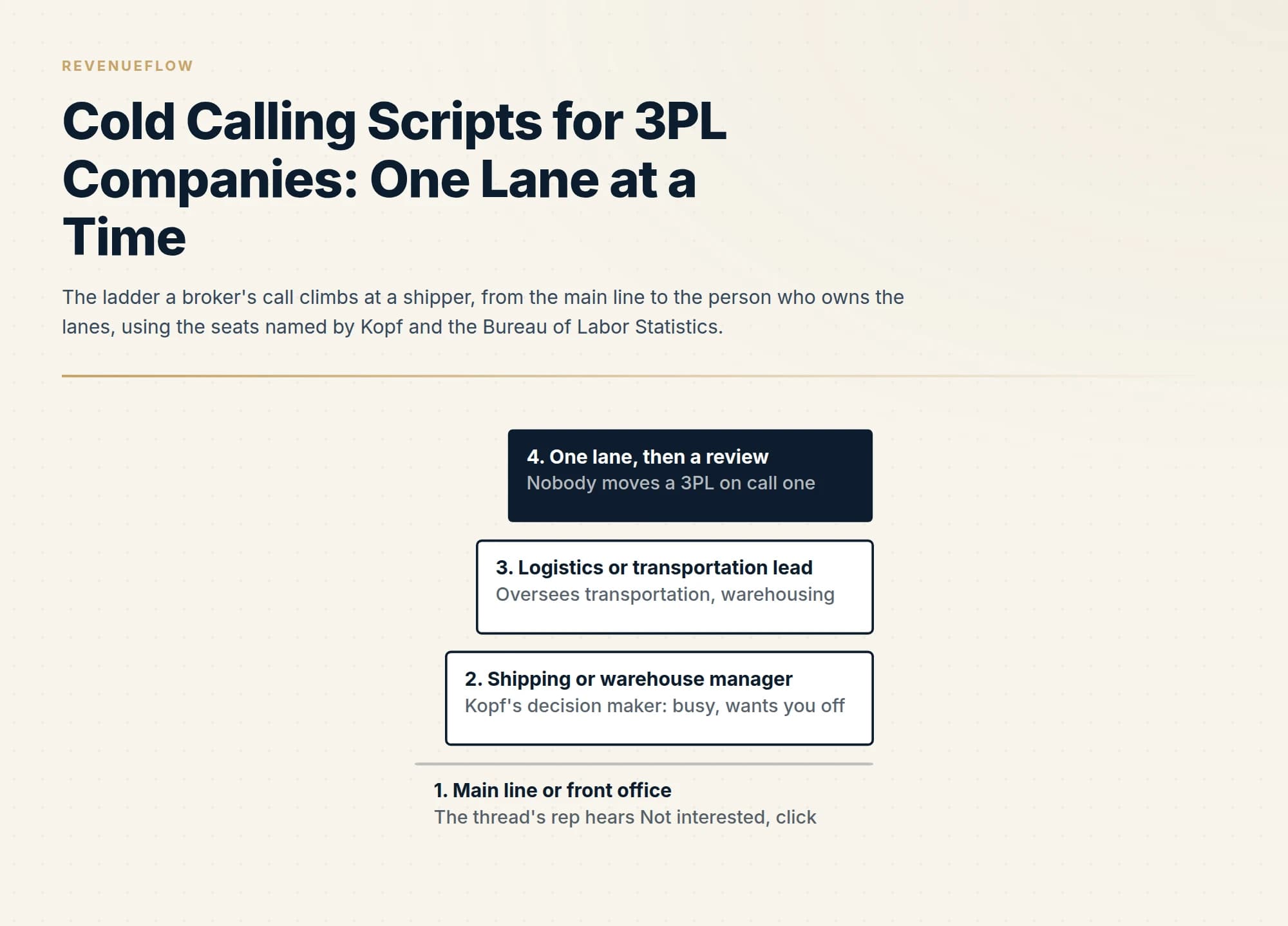
Shippers hear several broker pitches a week and treat brokers as interchangeable, so 3PL call scripts should say what the caller is, name a lane, ask for one quote and leave the incumbent alone. The credibility line is a fact the shipper can check: broker authority, an MC number and a bond in effect, all registered with FMCSA.
Key takeaways
- Kopf Logistics Group tells its freight agents to find the shipping manager or warehouse manager by name and to expect two answers: too busy to talk right now, and my freight is already taken care of.
- A former rep in a 2016 r/sales thread writes that brokerage service is nearly identical and shippers know this, so the advice is to be blunt about why you are calling and drop the boilerplate.
- Chambr's page on the 3PL script says buyers do not move 3PLs on call one, which is why every opener here asks for one lane or one quote and never for the account.
- FMCSA's broker registration page lists a surety bond or trust fund of $75,000 and a BOC-3 filing after the MC number is assigned, and 49 CFR 387.307 keeps the registration in effect only while the bond is.
Reviewed and updated September 19, 2026
Cold Calling Scripts for 3PL Companies: One Lane at a Time
A new account executive at a freight brokerage has a list of two hundred manufacturers and a headset. The first forty dials end at the front office. The forty-first reaches a shipping manager, who listens to nine words about capacity and round-the-clock service and says the freight is already taken care of. By lunch the rep has learned what every shipper on the list already knew: the pitch is the same one they heard yesterday, from a different brokerage.
This page is for the third-party logistics company whose own people make the calls: a freight brokerage, a freight agent, a 3PL selling managed transportation or warehousing, calling shippers. The scripts below are written for that call and no other. The opposite direction, a vendor selling to 3PL operators, is cold email for warehousing and 3PL. Every outside source here was fetched on 18 September 2026, and every company, lane and number inside a script is a placeholder.
Who picks up at a shipper, and who they hand you to
The vertical's own script pages name the seat. Kopf Logistics Group, a brokerage that publishes a cold call script for its independent freight agents, tells agents to research the name of the person who makes decisions, "whether it be the shipping manager or warehouse manager." The Bureau of Labor Statistics describes the professional layer above that desk. Its Occupational Outlook entry for logisticians says they oversee activities related to purchasing, transportation, inventory and warehousing, and its entry for transportation, storage, and distribution managers says they plan, direct, or coordinate transportation, storage, or distribution activities. Both entries say most work full time and some work more than 40 hours per week, and the logisticians entry adds that the work is fast paced and that they must keep operations on schedule, working quickly to solve problems that arise.
That is the person a broker interrupts: someone whose day is a schedule that is already slipping. Before them sits whoever answers the main line. The rep who opened the r/sales thread 3PL Cold Call help on 6 August 2016 describes it exactly: either the gatekeeper shuts the call down with a "Not interested" and a click, or a live person hears a request that amounts to asking for their full truckloads.
What a shipper has already heard this week
Two voices from inside the trade describe the listener's state of mind, and neither is flattering to the caller. A commenter in the r/sales thread who had done the job writes that the service a client gets from the large brokerages is nearly identical, "and shippers know this," and that shippers get dozens of calls every week with pitches about capacity and 24/7 availability. The advice that follows is to be blunt about why you are calling and to drop the boilerplate lines learned in sales training. Kopf's page says the same from the employer's side: shippers are busy, will often be anxious to get the caller off the phone, and have probably received several calls asking for their business already. It names the two responses an agent will hear most: "I'm too busy to talk right now." and "My freight is already taken care of."
Chambr, a sales training vendor whose page on the 3PL cold call script ranks for this search, describes the same moment: the prospect hears that the caller is with a third-party logistics provider, files it under another 3PL and says the company is all set. Its prescription is an opening specific to the shipper's freight and an ask that stays tiny. In its words, "Buyers don't move 3PLs on call one."
Every script below is built on those three accounts. The opener names a lane or a freight fact. The ask is one lane or one quote. The response to the incumbent is written in before the call starts.
Script 1: the front office
Grounded in the thread's gatekeeper problem. Whoever answers the main line at a plant or a distribution centre is rarely a trained screener, a point the live page on calling owner-led businesses makes for small companies generally. The line that works is short and true.
Hi, this is {{name}} with {{brokerage}}. We're a freight broker, and the call is for whoever books your outbound trucks, probably shipping or transportation. Is that {{contact_name}}, or someone else? Happy to hold, or to call back at a better time for them.
It says what the caller is, which the thread's blunt-about-why advice requires, and it asks a question the person answering can actually answer. It does not pretend to a relationship.
Script 2: the opener to the person who owns the lanes
Grounded in Chambr's page: an opening specific to their freight, and an ask that does not threaten the incumbent.
{{contact_name}}, this is {{name}} with {{brokerage}}. This is a cold call, so it will be quick. We run {{equipment_type}} out of {{origin_region}} into {{destination_region}} every week, and you ship {{commodity}} out of {{facility_city}}. Nobody is asking you to replace anyone. Is there one lane that gives you trouble where we could quote against what you have?
Call to the person who owns the lanes
This is a cold call, so it will be quick. 1
We run this equipment out of this region into that one every week. 2
Nobody is asking you to replace anyone. 3
Is there one lane that gives you trouble where we could quote against what you have? 4
- 1The thread's advice: be blunt about why you are calling and drop the boilerplate.
- 2Chambr: an opening specific to their freight, in place of capacity and 24/7 availability.
- 3Nobody moves a 3PL on call one, so the script says so first.
- 4Kopf's question about lanes with consistent issues, turned into one quote.
Script 3: "My freight is already taken care of"
Grounded in Kopf's page, which answers this objection by asking whether the shipper is happy with the results and whether there are lanes that need improvement, lanes the shipper consistently has issues with.
That's what we'd expect, and nobody is trying to change it. Shippers we talk to often have one or two lanes that are harder to cover than the rest, the ones where a truck falls through on a Friday. If you have one, send over the origin, the destination and the equipment, and you'll have a quote today. If it's no better than what you have, you've lost nothing.
Script 4: the request to email your information
Every rep in this trade hears a version of this. None of the sources fetched for this page measures how often it is a brush-off, so treat it as both possibilities and ask for the one thing that makes the email useful.
Happy to. So it isn't a brochure: which lane should we quote? With one origin and destination, the email will have a number in it and you can compare it in ten seconds. What's the best address, and is it you who'd look at it?
If the answer is a lane, the call worked. If the answer is an address and nothing else, send one short message and leave it there. House policy on the written side is one message per campaign, with no chasing sequence behind it.
Script 5: the produce or seasonal lane
Grounded in a public dataset. The Agricultural Marketing Service at the United States Department of Agriculture publishes the Agricultural Refrigerated Truck Quarterly, which it describes as a view of U.S. regional refrigerated truckload movements, with a rotating regional focus, in terms of volume and rates, applied to fresh fruit and vegetable markets. A broker with refrigerated capacity can read the current issue before calling a produce shipper in the region it covers.
{{contact_name}}, {{name}} with {{brokerage}}. We book reefers out of {{growing_region}}, and USDA's latest refrigerated truck report covers your region this quarter. When your volume picks up, which lane is hardest to cover? We'd like to be the backup on that one lane before you need it.
The script asks to be the backup. A shipper in season cannot risk a new primary carrier, and a broker who asks for that has misread the week.
Script 6: the voicemail, and the credibility line
{{contact_name}}, {{name}} at {{brokerage}}, {{phone}}. We cover {{equipment_type}} from {{origin_region}} to {{destination_region}}. If you have one lane that's hard to cover, call back with it and we'll quote it the same day. {{phone}} again. If it's not useful, ignore this and we won't chase.
When a shipper asks who the caller is, the honest answer is a fact the shipper can check. Federal rules define a broker as a person who, for compensation, arranges, or offers to arrange, the transportation of property by an authorized motor carrier (49 CFR 371.2). The Federal Motor Carrier Safety Administration's broker registration page says first-time brokers apply for broker authority through the Unified Registration System and, once an MC number is assigned, file a surety bond (Form BMC-84) or trust fund agreement (Form BMC-85) in the amount of $75,000 and a process agent designation (Form BOC-3). The regulation behind the bond, 49 CFR 387.307, says the registration remains in effect only as long as the surety bond or trust fund does.
We're a licensed property broker, MC {{mc_number}}. You can look
that up with FMCSA, the federal registry, while we talk:
it shows our authority and that our bond is in effect.
| The caller says | The shipper checks | Source |
|---|---|---|
| We are a property broker | Arranges transportation by an authorized motor carrier, for compensation | 49 CFR 371.2 |
| Our MC number is this | Broker authority granted through the Unified Registration System | FMCSA broker registration page |
| Our bond is in effect | Surety bond (BMC-84) or trust fund (BMC-85) on file; registration lasts only while it does | 49 CFR 387.307 |
The rules on the call itself
Calling a shipper's business line about freight is a business-to-business call. The federal position on those, the carve-outs, and the separate statute on autodialers and mobile numbers are quoted in is cold calling against the law, and nothing about freight changes them. What the trade adds is the authority question above: a caller who arranges transportation for compensation is a broker under the federal definition, and a shipper is entitled to ask for the MC number. The Transportation Intermediaries Association, the trade's own body, describes third party logistics companies as the facilitators who "arrange the efficient and economical movement of goods", which is a fair one-line answer when a front office asks what a broker does.
Objections that are really about the list
The thread's former rep makes a point no script can answer: what the caller sells has little value relative to the competition, the shippers know it, and nothing the caller says is new to them. The response shapes for a dismissive answer, a timing answer and an incumbent answer are set out in cold call objections sort into three buckets. What this vertical adds is that the incumbent answer is nearly universal, so the useful objection work happens before the call: choosing shippers where something has changed.
When a script is the wrong tool
A script changes the order and the wording of a call. It does not change which shipper was called or why. The live page on logistics lead generation argues that every shipper already has a provider and that the windows when one will look at an alternative, a new facility, a hiring post for a transportation role, a contract cycle, peak season, are mostly public. A rep working a list with no such event behind it is reading good scripts to people with no reason to listen, which is the situation the thread's former rep describes.
A script is also the wrong tool when the rep cannot quote. Scripts 2, 3 and 4 all end in a price on a lane. A caller who has to go and ask someone else whether the brokerage covers that corridor has spent the call's only advantage.
Where the call sits next to written outreach
RevenueFlow runs email and LinkedIn for clients and does not cold-call, so the scripts above describe this trade's working reality and are no part of our own motion. The two channels fail differently, as the comparison of email and cold calling sets out, and in freight they suit different jobs. A call gets a lane and a number inside a minute from a shipper who happens to be at the desk. A written message reaches several hundred shippers with the same verified reason, a new distribution centre or a posted transportation role, and waits until the reader has a moment. If the list of shippers with a reason to look is the part you would rather have built, see what a first campaign would target.
The short version
A shipper has heard the capacity pitch several times this week and believes brokers are interchangeable. Scripts for this trade therefore say what the caller is, name a lane, ask for one quote and leave the incumbent alone. The credibility line is a checkable fact: broker authority, an MC number, a bond in effect. When the answer is still no, the wording was rarely the problem.
Frequently asked questions.
Frequently asked questions- Who should a freight broker ask for when cold calling a shipper?
- Kopf Logistics Group tells its agents to research the person who makes decisions, the shipping manager or the warehouse manager. Above that desk the Bureau of Labor Statistics describes logisticians, who oversee purchasing, transportation, inventory and warehousing, and transportation, storage and distribution managers. At the front office, say you are a freight broker and ask who books the outbound trucks.
- What do you say when a shipper says their freight is already taken care of?
- Agree, and shrink the ask. Kopf's own page answers this objection by asking whether there are lanes that need improvement, lanes the shipper consistently has issues with. The script on this page asks for the origin, destination and equipment on one hard lane and promises a quote the same day, so the shipper can compare a number without replacing anyone.
- How does a broker prove it is legitimate on a cold call?
- With facts the shipper can check during the call. Federal rules define a broker as a person who arranges transportation of property by an authorized motor carrier for compensation. FMCSA registers brokers, assigns an MC number, and requires a surety bond or trust fund on file; the regulation says registration lasts only while that security is in effect. Give the MC number and invite the lookup.
- When is a cold calling script the wrong tool for a 3PL?
- When the list has no reason behind it. Every shipper already has a provider, and the moments when one will consider another, a new facility, a posted transportation role, a contract cycle, peak season, are mostly public. A script reorders and rewords a call; it cannot change which shipper was called. It also fails when the rep cannot quote the lane being discussed.
About the author.

B2B cold email experts helping companies generate qualified leads through done-for-you outreach campaigns.
RevenueFlow Team
Explore more.
Ready to scale your outreach?
We build GTM engines that book real meetings. See the receipts.
Related articles.
Appointment Setting for 3PL Companies: Fit Before the Calendar
For 3PLs, warehousing operators and brokers wanting shipper meetings: the five fit gates, the bid calendar, contract terms, the trade's rules and three openers.
Cold Calling Scripts for SEO Agencies: After Google's Warning
Six call scripts for SEO agencies calling local businesses, written around what Google and the FTC tell owners about this call: no Google tie, no ranking guarantee.
Merchant Services Cold Calling Scripts: The Honest Version
Six call scripts for merchant services agents and ISO reps, built around what the FTC alleged about this exact call: no affiliation claim, no rate before a statement.
Cold Calling Scripts for Accounting Firms, by Service Line
Six call scripts for accounting firms by service line, the Supreme Court case that lets CPAs call business prospects, and the filing calendar that says when to.
Cold Calling Scripts for Law Firms: Who Answers and What Works
Five call scripts for vendors calling law firms: the receptionist, the legal assistant, the firm administrator and the partner, plus why firms cannot cold call clients.
Cold Calling Scripts for Restaurants: Call Between Services
Six call scripts for vendors calling independent restaurants: when the line can talk, who to ask for by name, the contract objection and the pre-opening call.