SDR Outsourcing for Commercial Insurance Agencies
What an outsourced sales development team may legally say for a commercial insurance agency, how it may be paid, and the expiration-date calendar it has to work.
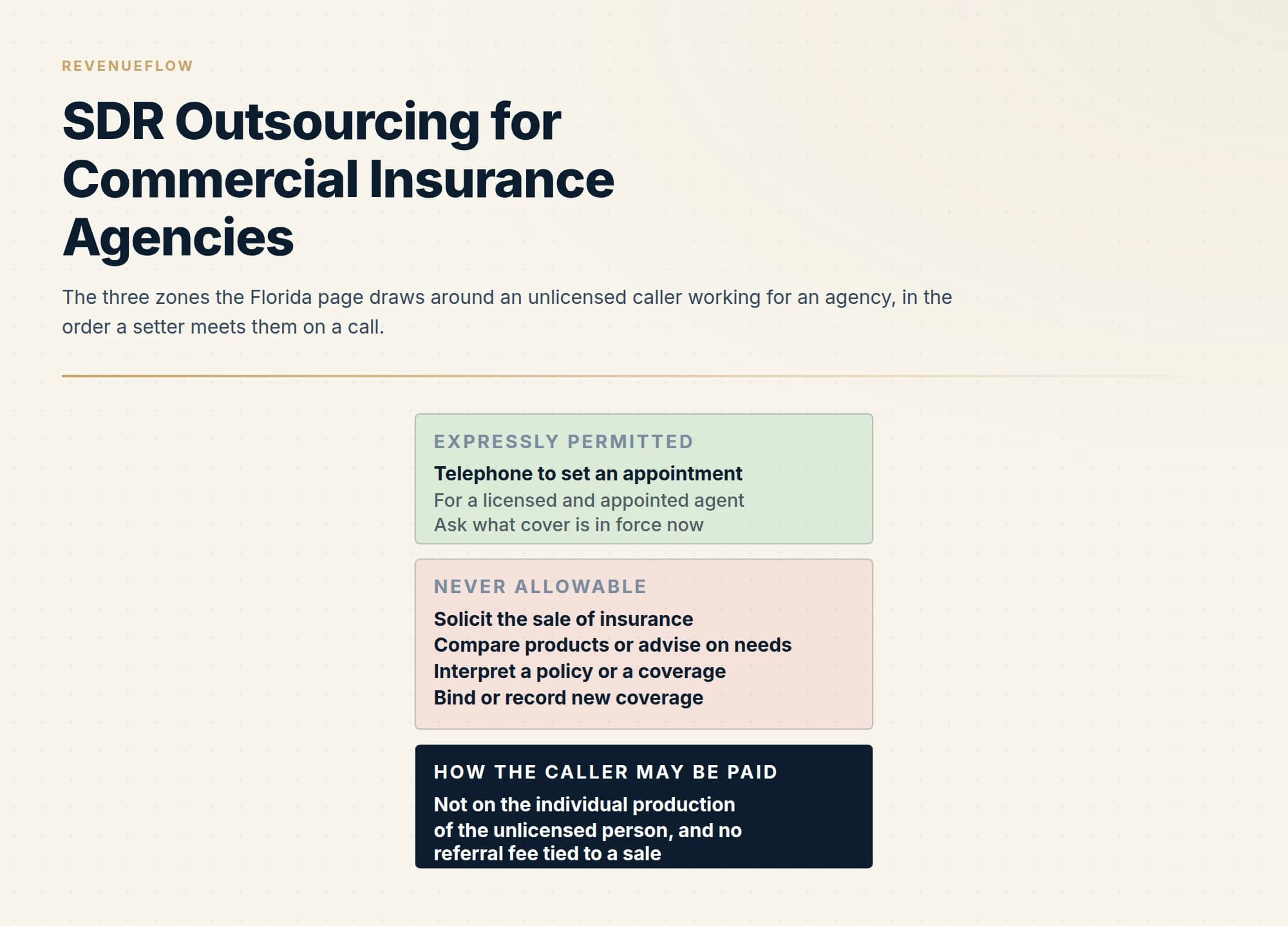
An outsourced setter working for a commercial insurance agency may telephone to book appointments for a licensed producer and ask what cover is in force, and may not solicit, compare products or advise on coverage. Payment must not depend on a policy being written. Work the four months before each expiration date.
Key takeaways
- Florida's insurance department page allows an unlicensed person to telephone to set appointments for a licensed and appointed agent and to ask what cover is in force, and never allows soliciting a sale, comparing products, advising on needs or interpreting a policy.
- Florida Statutes 626.112(8) bars paying an unlicensed person a referral fee that depends on whether the referral results in a purchase, so what triggers a vendor's payment is a licensing question and not only a commercial one.
- The FTC's Telemarketing Sales Rule guide treats insurance separately under McCarran-Ferguson and says the rule does not necessarily apply simply because a campaign is run by a third-party telemarketer, which sends the analysis back to state law.
- Riskonnect's page reports Aon's Robert Stein saying typical renewal dates fall in January and June and that the process must begin at least 120 days in advance, which is the window a booked meeting has to land inside.
Reviewed and updated September 21, 2026
Florida's Department of Financial Services publishes a list of things an unlicensed person working for an insurance agency may never do, and one sentence in the middle of it decides whether an outsourced sales development team is a legal purchase for your agency at all. Read on 21 September 2026, the page says that the actions never allowable by unlicensed personnel include "Soliciting the sale of insurance by telephone, in person, or by other communication", and then adds the exception: "However, the unlicensed person may telephone persons to set appointments for licensed and appointed agents, customer representatives, or to obtain basic policy information as to existing insurance coverage." One sentence later it closes the gap again: "The unlicensed person may not engage in a substantive discussion of insurance products." (Florida Department of Financial Services, General Lines Agents and Customer Representatives)
This page is written for a commercial lines agency or brokerage deciding whether to pay an outside team to open commercial accounts. It is not written for a vendor trying to sell software to agencies; that direction is cold email for insurance. It is also not the list-building page: how a commercial agency builds a prospect list from carrier appetite outward, and what its own regulators require of it when it writes, is lead generation for commercial insurance agencies, and none of that is repeated here.
One paragraph on what a search for this phrase returns, because it shapes what you will find elsewhere. The ten results are almost entirely the vertical-free outsourced-SDR listicle: vendor round-ups, one generated services page, a flood-insurance result that is pure noise, and a practitioner thread asking whether the model is sustainable for agencies at all. Four of the ten name insurance somewhere. Nobody in that set answers the licensing question above, which is the first question an agency principal will ask.
What the generic decision looks like, the four models and what a seat or a meeting costs, is in SDR outsourcing and outsourced SDR pricing. This page is the insurance layer on top: what a setter may say, who the incumbent is, which calendar the call has to land in, and where the model breaks.
The line an outside caller may not cross
Take the Florida page apart, because the structure repeats in other states in their own wording and the shape of the problem does not change. Three things are permanently off limits to an unlicensed person: "Comparing insurance products; advising as to insurance needs or insurance matters; or interpreting policies or coverage." Binding coverage is off limits. Soliciting a sale is off limits. Setting an appointment for a licensed agent, and asking what the business currently has in force, is expressly allowed.
An outsourced sales development team sits exactly on that line. Scoped as booking a meeting for a licensed producer and confirming current carrier and renewal month, it is inside the permitted list. If the vendor's script quotes a rate, argues that a competitor's form is worse, or tells a prospect what coverage they need, an unlicensed person has done a licensed act on your agency's behalf.
The page adds two operational limits that read like footnotes and are not. It states that incidental activities "cannot exceed 10% of an employee's overall activities and compensation cannot be made based on the individual production of the unlicensed person." That second clause is a pricing constraint, and it is reinforced by statute. Florida Statutes section 626.112(8), in the 2025 statutes read the same day, provides: "No insurance agent, insurance agency, or other person licensed under the Insurance Code may pay any fee or other consideration to an unlicensed person other than an insurance agency for the referral of prospective purchasers to an insurance agent which is in any way dependent upon whether the referral results in the purchase of an insurance product." (The Florida Senate, 626.112)
Read that against the way outcome-based sales development is usually sold. A fee per booked meeting is not contingent on a policy being written. A fee per bound policy is. None of this is legal advice and your own state's rule is the one that governs you, but the question to put to a vendor before signing is narrow and answerable: what exactly triggers payment, and does anything in the agreement make it depend on a sale.
The federal rules do not settle it either
An agency that has run outbound before will reach for the two federal guides it already knows. Both apply, and one of them says something about insurance that no other vertical hears.
On email, the Federal Trade Commission's CAN-SPAM guide, read on 21 September 2026, states that "The law makes no exception for business-to-business email", and that when you use an outside sender, "Both the company whose product is promoted in the message and the company that actually sends the message may be held legally responsible." (FTC, CAN-SPAM Act: A Compliance Guide for Business) Your agency's name is on the message, so your agency reads it before it goes.
On calling, the Commission's Telemarketing Sales Rule guide is where the vertical diverges. It lists business-to-business calls among the exempt categories, and then treats insurance separately under a heading of its own. It says the McCarran-Ferguson Act makes the FTC Act and the TSR applicable to the business of insurance "to the extent that such business is not regulated by state law", that whether the exemption removes insurance telemarketing from the rule "depends on the extent to which state law regulates insurance telemarketing", and, in the sentence that matters for a vendor engagement: "Unlike the jurisdictional exemptions for banks and non-profit organizations, which do not extend to third-party telemarketers making calls on their behalf, in the case of the telemarketing of insurance products and services, the TSR does not necessarily apply simply because the campaign is conducted by a third-party telemarketer." (FTC, Complying with the Telemarketing Sales Rule)
The practical reading for an agency principal is not that the calling is unregulated. It is that the analysis runs through your state's insurance code rather than around it, which is the same place the licensing answer came from. The federal rules on automated dialling and prerecorded messages sit on top of all of it at 47 CFR 64.1200, and a business owner's mobile number is a wireless number whatever your system calls it.
| Page | Channel | What it governs |
|---|---|---|
| State insurance code and department page | Call and email | What an unlicensed person may say, and how they may be paid |
| FTC CAN-SPAM guide | Header accuracy, opt-out, and shared responsibility with the sender you hire | |
| FTC Telemarketing Sales Rule guide | Call | The insurance analysis runs through state law under McCarran-Ferguson |
| 47 CFR 64.1200 | Call and text | Automated dialling and prerecorded voice, and consent for wireless numbers |
The incumbent is a producer, and the trade publishes what one costs to grow
The alternative to buying meetings is hiring the person who generates them, and the independent agency channel measures that investment in public. The Independent Insurance Agents and Brokers of America and Reagan Consulting released the 2026 update of their Best Practices Study on 12 August 2026, and the association's own magazine reports what it found across the seven revenue bands of the study's agencies.
Two findings decide the build-versus-buy question. The first is the growth backdrop, and IA Magazine reports it in the study's own words: "With softening rates, organic growth for Best Practices agencies decelerated in six of the seven revenue bands. Results ranged from 6.2% to 10.2%". The second is the pipeline of producers, where the same report quotes the study directly: "Net unvalidated producer payroll (NUPP), a measure of successful producer recruitment and development, ranged from 0.0% to 1.7% across revenue groups. A healthy NUPP investment is 1.5%-2.0%." The same report notes that in most revenue bands, producers aged 36 to 45 generate the largest share of new business. (IA Magazine, on the 2026 Best Practices Study update, 12 August 2026)
Those figures describe the study's own Best Practices agencies in that period and nobody else, and they are not a benchmark for your agency. What they are useful for is the shape of the decision. An unvalidated producer is a salaried cost carried for years before the book supports it, the channel's own benchmark for that spend is a band rather than a number, and rate is no longer doing the growth work it did last year. An outsourced setter is a different shape of cost: it buys conversations, not a book, and it stops when you stop paying. The honest comparison of the two, fully loaded on both sides and divided by meetings that happened, is in outsourced SDR vs in house.
The calendar is the expiration date, not the quarter
Commercial insurance has the most useful buying calendar in business-to-business selling, because every account carries a date on which it is free to move. Agencies call it the expiration date, and prospecting against it is the difference between a list of businesses and a list of buyers.
Two timing facts are worth having from outside the agency channel. Riskonnect's page on commercial renewal dates, read on 21 September 2026, reports a Business Insurance article in which Aon's chief brokerage officer Robert Stein says that "typical insurance renewal dates are in January and June", and that the renewal process for most companies "must begin at least 120 days in advance", with most commercial renewals amounting to "a continuous process that may need attending to 365 days a year". (Riskonnect, Important Commercial Insurance Renewal Dates)
A hundred and twenty days is the number to hand a vendor. It means the window in which a conversation can lead anywhere opens roughly four months before the date, and that a meeting booked three weeks out is a meeting with somebody who has already collected their submissions. It also means the queue is built from dates, not from industry codes, and that a programme which cannot hold a per-account date in its list is going to call the right company in the wrong month.
What the setter must have before the first call
Everything above compresses into a short list that belongs in the engagement document rather than in a kickoff call. A setter who cannot answer these will be found out on the second question, and the prospect will not take a third call to hear the answer.
Which classes of business the agency can actually write, because a conversation in a class none of your carriers wants is a conversation you cannot follow. Which states the licensed producer who will attend is licensed in, because the appointment is being set for that person. What the setter is allowed to ask, which is the expiration month, the current carrier and the decision maker, and what they are not allowed to discuss, which is anything about coverage, price or whether the current programme is any good. What happens when the prospect asks a coverage question anyway, which is a named licensed person joining the conversation rather than a best effort from the caller.
The list is built from the classes your carriers will write, because a conversation you cannot quote is a conversation you cannot use.
The meeting is being set for a specific licensed and appointed producer, in the states that producer holds.
Expiration month, current carrier and decision maker are askable. Products, price and coverage advice are not.
A coverage question ends the setter's part of the call and starts the producer's.
Three openers, each built on a page read for this article
Three illustrative first messages follow. Each is one message to one buyer, sent once, on email and LinkedIn, with no bump and no thread reply. They name no real recipient, they make no claim about results, and the agencies speaking in them are invented.
Invented example, resting on the expiration-date mechanic and asking only what an unlicensed caller may ask.
Your firm's general liability and property programme renews at some point in the next few months, and the useful conversation is the one that happens before the submission goes out rather than after. We are not able to talk about coverage or pricing on this call; we book the time with the producer who can. Would it help to put twenty minutes in with her in the week after next?
Invented example, resting on the softening market the association and Reagan Consulting report, and naming the source rather than implying a private insight.
The Independent Insurance Agents and Brokers of America and Reagan Consulting reported in August that organic growth at their Best Practices agencies slowed in six of seven revenue bands as property and casualty rates softened. Whatever that does to your renewal, it makes a second quote worth having this year more than last. Our commercial producer covers your state and your class of business. Is a short call in the first week of next month useful?
Invented example, the one a setter sends to an account whose date they already hold, asking for the date rather than the meeting.
We spoke last spring and you told us your workers compensation programme renews in April. We are writing now because April is close enough that our producer would need a few weeks to be useful and too far away for you to have started it yourself. Is April still the month, and shall we put something in?
When this is the wrong play for an agency
Four cases, stated plainly. Personal lines, where the buyer is a consumer and the entire consumer telemarketing apparatus applies rather than the business-to-business analysis above. Small-premium commercial accounts, where the commission on a written policy does not cover the cost of the meetings it took to get there, and where the channel itself expects to lose volume to direct buying. An agency without a licensed producer with capacity to take the meetings, because a booked appointment nobody attends is worse than no appointment. And any engagement where the vendor wants to be paid on written business, which the referral rule above puts out of reach in at least one state and which should send you back to the agreement.
A fifth case is the most common of all. An agency that has never written down which classes it wants, in which states, at what size, will get exactly what it asked for, which is a queue of meetings with businesses that were easy to reach. Narrow the definition first. Our own practice is one message per campaign, sent once, with qualification criteria agreed in writing before anything sends, and with a new campaign when there is a new reason to write rather than a second message under the first.
If you would like to see a first list built from a class of business and a set of expiration months before committing to a programme, you can see what a first campaign looks like.
Regulatory pages, association figures and vendor facts on this page were fetched and verified on 21 September 2026. Rules change and vary by state. Verify current terms against the regulator's own page before relying on them, and take legal advice on your own programme.
Frequently asked questions.
Frequently asked questions- Can an outsourced SDR legally call prospects for an insurance agency?
- In Florida the department's own page says an unlicensed person may telephone people to set appointments for licensed and appointed agents and may ask what cover is already in force. The same page says that person may not solicit a sale, compare products, advise on insurance needs or interpret coverage. Other states write their own version of that line, so read yours before scoping an engagement.
- How should an outsourced setter be paid in insurance?
- Not in a way that depends on a policy being written. Florida Statutes 626.112(8) prohibits paying an unlicensed person a fee for referring prospective purchasers where the fee is in any way dependent on whether the referral results in a purchase. A fee per booked meeting is a different arrangement from a fee per bound policy, and the difference is worth settling in the agreement rather than after.
- When should a setter contact a commercial insurance prospect?
- Against the expiration date rather than the quarter. Riskonnect's page reports Aon's chief brokerage officer saying the renewal process for most companies must begin at least 120 days in advance, which puts the useful window roughly four months to two months before the date. Closer than that and the submissions are usually already with markets.
- When is outsourced sales development the wrong choice for an agency?
- On personal lines, where the consumer telemarketing rules apply instead. On small-premium commercial accounts, where commission does not cover the cost of the meetings. When no licensed producer has capacity to attend what gets booked. And when a vendor wants to be paid on written business rather than on meetings, which runs into the referral rule.
About the author.

B2B cold email experts helping companies generate qualified leads through done-for-you outreach campaigns.
RevenueFlow Team
Explore more.
Ready to scale your outreach?
We build GTM engines that book real meetings. See the receipts.
Related articles.
LinkedIn Lead Generation for Commercial Insurance Agencies
LinkedIn lead generation for a commercial insurance agency: where the buyers are sourced, what a licensed producer may say in a note, and the three rules that reach it.
SDR Outsourcing for Agriculture Companies
Whether an outside sales development team can work for a company selling into agriculture: who already covers the account, which weeks exist, and the show rule.
Commercial Insurance Lead Lists: Four Fields, Four Records
The anatomy of a commercial insurance lead list for an agency: class, exposure, renewal month and carrier, the public records that hold each, and what vendors sell.
SDR Outsourcing for Ecommerce Software Companies
Whether bought meetings can work for a company selling software to merchants: the app store as distribution, the billing model, the data rule and the agency.
SDR Outsourcing for Business Brokers: The Fee Timing
Whether a success-fee brokerage should rent sales development at all: the fee timing, the texts that limit what an outside person may say about value, and who signs.
SDR Outsourcing for Logistics Companies: The Brokerage Line
What an outside sales development team may do in a freight company's name, the calling and email rules it inherits, and which arrangement survives a bid-shaped market.