Commercial Insurance Lead Lists: Four Fields, Four Records
The anatomy of a commercial insurance lead list for an agency: class, exposure, renewal month and carrier, the public records that hold each, and what vendors sell.
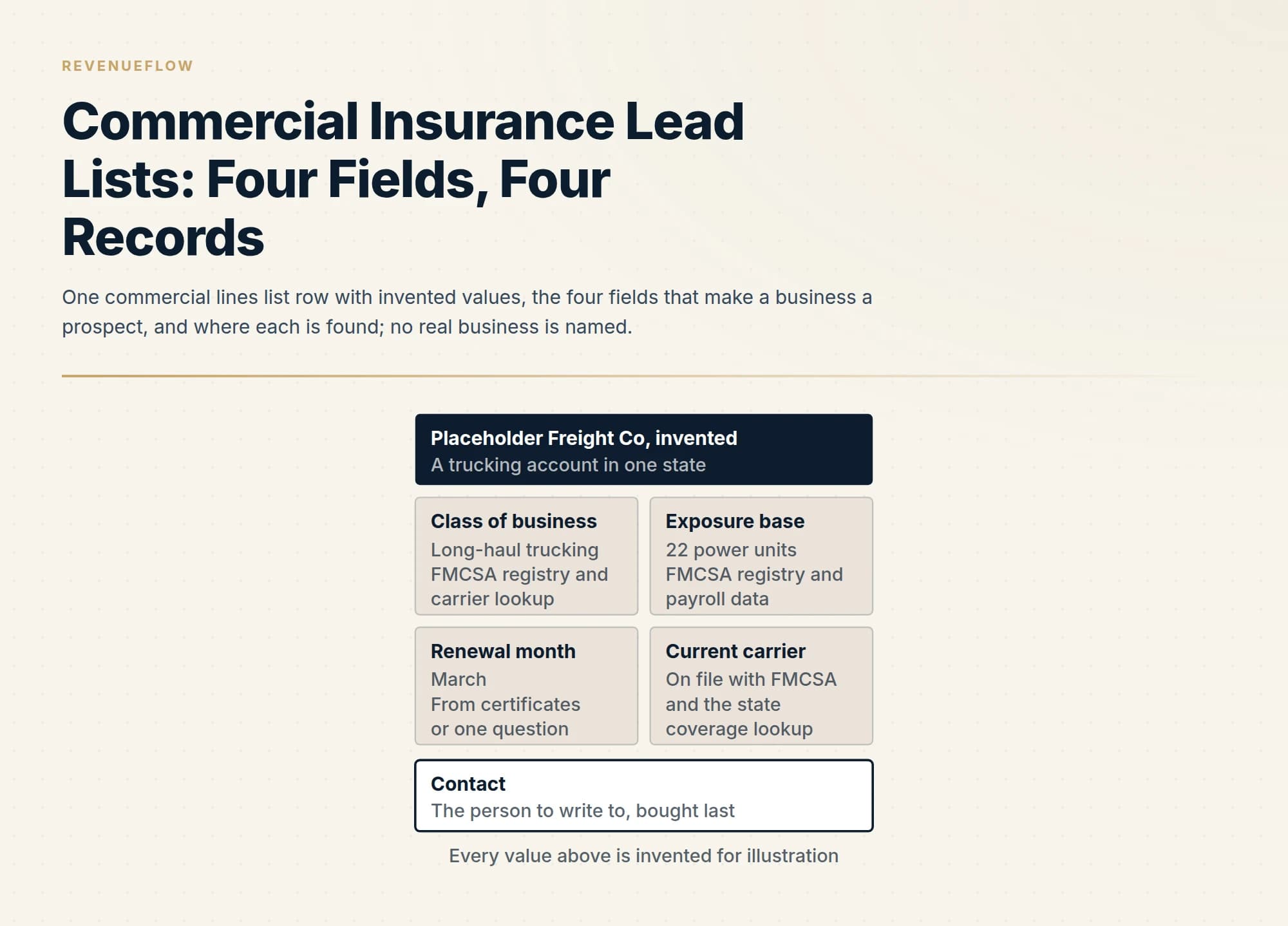
A commercial lines prospect is a business plus four fields: class, exposure, renewal month and current carrier. FMCSA filings hold a fleet's authority and insurer, a state workers' comp lookup such as Texas's holds the carrier, Form 5500 datasets hold the benefit plan, and OSHA's establishment data holds loss summaries. The renewal month is chased; vendors sell the contact.
Key takeaways
- FMCSA says entities granted operating authority must keep proof of insurance on file to avoid revocation, so a fleet account's class, exposure and insurer are public before any list is bought.
- Texas's Division of Workers' Compensation publishes a subscriber list of employers covered through a carrier on its open data portal, which is a current-carrier field for that line.
- The Department of Labor's Form 5500 datasets cover approximately 800,000 retirement and welfare benefit plans and are updated around the first of each month, naming the plan sponsor and plan.
- OSHA publishes Form 300A injury and illness summaries by establishment for those above its reporting thresholds, the closest public record to a loss history.
Reviewed and updated September 21, 2026
An independent agency buys a list of two thousand businesses in its three counties, sorted by employee count, and starts quoting. Nine weeks later the producer has written four accounts, all of them in the one class of business the agency's carriers happen to want, and has spent the rest of the quarter learning that a business with forty employees and no renewal date on the row is not a prospect. It is a name.
This page is the anatomy of a commercial insurance lead list for the agency building one: the producer, the commercial lines manager and the principal of an independent agency who wants business accounts to quote. It is written for the people inside the agency, not for vendors selling to them. It covers which fields turn a business into a prospect, which public records hold each field, what the lead vendors on the first page of results actually sell, the rules on the data and on the contact, and how to check a row before a producer touches it. Why the renewal date is the organising fact of the trade, the market cycle and building from carrier appetite outward are covered in lead generation for commercial insurance agencies and are linked, not repeated; what a lead list is in general is the lead list entry's job. Every outside page below was fetched on 21 September 2026 and is dated where it publishes a date.
What a search for this sells
All ten results address an agency looking for business accounts, and they sell four different things. Superhuman Prospecting and LaunchLeads sell outbound programmes; Superhuman says it does not sell "leads generated from generic websites" and instead runs "custom sales development campaigns to reach out to your target client profile" (Superhuman Prospecting, as fetched). Salesgenie, Avocadata and DataPartners sell or rank data files, Avocadata's page offering aged insurance leads alongside consumer databases. CompStak sells lease data as a lead source, telling agencies to "Use lease start and lease end info to determine move-in dates" (CompStak, page modified 9 August 2023). Abstrakt, LeadHaste and Cleverly publish guides. A practitioner thread on the insurance agents' forum asks for the best lead sources; it could not be read from here and is named only as what the search returns. None of the ten names the public records below.
The anatomy of one row
A commercial lines row is a business plus four fields that no employee-count filter supplies. The class of business, because carrier appetite is written in classes and an account in a class none of the agency's carriers writes cannot be quoted. The exposure base, payroll for workers' compensation and the fleet for commercial auto, because it sizes the premium. The renewal month, because the account is a prospect in the months before its expiration and a name the rest of the year. And the current carrier, because a remarket is a different conversation from a first placement.
The values in the figure are invented. The pattern is not: for whole segments of commercial business, the four fields sit in public records that a producer can read for nothing, and the vendor's contribution is the name of the person to write to.
Which record holds which field
The federal motor carrier registry, for anything on wheels. Trucking accounts are the clearest case, because the regulator that grants operating authority also holds the insurer. The Federal Motor Carrier Safety Administration sets insurance requirements under 49 CFR Part 387 "for entities who apply and obtain operating authority registration", states that requirements "vary depending on the entity type (motor carrier, broker, freight forwarder)" and the type of authority, cargo and vehicles, and that "Once operating authority is granted, entities are required to maintain proof of insurance and designation of agents for process on file with FMCSA to avoid revocation proceedings" (FMCSA insurance filing requirements, as fetched). Its Safety and Fitness Electronic Records system "offers company safety data and related services to industry and the public over the Internet" and lets users "search FMCSA databases, register for a USDOT number" and "order company safety profiles" (SAFER, as fetched), and its Licensing and Insurance system carries the filings themselves. For a fleet account, the class, the exposure and the current carrier are on file with the regulator before any list is bought.
The state workers' compensation coverage lookup, where a state publishes one. Texas is explicit about what it holds. Its Division of Workers' Compensation page says "In Texas, private employers can choose to carry workers' compensation insurance coverage (subscribers), but it is not required in most cases", defines a subscriber as "An employer that provides workers' compensation benefits to their employees by purchasing coverage through an insurance carrier", and tells readers to verify coverage at the rating bureau's site and to "Get a list of subscribers at Texas Open Data Portal" (TDI workers' compensation coverage verification, as fetched). A published subscriber list is a list of insured employers with a carrier on file, which is the current-carrier field for the workers' compensation line. Other states run other lookups; Illinois's insurance department, for one, links a route to report an employer without coverage from its producers page (Illinois Department of Insurance, as fetched). Check the state's own page for what it exposes.
The Form 5500 datasets, for benefits. The Department of Labor says "The Form 5500 Annual Report is the primary source of information about the operations, funding and investments of approximately 800,000 retirement and welfare benefit plans", and that its datasets "contain structured data from Form 5500 and Form 5500-SF forms and schedules filed annually", with the 2009 and later datasets "typically updated around the first of each month" (DOL Form 5500 datasets, as fetched). For an agency with a benefits practice, the filing names the plan sponsor and the plan, which is the account and its line in one public row.
The OSHA establishment data, for the loss side. OSHA "collects work-related injury and illness data from establishments that meet specific industry and employment size specifications through the Injury Tracking Application", and its page "provides OSHA Form 300A Summary Data by establishment" for establishments that met the reporting thresholds, with case details from Forms 300 and 301 for some establishments from 2024 (OSHA establishment-specific injury and illness data, as fetched). An establishment's own summary is the closest public thing to its loss history, which is what a workers' compensation underwriter will ask about first.
The lease record, for the move. CompStak's page is a vendor's, and its figures are the vendor's claims, but the mechanism it names is real and public in part: a lease end is a move, and a move is a new property schedule to insure.
| Record | Holds | Does not hold |
|---|---|---|
| FMCSA registry and insurance filings | Authority type, cargo, vehicles, insurer on file | A named buyer, the renewal month |
| State workers' compensation coverage lookup | Which employers are covered and through which carrier, where the state publishes it | Payroll, the renewal month, email |
| DOL Form 5500 datasets | Plan sponsor, plan type, funding, filed annually | Small employers below the filing thresholds |
| OSHA establishment injury data | Injury and illness summaries by establishment above the thresholds | Establishments below them, any contact |
Bought leads and built lists
The vendors on the first page sell two different things, and the distinction decides what a row is worth. A bought lead is a business that filled in a form or answered a call about insurance, sold on to one or several agencies; Avocadata's page advertises aged insurance leads next to consumer databases, and Superhuman's page defines its own offer against that model. A built list is the four fields above assembled from public records for the classes the agency's carriers write. The renewal guide's summary of the channel's own study records that agencies name carrier appetite as their number one challenge, and that is the argument for building: a lead in a class no carrier will write is worthless whoever sold it, and a built list starts from the classes and works outward.
The renewal month is the field neither route supplies for free. Public filings put a carrier on file and a plan on record; they rarely state the policy's expiration. The renewal guide sets out where the date lives, on certificates of insurance and in lender and landlord requirements, and the one question a first message can ask. A list without it is a list of businesses; the guide's phrase is that a business is a prospect only in the months before its renewal.
The rules on the data and on the contact
Two rules reach the row itself, and the calling and email rules reach the message. The producer licence is the first: the renewal guide quotes the producer registry's definition, and a message that urges a business to apply for cover is solicitation by a licensed person in the state where the business sits. The second is the advertising rule of the NAIC's Unfair Trade Practices Act, which reaches "electronic mail, internet advertisement or posting" that is "untrue, deceptive or misleading" (NAIC Unfair Trade Practices Act, Spring 2024 edition); a list-driven message that states a business's premium or coverage before a quote is the case it describes. The federal email rule and the calling rules, including the line where a business owner's mobile becomes a wireless number, are the hubs' job: what cold calling is and which rules apply carries them and this page adds none. Nothing here is legal advice.
Verify before a producer touches it
The order is the cost order. The class check is free and removes every row no carrier will write. The carrier-on-file check is free where the regulator publishes it, and it splits first placements from remarkets. The exposure and loss records size the account. The renewal month is the field to chase, and the contact, the one field vendors sell, is bought and verified last; email list cleaning sets out when that verification spend is justified.
When a bought list is the wrong play
Three cases. The personal lines book: the records above describe employers and fleets, and a household is neither. The micro account, where the owner is the buyer and the renewal is a line of overhead, is the segment the renewal guide's study says agencies expect to lose to direct channels, and a list of them is a list of the accounts most likely to leave the channel altogether. And the class outside appetite: a producer with a full slate of carrier appointments still cannot quote a class none of them writes, and no record makes a business in that class a prospect.
A sample row and three reasons to write
The rows below are invented; no real business or person is named. Each reason comes from a record quoted above.
The authority is new. FMCSA says new entities registering for the first time should have their insurer file the required forms immediately after obtaining a docket number. A carrier whose operating authority is weeks old has a first placement on file and, twelve months later, a first renewal; both are reasons to write. The invented row: a regional carrier with a docket number granted this spring.
The subscriber list changed. The Texas portal publishes the list of employers covered through a carrier. An employer that appears on the list for the first time has just bought workers' compensation cover, and one that leaves it has dropped or self-insured; either is a reason to write about that line. The invented row: a manufacturer in a Texas county that joined the subscriber list in the summer.
The establishment reported. OSHA's data carries injury summaries by establishment above the reporting thresholds. An establishment whose summary shows recordable cases has a loss history it will be asked about at renewal, which is a reason to write about a remarket. The invented row: a food processor with a reported summary on the current file.
Each reason is checkable from the public record before a producer writes. RevenueFlow builds lists and runs email and LinkedIn for clients, one message per campaign with no follow-up bumps, so the reason to write has to be real and dated; if you would rather have a renewal-dated commercial list built from these records and a first message prepared with a licensed producer, see what a first campaign would target.
The short version
A commercial lines prospect is a business plus four fields: class, exposure, renewal month and current carrier. For fleets, the FMCSA registry holds the class, the exposure and the insurer on file; for workers' compensation, a state coverage lookup such as Texas's holds the carrier; for benefits, the Form 5500 datasets hold the plan; for the loss side, OSHA's establishment data holds the summaries. The renewal month is the field no record supplies for free, and the contact is the field vendors sell. Check class against carrier appetite first, carrier on file second, exposure third, renewal fourth, and buy and verify the contact last; keep every message inside the licensing and advertising rules the regulators publish.
Frequently asked questions.
Frequently asked questions- What should a commercial insurance lead list include?
- A business plus four fields: the class of business, because carrier appetite is written in classes; the exposure base, payroll or fleet, because it sizes the premium; the renewal month, because a business is a prospect only in the months before its expiration; and the current carrier, because a remarket is a different conversation from a first placement. The contact, the field vendors sell, comes last and is verified last.
- Where can an insurance agency find commercial prospects for free?
- In the regulators' own records. FMCSA's registry and insurance filings hold every motor carrier's authority type, cargo, vehicles and insurer on file. States that publish a workers' compensation coverage lookup, such as Texas, show whether an employer is covered and through whom. The Form 5500 datasets name benefit plan sponsors. OSHA's establishment data carries injury summaries. None of these names the buyer or the renewal month.
- Are bought insurance leads worth it for commercial lines?
- It depends on what is being sold. A bought lead is a business that filled in a form or answered a call, sold on to one or several agencies; some vendors sell aged leads next to consumer databases. A built list assembles the four fields from public records for the classes the agency's carriers write, which matters because the channel's own study names carrier appetite as agencies' top challenge. A lead outside appetite is worthless whoever sold it.
- How do you find a business's insurance renewal date?
- Public filings rarely state it. They put a carrier on file or a plan on record without the policy's expiration. The renewal date lives on certificates of insurance and in the requirements lenders and landlords impose, and it is the one question a first message can ask a prospect directly. A list without renewal months is a list of businesses; a business is a prospect only in the months before its renewal.
About the author.

B2B cold email experts helping companies generate qualified leads through done-for-you outreach campaigns.
RevenueFlow Team
Explore more.
Ready to scale your outreach?
We build GTM engines that book real meetings. See the receipts.
Related articles.
LinkedIn Lead Generation for Commercial Insurance Agencies
LinkedIn lead generation for a commercial insurance agency: where the buyers are sourced, what a licensed producer may say in a note, and the three rules that reach it.
Physician Email Lists: The Row, Its Sources and Its Gaps
The anatomy of a physician email list: the six field groups, which CMS, AMA and state board records hold each, what vendors claim, the rules, and the order to verify.
B2B Lead Lists for Utilities: Three Registries, One Gap
The anatomy of a utilities lead list: the EIA-861 census, PHMSA annual reports and SDWIS enumerate electric, gas and water utilities; vendors sell the field they lack.
B2B Lead Lists for Collection Agencies: Fields and Sources
What a creditor prospect list needs for a collection agency: the fields that matter, the FDIC, NCUA, CMS and court sources behind them, and the rules that apply.
Sales Prospecting for Consulting Firms: Find the Event
Prospecting for a consulting firm: where triggers are published by practice, who inside the firm reads them, why alumni and referrals come first, when to skip it.
Sales Prospecting for Utilities: Read the Filings First
Prospecting utilities from the proceedings that announce their spend: rate cases, resource plans and procurement decisions, who owns each, and the supplier gate.