B2B Lead Lists for Collection Agencies: Fields and Sources
What a creditor prospect list needs for a collection agency: the fields that matter, the FDIC, NCUA, CMS and court sources behind them, and the rules that apply.
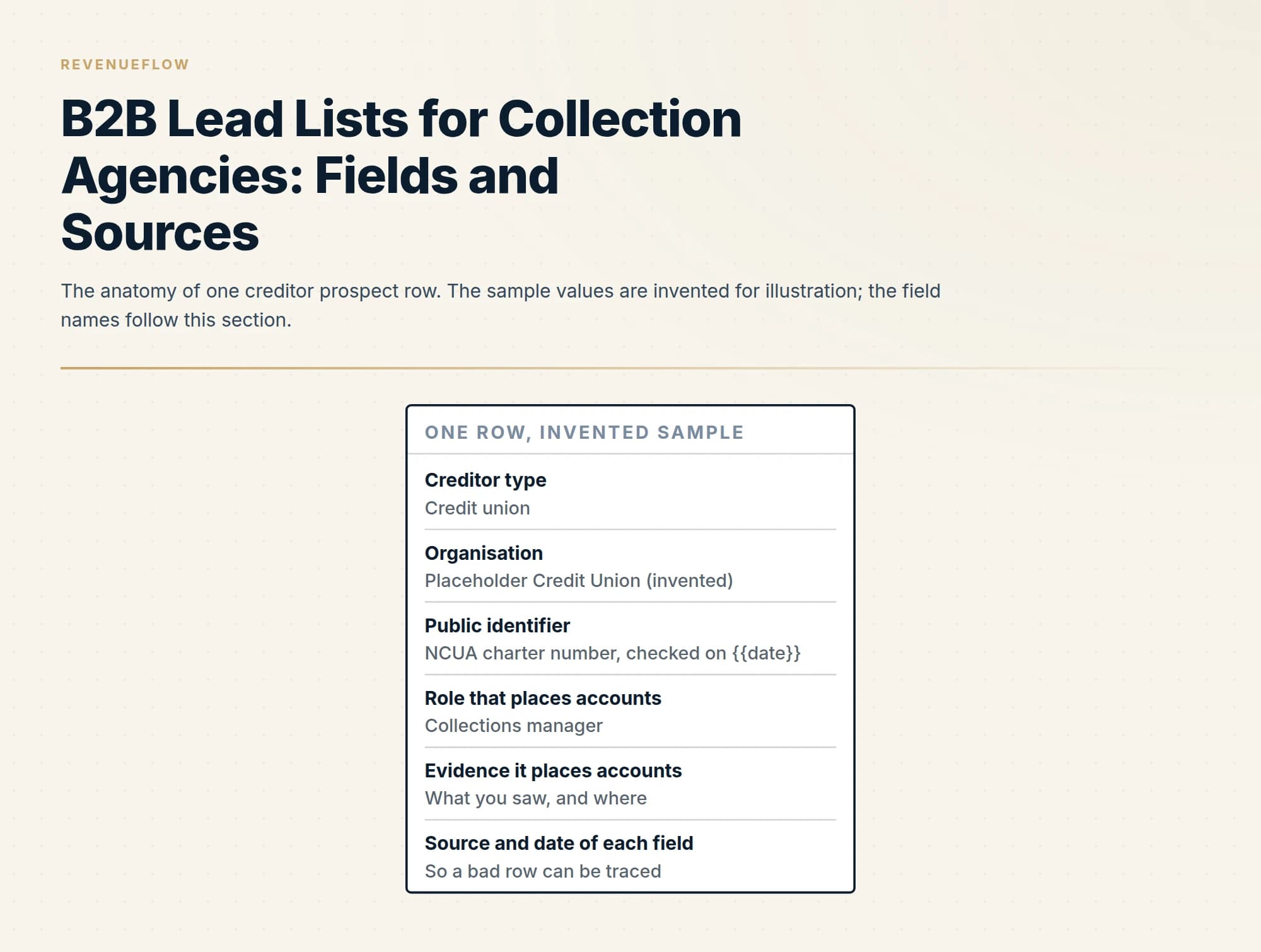
A collection agency's lead list is a list of creditors, never debtors. Each row needs the creditor type, a public identifier, the role that places accounts, evidence of placement, and the source and date of each field. FDIC, NCUA, CMS and court records verify organisations for free, and a vendor contact file adds names on top.
Key takeaways
- Aktos describes its free list, in a post dated January 20, 2026, as about 5,000 verified decision-makers at organisations that regularly outsource collections, including hospital revenue cycle managers and bank collection leaders.
- The FDIC's BankFind Suite shows whether a bank is insured, its branches, mergers and history, and NCUA publishes data on single credit unions, mergers and chartering changes.
- CMS publishes a full replacement monthly NPI file and weekly incremental files that include newly assigned NPIs, which identify new healthcare billers.
- Regulation F defines debt as a consumer's obligation arising from a personal, family or household transaction, so it governs collection contact, not an agency's own B2B marketing.
Reviewed and updated September 19, 2026
A software vendor that sells to collection agencies gives away a prospect list, and its description of that list is a fair summary of what agencies want to buy. Aktos, in a post by Peter Wang dated January 20, 2026, offers "~5,000 verified decision-makers across industries that regularly outsource collections", and names the job titles inside it: "Hospital Revenue Cycle Managers", "Bank & Credit Union Collection Leaders", "University Student Accounts Directors" and "Telecom & Utility Receivables Managers" among them (Aktos, read 18 September 2026). Those titles are the people who place accounts with an agency. They are the agency's customers.
This guide is for a collection agency building or buying a list of creditor prospects: the organisations that might place receivables with it. It is not about lists of debtors, which are a different thing under a different law, and it is not for vendors who want a list of agencies to sell to. What a lead list is, and the build against buy trade, are covered in our glossary entry on the lead list, and what a bought file really contains is taken apart in our piece on the CMO email list. Neither is repeated here. What follows is the list for this industry: the fields that matter on a creditor row, the public sources that hold them, what a vendor's list contains, the rules that do and do not apply to an agency's own marketing, and how to check a list before anything is sent.
The fields that matter on a creditor row
A generic business list gives you a company, a title and an email. A creditor prospect needs more, because whether an organisation is worth an agency's time depends on what kind of receivables it generates and whether it sends them out.
Start with the creditor type, since it decides everything else. The Aktos titles sort into the main types on their own: healthcare providers, banks and credit unions, universities, telecoms and utilities, insurers and retail card issuers. Each type has a different regulator, a different register that proves the organisation exists, and a different name for the person who places accounts.
Next is the public identifier. A bank has an FDIC certificate and a credit union has an NCUA charter. A healthcare provider has a National Provider Identifier. Carrying the identifier on the row means the record can be re-checked against the register at any time, which is the provenance our lead list entry argues every row should have.
Then the role. The title on the row should be the one that owns receivables, and the vendor's list shows how much the word changes by type: revenue cycle in a hospital, collections in a bank, student accounts in a university, receivables in a utility.
Last is the evidence that the organisation places accounts at all. The Aktos post describes its contacts as people who "Already outsource debt collection services". A vendor's statement is a claim, so on a list you build yourself the equivalent is a note of what you saw: a job posting that mentions agency management, a procurement notice, a court docket showing the creditor sues on its own paper. The figure below shows one such row with invented sample values; the field names are the point.
The public sources that hold those fields
The creditor types above are regulated industries, and a government register exists for the banks, credit unions and healthcare providers among them. None of these sources gives you an email address. They give you the organisation, verified, and that is the half of a row a purchased file is weakest on.
| Creditor type | Public source | What it gives the row |
|---|---|---|
| Banks | FDIC BankFind Suite and Institution Financial Reports | Whether the bank is insured, its branches, mergers and history |
| Credit unions | NCUA credit union data | Information on a single credit union, mergers and chartering changes |
| Healthcare providers | CMS NPPES downloadable file | Provider identifiers, refreshed monthly with weekly updates |
| Creditors that sue | PACER federal court records | Who files its own collection suits |
Banks. The FDIC describes its BankFind Suite as the place to "Determine if a bank is FDIC-insured, locate bank branches, see a bank's mergers and acquisitions, and review a bank's history", and its Institution Financial Reports as holding "details on all FDIC-insured banks" with history "going back to 1992" (FDIC data tools, read 18 September 2026). A merger is a prospecting trigger in this industry, because the combined bank has two sets of agency relationships to reconcile.
Credit unions. The National Credit Union Administration says its analysts "compile data on the credit union system's financial performance, merger activity, changes in credit union chartering and fields of membership", and that "Users can find information on a single credit union or analyze broader nation-wide trends." (NCUA, read 18 September 2026.)
Healthcare providers. The Centers for Medicare and Medicaid Services publishes the National Plan and Provider Enumeration System file for anyone to download. Its data dissemination page describes a "full replacement monthly NPI file" and says "CMS will also make available weekly incremental NPI files for downloading", which include "newly assigned NPIs" (CMS data dissemination, read 18 September 2026). A newly enumerated practice is a new biller.
Creditors that sue. PACER, the federal judiciary's system, stands for "Public Access to Court Electronic Records" (PACER, read 18 September 2026). A creditor that files its own collection suits is visibly handling delinquent accounts in house, which is a reason to ask whether it wants to. PACER covers the federal courts only. State courts publish their dockets on their own terms, so check your state's court portal as well.
For commercial agencies there is also the industry's own ground. The Commercial Collection Agencies of America, whose site carries the line "Elevating the standards of the commercial collection industry", has a section headed "For Credit Grantors" and lists its "Annual Conference 2026" for 7 October 2026 in Delray Beach, Florida (CCA of A, read 18 September 2026). The Commercial Law League of America publishes a list of the agencies it certifies (CLLA certified agencies, read 18 September 2026). Neither is a prospect list. Both are places a credit manager can check an agency's standing, so being findable there belongs to the same project.
What a vendor's list contains
The Aktos post is unusually clear about its own file, so it serves as the example. Each lead, it says, includes "Full Name + Job Title", "Verified Email Address", "Direct Phone Number (when available)", "Organization + Industry" and "LinkedIn Profile (when available)". That is a contact list: strong on the person, silent on the public identifier, the evidence of placement and the date each field was checked. It is also free, and offered by a company whose business is selling software to the same agencies, which tells you what the list is for.
The right way to use a file like that is as the contact layer on top of rows you have verified from the registers. The count on the vendor's page is the vendor's figure as of its post date. The list is untested here and nothing is claimed about its accuracy. Other vendors sell lists of collection agencies themselves, which serve people selling to agencies and are no use for this purpose.
The rules that apply, and the ones that do not
Collection agencies live under consumer protection law, so it is worth being exact about where that law stops. Regulation F, the rule that implements the Fair Debt Collection Practices Act, defines its central term this way: "Debt means any obligation or alleged obligation of a consumer to pay money arising out of a transaction in which the money, property, insurance, or services that are the subject of the transaction are primarily for personal, family, or household purposes". It defines a consumer as "any natural person, whether living or deceased, obligated or allegedly obligated to pay any debt." (12 CFR 1006.2, eCFR, read 18 September 2026.)
Those definitions are about contacting people who owe consumer debts. An agency writing to a hospital's revenue cycle manager to win the hospital as a client is doing something else: ordinary business-to-business marketing. The rules that touch it are the ordinary ones. The Federal Trade Commission's CAN-SPAM guide says "The law makes no exception for business-to-business email", and that a company cannot contract away responsibility for email sent on its behalf (FTC CAN-SPAM guide, read 18 September 2026). Calls to prospects fall under the rules set out in whether cold calling is against the law. This is a description of the cited texts and not legal advice. State collection licensing is a separate subject; we tried to read the industry association's own page on it and could not fetch it, so it is not summarised here.
One boundary deserves its own sentence. A prospect list must never contain debtors, and nothing learned about a consumer's debt belongs in marketing material. Keep the two datasets in separate systems.
Checking the list before anything is sent
The general case for verifying close to the send is made in our guide to email list cleaning. For a creditor list, four checks come first.
Three reasons to write, each from a source above
This article gives a sample row and three sourced reasons to write in place of finished openers, because a creditor message has to be built on that creditor's own facts. None names a real person or claims a result.
The merger. FDIC and NCUA data both record mergers.
Your merger with {{institution}} completed in {{month}}. Combined institutions usually end up with two sets of agency relationships and two placement processes. If a review of that is coming, we would like to be considered, and can send our licences and a sample remittance report first.
The new provider. The CMS weekly file lists newly assigned NPIs.
{{practice}} received its NPI in {{month}}. When a new practice sets up billing, the early-out and bad debt process is usually the last thing decided. If it is still open, here is a one-page outline of how practices your size handle it.
The creditor that sues. Court records show who files collection suits.
Court records show {{company}} filed {{count}} suits on unpaid accounts in {{county}} last year. If handling those in house is a choice and not a necessity, we can show what placing them earlier would look like.
When a bought list is the wrong play
It is the wrong play when the agency serves one creditor type in one state, because the register for that type is complete, free and better than any file. It is the wrong play when nobody will verify it, since a contact list ages from the day it is exported. And a list of any kind is the wrong play for an agency whose growth comes from referrals between credit managers; membership of the bodies above and a findable certification may do more.
A list fits an agency entering a new creditor type, with the registers as the base and a contact file on top. RevenueFlow builds lists that way and sends one message per campaign by email and LinkedIn, with nothing scheduled behind it. If you want to see a verified creditor list and a first message for your market, see what a first campaign looks like.
The short version
A collection agency's lead list is a list of creditors, never of debtors. The fields that matter are the creditor type, a public identifier, the role that places accounts, evidence that the organisation places accounts, and the source and date of each field. FDIC BankFind, NCUA data, the CMS NPPES file and court records verify the organisation for free, and mergers, new NPIs and collection suits are reasons to write. A vendor file such as Aktos's adds names and emails on top. Regulation F defines debt as a consumer's obligation, so it governs collection contact and not an agency's own B2B marketing, which falls under CAN-SPAM and the calling rules.
Aktos, FDIC, NCUA, CMS, PACER, eCFR, FTC and association pages quoted above were read on 18 September 2026. Registers, rules and vendor offers change. Confirm them at the source before relying on them.
Frequently asked questions.
Frequently asked questions- What should a lead list for a collection agency contain?
- Creditor prospects, not debtors. Each row should carry the creditor type, the organisation's public identifier such as an FDIC certificate, NCUA charter or NPI, the role that places accounts, such as a revenue cycle or collections manager, evidence that the organisation places accounts, a verified contact address, and the source and date of every field.
- Where can a collection agency find creditor prospects for free?
- In government registers. The FDIC's BankFind Suite and Institution Financial Reports cover insured banks, NCUA publishes data on individual credit unions, CMS offers the NPPES provider file monthly with weekly updates, and PACER gives access to federal court records showing creditors that sue. None provides email addresses, so a contact layer has to be added and verified.
- Does Regulation F apply to a collection agency's marketing emails?
- Regulation F defines debt as a consumer's obligation arising from a transaction primarily for personal, family or household purposes, and a consumer as a natural person obligated to pay such a debt. An agency writing to a creditor to win its business is doing B2B marketing, which the FTC says CAN-SPAM covers with no business-to-business exception. This is not legal advice.
- Should a collection agency buy a lead list?
- Only as a contact layer. A vendor file such as Aktos's gives names, titles, emails and sometimes direct phones, without public identifiers or dated sources. For an agency serving one creditor type in one state, the public register is complete and free. A bought list that nobody verifies ages from the day it is exported.
About the author.

B2B cold email experts helping companies generate qualified leads through done-for-you outreach campaigns.
RevenueFlow Team
Explore more.
Ready to scale your outreach?
We build GTM engines that book real meetings. See the receipts.
Related articles.
Outbound Sales for Higher Education Vendors: Which Door to Use
Outbound for higher education vendors, built on universities' own purchasing policies: three doors, the ask that fits each one, and a dated accessibility review.
Outbound Sales for Food and Beverage Companies: Who to Reach
Outbound sales for food and beverage brands: the four buyers behind a yes, the public show calendar, what a message may claim, and when outbound is the wrong play.
Freight Broker Lead Lists: The Shipper Row and Its Sources
What a usable shipper row contains for a freight broker, which sources hold each field, what list vendors say they sell, and how to check a list before contact.
Cold Calling for Legal Tech Companies: Who Answers at a Firm
What changes when a legal tech company cold calls a law firm: which desks answer, why the billable hour hurts the pitch, the 2027 show dates, and what not to ask.
Lead Generation for Food Distributors: Finding New Operators
How a food distributor finds new operator accounts: public licence and inspection lists, who controls the purchase, the DSR model, show dates and FDA traceability.
Sales Prospecting for Cloud Services: Dated Triggers
How a cloud services company builds a prospect list: co-sell with platform sellers, partner-to-partner routes, and the end-of-support dates Microsoft publishes.