Cold Calling for Legal Tech Companies: Who Answers at a Firm
What changes when a legal tech company cold calls a law firm: which desks answer, why the billable hour hurts the pitch, the 2027 show dates, and what not to ask.
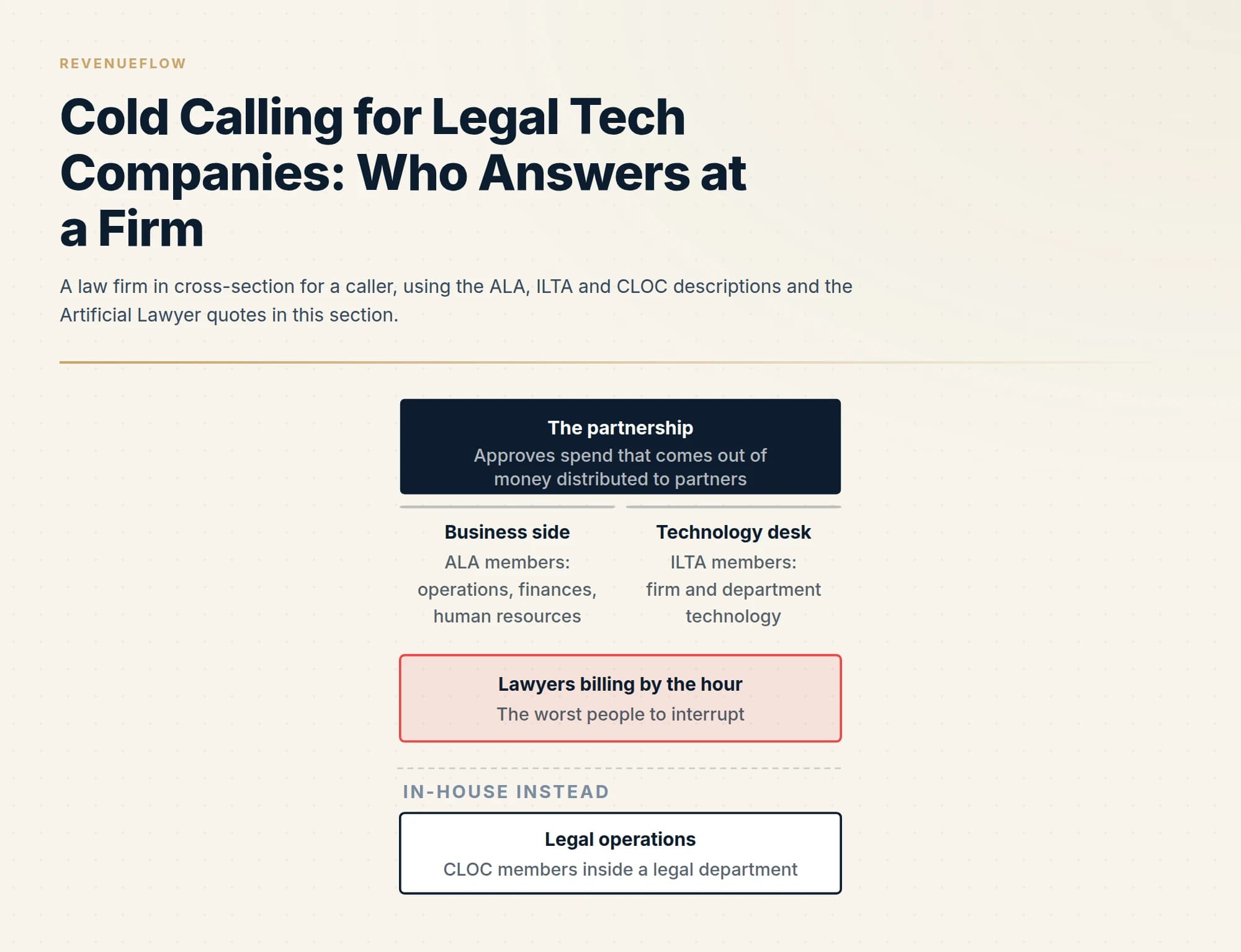
Law firms have no standard structure, so a legal tech caller works from desks: the business side that ALA represents, the technology desk ILTA represents, and legal operations in-house through CLOC, with partners approving spend. The billable hour makes efficiency a poor pitch, Model Rule 1.6 rules out client and matter questions, and the 2027 shows are dated.
Key takeaways
- Haley Altman of Litera told Artificial Lawyer in February 2022 that there isn't a standard firm structure or procurement process a vendor can model its sales process on.
- Vendors interviewed by Artificial Lawyer named the billable hour as an obstacle, with one saying it discourages gains in efficiency, so hours saved is a weak opening line.
- ABA Model Rule 1.6(a) says a lawyer shall not reveal information relating to the representation of a client, so discovery questions should be about the firm as a business.
- Legalweek New York lists March 1 to 3, 2027 and ABA TECHSHOW lists March 3-6, 2027 in Chicago, so the two shows overlap on March 3, and ILTACON lists 8-12 August 2027.
Reviewed and updated September 18, 2026
Haley Altman has sold legal technology as a founder and as a director at Litera, and she describes the problem a cold caller meets in one sentence: legal is hard to sell into "because there isn't a standard firm structure or procurement process that you can look to, to model your sales process." She said it to Artificial Lawyer, which asked a group of vendors on 24 February 2022 what made selling legal tech difficult (Artificial Lawyer, read 18 September 2026).
This guide is for a legal tech company whose reps phone law firms and legal departments cold. It is not for firms selling services to legal tech vendors, and it is not for lawyers looking for clients. The mechanics of a cold call are covered elsewhere on this site. What follows is what a law firm changes: who a call can reach when no two firms are organised the same way, why the billable hour makes the person you most want the worst person to interrupt, the dated shows the industry buys around, what confidentiality puts off limits on a call, the objections vendors report, and when the phone is the wrong tool.
Who answers, when there is no standard firm
Altman's second sentence is the one to build a call list around: "Each firm relies on different stakeholder groups or decision makers to evaluate technology and make buying decisions." A caller cannot assume a title. What a caller can do is use the three professional bodies that organise the people who run legal businesses, because each one describes a desk.
The Association of Legal Administrators describes its members as the people "responsible for several vital roles within their law firms", and lists the ground they cover: "From human resources and operations to strategy and finances, ALA members keep the business side of law firms running." (ALA, read 18 September 2026.) That is the firm administrator, the office manager at a small firm, the chief operating officer at a large one.
The International Legal Technology Association covers the technology desk. ILTA says that while it has "a strong focus on technology", its offerings "support professionals of every stripe in law firms and corporate/government legal operations" (ILTA, read 18 September 2026). That is the IT director, the knowledge management lead, the applications manager.
The Corporate Legal Operations Consortium covers the in-house side. CLOC describes itself as a community that brings together "legal operations professionals, service and solutions providers, and other stakeholders" (CLOC, read 18 September 2026). Its board chair's title on the same page is Legal Operations and Administration Director at an airline, which is a fair picture of the role: a business manager inside a legal department.
Above all three sits the partnership, and an anonymous chief executive of a United States legal tech start-up told Artificial Lawyer why that matters: "the partnership model at many firms makes them try to keep expenses as low as possible so more money can be distributed to partners each year." The people who answer the phone evaluate. The partners, whose own income the purchase comes out of, approve.
Why the billable hour makes the obvious target the wrong one
Artificial Lawyer summarised what several vendors told it: if you offer efficiency tools "to people who sell or buy time for a living" then you have what the site called an interesting problem. Noah Waisberg, chief executive of Zuva and co-founder of Kira Systems, put it from experience: "our biggest obstacle was convincing hourly billing lawyers that being more efficient was in their best interest." The anonymous chief executive listed it second among three reasons: "the billable hour discourages gains in efficiency".
For a caller that has two consequences. The first is about the pitch. A call that opens on hours saved is arguing against the way the listener earns a living, and Helena Hallgarn, co-founder of VQ Virtual Intelligence, reported hearing exactly that from early prospects, that "they still could bill those hours, and therefore there was no reason paying us instead." Altman's advice is to find value "that don't rely on efficiency as the main benefit", and she names profitability and retention.
The second is about the interruption. A lawyer who bills time is, during working hours, selling the minutes a cold call consumes. That is a mechanism and not a measured figure, and it points the same way as the sources above: call the business side and the technology desk, whose time is not the product, and leave fee earners to a channel they can read when they choose.
The calendar the industry publishes
Legal technology buying gathers around three shows, and all three have posted their next dates. As read on 18 September 2026:
- ABA TECHSHOW lists "March 3-6, 2027" at McCormick Place in Chicago (ABA TECHSHOW).
- Legalweek New York lists March 1 to 3, 2027 at the North Javits Center (Legalweek).
- ILTACON lists "8-12 AUGUST 2027" as next year's dates, with a wrap-up of ILTACON 2026 already posted (ILTACON).
Two things follow. The first week of March 2027 holds two of the three shows, in two cities, overlapping on March 3, so the technology and innovation people at your target firms are split between New York and Chicago and nobody is at a desk. February is the month to ask for a meeting at either, and the weeks after are when shortlists get written. August does the same for the ILTA community. We could not find a published source for firm budget or partner compensation calendars, so none is given here; ask the administrator on the first call when the firm sets its technology budget, and record it.
What the call may not ask
The rules that apply to any business call are set out in what cold calling is and which rules apply and in our reading of whether cold calling is against the law, and they are not repeated here. A law firm adds a constraint that comes from the lawyers' own professional rules.
ABA Model Rule 1.6(a) reads: "A lawyer shall not reveal information relating to the representation of a client unless the client gives informed consent, the disclosure is impliedly authorized in order to carry out the representation or the disclosure is permitted by paragraph (b)." (American Bar Association, read 18 September 2026.) States adopt their own versions, and this is a description of the model text, not legal advice.
A discovery question that works in other markets therefore fails here. Asking which matters a tool would be used on, which clients are pushing for it, or what a current case load looks like asks the person on the phone to talk about client representations with a stranger. The questions that can be answered are about the firm as a business: how many timekeepers, which document or practice management system, who evaluates software, whether there is a security questionnaire. Altman names that last point too, saying "Security and integration concerns can also impact the sales cycle." Our guide to sales engagement tools for legal services sets out the professional conduct position on volume from the firm's side of the table.
Cannot be answered
- Which matters would you use this on?
- Which clients are pushing for it?
- What does the current case load look like?
Can be answered
- How many timekeepers does the firm have?
- Which document or practice management system?
- Who evaluates software, and is there a security questionnaire?
The objections vendors report
These come from the vendors Artificial Lawyer interviewed, so they are what your peers heard, in their words.
From firms, the hours objection above, and its cousin. Hallgarn again: "Other firms argued that young associates needed this training which could be paid by the client." Jim Leason of Agiloft described the stakes for the individual: "any buying decision can feel like a career defining moment, particularly if the software will directly interface with a lawyer's clients". A caller is asking someone to take a personal risk, and a first call that tries to close anything larger than a second conversation is asking too much.
From legal departments, the objection is inexperience as buyers. Sacha Kirk of Lawcadia said "the in-house legal team generally haven't purchased technology before", and that "Their IT team will also question why the legal team needs their own tech". She added that the growing presence of legal operations professionals is helping, which is a reason to start at the CLOC desk in the diagram above.
There is a reward on the other side, and the anonymous chief executive stated it: "once a subscription sale is made, law firms almost never leave." The general craft of handling objections live is in cold call objection handling.
Three openers, each tied to a source above
None names a real person or claims a result.
To a firm administrator, grounded in the ALA description.
This is {{name}} from {{company}}. We are calling the business side of the firm on purpose, not a partner. We make {{product}}, and our question is a business one: who at {{firm}} evaluates software before it ever reaches the partners?
It is legitimate because ALA describes that desk as running operations and finances, and it asks for a process, not a meeting.
To the technology desk, grounded in the show dates.
This is {{name}} from {{company}}. Legalweek and TECHSHOW land in the same week next March, so we are asking early. Is anyone from your team going to either, and would twenty minutes there be more useful than a call now?
It is legitimate because both organisers have published the dates.
To legal operations, grounded in Kirk's observation.
This is {{name}} from {{company}}. Vendors in our field say legal teams often have not bought their own technology before and get questioned by IT when they try. If that is where {{department}} is, we can send the business case outline other legal operations teams have used. Would that help?
It offers the thing the source says the buyer lacks.
When the phone is the wrong play
The phone is the wrong play for reaching fee earners, for the reason the billable hour gives. It is the wrong play in the first week of March and the second week of August, when the people who evaluate are at shows. And it is the wrong play for any pitch built on hours saved.
Where calling sits next to written outreach is a question we answer as policy and not as a result. RevenueFlow runs email and LinkedIn for clients and does not make cold calls, and our comparison of email and cold calling sets out how each channel fails. In this market the written channel has a particular fit: a partner can read a short message between matters at no cost to a client. Our legal cold email benchmarks cover how legal audiences respond by persona. Our own doctrine is one message per campaign with nothing scheduled behind it. If you want that built for your segment of the legal market, see what a first campaign looks like.
The short version
No two law firms are organised the same way, so a caller works from desks and not from titles: the business side that ALA represents, the technology desk that ILTA represents, legal operations in-house through CLOC, and a partnership above them that approves spend out of its own distributions. The billable hour makes efficiency the wrong pitch and fee earners the wrong people to interrupt. Confidentiality under Model Rule 1.6 puts client and matter questions off limits, so discovery stays on the firm as a business. Legalweek and ABA TECHSHOW share the first week of March 2027 and ILTACON takes the second week of August, and vendors report that once a firm subscribes it almost never leaves.
Association, show organiser, ABA and Artificial Lawyer pages quoted above were read on 18 September 2026. Show dates change and professional conduct rules vary by state. Confirm both before relying on them.
Frequently asked questions.
Frequently asked questions- Who should a legal tech company call at a law firm?
- Start with the people who run the firm as a business. The Association of Legal Administrators says its members cover human resources, operations, strategy and finances, and ILTA covers technology professionals in law firms and legal departments. In-house, CLOC organises legal operations professionals. Partners usually approve the spend, but lawyers billing by the hour are the worst people to interrupt.
- Why is cold calling lawyers about legal tech so hard?
- Vendors blame the business model. Noah Waisberg of Zuva told Artificial Lawyer that Kira's biggest obstacle was convincing hourly billing lawyers that being more efficient was in their best interest. An anonymous legal tech chief executive added that the partnership model makes firms keep expenses low so more money can be distributed to partners each year.
- What questions should you avoid on a call to a law firm?
- Anything about clients or matters. ABA Model Rule 1.6(a) says a lawyer shall not reveal information relating to the representation of a client without informed consent or another listed basis. Ask about the firm as a business instead: the number of timekeepers, the document or practice management system, who evaluates software, and whether there is a security questionnaire.
- When do law firms look at new legal technology?
- The industry gathers at three dated shows. As read on 18 September 2026, Legalweek New York lists March 1 to 3, 2027, ABA TECHSHOW lists March 3-6, 2027 at McCormick Place in Chicago, and ILTACON lists 8-12 August 2027. The weeks before each show suit meeting requests, and the weeks after are when shortlists tend to form.
About the author.

B2B cold email experts helping companies generate qualified leads through done-for-you outreach campaigns.
RevenueFlow Team
Explore more.
Ready to scale your outreach?
We build GTM engines that book real meetings. See the receipts.
Related articles.
Cold Calling for Software Development Companies: Proof First
What changes when a custom software development shop cold calls: how buyers shortlist on proof, what a call should ask for, and the UK and US calling rules.
Outbound Sales for Law Firms: What the Rules Allow
Outbound business development for law firms, read against ABA Model Rules 7.1 to 7.3: who a firm may approach, what a message must carry, and when it is the wrong play.
Cold Calling for EdTech Companies: Who Answers at a School
What changes when an edtech company cold calls a school: who picks up, the fiscal and testing calendars, district vendor contact rules, and when not to dial.
Cold Call Openers: Eleven Lines by Situation, and the Data
Eleven cold call openers sorted by what is true about the call, the four beats every opener has, and what Gong's 2018 opener study actually counted.
B2B Lead Lists for Collection Agencies: Fields and Sources
What a creditor prospect list needs for a collection agency: the fields that matter, the FDIC, NCUA, CMS and court sources behind them, and the rules that apply.
Outbound Sales for Food and Beverage Companies: Who to Reach
Outbound sales for food and beverage brands: the four buyers behind a yes, the public show calendar, what a message may claim, and when outbound is the wrong play.