Outbound Sales for Law Firms: What the Rules Allow
Outbound business development for law firms, read against ABA Model Rules 7.1 to 7.3: who a firm may approach, what a message must carry, and when it is the wrong play.
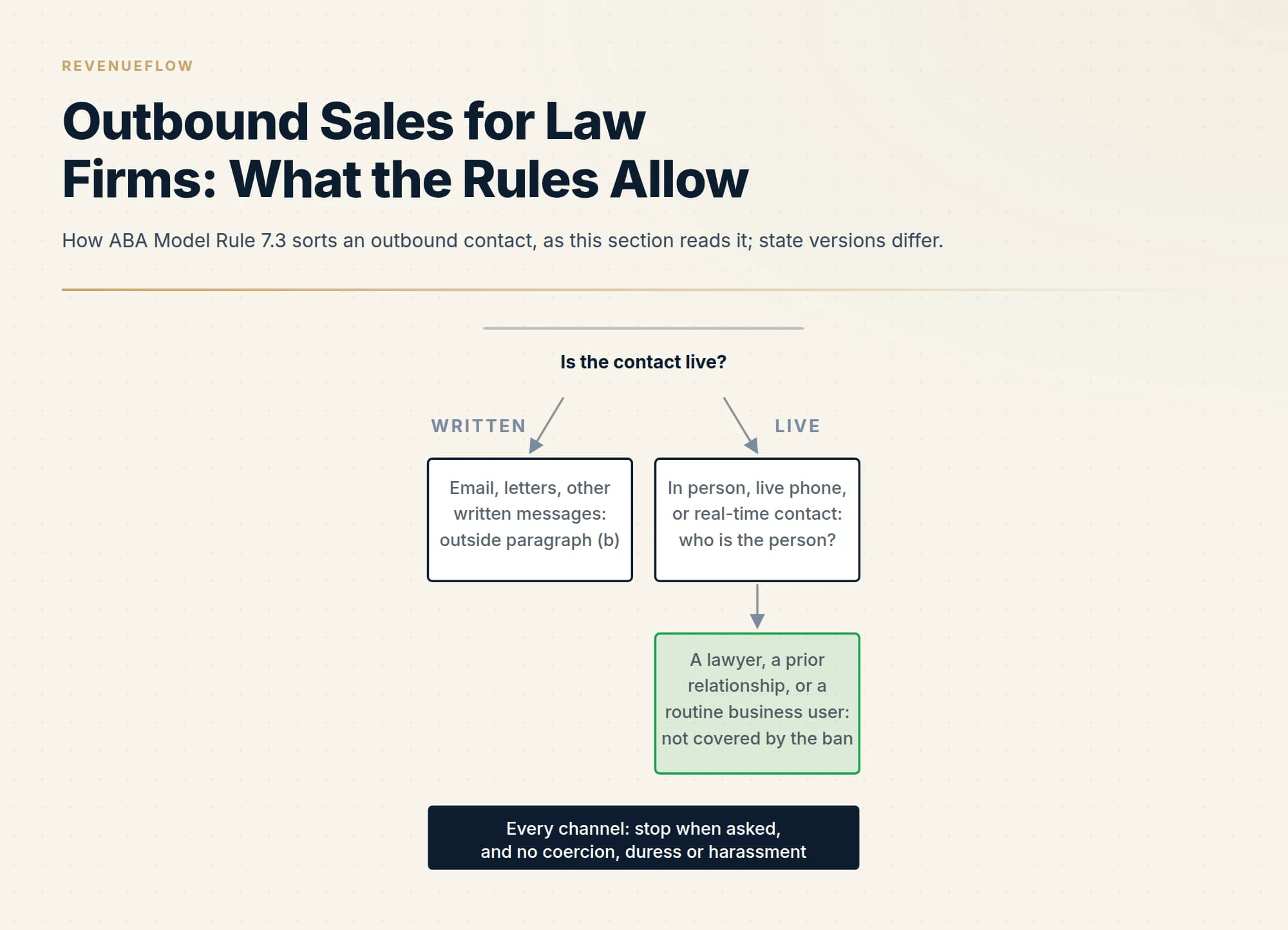
A law firm can run outbound business development within its ethics rules. ABA Model Rule 7.3 bans live person-to-person solicitation, with exceptions for lawyers, prior relationships and routine business users of legal services, and its comment treats written messages differently. Every message must be truthful and name a responsible lawyer, and your state's version of the rules governs.
Key takeaways
- ABA Model Rule 7.3 prohibits solicitation by live person-to-person contact, and its comment says that does not include written communications recipients may easily disregard.
- The ban does not cover lawyers, people with a prior relationship, or a person who routinely uses for business purposes the type of legal services offered.
- Model Rule 7.1 bars false or misleading statements, and Rule 7.2 requires the name and contact information of at least one responsible lawyer or firm.
- The ABA publishes charts showing how each jurisdiction modified the Model Rules, so a firm has to read its own state's rule before sending anything.
Reviewed and updated September 18, 2026
A partner in a twelve-lawyer employment practice wants more corporate clients and is told by a colleague that lawyers are not allowed to cold email. The colleague is remembering a real rule and getting it wrong. The American Bar Association's comment on its solicitation rule says the prohibited kind of contact "does not include chat rooms, text messages or other written communications that recipients may easily disregard."
This guide is for law firms doing their own business development: firms with business clients, such as corporate, employment, intellectual property, real estate and regulatory practices, that want to start conversations with companies that do not know them yet. If you sell software or services to law firms, this is the wrong page, and legal cold email benchmarks is a better starting point. Nothing here is legal advice. It sets out the text of the ABA's Model Rules, and your own state's version of those rules is the one that binds you.
What the solicitation rule prohibits, in its own words
ABA Model Rule 7.3 defines the thing it regulates. A solicitation is a communication initiated by or on behalf of a lawyer or law firm "that is directed to a specific person the lawyer knows or reasonably should know needs legal services in a particular matter" and that offers to provide legal services for that matter. A general message to a company about your practice, sent to someone you have no reason to think has a live matter, sits outside that definition. A message about the lawsuit filed against them last week sits inside it.
The prohibition is narrower than the definition. Paragraph (b) reads: "A lawyer shall not solicit professional employment by live person-to-person contact when a significant motive for the lawyer's doing so is the lawyer's or law firm's pecuniary gain", and then lists three kinds of people the ban does not cover: a lawyer; a person with a family, close personal, or prior business or professional relationship with the lawyer or firm; and a "person who routinely uses for business purposes the type of legal services offered by the lawyer."
The comment explains what live means: "in-person, face-to-face, live telephone and other real-time visual or auditory person-to-person communications where the person is subject to a direct personal encounter without time for reflection." It also explains why written messages are treated differently. In the comment's words, "communications can be mailed or transmitted by email or other electronic means that do not violate other laws."
Two limits apply to every channel. Under paragraph (c) a lawyer shall not solicit when "the target of the solicitation has made known to the lawyer a desire not to be solicited by the lawyer", or when the solicitation involves coercion, duress or harassment. In plain terms: stop when asked, on every channel. Email, letters and other written messages sit outside paragraph (b), and they still answer to paragraph (c).
Who a firm may approach, using the ABA's own examples
The third exception is the one that makes business development possible for a firm with business clients, and the comment to the rule gives examples of who it means. It names "persons who routinely hire outside counsel to represent the entity", entrepreneurs who regularly engage business, employment law or intellectual property lawyers, "small business proprietors who routinely hire lawyers for lease or contract issues", and other people who routinely retain lawyers for business transactions or formations.
That list works as a targeting brief. It describes general counsel and their deputies at companies with a legal department. It describes founders who have already bought legal work more than once. It describes owners of small companies with recurring leases and contracts. The comment's reasoning is that there is no serious potential for overreaching with people like these, because buying legal services is part of their job.
The same comment marks the other end of the range. It says live contact with individuals who may be especially vulnerable to coercion or duress "is ordinarily not appropriate", and the rule's concern throughout is the person who is overwhelmed by the circumstances that created the need for a lawyer. A firm whose clients are individuals in a crisis is reading a different part of the rule from a firm whose clients are companies.
| The comment names | In practice |
|---|---|
| Persons who routinely hire outside counsel to represent the entity | General counsel and their deputies |
| Entrepreneurs who regularly engage business, employment law or intellectual property lawyers | Founders who have bought legal work more than once |
| Small business proprietors who routinely hire lawyers for lease or contract issues | Owners with recurring leases and contracts |
What every message has to carry
Rule 7.3 decides whether you may make the contact. Two other rules decide what the contact may say.
Model Rule 7.1 is one sentence long and it governs everything: "A lawyer shall not make a false or misleading communication about the lawyer or the lawyer's services." The rule adds that a communication is misleading if it "omits a fact necessary to make the statement considered as a whole not materially misleading." For outbound that rules out the staples of sales copy. A specialist claim, a superlative or a track record has to be true as the reader will understand it. There is no room for an unverifiable superlative, a result presented without its circumstances, or a client list the clients have not agreed to.
Model Rule 7.2 adds two mechanical requirements. Paragraph (c) says a lawyer shall not state or imply certification as a specialist in a field of law unless the certifying organization is approved or accredited and is clearly identified. Paragraph (d) says any communication made under the rule "must include the name and contact information of at least one lawyer or law firm responsible for its content."
Email has its own federal layer. The FTC's CAN-SPAM guide says "The law makes no exception for business-to-business email", and it requires, among other things, a working way to opt out that is honored within 10 business days. The FTC's text is at the CAN-SPAM compliance guide, and the general position is covered in is cold email legal.
- Yes: Nothing false or misleading about the lawyer or the lawyer's services
- Yes: The name and contact information of at least one lawyer or law firm responsible for its content
- Yes: A working way to opt out, honored within 10 business days
- No: A specialist claim with no certifying organization identified
- No: A client list the clients have not agreed to
The state rule is the one that binds
Everything above is the ABA's model. Lawyers are regulated by their state, and states change the model before adopting it. The ABA publishes comparison charts for exactly this reason, introduced with the sentence: "The following materials show how each jurisdiction has modified each of the ABA Model Rules of Professional Conduct."
So the working order is this. Read the model rule to understand the structure. Open the ABA's chart for Rule 7.3 and find your jurisdiction. Then read your state's own rule and comments, and if a planned campaign sits near a line, ask your state bar's ethics counsel before you send. A firm that practises in several states has to satisfy each of them. We are an outbound company and not your counsel, so we leave this step with you and we mean it.
A reason to write: the law changed
A law firm has an advantage no other seller has. Its product is knowledge of rules, and rules change on published dates. A change that affects the reader is a legitimate reason to write, it costs the reader nothing to evaluate, and it shows the firm's work before anyone has paid for it.
Three illustrative openers follow. Each rests on a page we read on 18 September 2026, names no real recipient and promises no outcome. They are written messages, so they sit on the written side of the path above.
The first illustrative opener is for counsel at a public university or a city, from a firm with a public sector practice. The Department of Justice's page on its web accessibility rule under Title II of the Americans with Disabilities Act describes an interim final rule published on April 20, 2026 as "extending the compliance date for State and local government entities with a total population of 50,000 or more to April 26, 2027."
Your compliance date for web content and mobile apps under the Title II rule moved to April 26, 2027. We have prepared a two-page note on what the extension changes for procurement contracts already signed, and we are glad to send it.
The second illustrative opener is for the owner of a tax preparation or mortgage brokerage business, from a firm with a privacy practice. The FTC's Safeguards Rule page tells companies to consult the definition of a covered financial institution periodically, because a business that was outside the rule may now be inside it.
The federal Safeguards Rule reaches more businesses than its name suggests, and the regulator advises checking the definition again as a business changes. We can tell you in one short call whether it reaches yours.
The third illustrative opener is for another lawyer, which the rule's first exception covers on any channel. Model Rule 7.2 permits reciprocal referral arrangements on two conditions: the agreement is not exclusive, and the client is informed of its existence and nature.
We turn away two or three trademark matters a month because we do not handle them, and your firm does. We would like to talk about a referral arrangement that is not exclusive and that both of us disclose to the client.
The monthly count in the third example is invented for illustration.
When outbound is the wrong play for a law firm
Some firms should not run outbound at all, and some should run only part of it.
Outbound can fit
- The buyers are companies that routinely use the type of legal services you offer
- The message is written, and the reason to write is a dated change in the law
- A named lawyer is responsible for the content and will answer the reply
The wrong play
- The clients are individuals in a crisis
- The plan depends on live calls to people who are not routine business users
- Nobody senior has time to take the conversations it starts
If your clients are individuals in a crisis, such as injury, divorce, arrest or debt, the person you would write to is the person the rule was written to protect. Live contact is prohibited, and written contact about a particular matter is a solicitation that your state may condition further. Put the effort into being found, and into referral relationships with other lawyers.
If the plan depends on live calls to people who are not routine business users of legal services, the model rule prohibits it. We run email and LinkedIn and we do not run phone campaigns, so we would not build that plan for any client, and for a law firm the rule settles the question before preference does.
If nobody senior has time to take the conversations, outbound wastes the contact. A general counsel who replies to a partner's note expects the partner, and a reply that goes unanswered for a week costs more than never writing.
How we would run it
We send one message per campaign, and we do not follow it with a reminder to someone who did not answer. The reasoning is set out in why we stopped using follow-ups. For a law firm the practice has a second benefit, because paragraph (c) of the rule turns on whether the person has made known a desire not to be contacted, and a firm that writes once, on a real change in the law, gives nobody a reason to say so. A later message belongs to a new campaign with a new reason, and the statute book supplies them.
The habits of other professional services sellers carry over, and outbound for consultants covers the capacity problem a small partnership shares with them. Where outbound sits among the other ways a firm finds work is compared in lead generation channels. If you would like to see a list of routine business users of your type of legal work in your market, and one message built on a dated change in the law, you can see what a first campaign would look like.
ABA Model Rules 7.1, 7.2 and 7.3, the comment to Rule 7.3 and the ABA's jurisdictional comparison page were read on the ABA's own site on 18 September 2026, from stored snapshots, as were the Department of Justice and FTC pages. The Model Rules are a model; your state's rules of professional conduct govern you. Nothing on this page is legal or ethics advice.
Sources: ABA Model Rule 7.3, Comment on Rule 7.3, ABA Model Rule 7.1, ABA Model Rule 7.2, ABA, Jurisdictional Rules Comparison Charts, ADA.gov, web accessibility rule fact sheet, FTC, Safeguards Rule: What Your Business Needs to Know, FTC, CAN-SPAM Act compliance guide
Frequently asked questions.
Frequently asked questions- Can a law firm send cold emails to potential clients?
- Under the ABA Model Rules, written messages are treated differently from live contact. Rule 7.3 bans solicitation by live person-to-person contact, and its comment says that does not include written communications that recipients may easily disregard. The message still has to be truthful, name a responsible lawyer, and stop when the person asks. States modify these rules, so check your own.
- Who can a law firm contact for business development?
- The Model Rule's exceptions cover other lawyers, people with a family, close personal or prior business or professional relationship, and a person who routinely uses for business purposes the type of legal services offered. The ABA's comment gives examples: people who routinely hire outside counsel for an entity, entrepreneurs who regularly engage lawyers, and small business proprietors with recurring lease or contract work.
- What must a law firm's outreach message include?
- Model Rule 7.2 says a communication must include the name and contact information of at least one lawyer or law firm responsible for its content. Model Rule 7.1 bars anything false or misleading, including omissions that make the whole misleading. For email, the FTC's CAN-SPAM guide requires a working opt-out that is honored within 10 business days, and it applies to business recipients.
- When should a law firm avoid outbound altogether?
- When its clients are individuals in a crisis, such as injury, divorce, arrest or debt. The solicitation rule was written to protect that person, live contact is prohibited, and states may add conditions to written contact about a particular matter. Outbound is also the wrong play when the plan depends on live calls to strangers, or when no senior lawyer has time to answer replies.
About the author.

B2B cold email experts helping companies generate qualified leads through done-for-you outreach campaigns.
RevenueFlow Team
Explore more.
Ready to scale your outreach?
We build GTM engines that book real meetings. See the receipts.
Related articles.
LinkedIn Outreach for Automotive Companies: Who It Reaches
LinkedIn outreach into automotive, split by buyer: what it can open at manufacturers, parts suppliers and dealer groups, and the cases where it is the wrong channel.
LinkedIn Outreach for Ecommerce Companies: Who Is Reachable
LinkedIn outreach to ecommerce brands: why the storefront address reaches support, what Shopify's partner agreement says about contacting merchants, and who is reachable.
LinkedIn Outreach for Logistics Companies: Finding Shippers
LinkedIn outreach for brokers, forwarders and 3PLs: why the industry filter returns competitors, how to find shippers by function, and what goes in one checkable message.
Outbound Sales for Higher Education Vendors: Which Door to Use
Outbound for higher education vendors, built on universities' own purchasing policies: three doors, the ask that fits each one, and a dated accessibility review.
Outbound Sales for Food and Beverage Companies: Who to Reach
Outbound sales for food and beverage brands: the four buyers behind a yes, the public show calendar, what a message may claim, and when outbound is the wrong play.
Outbound Sales for Property Management Companies: Winning Owners
Outbound for property management companies that want owner clients: three audiences, the calling, texting and email rules for each, licensing, and agent referrals.