LinkedIn Outreach for Logistics Companies: Finding Shippers
LinkedIn outreach for brokers, forwarders and 3PLs: why the industry filter returns competitors, how to find shippers by function, and what goes in one checkable message.
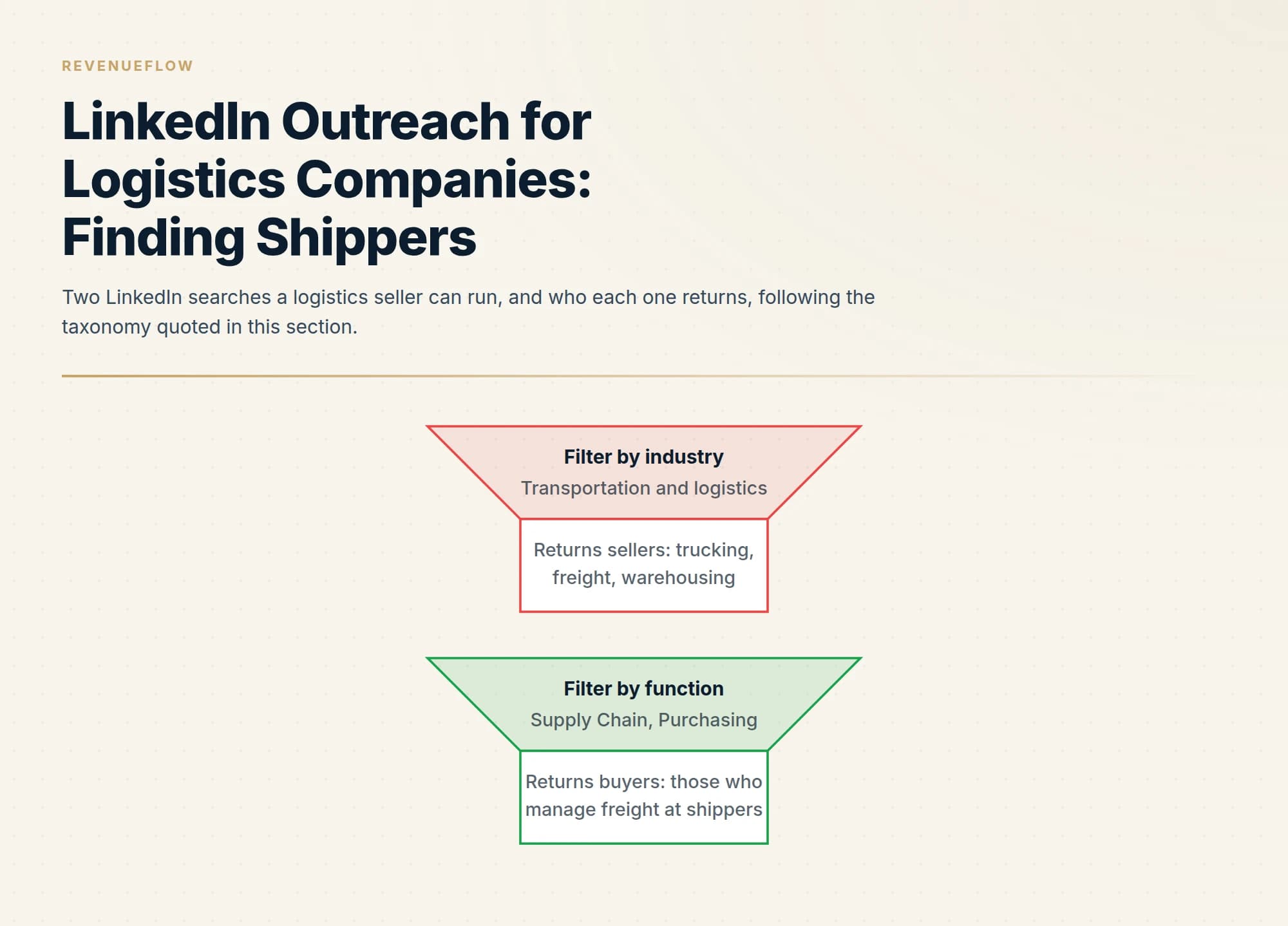
Logistics companies should search LinkedIn by job function, such as Supply Chain and Purchasing, inside their customers' industries, because LinkedIn's transportation and logistics industry contains sellers of transport. Make the profile checkable with an MC Number, send a connection request with no pitch, and follow with one hand-written message built on a current market reason.
Key takeaways
- LinkedIn's transportation, logistics, supply chain and storage industry covers trucking, freight, warehousing, maritime and rail, so filtering by it returns competitors and subcontractors.
- LinkedIn's published job functions include Supply Chain and Purchasing, which is how a broker or 3PL finds the people who manage freight at shippers.
- The FMCSA says brokers need authority, an assigned MC Number and proof of a surety bond or trust fund, which gives a logistics seller a credential the reader can verify.
- LinkedIn's help page says it does not permit third party software that automates activity on its website, whatever automation vendors' pages promise.
Reviewed and updated September 18, 2026
A sales rep at a freight brokerage opens Sales Navigator, picks the industry that has logistics in its name, and gets back several thousand profiles. The page fills with brokers, carriers, forwarders and warehouse operators. The rep has built a list of competitors, because LinkedIn files a company by what it does for a living, and the people who buy freight do something else for a living.
This guide is for logistics companies that sell to shippers: freight brokers, forwarders, third-party logistics providers, carriers and warehouse operators who want to use LinkedIn to start conversations. It covers the LinkedIn channel only. The motion itself, including the windows when a shipper reviews providers, the roles involved and the offers that earn a reply, is in logistics lead generation, and this page does not repeat it. What LinkedIn permits, and what can be handed to an agency, is in what is safe to outsource on LinkedIn.
LinkedIn files your buyers somewhere else
LinkedIn publishes its industry taxonomy in Microsoft's developer documentation, and the entry for this trade reads: "This industry includes entities that store and warehouse goods, transport passengers and cargo, provide scenic and sightseeing transportation, and provide support activities related to modes of transportation." Under that heading sit Freight and Package Transportation, Truck Transportation, Warehousing and Storage, Maritime Transportation and Rail Transportation.
Every one of those is a seller of transport or storage. A shipper is a manufacturer, a retailer, a wholesaler or a food company, and LinkedIn classifies it under its own industry. So the industry filter that looks like the obvious starting point points the wrong way. It finds the people you compete with and the people you subcontract to.
The filter that finds buyers is the function. LinkedIn's published list of job functions includes Supply Chain and Purchasing. A search for those functions inside the industries your customers belong to, such as food production or building materials, returns the people who manage freight for a living at companies that ship. It is a smaller list than the industry filter gives, and it is the right one.
Be checkable before you write
A shipper who receives a message from a broker it has never heard of has one quick way to find out whether the broker is real, and it is a government database. The Federal Motor Carrier Safety Administration's broker registration page says first-time brokers must apply for broker authority through its Unified Registration System, that an MC Number is assigned, and that brokers of property must then file proof of a surety bond or trust fund agreement "in the amount of $75,000."
That gives a logistics seller a public credential. Put the MC Number in the profile headline or the About section, and put it in the message. It turns a stranger's claim into something the reader can verify in a minute, and on a platform full of automated outreach that is the difference between a person and a bot.
The profile has to say what you move. A headline that reads business development at a logistics company tells a supply chain manager nothing. A headline that names the mode, the region and the freight type tells the reader whether to keep reading before the message is opened.
What the tool pages promise, and what LinkedIn says
Search for LinkedIn outreach in this trade and the results are mostly software. The pages are candid about what they sell. One automation vendor's page for logistics and freight companies offers to "Run outreach on autopilot, safely" and describes "Multi-step campaigns that follow up". Another, aimed at logistics and 3PL firms, lists among its features "Dedicated IP, smart limits, stealth mode."
Those are the vendors' claims about their own products. LinkedIn's position is on its help page for prohibited software. It says "we don't permit the use of any third party software" of this kind, and it names crawlers, bots, browser plug-ins and browser extensions "that scrape, modify the appearance of, or automate activity on LinkedIn's website." A feature called stealth mode implies there is something to stay hidden from. We do not recommend any of these tools, and we do not describe any of them as safe, whatever their pages say.
Our own practice is narrower still. A connection request carries no pitch. After it is accepted, one message goes, written and sent by a person. If there is no answer we do not send another one under it, and we do not come back to that thread later. A later approach to the same company goes to a different person, for a different reason.
Run outreach on autopilot, safely. Multi-step campaigns that follow up. Dedicated IP, smart limits, stealth mode.
No third party software, crawlers, bots, browser plug-ins or browser extensions that scrape, modify the appearance of, or automate activity on LinkedIn's website.
A connection request with no pitch, then one message, written and sent by a person.
A reason to write, from this week's trade press
One message needs one reason, and freight supplies them constantly because the market moves in public. On Monday, September 14, 2026, FreightWaves carried the headline "Cass: TL rates jump 11% in August, freight shipments turn positive", with the summary that volumes were "finally inflecting positively after 42 months of decline." DAT's blog in the same week led with market reports headed "Capacity stays tight" for dry van and "Shippers paid more to move less in Q2" for flatbed. A shipper reading those headlines is wondering what happens to its contract rates, and a provider with capacity on the shipper's lanes has a legitimate reason to say so.
Three illustrative openers follow. They name no real recipient and promise no result, and the lanes and company details inside them are invented for illustration.
The first illustrative opener is for a transportation manager at a building materials manufacturer, sent after an accepted connection.
Shippers paid more to move flatbed freight last quarter. We run flatbed from Georgia and Alabama into Texas every week and have trucks open in October. Our MC Number is on our company page. If your contract carrier is pushing back on tenders, we can quote your lanes.
The second illustrative opener is for a supply chain director at a food company, built on the turn in volumes.
Truckload volumes turned positive in August for the first time in more than three years. If your routing guide was built for a loose market, it is about to be tested. We can run your top ten lanes against current capacity and send you the result, with no obligation.
The third illustrative opener is for a purchasing lead at a retailer before peak season.
Peak is eight weeks out. We hold warehouse space within a day's drive of your two distribution centres and can take overflow on a month-to-month basis. If you already have cover, ignore this. If not, a fifteen-minute call now is cheaper than one in November.
When LinkedIn is the wrong play for a logistics company
It is the wrong play when the buyer is not there. The Supply Chain and Purchasing functions exist on LinkedIn, but whether the dock, dispatch and plant roles at your target shippers keep a profile is something we found no public measure of, so test it: take twenty target shippers, look for the person who tenders freight, and count the active profiles. If the count is low, use email and the phone number on the shipper's own site.
It is the wrong play when you need volume. One hand-written message per person will not reach two thousand shippers this month. Email can, under the same rule of one message per campaign, and logistics cold email benchmarks shows what that channel returns.
It is the wrong play when the plan is automation. The account that gets restricted belongs to a named person at your company, and in a trade that runs on relationships, that person's network is an asset the company cannot replace.
It is the wrong play when you cannot be checked. A broker without active authority, or a profile that does not say what the company moves, gives the reader no reason to believe the message.
Where it fits, LinkedIn is a small, precise channel for a logistics seller: shippers found by function, a profile that can be verified against a federal record, and one message built on something the market did this week. How it sits beside the other channels is compared in lead generation channels. If you would like to see a shipper list built by function for your lanes, and a first message to go with it, you can see what a first campaign would look like.
LinkedIn's industry and job function lists were read in Microsoft's developer documentation, and the FMCSA, LinkedIn help, FreightWaves, DAT and vendor pages on their own sites, on 18 September 2026, from stored snapshots. Market headlines are quoted as published that week and will be out of date when you read this. Nothing here is legal advice.
Sources: Microsoft Learn, LinkedIn industry codes, Microsoft Learn, LinkedIn job function codes, FMCSA, Broker Registration, LinkedIn Help, Prohibited software and extensions, FreightWaves, trucking news, DAT Blog, Quicklead, LinkedIn Automation for Logistics and Freight Companies, LinkedCamp, LinkedIn Automation for Logistics and 3PL
Frequently asked questions.
Frequently asked questions- How do logistics companies find shippers on LinkedIn?
- By function, and inside the shipper's own industry. LinkedIn classifies a manufacturer or retailer under what it makes or sells, so the transportation and logistics industry filter returns carriers, brokers and warehouses. Search for the Supply Chain and Purchasing job functions within industries your customers belong to, such as food production or building materials, and build the list from there.
- Should a freight broker use LinkedIn automation tools?
- LinkedIn's help centre says it does not permit third party software that scrapes or automates activity on its website, and accounts that use it risk restriction. Automation vendors describe their products as safe, and one lists a stealth mode among its features. We do not recommend them. The account at risk belongs to a named person whose network the company cannot replace.
- What should a logistics LinkedIn message include?
- One reason that belongs to the shipper, such as a change in rates or capacity reported in the trade press that week, the lanes or space you can actually offer, and your MC Number so the reader can check your authority with the FMCSA. Send it after a connection request that carried no pitch, and do not send a second message under it.
- When is LinkedIn the wrong channel for a logistics company?
- When the person who tenders freight at your target shippers has no active profile, when you need to reach thousands of shippers in a month, when the plan depends on automation, or when your own profile cannot be verified. Test twenty target shippers first. If few have an active profile in the freight role, use email and the phone number on the shipper's site.
About the author.

B2B cold email experts helping companies generate qualified leads through done-for-you outreach campaigns.
RevenueFlow Team
Explore more.
Ready to scale your outreach?
We build GTM engines that book real meetings. See the receipts.
Related articles.
LinkedIn Outreach for Automotive Companies: Who It Reaches
LinkedIn outreach into automotive, split by buyer: what it can open at manufacturers, parts suppliers and dealer groups, and the cases where it is the wrong channel.
LinkedIn Outreach for Ecommerce Companies: Who Is Reachable
LinkedIn outreach to ecommerce brands: why the storefront address reaches support, what Shopify's partner agreement says about contacting merchants, and who is reachable.
Outbound Sales for Web Development Companies: A Guide
Outbound for a web shop starts from the prospect's own public site: what it runs on, how it performs and whether a dated accessibility duty applies.
Outbound Sales for Law Firms: What the Rules Allow
Outbound business development for law firms, read against ABA Model Rules 7.1 to 7.3: who a firm may approach, what a message must carry, and when it is the wrong play.
Outbound Sales for Higher Education Vendors: Which Door to Use
Outbound for higher education vendors, built on universities' own purchasing policies: three doors, the ask that fits each one, and a dated accessibility review.
Lead Generation for Martech Companies: A B2B Playbook
Lead generation for a martech vendor: a buyer who recognises every tactic, a shelf of 15,384 products, and lists built on replacement events rather than titles.