Lead Generation Channels: Sorted by How Fast They Answer
Channels differ most in how long they take to answer and how much you control who hears you. That axis decides what each one can be asked to do.
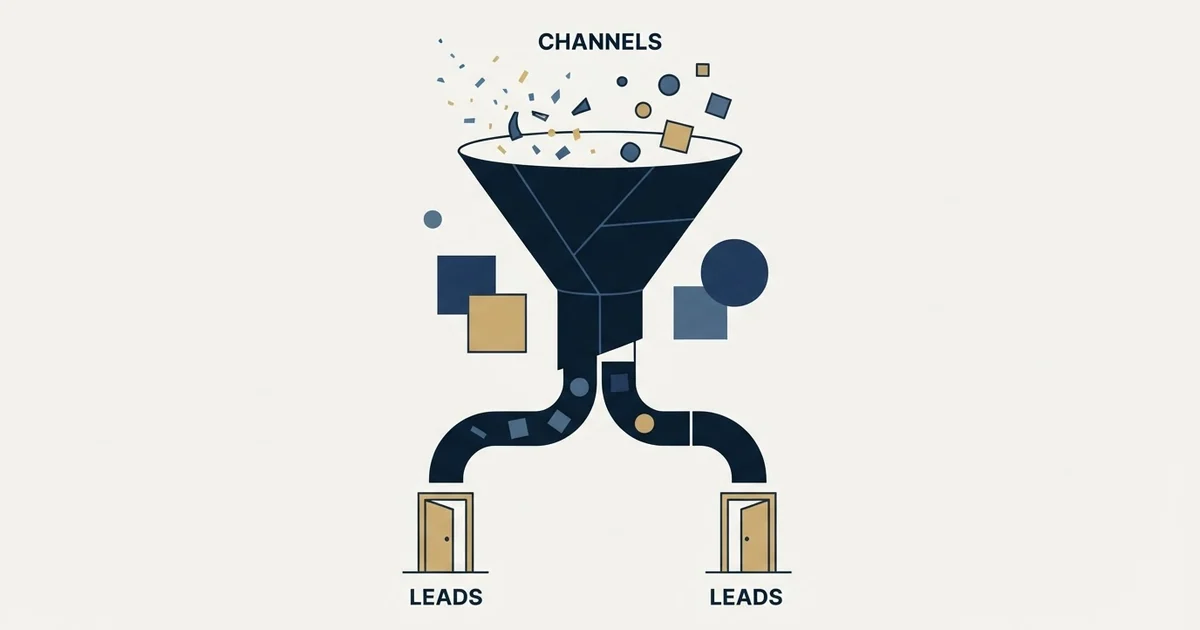
Lead generation channels separate best on two properties: latency, meaning how long before a meeting appears, and control, meaning whether you choose who hears from you. Fast, controllable channels are the only ones that can fix the current quarter. Slow, uncontrollable ones are the only ones that lower cost per meeting over time.
Key takeaways
- A channel's latency and how much you control its audience decide what job it can do, and cost per attempt only decides what you can afford within a group.
- Conferences, partnerships and webinars sit in an awkward middle where they look fast and behave slow, which is why they get funded like outbound and judged like outbound.
- Write down two dates before funding a channel: the earliest plausible first meeting, and the point at which enough volume exists to read a rate.
- The number of channels you can honestly run is capacity divided by the volume each needs to become readable, which for most teams under twenty people is two.
Reviewed and updated September 2, 2026
Lead Generation Channels: Sorting Them by How Fast They Answer
A founder funds three things in January: a content programme, a conference booth, and an outbound team. In April the board asks which one is working. Content has produced eleven newsletter subscribers, the conference produced two conversations that have gone quiet, and outbound has produced nineteen meetings and four proposals. Outbound gets more budget, content gets cut, and eighteen months later the company is still buying every conversation it has because the compounding channel was killed at the point where it looked worst.
That decision was not a judgment about channel quality. It was a judgment made on a calendar that suited one channel and not the others, and it is the most expensive recurring mistake in channel selection.
Most channel advice sorts options by cost or by conversion rate. Both matter, and both are downstream of a property that gets discussed far less: how long a channel takes to tell you anything, and how much of its output you control. Sort your options that way first and a lot of the usual arguments resolve themselves.
The two properties that actually separate channels
Latency is the gap between the work and the meeting. Outbound has latency measured in days. SEO has latency measured in quarters. That gap is not a quality difference, it is a structural property of the channel, and it decides what a channel can be used for.
Control is whether you can decide who hears from you. In outbound you choose the list, so you can point the channel at forty named accounts this week. In content and search you publish and wait for the right person to arrive, and you cannot make a specific company read anything.
Those two properties travel together more often than not, and together they explain the channel mix most B2B companies eventually land on.
Readers arriving from a search for b2b marketing channels are asking the same question in marketing words, and the sort above answers it: the list is the same list, and latency and control decide which entry can be asked to solve which problem.
- Cold email
- Cold calling
- LinkedIn outreach
- Targeted events and dinners
- Paid search on high-intent terms
- SEO and content
- Organic social and personal brand
- Podcast and community presence
- Word of mouth and referral
- PR and analyst relations
- Conferences and trade shows
- Partnerships and channel
- Webinars and roundtables
- Review sites and directories
- Paid social
The middle column is where most disagreements live, and the reason is that those channels have low latency in appearance and high latency in reality. A conference produces conversations this week and revenue three quarters later. It gets funded like outbound and judged like outbound, and it fails that test almost every time.
Teams that have leaned on conferences ask what other lead generation channels beyond events actually work, and the awkward-middle column above is the reason the question comes up at all: events feel low-latency and behave as high-latency, so the honest comparison is against another slow channel rather than against outbound.
Budget cycles create their own latency traps, and selling into schools and universities means timing outreach around institutional budget calendars rather than company size.
What each group is actually good for
A low-latency, high-control channel is the only kind that can solve a problem in the current quarter. If pipeline is short in March, the honest list of things that can change March is short: contact more of the right people, contact them better, or contact people you had ruled out. Which of those three is available depends on how the list was built in the first place, and a list built from dated signals rather than firmographic filters gives you a lot more room here than one built from industry and headcount. Publishing more cannot move March, however good the publishing is.
A high-latency, low-control channel is the only kind that lowers what a meeting costs over time. It works by making some fraction of your market arrive already knowing who you are, which changes the reply rate of everything else you do. Nothing else in the mix has that property. It also has a dependency most channel plans forget: the traffic it earns arrives on a website, and a site that leaks the visitors it already has will hide a slow channel's results for another two quarters on top of its natural latency.
This is why the two are not substitutes and why the January decision above was wrong on its own terms. The outbound programme and the content programme were not competing to do the same job. One was buying meetings now and one was lowering the price of meetings later, and only one of them had had enough time to show a number.
Buyers sometimes describe the answer as online lead generation combined with offline relationship building, which is the same insight in different words: origination wants a low-latency channel you control, and relationship building is a high-latency one, so the pair works precisely because the two halves are being asked to do different jobs.
The test that stops you funding a slow channel for a fast problem
Asked which channels generate the most meetings for a particular buyer, the answer follows from the two properties above rather than from a ranking, because a channel that answers quickly for one audience answers slowly for another.
The same sorting answers the broader question about go-to-market channels, because the options a founder weighs at that level are this list plus the route to market, and latency and control separate those the same way.
Buyers asking what other ways to engage exist beyond the channel they are running are asking a sequencing question, and the sorting test below answers it before any channel is costed.
Results that read as inconsistent across all channels are frequently this pattern rather than a quality problem, because a fast channel and a slow one judged on the same calendar will always disagree, and the disagreement gets recorded as inconsistency.
Individual accounts carry the same timing problem, and a fit failure against a readiness failure decides which verdicts expire and which stand.

Before adding a channel, answer one question in writing: what is the earliest date this could plausibly produce a first meeting, and the earliest date it could produce enough meetings to have a rate worth reading?
Two dates, not one. The first date tells you whether the channel is relevant to your current problem. The second tells you when you are allowed to judge it, and writing it down in advance is what stops the April conversation from going the way it did.
- Yes: The earliest plausible first meeting is written down as a date
- Yes: The date at which the channel has produced enough volume to read a rate is written down separately
- Yes: The problem you are solving is named as either this-quarter pipeline or next-year cost per meeting
- Yes: Somebody owns the channel by name and has time allocated to it
- Depends: You know what you will stop doing to pay for it
- No: It was chosen because a competitor does it
- No: It was chosen because a channel you already run is underperforming this month
The last two are worth stating as failures rather than cautions. Adding a channel because an existing one had a bad month is how companies end up running five channels badly, and running five channels badly is materially worse than running two well, because each one is now below the volume at which its own numbers mean anything.
Volume decides how many channels you can honestly run
This is the arithmetic that answers whether you can test multiple lead generation approaches at the same time, and for most teams the answer is two: a third approach does not add a third result, it makes all three unreadable.
This is the constraint that gets skipped, and it is arithmetic rather than opinion.
A channel tells you something when it has produced enough attempts for its rate to be stable. Suppose a channel converts at somewhere near two percent and you want to distinguish two percent from one percent with any confidence. You need attempts in the high hundreds before those two numbers look different from each other. Below that, the difference between a good month and a bad month is noise, and you will read the noise as a verdict.
So the number of channels you can genuinely run is your total capacity divided by the volume each one needs to become readable. For most teams under twenty people that number is two, occasionally three. Everything past that is a channel you are paying for and cannot evaluate, which is the worst of both.
The practical version: pick one low-latency channel to carry this quarter and one high-latency channel to compound, resource both properly, and refuse the third until one of the two is genuinely stable. Our own position on the outbound half of that pair is that a campaign carries one message built on one premise and is sent once, and a later approach is a separate campaign with a separate premise. That constraint exists for a reason that belongs to this article: it forces the premise to be good enough to earn a reply on its own, rather than letting volume of contact substitute for having something to say. It also removes the largest ongoing time sink from the channel, which is what makes running only two channels feasible.
The question usually arrives as whether to try different channel combinations, and the test above answers it without a debate: a combination is worth running when each half has its own judgment date and enough volume to be readable, and is worth refusing when it exists to spread a bad month across more surfaces.
Where the money argument actually belongs
Cost per attempt varies enormously across channels and it does set hard ceilings, particularly at low deal sizes. That arithmetic is worth doing properly and it is done properly elsewhere: the outbound channel mix by deal size piece works through what an attempt costs in each outbound channel and which ones stop making sense at which contract values, and B2B SaaS lead generation covers how contract value flips the whole motion.
The reason cost is not the first question here is that cost tells you what you can afford within a group, not which group to use. Two channels can cost the same per attempt and be useful for completely different problems, and no cost comparison will surface that.
The channels people over-rate and under-rate
Worth naming, because the pattern is consistent across the companies that get this wrong.
Over-rated: adding a channel as a response to a bad month. Covered above, and it remains the single most common way a two-channel company becomes an unreadable five-channel company.
Over-rated: directories and review sites for early-stage companies. They convert well because the visitor already has intent, which reads as a great channel. The volume is capped by your category's traffic, and if nobody is searching your category yet, an excellent conversion rate on forty visitors is forty visitors.
Under-rated: your existing customers and their leavers. When a champion changes company they arrive somewhere new already knowing what you do, which is the shortest path to a meeting that exists. It has low latency and reasonable control, it costs almost nothing, and it is nobody's job at most companies.
Champions who switch employers show how displacement works elsewhere too, and logistics selling is built entirely on that same incumbent displacement logic, detailed in the logistics lead generation guide.
Under-rated: narrow events over large ones. A dinner with nine of the right people has better economics than a booth in front of nine thousand of the wrong ones, and it moves from the awkward middle column into the low-latency, high-control group, because you choose the guest list.
A team already running several of these at once, which is the common case rather than the exception, gets more from sorting its existing mix on the two properties than from adding anything. Calls, events, webinars and referrals is a mix carrying one fast high-control channel, two in the awkward middle and one that cannot be scheduled at all, and the usual finding is that the slow channels are being asked to answer a fast problem while the fast one is under-resourced. Place each channel you run on the two axes before deciding what to add, because the gap the mix actually has is frequently not the one anybody is arguing about.
Genuinely contested: paid. It has low latency and high control and it is the one channel where you can buy your way out of a bad quarter, which is exactly why it is easy to become dependent on. Whether it belongs in your two depends on whether your category has search demand at all, and that is checkable before you spend anything.
Putting it together

Sort the options by how fast they answer and how much you control who hears you. Use a fast channel for the current quarter's pipeline and a slow one to lower next year's cost per meeting, and be explicit that those are different jobs so nobody expects one to do the other's work. Write both judgment dates down before you start, because the whole failure mode is judging a slow channel on a fast channel's calendar.
Then run two, properly, and treat the third as a decision you have to earn rather than one you can add.
The short version
Channels differ most in how long they take to answer and how much you control who hears you, and that difference decides what each one can be asked to do. Fast, controllable channels are the only ones that can fix this quarter; slow, uncontrollable ones are the only ones that lower what a meeting costs later. Write down when you are allowed to judge a channel before you fund it, run two well rather than five badly, and add the third only when one of the two is genuinely stable.
If you want the fast half of that pair built and running against a named list, we can put a campaign in front of your market and you can judge it on the dates you set.
Frequently asked questions.
Frequently asked questions- How many lead generation channels should we run at once?
- Usually two, occasionally three. A channel only tells you something once it has produced enough attempts for its rate to stabilise, so the real limit is your total capacity divided by that volume. Running five channels below their readable threshold is worse than running two above it, because none of the five produces a number you can act on.
- Which channel works fastest for B2B?
- The channels where you choose the audience and contact them directly: cold email, calling, targeted LinkedIn outreach, and small invite-only events. They produce conversations in days because nothing has to be discovered or waited for. That speed is a structural property rather than a sign of quality, and it comes with a cost per meeting that does not fall much over time.
- How long before we can judge SEO or content?
- Quarters, and the first two usually look like failure by any measure borrowed from a fast channel. The useful discipline is deciding the judgment date in advance rather than reacting to a bad month. If the programme is being funded to solve a current-quarter pipeline gap, it is the wrong instrument regardless of how long you wait.
- Should we add a channel when the current one has a bad month?
- Almost never. A bad month in a channel that is otherwise working is usually volume noise or an audience getting used up, and neither is fixed by starting something new. Adding a channel under pressure is the main way a focused two-channel programme becomes an unreadable five-channel one, with each below the volume its numbers need.
About the author.

Ben Carden is CRO at RevenueFlow, which builds and operates outbound revenue engines for B2B companies. Previously at Gartner Enterprise. Studied at London School of Economics.
Ben Carden · CRO
Connect on LinkedIn →Explore more.
Ready to scale your outreach?
We build GTM engines that book real meetings. See the receipts.
Related articles.
Allbound: Merging Inbound and Outbound
Allbound runs inbound and outbound as one motion. Merging them creates two decisions: what a signal may trigger, and who is credited when both touched the deal.
5 ABM Campaign Examples and How Each One Is Built
Five worked account-based campaign examples, each built on the same five fields: account set, tier, plays in order, owner and handoff, and the exit condition.
Two Agencies, One Target List: Who Owns Which Accounts
Two outbound suppliers on one market will contact the same companies unless the buyer splits it first. How to cut the list, run the exclusion feed and check the overlap.
Define Content Syndication: Two Purchases Behind One Word
One budget line, two different purchases. Republication buys reach; lead syndication buys contact records produced by a download. The deliverable tells you which.
Last Outbound Agency Did Not Deliver: Locating the Failure
The leads were bad names a symptom and no stage. Four places an outbound engagement fails, the counts that separate them, and what to change in the next purchase.
HR Lead Generation: The Renewal Clock and Who Signs
An HR buyer who agrees with every word still cannot act outside their own renewal window. Which triggers are observable, and who signs.