Unqualified Lead: Which Test It Actually Failed
One flag covers two opposite verdicts. A fit failure is stable and belongs in an exclusion; a readiness failure expires and belongs on a watch list with its trigger.
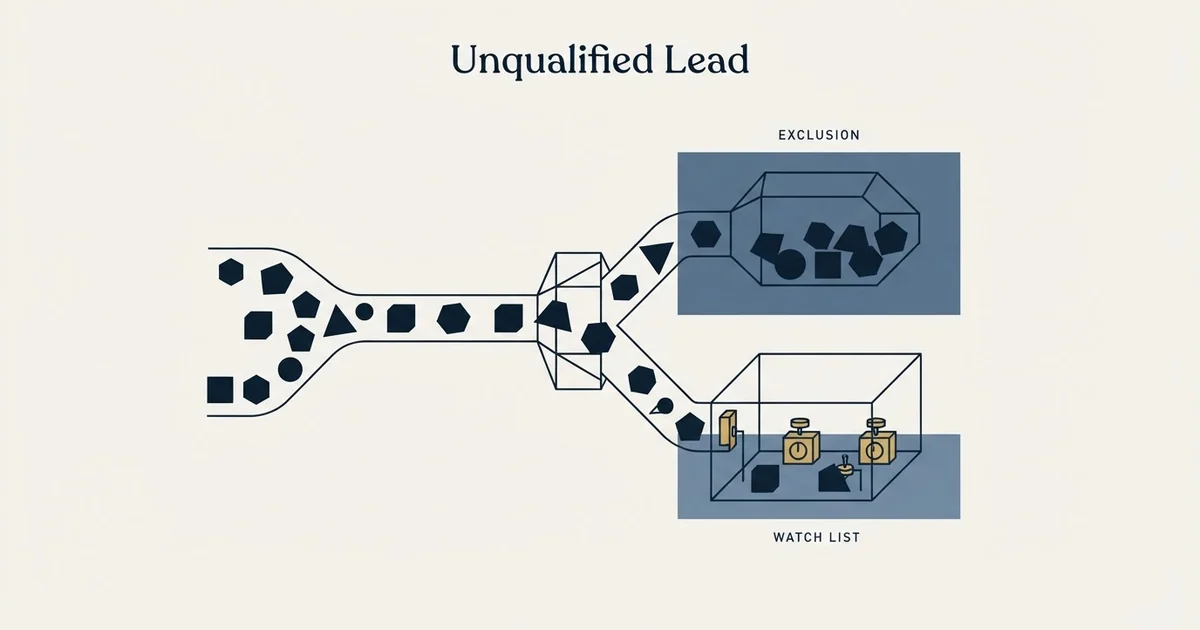
An unqualified lead has been assessed against the criteria for active pursuit and failed. The useful question is which part of it failed. A fit failure is stable and belongs in a recorded exclusion. A readiness failure is a dated snapshot and belongs on a watch list with the event that would reverse it.
Key takeaways
- Fit failures and readiness failures wear the same label and call for opposite dispositions, which is why an undifferentiated flag becomes unusable within months.
- A disqualification record needs the test failed, the specific criterion, the date, where the verdict was reached and what would reverse it.
- A do-not-contact instruction belongs in its own field, because it comes from the person rather than from the seller's assessment and survives every change of criteria.
- Qualification thresholds move with team capacity, so an unqualified flag partly records the seller's bandwidth rather than the lead.
Reviewed and updated September 2, 2026
A CRM record shows a company marked unqualified in March. The field that holds the reason is empty. In September the same company appears on a target list built from a new criterion, a rep notices the old flag, and nobody in the building can say whether the March verdict meant this company will never be a customer or meant that the timing was wrong six months ago. The rep either skips a good account or contacts a company that already said no for a reason that has not changed. Both are wrong and the record cannot tell which.
An unqualified lead is a person or company that has been assessed against the criteria for active pursuit and failed. That is the whole of the definition, and it is also the reason the label causes so much trouble: it names the outcome of a test without naming which part of the test was failed.
The two failures the one word covers
Qualification asks two questions that behave differently, and lead qualification covers them as the fit judgement and the readiness judgement. An unqualified verdict can come from either, and the correct handling is close to opposite.
Failed on fit. The company is the wrong size, in the wrong sector, running the wrong technical setup, or solving a problem the product does not address. Fit is stable. A company that is wrong on fit today is almost certainly wrong on fit next quarter, unless something structural changes at their end or the product changes at yours. The correct disposition is a durable exclusion with the criterion recorded.
Failed on readiness. The company is right and nothing is happening. No budget cycle, no trigger, no mandate, no deadline. Readiness is volatile by nature and invisible from outside. A company that fails on readiness today can be the strongest account on the list in six months, and the verdict is worth exactly as long as the evidence behind it.
Treating these two as one label is what produces the September problem above. Suppress a readiness failure and a good account is lost for no reason. Recycle a fit failure and the same wrong company gets contacted repeatedly, which wastes sending capacity and teaches the recipient that the sender is not paying attention.
- Wrong size, sector, model or technical situation
- The judgement holds until the company or the product changes
- Re-checking it later mostly repeats the same work
- Correct disposition is a recorded exclusion with the criterion named
- Contacting again without a structural change is a targeting error
- Right company, nothing happening right now
- The judgement expires as soon as the situation moves
- Re-checking is the whole point
- Correct disposition is a dated verdict with the trigger that would reverse it
- Contacting again on a real event is the intended behaviour
Where the label gets applied, and what evidence exists at each point
The verdict is reached at three different moments, with very different amounts of information behind it, and a record that does not say which moment produced it is hard to trust.
At list build. A fit judgement made from firmographic and technographic attributes before anyone is contacted. This is the cheapest place to be wrong and the cheapest place to correct, because nothing has been sent. A row rejected here is a targeting decision rather than a lead at all, and the criterion that rejected it is worth keeping, since a criterion is reusable and a row is not.
At first response. Somebody replies and a fast human read decides whether this is the right person at the right company with a plausible reason. The evidence is thin and the speed is worth more than the precision, because a fast read that gets revisited beats a careful one made a week later.
At the discovery call. The buyer participates in their own qualification, and the evidence is at its richest. This is where a readiness failure is separable from a fit failure with any confidence, because the buyer can say what would have to change. Running a discovery call so that disqualifying is a normal outcome is what makes that information available at all, and a call structured to avoid a no returns a verdict nobody can act on.
The verdict from list build and the verdict from a discovery call are not the same claim, and putting both into one boolean field is how a rich judgement gets flattened into a flag.
What a disqualification record has to carry

The record is the deliverable, not the flag. A verdict that cannot be re-read is a verdict that gets re-derived from scratch or ignored, and both of those cost more than writing it down.
- Yes: Which test was failed, fit or readiness, stated explicitly
- Yes: The specific criterion, not a category name
- Yes: The date, because a readiness verdict expires and a fit verdict does not
- Yes: Where the verdict was reached: list build, first reply or a conversation
- Yes: For a readiness failure, the event that would reverse it
- Yes: Whether the person asked not to be contacted, which is a separate and permanent instruction
- Depends: Who made the call, so a pattern of bad verdicts can be found
The last item on that list is the one people resist and the one that pays. A single field naming the decider turns qualification from an opinion into something with a measurable error rate, which is the only route to improving the bar rather than arguing about it.
The unsubscribe or do-not-contact instruction deserves its own field for a reason that has nothing to do with qualification. It is a request from the person rather than an assessment by the seller, it survives every change of criteria, and it belongs in the suppression list that governs every future campaign regardless of what any targeting decision later concludes.
Where the standard advice breaks
The published answer to this question is close to unanimous: do not discard unqualified leads, put them into a nurture programme, and re-engage them when they show interest. Three things go wrong with it.
It treats both failures identically. A drip programme aimed at a company that will never be a fit is a scheduled apology for a targeting error. The programme cannot fix fit, and the only outcome available to it is a slow accumulation of unsubscribes from people who were never candidates.
The bar moves without anybody deciding it moved. A team that can work a fixed number of conversations a week sets the qualification threshold where that number arrives. Grow the team and leads that were unqualified last month become qualified with nothing having changed about them. That is a defensible operating decision and a poor definition, and it means an unqualified flag records the state of the seller's capacity as much as the state of the lead. Qualification rates are therefore not comparable across companies or across quarters, which is worth remembering before benchmarking one.
The label rots quietly. A readiness verdict describes a moment. People change roles, budgets reset, systems get replaced, and the flag stays exactly where it was. Any process that reads the flag without reading its date is making a decision from evidence of unknown age. That is the same decay problem lists have, and it is why what a lead list is, as opposed to a spreadsheet of names treats provenance and dating as structural rather than as hygiene.
There is also a quieter cost in the direction nobody measures. Teams are compensated and reported on qualified volume, so a marginal lead is cheaper to keep alive than to reject. The pipeline fills with accounts nobody believes in, the forecast inherits them, and the tell arrives late. The prospect who passes every qualification and never buys is the individual version of the same pressure.
Where we differ
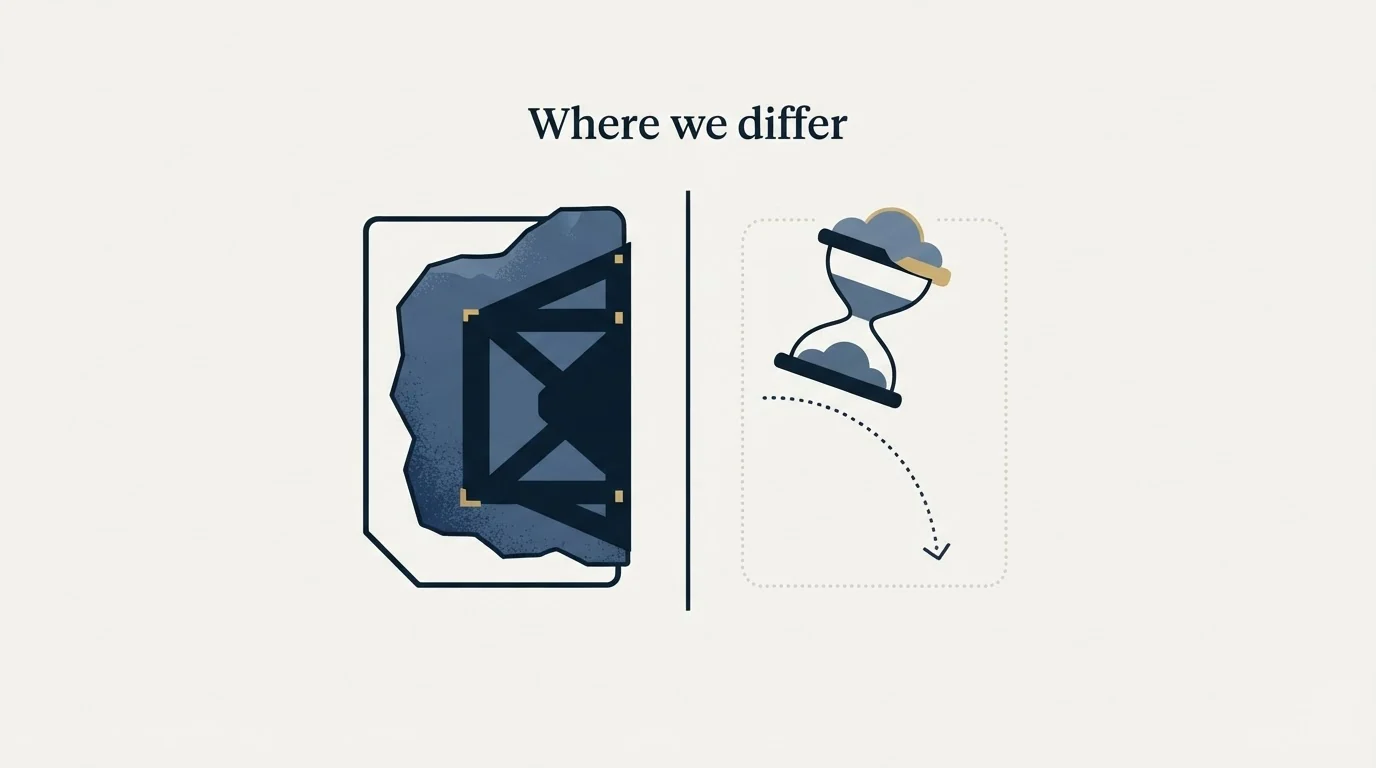
Standard practice for a company that failed on readiness is a scheduled programme of educational messages until something happens. We do not run those, on any channel. One message per campaign, built on one premise, sent once, with any later approach run as a separate campaign carrying its own reason to exist.
The argument is about what the verdict actually means. A company that was assessed and found not ready has given real information about their situation, and adding messages to a timetable does not change their situation. What changes it is an event: new leadership in the relevant function, a system being replaced, visible hiring for a role the product supports, a regulation or a platform change that alters their arithmetic. Each of those has a date, and each supports one specific message that could not have been written in advance.
That turns the readiness bucket from a mailing list into a watch list, which is a different piece of work. It is a targeting exercise rather than a writing one, and the criteria that make an event meaningful come from the same place the original fit judgement did. Building an ideal customer profile with the arithmetic attached is the document that keeps both decisions honest, because without it the bar gets renegotiated every time a count comes back small.
- Step 1The verdict
Fit or readiness, dated, with the criterion named
- Step 2The disposition
Fit failures go to a recorded exclusion; readiness failures go to a watch list
- Step 3The trigger
A dated event at their company, at yours, or in the market
- Step 4A new campaign
One message on the new premise, not the next item on a timetable
What to measure
Two numbers make this process visible, and neither of them is the count of qualified leads.
The first is speed to a no. A clean rejection reached quickly is worth close to as much as a yes and costs a fraction of the time, because the resource being protected is attention rather than volume. A team that measures only qualified volume has no reason to produce fast rejections and every reason to keep marginal accounts open.
The second is what happens to the readiness bucket. If companies parked as not ready never come back, either the trigger watching is not running or the verdicts were fit failures wearing the wrong label. That is a diagnosis worth having, and it is only available if the record separated the two in the first place. The handover version of the same argument, where one team's definition of qualified has to survive contact with another team's, is in what qualified has to mean when money depends on it.
The short version
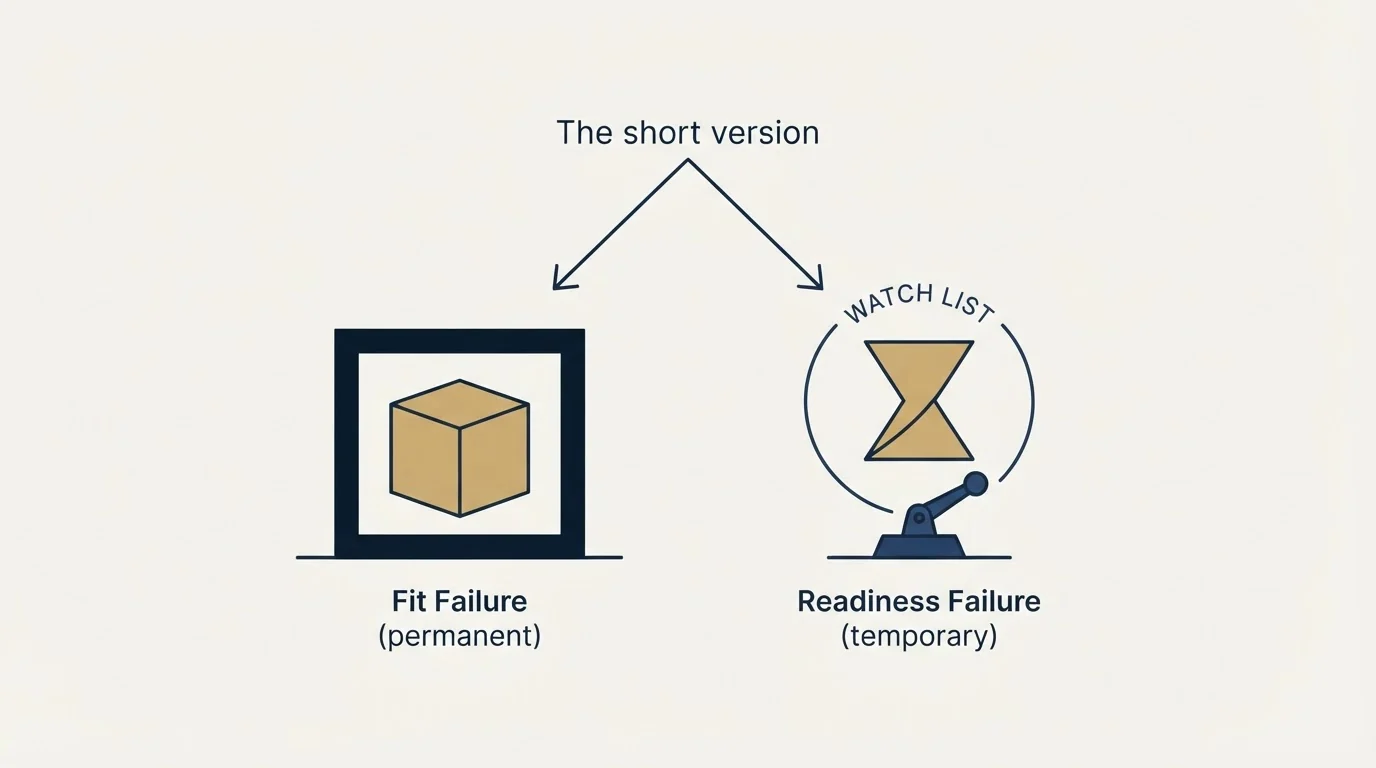
An unqualified lead has failed the test for active pursuit, and the useful question is which part of the test it failed. A fit failure is stable and belongs in a recorded exclusion with the criterion named. A readiness failure is a dated snapshot and belongs on a watch list with the event that would reverse it.
Write the verdict down properly: which test, which criterion, what date, where it was reached, and what would change it. Do not answer a readiness failure with a timetable of messages, because the timetable is not the thing that changes their situation. Wait for a real event and write once about that. And keep the do-not-contact instruction in its own field, because it comes from the person rather than from your assessment, and it outlives every criterion you will ever revise.
If the constraint is that too few of the right companies are in the assessment at all, that is a sourcing problem rather than a qualification one, and what one campaign against a tightly built list produces is the version of it we run.
Frequently asked questions.
Frequently asked questions- What is an unqualified lead?
- A person or company assessed against the criteria for active sales pursuit and found not to meet them. The label names the outcome without naming the cause, which is where the trouble starts. The two causes are failing on fit, meaning the company is wrong, and failing on readiness, meaning the company is right and nothing is happening yet.
- What should you do with unqualified leads?
- Split them first. Companies that failed on fit go into a recorded exclusion with the criterion named, because the judgement holds until something structural changes. Companies that failed on readiness go onto a watch list with the event that would reverse the verdict, and get contacted again when that event actually happens rather than on a schedule.
- Should unqualified leads go into a nurture sequence?
- A timetable of messages does not change a company's situation, and it cannot fix a fit problem at all. Our own practice is one message per campaign, sent once, with any later approach run as a new campaign built on a real event: new leadership, a system replacement, visible hiring, a market change. The event supplies the premise a scheduled message lacks.
- How is an unqualified lead different from a disqualified one?
- In common use they are the same verdict, and the distinction people are usually reaching for is where it was reached. A list-build rejection is a targeting decision made before contact, with thin evidence and no cost. A verdict reached in a discovery call has the buyer's own account behind it and can separate fit from timing with confidence.
About the author.

Ben Carden is CRO at RevenueFlow, which builds and operates outbound revenue engines for B2B companies. Previously at Gartner Enterprise. Studied at London School of Economics.
Ben Carden · CRO
Connect on LinkedIn →Explore more.
Ready to scale your outreach?
We build GTM engines that book real meetings. See the receipts.
Related articles.
Warm Lead: What Made It Warm, and When It Expires
Warmth is a property of evidence rather than of a person. Store the action and its date, because a temperature column cannot be turned back into the event behind it.
Deal Registration: Who Owns a Contested Deal
Deal registration lets a partner claim an opportunity before pursuing it. The policy is tested once, in public, on the first deal your direct team also wants.
Lead Verification: What Each Check Actually Proves
Lead verification covers two different jobs. One asks whether a mailbox will accept mail, the other asks whether the person behind the row is real and lawful to contact.
Typeform Alternatives: Read the Response Meter First
Typeform meters responses with a hard ceiling and counts seats inside the plan. What Tally, Fillout, Formbricks and Jotform count instead, from their own pricing pages.
B2B Database: What to Test Before You Pay
Total record count is the number every vendor leads with and the one that predicts least. The test that replaces it takes a day and settles the purchase.
Drift Competitors: What Replaced It and What Each Costs
Drift is retired and drift.com now serves a Salesloft page. What the successors publish about price, who owns them now, and which one fits which job.