The Discovery Call: Structure, Questions, Disqualifying
The most valuable discovery call outcome is often a disqualification, and no rep is rewarded for one. A structure and question set that survive contact.
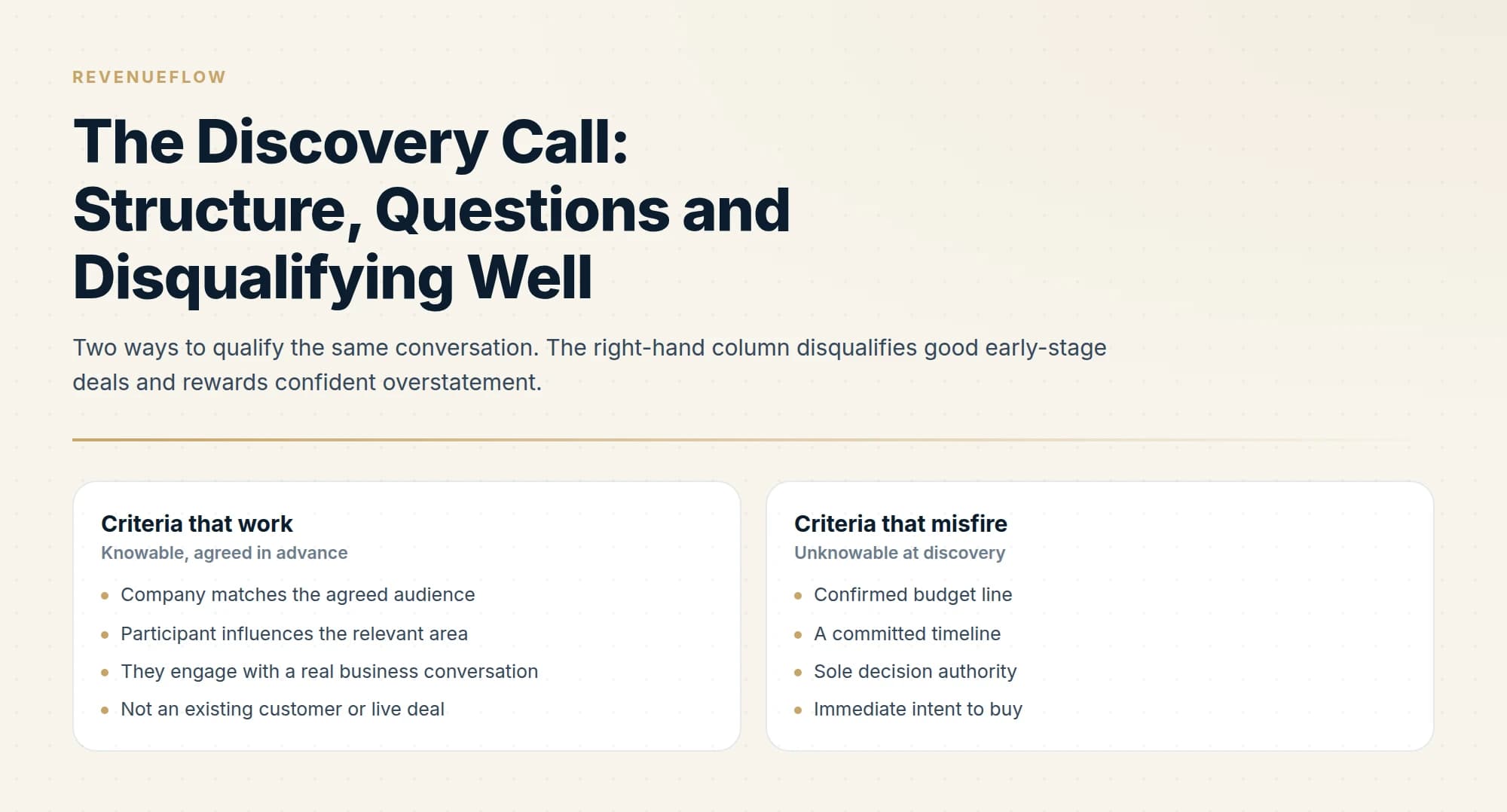
A discovery call exists to decide fit against criteria written beforehand, to understand the problem in the prospect's own words, and to produce either a specific next step or a clean ending. Presenting the product belongs in a different meeting, and moving it earlier costs the information the call existed to collect.
Key takeaways
- Telling a prospect at the start that you will say so if you are not a fit changes the conversation and makes disqualifying later feel like honesty rather than rejection.
- How does that work today produces more than any question about pain, because it is easy to answer and the problems surface unprompted.
- Budget, timing and decision authority are rarely knowable at discovery, so using them as gates disqualifies good early deals and rewards confident overstatement.
- Disqualification reasons captured in a structured field are the highest-quality targeting feedback available anywhere in the business.
Reviewed and updated September 1, 2026
The most valuable outcome of a discovery call is frequently a disqualification, and almost no rep is rewarded for producing one. That single misalignment explains most of what goes wrong on these calls: the incentive is to keep the deal alive, and the job is to find out whether it should be.
A discovery call exists to establish whether there is a real problem, whether this company is the kind you can solve it for, and what would have to be true for them to act. Everything else is a demo with questions attached.
Anyone new to the term can read the discovery call definition first, which explains why a clean no counts as a good outcome.
What people are asking for when they search for a sales meeting script is this structure written down, and the useful form of it is an agenda plus the disqualifying questions, never a recital.
The wider question set, sorted by what each question establishes rather than by number, is in sales qualifying questions.
Those five are the discovery questions worth carrying into the call from memory, and the reason to keep the list this short is that a longer bank gets worked through rather than asked, which is what produces the interrogation a prospect can hear happening.
What the call is for
Three outputs, in order of value.
A decision about fit, made against criteria written down before the call. Either the company matches the definition or it does not, and the second answer is worth as much as the first because it returns your time.
The managed services sales process applies this same fit-first discipline, insisting on a structured estate assessment before any agreement is priced.
An understanding of the problem in the prospect's own words. Not your framing of their problem. Theirs, with their vocabulary, their numbers and their internal politics attached.
A clear next step or a clean ending. A call that concludes with "send me some information" has produced neither.
What the call is not for is presenting your product. The presentation is a different meeting, and moving it earlier is the single most common way to lose the information the call existed to collect.
This is what a first sales meeting with a prospect has to do, whatever the invitation calls it, and the same phrase is also used by people still trying to get one booked, which is a different problem with a different answer.
Structure that survives contact
- Step 1Frame the call, 2 minutes
Say what you want to cover, how long it will take, and that you will tell them honestly if you are not a fit.
- Step 2Their situation, 15 minutes
How the relevant thing works today, who is involved, what triggered the conversation.
- Step 3The problem and its cost, 10 minutes
What is not working, what it costs them, and what they have already tried.
- Step 4Fit check against criteria, 5 minutes
The specific things that determine whether this is a real opportunity. Ask them plainly.
- Step 5Next step or clean ending, 5 minutes
A specific commitment with a date, or an honest statement that this is not a fit and why.
The opening frame does more work than its two minutes suggest. Telling a prospect you will say so if you are not a fit changes the conversation, because it signals you are not there to push, and it gives you permission to disqualify later without it feeling like a rejection of them.
A prospect who leaves early has usually decided in the first two minutes that the call is a pitch, which is what the opening frame exists to prevent.
The closing five minutes are where discipline collapses. A rep who has had a good conversation wants to end warmly, so "I'll send some information over and follow up next week" becomes the default. That is not a next step, because nothing is committed and nobody is accountable. A next step has a date, a named person, and something specific happening.
The published frameworks that name these same parts, from Winning by Design's opener to 30MPC's closing drill, are set side by side in discovery call frameworks.
The questions that change the answer
Question quality varies enormously and the difference is not cleverness, it is specificity.
"How does that work today?" produces more than any question about pain, because it is easy to answer and the problems surface on their own as they describe the process.
"What made you take this call?" establishes the trigger. For outbound conversations this is especially useful, since the honest answer is sometimes "your message was well timed" and sometimes "I take most calls", and those are very different prospects.
"What have you tried already?" tells you whether the problem is genuinely felt. Nobody has tried things to solve a problem they do not have, and it also reveals which of your competitors is in the picture.
"Who else is affected by this?" starts the multithreading conversation early, without asking the awkward version, which is who the decision maker is.
"What happens if you do nothing?" is the closest thing to a qualification question that a prospect enjoys answering. If the honest answer is "not much", you have learned the deal will not move regardless of how well you sell.
The question to avoid is any variant of "what keeps you up at night". It signals a script, and it asks the prospect to do your analysis for you.
Qualification, and the part that is a commercial decision
Qualification frameworks are the most over-engineered part of sales. What matters is that the criteria are written down before the call and applied consistently afterwards.
A more structured alternative worth weighing is the SPICED framework, which orders discovery so impact and critical event surface before any decision talk.
We hold a specific position on this because we are paid on attended qualified meetings, so the definition has commercial consequences for us directly. A meeting qualifies when the company is in the agreed audience, the participant has reasonable responsibility for or influence over the relevant area, they agree to a relevant business conversation, they attend and participate, and they were not disclosed as an existing customer or an active opportunity beforehand.
Budget, timing and decision authority are deliberately not conditions. They are the classic BANT gates and they fail as qualification criteria for a simple reason: they are rarely knowable at the discovery stage, and treating them as gates disqualifies good early conversations while rewarding prospects who confidently overstate their own authority.
It also explains why a prospect can be wrong about their own budget without anyone being dishonest: budget answers are useful for planning the deal and unreliable as a gate, because the confident answer and the accurate one are not the same population.
That does not mean the topics are off limits. Ask about budget and timing to plan the deal. Just do not use the answers to decide whether the conversation was legitimate.
- Company matches the agreed audience
- Participant influences the relevant area
- They engage with a real business conversation
- Not an existing customer or live deal
- Written down before contact starts
- Confirmed budget line
- A committed timeline
- Sole decision authority
- Immediate intent to buy
- Applied after the fact, when the number is short
Disqualification as an output
A rep who disqualifies well is more valuable than one who never does, and most comp plans say the opposite.
The practical fix is to make disqualification visible and legitimate. Report it as an outcome rather than a non-event, and ask for the reason in a structured field. Those reasons are the highest-quality targeting feedback available anywhere in the business, because they come from a real conversation with someone who almost fitted.
Over a quarter, patterns in disqualification reasons will tell you more about your ICP than any firmographic analysis. If half your disqualifications share a cause, that cause belongs in the targeting criteria, and everyone upstream stops wasting effort on it. The list-building side of that is covered in defining an ideal customer profile.
The handoff, if it passes
The bottleneck people describe is rarely the call itself: converting qualified relationships into signed contracts stalls after this stage, where the outcome depends on a next step being agreed in the room rather than on the quality of the questions asked in it.

A qualified discovery call that hands off badly wastes most of what it produced.
The receiving AE needs the problem in the prospect's words, the trigger, who else is involved, what they have tried, and what was agreed as the next step. A calendar invite with a company name attached forces the prospect to repeat the entire conversation, which is the fastest way to lose the goodwill the call generated.
- Yes: A fit decision against written criteria, either way
- Yes: The problem captured in the prospect's own words
- Yes: The trigger that made them take the call
- Yes: Who else is affected inside the account
- Yes: A next step with a date and a named person
- No: A product demo delivered during the call
- Depends: Budget confirmed, useful to know and not a qualification gate
Preparing for the call without over-preparing
Preparation has a point of diminishing returns that arrives faster than most reps expect.
What is worth knowing beforehand: what the company does in its own words, roughly how big it is, who the person is and what their role likely involves, and any obvious trigger such as a recent hire, launch or funding event. That is ten minutes of work and it earns the right to ask better questions.
What is not worth doing is building a hypothesis so detailed that you spend the call confirming it. A rep who arrives certain about the prospect's problem asks leading questions, hears agreement, and leaves with a confirmed theory rather than information. The prospect will often agree with a confident diagnosis out of politeness, which makes this failure mode invisible in the moment and expensive later.
The four fields that keep that preparation short, and the reason the ask has to be decided before the conversation starts, are in sales call planning.
The useful posture is a light hypothesis held loosely: a reason you thought this company might have this problem, offered early as something to correct rather than as a conclusion. "We tend to see this when a team is at your stage, though I would rather hear how it actually works for you" invites contradiction, and the contradiction is where the value is.
Where the research comes from matters less than how much of it there is. Company materials in the company's own words, a rough size, the person's role and history, and one recent observable change are available inside ten minutes from public sources, and scraped or enriched company data at scale is the same set assembled in advance rather than a deeper one. What that automation buys is coverage across a list rather than depth on a single account, and it has the same ceiling: the material is only useful up to the point where it starts producing a hypothesis you defend instead of a question you ask.
One preparation habit that pays disproportionately: write down the two things that would make you disqualify this company before the call starts. Deciding those in advance, when you have no emotional investment in the outcome, makes it far easier to act on them thirty minutes later when the conversation has been pleasant and you would rather not.
Where discovery calls come from matters

A discovery call from inbound and one from outbound start in different places, and running them identically is a mistake.
An inbound prospect has a problem they have already named to themselves, so discovery can go deeper faster. An outbound prospect took the call out of mild interest, so the first job is establishing whether the problem you assumed exists actually does. Opening an outbound discovery call with the same depth of questioning that suits inbound reads as presumptuous, because you have not yet earned the premise.
For where these calls come from in the first place, see what a sales development rep does and outbound SDR versus inbound SDR. For how the qualification standard gets agreed commercially, appointment setting versus lead generation covers what each purchase actually delivers.
The short version
Run discovery to decide fit, understand the problem in the prospect's words, and produce a real next step or a clean ending. Frame the call by promising honesty about fit, spend the middle on how things work today rather than on pain questions, and protect the last five minutes from a vague follow-up. Qualify against criteria written before the call, and keep budget, timing and authority out of the gate even while you ask about them. Treat disqualification as an output and capture the reason, because those reasons are the best targeting data you will get.
If the problem is that there are not enough of these calls happening, we book attended qualified meetings with the criteria agreed in writing beforehand, and you can see what a campaign would look like for your market.
Frequently asked questions.
Frequently asked questions- What should a discovery call produce?
- Three things. A fit decision made against criteria written down before the call, where a no is worth as much as a yes because it returns your time. An understanding of the problem in the prospect's own vocabulary, with their numbers and internal politics attached. And a next step with a date and a named person, or an honest statement that this is not a fit.
- Which discovery questions actually work?
- How does that work today, which is easy to answer and surfaces problems on its own. What made you take this call, which establishes the trigger. What have you tried already, which shows whether the problem is genuinely felt. Who else is affected, which starts multithreading gently. And what happens if you do nothing, which is qualification the prospect enjoys answering.
- Should budget and authority be qualification gates?
- No. They are rarely knowable at the discovery stage, and gating on them disqualifies good early conversations while rewarding prospects who overstate their own authority. Ask about both to plan the deal, and keep the answers out of the decision about whether the conversation was legitimate. Fit criteria should describe the company, the participant and the conversation instead.
- How do you make disqualification a legitimate outcome?
- Report it as an outcome rather than a non-event, and capture the reason in a structured field. Over a quarter, patterns in those reasons say more about your ideal customer profile than any firmographic analysis, because each one comes from a real conversation with somebody who almost fitted. Where half share a cause, that cause belongs in the targeting criteria.
About the author.

Ben Carden is CRO at RevenueFlow, which builds and operates outbound revenue engines for B2B companies. Previously at Gartner Enterprise. Studied at London School of Economics.
Ben Carden · CRO
Connect on LinkedIn →Explore more.
Ready to scale your outreach?
We build GTM engines that book real meetings. See the receipts.
Related articles.
The Seven-Step Sales Process: What Each Step Assumes
Prospecting through follow-up, walked one box at a time. Each of the seven steps carries an assumption about the buyer, and most of them have quietly stopped holding.
The Five-Step Sales Process: What You Stop Checking
Cutting a process to five steps is a decision about which checks you drop. Which deals the short version fits, and the two loss patterns that say it does not.
The Customer-Centric Sales Process: The Edit That Matters
Renaming the pitch achieves nothing. Writing every step as buyer evidence changes the forecast within a quarter, and three other things nobody warns you about.
The Sales Process: Writing Steps a Buyer Has to Complete
The seven-step template names things the seller does, so a process built on it advances in quarters where nothing is bought. What to write instead, and how.
The Managed Services Sales Process: Qualifying on the Estate
Selling an ongoing obligation at a fixed price changes what the process has to establish. The assessment step, the four signals that predict margin, and payback.
The Consultative Sales Process: What Diagnosis Costs
Diagnosis before prescription is easy to say and expensive to run. What the approach actually requires, and why proposal volume falls before close rate rises.