The Customer-Centric Sales Process: The Edit That Matters
Renaming the pitch achieves nothing. Writing every step as buyer evidence changes the forecast within a quarter, and three other things nobody warns you about.
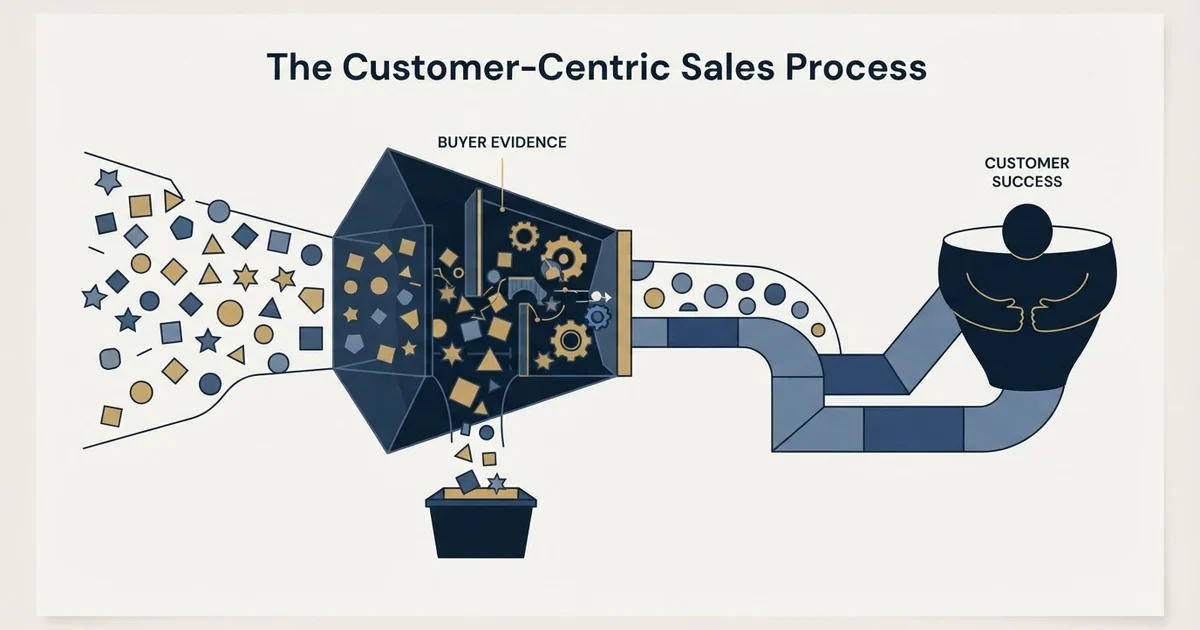
A customer-centric sales process defines every step as something the buyer did that an uninvolved person could verify, rather than something the seller performed. It adds written criteria on which a seller may end a conversation, permits deals to move backwards, and stores the buyer's own words rather than a summary of them.
Key takeaways
- Steps written as buyer evidence cannot advance on seller activity alone, so a quarter where nothing is being bought looks like one from the inside rather than at the end of it.
- Symmetrical qualification is what stops the orientation collapsing into agreeableness; without a written basis for ending a conversation, sellers follow buyers into unwinnable deals.
- Quote the buyer in the record. A paraphrase cannot be checked by anyone who was not on the call, which is how seller optimism gets stored as qualification data.
- Pipeline shrinks before win rate moves, so decide in advance which number is being watched or the change gets abandoned at the exact point it starts working.
Reviewed and updated September 1, 2026
A company decides to become customer-centric. The pitch is renamed the value conversation, the demo is renamed the solution walkthrough, and a slide about the customer's world goes at the front of the deck. Six months later the win rate is identical, the losses are still to no decision, and the only measurable change is that everyone spends longer in an internal meeting agreeing what to call things.
That outcome is the default, because the phrase describes an intention rather than a mechanism. A sales process becomes customer-centric when its steps stop being things the seller performed and start being things the buyer did, and that edit is unglamorous, awkward to introduce and visible in the forecast within a quarter.
The same edit applies before anyone is in a process at all, and the buyer experience an unrequested first message creates is the chapter that runs before any stage exists to be rewritten.
Two different things wear this name
The phrase is used in two ways and they are worth separating before anything else.
The first is the adjective, meaning a general orientation toward the buyer's situation over the seller's script. Most articles on the subject mean this, and most of them stop at the sentiment.
The second is CustomerCentric Selling, a trademarked methodology sold as training, whose own site describes the aim as helping sales teams consistently facilitate the customer's buying process. Like the other named methodologies it comes with a vocabulary, a workshop and a certification path, and like the others it is bought by companies who want one shared language rather than six.
This page is about the mechanism both senses point at, which does not require anybody's training programme to implement, though a shared vocabulary genuinely does help it survive.
Customer-centric selling, as the phrase is usually searched, is the same thing as the customer-centric sales process described here: a process whose steps are buyer actions rather than seller activities.
The edit that does the work
Write every step of the process as something the buyer did, phrased so somebody who was not in the room could confirm it from the record.
- Qualified the account
- Discovery call completed
- Demo delivered
- Proposal sent
- Following up on the proposal
- They attended, and the account meets criteria written before we looked at them
- They described their current process, what it costs and who else is involved, in their own words
- They confirmed the solution addresses the problem they described
- A priced proposal reached the person who can act on it
- They responded with terms, questions or redlines
The right-hand column is what customer-centric means in practice. Every entry requires the buyer to have done something, which means the process cannot advance on seller activity alone, which means a quarter where nothing is being bought looks like one from the inside rather than at the end.
Three consequences follow immediately, and each of them is a change somebody will resist.
Deals move backwards. If a step can be completed it can also become uncompleted, and a buyer who stops returning calls has un-done the evidence. Most pipelines forbid this implicitly. A process built on buyer evidence has to permit it, and the first month of permitting it is uncomfortable reading.
Some steps disappear. A step nobody has ever failed is not a filter. The internal review that has never reversed a recommendation and the demo that always precedes a proposal regardless of what it showed are rituals with calendar invites attached, and the buyer-evidence test deletes them on contact. Which pipeline stages earn their place works through that deletion in detail.
Forecasts get worse before they get better. They were not accurate before. They were confident, which is a different property, and the first honest re-check usually shrinks the pipeline.
Converting a process you already have
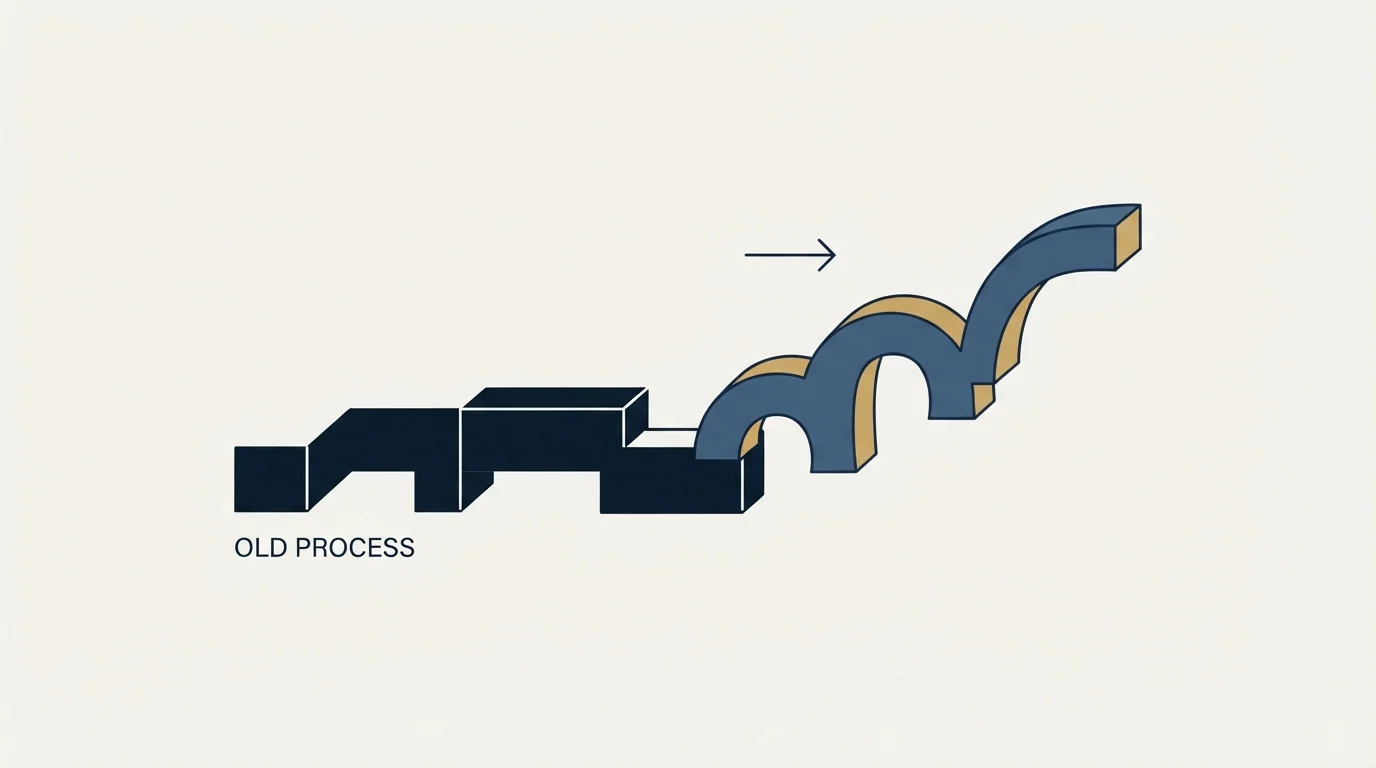
The change does not need a relaunch, and relaunches are where this kind of work usually dies. It needs one pass over the steps that already exist.
- Step 1Read twenty deals
Ten won and ten lost, listing the observable buyer events in order for each one
- Step 2Keep what discriminates
Steps present in most wins and absent from most losses are the process. Steps present in both are activity
- Step 3Rewrite each survivor
Phrase it as the buyer evidence a third party could confirm, and give it an expected duration from your own closed deals
- Step 4Re-check the open pipeline
By hand, against the new criteria, expecting it to shrink where deals had quietly stopped qualifying
The twenty-deal read is the part people try to skip in favour of a workshop, and it is the part that produces the answer. A workshop produces the steps everybody believes in. The deal read produces the steps that discriminated between winning and losing, and those two lists are rarely the same.
Do it at a period boundary and map old steps to new in one direction only, so historical conversion stays reconstructible. A process is a measuring instrument as much as an operating one, and changing it mid-quarter destroys the comparison that would have told you whether the change helped.
Qualification has to run in both directions
The second mechanism is symmetry. A customer-centric process has a defined way for the seller to conclude that this is not a fit and say so, and it treats that outcome as a success rather than as a failure of persistence.
Without it the orientation collapses into agreeableness, which is the most common failure of the whole idea. A seller who cannot disqualify will follow the buyer wherever the buyer goes, including into a scoped, priced, unwinnable deal that consumes a quarter.
The mechanical form is a written set of criteria agreed before contact, plus permission to end a conversation against them. Structuring a discovery call so that disqualifying is a real outcome is the skill; the criteria are the policy. Our own commercial position is a version of this made contractual. A meeting counts when the company matches the audience agreed in writing before launch, the person has genuine responsibility for the area, they agreed to a relevant business conversation, and they attended. Budget, timing and authority sit deliberately outside that definition, because a real conversation with the right person should not become void afterwards on a fact that changes every quarter.
Keep the buyer's vocabulary in the record
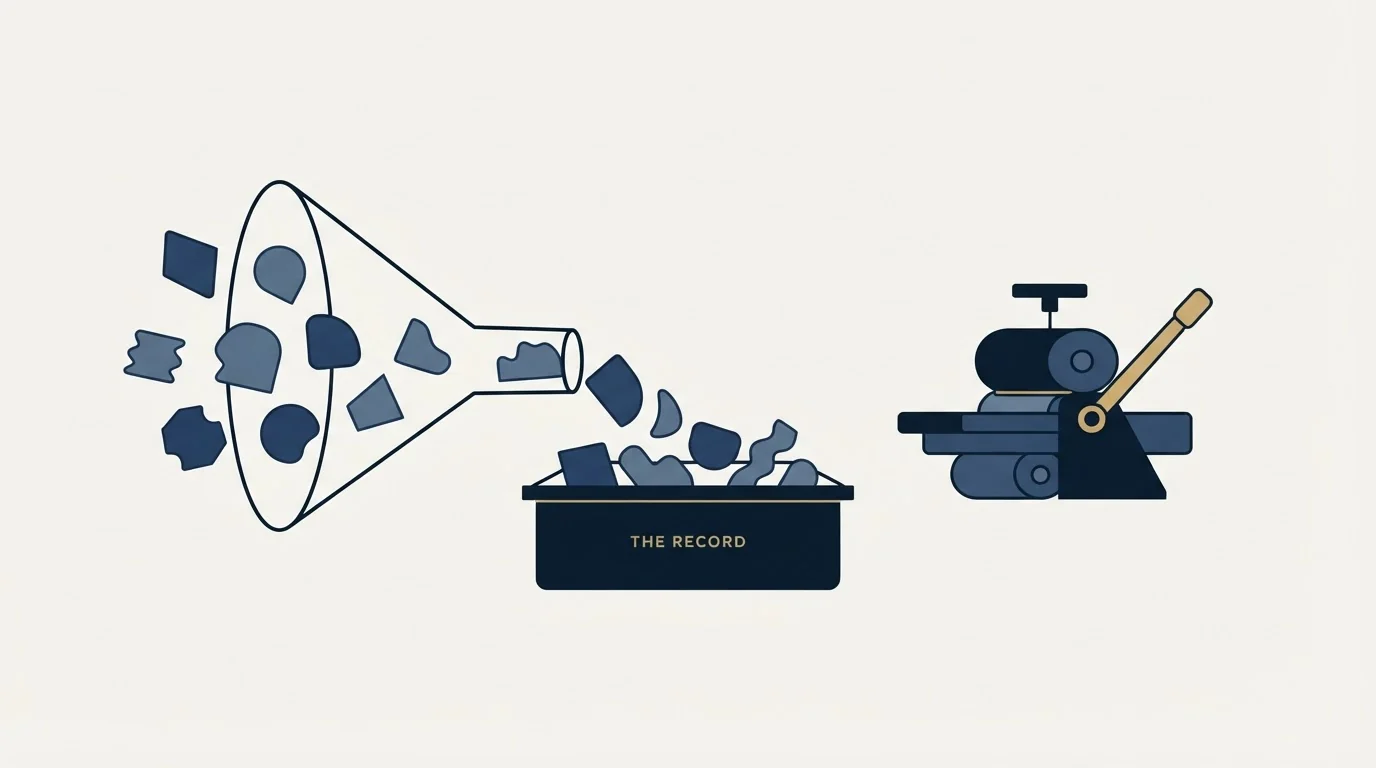
The third mechanism is the cheapest to adopt and the one most often skipped. Record what the buyer said in their words, quoted, rather than the seller's summary of it.
A quote can be re-read by somebody who was not on the call. A paraphrase cannot be checked at all, and a CRM full of paraphrase stores the seller's optimism as though it were qualification data. It also decides whether the eventual proposal sounds like the buyer's problem or like your category page, because the words that make a proposal land are usually the ones the buyer used to describe what was going wrong.
- Yes: Every step names something the buyer did that a third party could verify
- Yes: Deals are permitted to move backwards when the evidence says they should
- Yes: There are written criteria on which the seller may end a conversation
- Yes: The account record quotes the buyer rather than summarising them
- No: The main change was renaming existing stages
- No: Nobody has been disqualified this quarter
- No: Being customer-centric is measured by a satisfaction score at the end
The last item deserves its no. A post-sale satisfaction score measures how the deal felt to the people who bought, which is worth knowing and is not evidence about the process, because it surveys only the population that said yes. The buyers who tell you the most about a customer-centric process are the ones who did not buy, and their reasons are recoverable only where somebody recorded what they actually said at the step where they stopped.
What it costs, and where teams abandon it
The visible cost arrives in the first quarter, in the shape of a thinner pipeline. Sellers disqualify earlier, fewer proposals go out, and the number that improves is the one that improves last.
Teams measured on proposals sent or on meetings booked abandon the approach at precisely that point, and it is worth deciding in advance which number will be watched, because the dip is a feature of the thing working rather than a sign of it failing. The comparison that survives the transition is win rate against opportunities that entered the process after the change, held against the previous cohort, with the date of the definition change marked on the same chart as the metric it moved.
The second cost is managerial. A process built on buyer evidence produces review meetings that are harder to run, because the honest answer to where a deal is can now be nowhere. Managers who liked the old reviews will describe the new ones as pessimistic.
The third is that it does not help with a supply problem. A team with a customer-centric process and four opportunities a month has a demand constraint, and every hour spent on step design is an hour not spent on the constraint. Where that is the diagnosis, what a qualified meeting has to mean before anyone buys one is the definition worth settling first.
Where we differ from standard practice
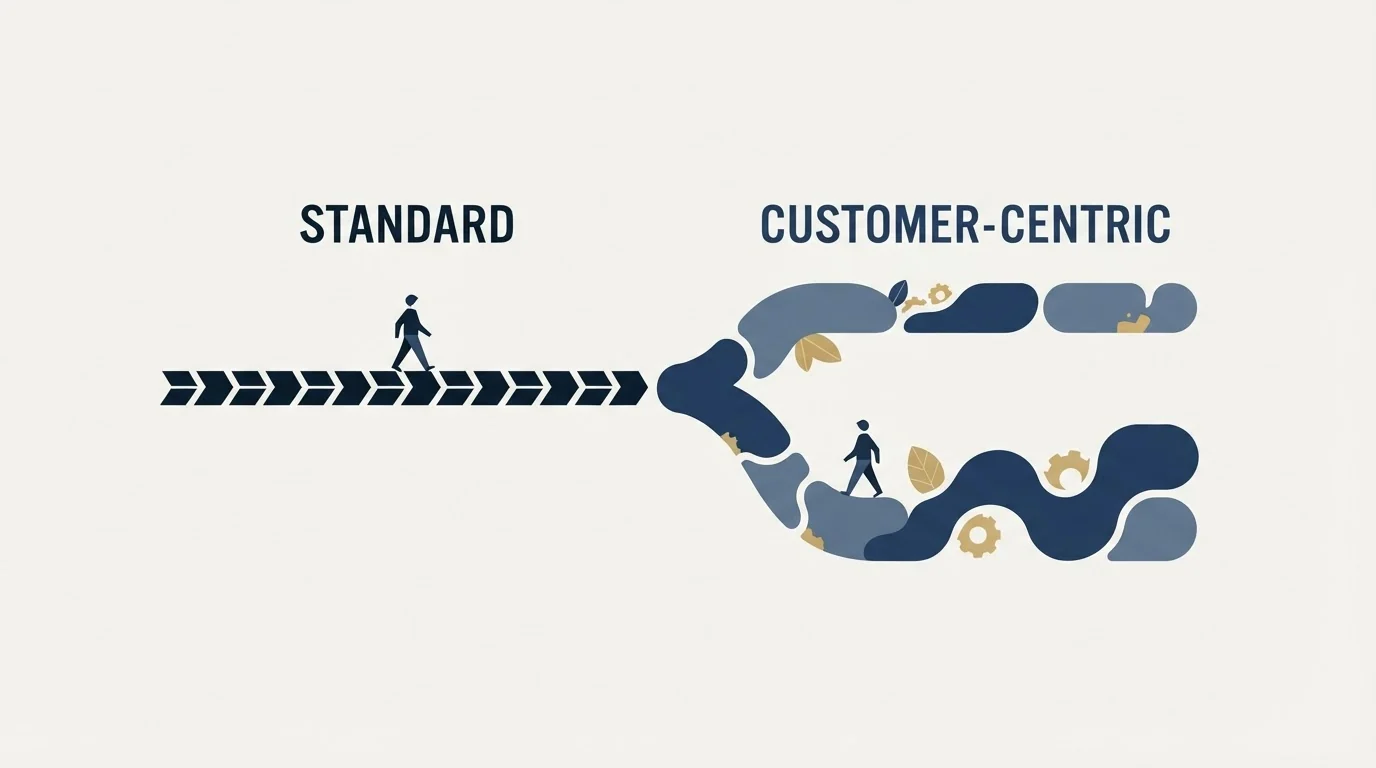
Much of the published advice on this subject reflects how outbound is commonly run, and since this page sits on our site the divergence is worth stating plainly.
The standard customer-centric recommendation for the top of the process is more touches: a sequence of messages to each prospect over several weeks, with later ones landing under the first. We do not do that. We run one message per campaign, with no bumps and no thread replies, and where an audience does not respond we build a separate campaign with a genuinely different premise rather than a reminder of the one they already declined. The reasoning is mechanical: a reminder reaches the population that saw the message and chose not to answer, which is the population most likely to complain, and the reputation cost lands on the sending domain across everything else it sends. Reading a non-reply as an answer is itself a customer-centric position, and it costs us reach, which is the trade set out in why we stopped using follow-ups.
Read the methodology neighbours alongside this rather than as competitors to it. Winning by Design's SPICED framing arrives at similar step definitions from a different direction, and the Challenger argument is the useful counterweight, since a buyer-led process still requires a seller with something to say.
The short version
A customer-centric sales process is one whose steps are buyer events rather than seller activities, written so an uninvolved person could verify each one. Everything else attached to the phrase is downstream of that edit, and renaming stages achieves none of it.
Since seller-activity steps can always be marked done regardless of buyer behavior, why the seven-step framework only teaches selling explains each stage's hidden assumption.
Add symmetrical qualification, meaning written criteria on which a seller may end a conversation, and quote the buyer in the record instead of summarising them. Expect the pipeline to shrink first and the win rate to move later, and mark the date of the definition change on the chart. Where the constraint turns out to be the supply of the right conversations, that is the half we run: see what a first campaign produces.
Frequently asked questions.
Frequently asked questions- What makes a sales process customer-centric?
- Each step names something the buyer did, phrased so a manager who was not there can confirm it from the record. That single edit produces the rest: steps that never discriminate get deleted, deals become able to move backwards, and the forecast stops counting seller activity as progress. Renaming existing stages produces none of it.
- Is CustomerCentric Selling the same thing?
- CustomerCentric Selling is a trademarked methodology sold as workshops and an online course, whose own site frames the goal as helping a sales team consistently facilitate the customer's buying process. The mechanism described here does not require that programme, although a shared vocabulary does help the change survive contact with a sales team.
- Does a customer-centric process slow deals down?
- It usually shortens the cycle on deals that close and removes deals that were never going to. The visible first-quarter effect is a thinner pipeline and fewer proposals, because sellers disqualify earlier. Judging the change on proposal volume rather than on closed revenue is what causes most teams to abandon it.
- How do you measure whether it is working?
- Win rate on opportunities that entered after the change, compared with the previous cohort, with the date of the definition change marked on the same chart as the metric. A post-sale satisfaction score cannot answer this, because it surveys only the buyers who said yes and none of the ones who stopped.
- How do salespeople assist customers during the sales process?
- By making it possible for the buyer to complete each step, and by treating what the buyer did as the only evidence the deal moved. That means helping them describe their current process and what it costs, confirming the solution addresses the problem they named, and getting a priced proposal to the person who can act on it. Activity the seller performs alone assists nobody.
About the author.

Ben Carden is CRO at RevenueFlow, which builds and operates outbound revenue engines for B2B companies. Previously at Gartner Enterprise. Studied at London School of Economics.
Ben Carden · CRO
Connect on LinkedIn →Explore more.
Ready to scale your outreach?
We build GTM engines that book real meetings. See the receipts.
Related articles.
B2B Sales Methodologies: Four Arguments, Sixteen Names
Sixteen named frameworks collapse into four arguments about what sellers get wrong. Which family fits where your deals die, and why adoption fails more often than choice.
The JOLT Effect: Selling to a Buyer Who Cannot Decide
The loss that shows no competitor and no rejection. What the JOLT research names, why the standard urgency playbook makes it worse, and the four moves that answer it.
The Seven-Step Sales Process: What Each Step Assumes
Prospecting through follow-up, walked one box at a time. Each of the seven steps carries an assumption about the buyer, and most of them have quietly stopped holding.
The Five-Step Sales Process: What You Stop Checking
Cutting a process to five steps is a decision about which checks you drop. Which deals the short version fits, and the two loss patterns that say it does not.
CHAMP: Qualification That Starts With the Problem
CHAMP is BANT with the letters moved, and the order is the argument. What each of the four checks should produce, and which one predicts a deal ending in nothing.
Solution Selling: The Generic Term and the Licensed Method
One name covers a generic problem-led posture and a specific licensed methodology. The lineage, the three moves that matter, and the assumption that aged badly.