CHAMP: Qualification That Starts With the Problem
CHAMP is BANT with the letters moved, and the order is the argument. What each of the four checks should produce, and which one predicts a deal ending in nothing.
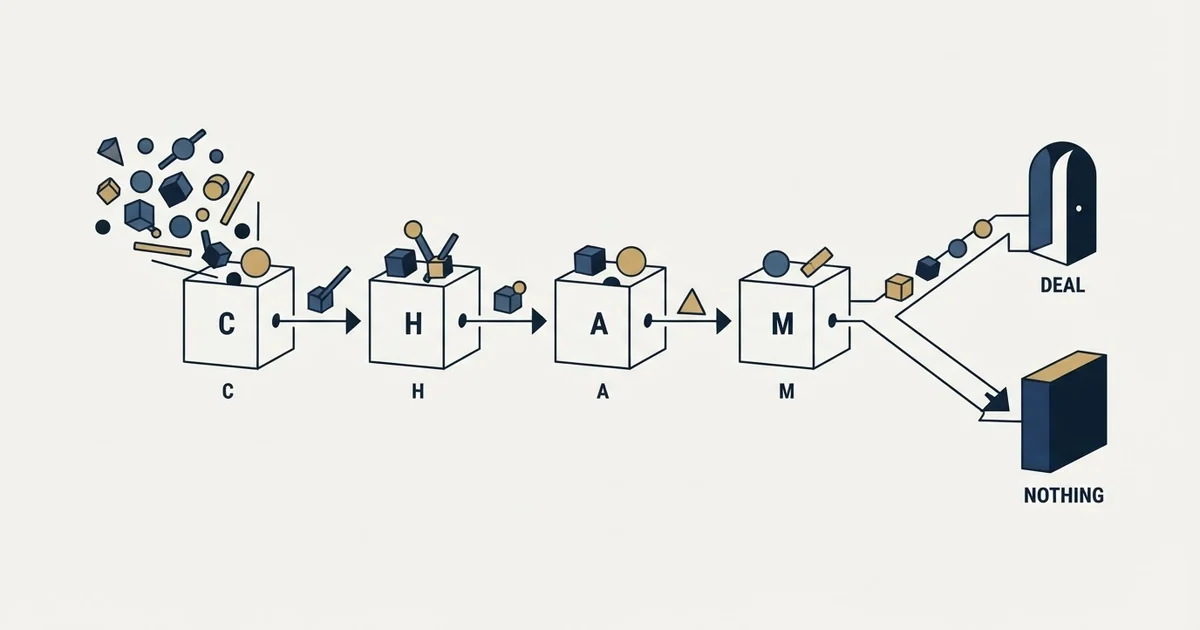
CHAMP is a qualification framework covering Challenges, Authority, Money and Prioritization. It reorders BANT to lead with the buyer problem instead of the budget question, on the argument that a buyer with a serious articulated problem will find both money and the right people.
Key takeaways
- CHAMP checks the same four things as BANT in a different order, and the order changes what a seller does in the first conversation rather than adding a new test.
- The challenges check is the only one a peripheral contact cannot answer plausibly, because a real problem comes with specifics that cannot be improvised.
- Money asks whether the organisation can fund a purchase of this size and from where, which is a different question from whether a budget line already exists.
- Prioritisation is the check that catches the deal that ends in no decision, and the signal that works is a named owner rather than expressed interest.
Reviewed and updated August 28, 2026
Four minutes into a first call, a rep asks what the budget is. The buyer says they are not sure, they would have to check, it depends what the thing costs. Both people now have a problem: the seller has an unusable answer in a required field, and the buyer has been asked to price a solution to a problem nobody has yet agreed exists. CHAMP is the qualification framework built around moving that question later and putting a different one first.
What CHAMP asks, and in what order
The acronym is published consistently across the pages that rank for it. Revenue.io's glossary entry states that CHAMP stands for Challenges, Authority, Money, and Prioritization, and describes it as designed to help sales teams lead with value instead of starting with budget. Weflow's guide, which is the top organic result for the term, gives the same four words and adds the reasoning: qualification frameworks that ask the wrong questions in the wrong order are what produce pipelines full of deals that were never going to buy.
- Step 1Challenges
What is going wrong today, in the buyer's own words, what it has already cost to leave alone, and who inside the company feels it
- Step 2Authority
Who signs, who vetoes and who has to be consulted, plus how a purchase like this was approved the last time
- Step 3Money
Where funding for this class of purchase comes from, what the approval threshold is, and what it would be spent instead of
- Step 4Prioritization
What else competes for the same attention, what happens if it slips two quarters, and whether anybody has been made responsible
Read in that order, the framework is making a claim about causality. A buyer with a serious, articulated problem will find money and will find the right people. A buyer with money and no problem will spend it on something else. Starting with the challenge is a bet that the problem is the constraint and everything else is downstream of it.
The reordering is the whole argument
CHAMP is BANT with the letters moved, and every framework in that family is an argument about which check should come first. BANT asks about budget, authority, need and timing in that order, and it was designed for a world where a single named buyer held a line item and could tell you what was in it. The complaint that produced CHAMP is that leading with budget teaches sellers to interrogate strangers about money before establishing there is anything to buy, which is both bad manners and bad information: the answer arrives as a guess, gets typed into a field, and is then treated as a fact by everyone who reads the record afterwards.
Deciding where the problem check belongs in the call order is the same question the Sandler system's ordered steps answer by placing presentation after pain and budget.
What CHAMP does not do is add a check. The four things it looks at are the same four things, which is worth saying plainly because the acronym market makes each new arrangement sound like a different discipline. What changes is the order, and the order changes what a seller does in the first conversation. That is not a small thing. It is also not a methodology in the sense that SPIN or the Challenger approach are, since those prescribe how to run the conversation, while CHAMP prescribes what has to be true before the conversation is worth continuing.
Challenges is the only check a stranger cannot answer for you

The reason this letter carries the weight is that the other three can all be answered badly by someone who is not really involved. A junior contact can name a signer, guess a budget range, and describe a roadmap they read in a deck. None of it is checkable and all of it will sit in your CRM looking like qualification.
A challenge is different, because a real one comes with specifics that cannot be improvised: what broke, when, what it cost, who complained, what they already tried. If a contact cannot produce those, that is the finding. It usually means one of three things: the problem is real but they do not own it, the problem is theoretical and nobody is funding a fix, or you are talking to someone who was asked to gather information rather than solve anything.
The practical form of this check is a note-taking discipline rather than a scoring one. Record the buyer's own words about the problem, as they said them, rather than a summary written afterwards. A quote can be re-read later by someone who was not on the call. A paraphrase cannot be checked at all, and it is the paraphrase that tends to survive into the forecast.
Money and budget are two different questions
The M in CHAMP is deliberately not the B in BANT. Budget asks whether an amount has been allocated. Money asks whether the organisation can fund a purchase of this size at all, from where, and what that would require. In most B2B purchases below a certain threshold the budget line does not exist until after the decision to buy, so a truthful answer to the budget question is no, and a truthful answer to the money question is yes with a named route.
Three things are worth finding out under this letter, and none of them is a number. Where money for this class of purchase has come from before. What the approval threshold is, since that determines how many people have to say yes. What this would be funded instead of, because that answer tells you what you are really competing with, and it is very often not another vendor.
Prioritisation is the letter that sees the deal you lose to nobody
The last check is the one most often skipped and the one that predicts the most common bad outcome in B2B sales, which is a deal that ends in no decision. A buyer can have a real problem, real authority and real money, and still not act, because three other things are more urgent and nobody has been made responsible for this one.
- Yes: Somebody is named as responsible for fixing this, by name
- Yes: There is a date attached to something other than your renewal
- Yes: The buyer can say what this would be funded instead of
- No: The problem competes with an active project nobody will pause
- No: Interest is high and the timeline is described as when we get to it
- No: Everyone agrees it matters and nobody owns it
Interest is not priority, and enthusiasm on a call is the least reliable signal in the whole framework. The check that works is ownership: a person, named, who is measured on whether this gets fixed. Where that person does not exist, the honest read is that the deal is not ready, and the useful next move is to find out what would make it ready rather than to keep the deal warm.
Where CHAMP stops

The framework qualifies a conversation. It does not tell you whether you should be having the conversation, which is a targeting decision made long before any individual deal and belongs in an ideal customer profile with the arithmetic attached. A perfectly qualified deal at a company you cannot serve well is still a bad deal, and no arrangement of four letters catches that.
It also does not survive being turned into fields. The failure mode is identical to the one every qualification framework runs into: the four checks become four required boxes, the boxes get filled to move the deal to the next stage, and within a quarter the record describes a process rather than a buyer. If the fields are mandatory, they will be completed, and completion will stop meaning anything. Keeping the answers as quotes attached to the stages a deal actually passes through holds up better than a score, and it survives a change of rep, which a score does not.
How it fits with the frameworks around it
CHAMP is a first-conversation instrument. It is at its most useful in the discovery call, where the questions under each letter are genuinely open and the answers are still coming from the buyer rather than from your own notes, and the letters map cleanly onto the questions a discovery agenda already asks. Later in a deal the more demanding frameworks earn their place: MEDDIC asks for evidence about metrics, an economic buyer and a paper process, which is a different job from deciding whether to keep talking. Qualification as a discipline is the same four or six questions asked repeatedly as the answers change, rather than one framework applied once at the start.
Where we differ from standard practice

Our own use of qualification sits earlier than any of these frameworks, and it is a written agreement rather than a call-time judgement. For every campaign we run, the criteria that make a meeting qualified are agreed with the client in writing before anything sends, and they never include budget, timing or authority as billing conditions. That distinction matters more than it sounds: a criterion that decides whether a meeting is paid for will be argued about after the meeting, and the argument is always more expensive than the meeting.
The outbound side of the same discipline is that we send one message per campaign. There are no bumps and no thread replies, so a prospect who does not respond is not chased with a second touch under the first. When we want to reach the same audience again, it goes out as a new campaign with a new angle, which is a different offer rather than a reminder. Qualification of the kind CHAMP describes happens in the conversation that follows rather than in the campaign that starts it. The full argument for that constraint, including what it costs us, is in why we stopped using follow-ups.
The short version
If you want to see the front half working, a campaign built this way is the fastest thing to judge it by. CHAMP asks about Challenges, Authority, Money and Prioritization, in that order, and the order is the entire contribution. Leading with the problem gets you information a stranger cannot fake, and leaves the money question for a point in the conversation where it has something to attach to. Treat the four letters as things to find out rather than fields to complete, record what the buyer said in their own words, and pay particular attention to the last one, because the deals that quietly disappear tend to be the ones where the problem never became anybody's job.
Frequently asked questions.
Frequently asked questions- What does CHAMP stand for in sales?
- Challenges, Authority, Money and Prioritization. Revenue.io publishes that expansion in its inside-sales glossary and describes the framework as designed to help teams lead with value instead of starting with budget. Weflow, which ranks first for the term, gives the same four words.
- How is CHAMP different from BANT?
- BANT asks about budget, authority, need and timing in that order. CHAMP moves the problem to the front and the money question later, and reframes budget as whether the organisation can fund this at all. The checks are the same four subjects, so the contribution is the sequence rather than the coverage.
- When should a team use CHAMP rather than MEDDIC?
- CHAMP is a first-conversation instrument for deciding whether to keep talking. MEDDIC asks for evidence about metrics, an economic buyer and a paper process, which is what you need before forecasting a deal. Teams often run the lighter framework at the start and the heavier one once a deal is live.
- Does CHAMP work for small deals?
- Yes, and the money check is the reason. In smaller purchases the budget line is usually created after the decision, so asking whether an amount is allocated returns a misleading no. Asking where funding for this class of purchase comes from returns something useful at any deal size.
About the author.

Ben Carden is CRO at RevenueFlow, which builds and operates outbound revenue engines for B2B companies. Previously at Gartner Enterprise. Studied at London School of Economics.
Ben Carden · CRO
Connect on LinkedIn →Explore more.
Ready to scale your outreach?
We build GTM engines that book real meetings. See the receipts.
Related articles.
The JOLT Effect: Selling to a Buyer Who Cannot Decide
The loss that shows no competitor and no rejection. What the JOLT research names, why the standard urgency playbook makes it worse, and the four moves that answer it.
Solution Selling: The Generic Term and the Licensed Method
One name covers a generic problem-led posture and a specific licensed methodology. The lineage, the three moves that matter, and the assumption that aged badly.
The Customer-Centric Sales Process: The Edit That Matters
Renaming the pitch achieves nothing. Writing every step as buyer evidence changes the forecast within a quarter, and three other things nobody warns you about.
The Consultative Sales Process: What Diagnosis Costs
Diagnosis before prescription is easy to say and expensive to run. What the approach actually requires, and why proposal volume falls before close rate rises.
B2B Sales Methodologies: Four Arguments, Sixteen Names
Sixteen named frameworks collapse into four arguments about what sellers get wrong. Which family fits where your deals die, and why adoption fails more often than choice.
Sales Call Planning: The Plan a Booked Call Needs
A call cannot produce a commitment nobody named in advance. The four fields a call plan carries, and why the ask has to be decided before the meeting opens.