The JOLT Effect: Selling to a Buyer Who Cannot Decide
The loss that shows no competitor and no rejection. What the JOLT research names, why the standard urgency playbook makes it worse, and the four moves that answer it.
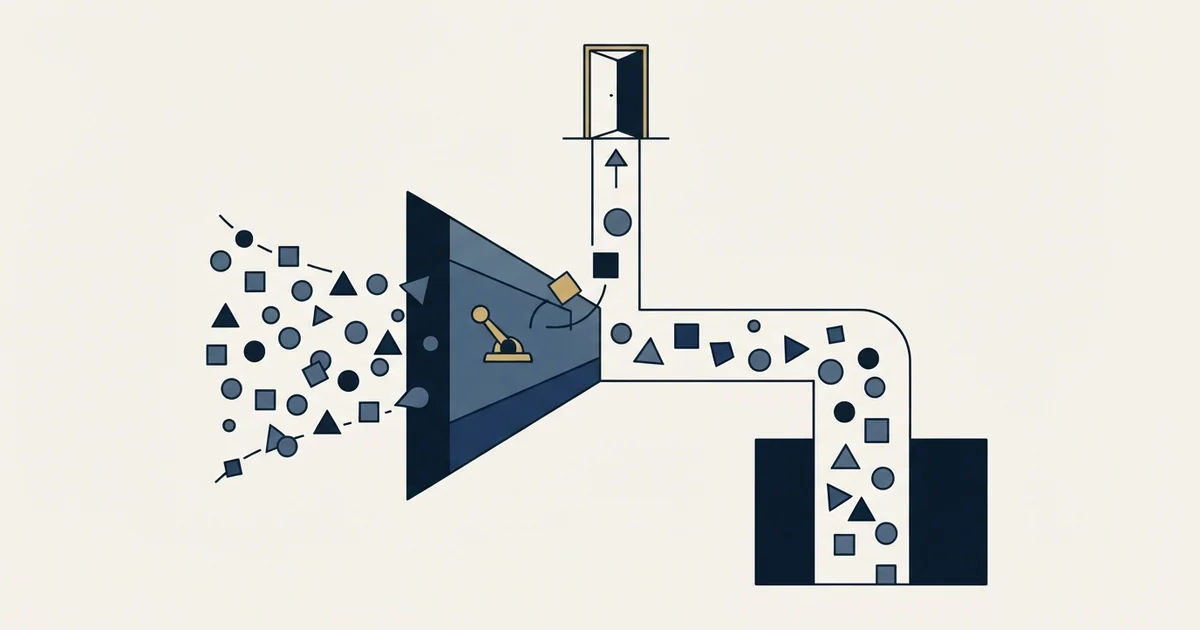
The JOLT sales methodology, from The JOLT Effect by Matthew Dixon and Ted McKenna, is a playbook for buyers who agree they should change but cannot commit. JOLT means Judge the level of indecision, Offer your recommendation, Limit the exploration and Take risk off the table. Judge comes first; the rest are used as needed.
Key takeaways
- The JOLT Effect is a 2022 Portfolio book by Matthew Dixon and Ted McKenna, built on a study of 2.5 million recorded sales conversations.
- Challenger's page on the research reports win rates of 30% in calls with medium indecision and 6% where indecision was high.
- Of deals lost to no decision, the authors attribute 44% to a preference for the status quo and 56% to indecision driven by fear of failure.
- JOLT is not a fixed sequence: Challenger's page says sellers may use the moves out of order, and the authors start at J and apply O, L and T as needed.
Reviewed and updated September 19, 2026
A deal does everything right and then stops. The buyer agreed the problem was real, brought two colleagues into the room, asked for a security review and told you the timeline. Then the replies get slower, the next meeting moves twice, and eventually nothing. No competitor won it. Nobody said no. The JOLT Effect, the sales methodology Matt Dixon and Ted McKenna built around customer indecision, is a named response to that specific outcome, and it starts by insisting that the buyer's silence is a different problem from the buyer's inertia.
What is the JOLT sales methodology?
The JOLT sales methodology is a four-part playbook for buyers who agree they need to change but cannot commit. It comes from The JOLT Effect, a 2022 book by Matthew Dixon and Ted McKenna built on a study of 2.5 million recorded sales conversations. JOLT stands for Judge the level of indecision, Offer your recommendation, Limit the exploration and Take risk off the table.
The authors' own synopsis calls it complementary to any selling methodology, and Challenger's page on the research is explicit that it is not a script: "This isn't a choreography, and sellers may use it out of order", with JLOT, JT and JOLO given as examples. The authors describe starting at J and applying tactics from the O, L and T in each sale as the deal needs them.
The same Challenger page names three drivers of indecision, and the moves line up against them. Choice overload is a buyer who cannot see the difference between options, and the page ties offering a recommendation to it directly. Information overload is the buyer who keeps asking for more, such as another reference after a fourth positive reference call; the authors write that all the data a seller keeps providing can cause it, which is what limiting the exploration stops. Expectations overload is a buyer who does not believe they can achieve the outcome being presented, and taking risk off the table answers it by setting realistic expectations.
What the research behind it looked at
The JOLT Effect is a book by Matt Dixon and Ted McKenna, and Dixon is described on Challenger's own site as a co-author of The Challenger Sale, which is why the two frameworks keep appearing together. Challenger's own page on the research describes the origin: in the spring of 2020 the pair set out to determine why so many promising deals were ending in a loss, beginning with 2.5 million recorded sales conversations, converting the audio to text with speech recognition and applying machine learning to identify 8,300 factors that drive sales success and loss.
That page states the findings plainly enough to quote directly. Challenger's own page reports that "medium to high levels of indecision show up in 87% of all deals". The same published page states: "We can attribute 40-60% of lost deals to indecision." It also reports what happened when reps met a wavering customer: 73% of reps went back to the beginning of their choreography, and some then hyped up fear or leaned into discounts. Challenger's page reports the result: "In 84% of these interactions, this pattern increased the likelihood the deal would be lost." The JOLT Effect's own curriculum page makes the positioning claim directly: no other sales methodology really addresses customer indecision, which is the heart of the approach.
Challenger's page also puts numbers on what indecision does to a deal: in calls with medium indecision, about 60% of all the calls analysed, it reports win rates of 30%, and where indecision was high, in about 30% of the calls, it reports win rates of just 6%.
Those numbers belong to that research and those pages. The argument underneath them is testable against your own closed-lost records.
Two different fears, and only one of them is on the standard curriculum
The authors' own curriculum page puts it plainly: nearly all sales methodologies are built for one purpose, to beat the customer's view of their status quo. Teach the buyer that their current approach is costing them something, quantify it, create tension, and the purchase becomes rational. That machinery answers the fear of not changing.
Teams that build this tension case still need the numbers to hold up under scrutiny, and the quantification step after diagnosis explains how to construct a figure the buyer can defend to others.
The authors put a number on the split. Of the deals lost to no decision, Dixon and McKenna's synopsis says 44% were lost to a preference for the status quo and 56% to indecision stemming from risk or fear of failure. Challenger's page names the two motivators Fear of Missing Out and Fear of Messing Up, and concludes that when it comes to indecision the second is the bigger driver. The standard playbook is built for the first.
Indecision is the other fear: the fear of changing badly. A buyer who has already accepted that the problem is real can still be afraid of choosing the wrong option, of missing information that would have changed their mind, of being the person who signed for something that did not work. Nothing in the status-quo playbook touches any of that, which is why the standard response makes it worse. Pushing harder on the cost of inaction says, in effect, that a buyer who is afraid of getting it wrong should hurry up.
The tell that you are in the second case rather than the first is that the buyer keeps agreeing with you. Agreement plus delay is the signature. Disagreement plus delay is an ordinary objection, and the usual instruments handle it.
The four moves, as the framework names them

Challenger's page sets out the acronym as J for Judge the Level of Indecision, O for Offer Your Recommendation, L for Limit the Exploration and T for Take Risk Off the Table.
Judge is a diagnostic step and the reason the other three do not fire at the wrong target. Challenger's page says sellers skilled in it qualify prospects on their ability to decide, and in some cases disqualify opportunities after this initial analysis; the authors put the distinction as qualifying the decision to buy, conceptually, against the ability to buy. The page lists how indecision shows up, from multiplying requests for a demo to delayed email responses and rescheduled syncs. The signals worth watching are behavioural rather than verbal: requests for more information that does not bear on the decision, new stakeholders arriving late without a defined role, meetings rescheduled rather than cancelled, and a buyer who asks what other customers did instead of what they should do.
Offer your recommendation is the move sales training tends to work against: the authors write that traditional sales methods may suggest asking the customer more questions and presenting a wealth of choices. Asked which option to take, the reflex is to present the trade-offs neutrally and let the buyer choose, which reads as professionalism and lands as abandonment. A buyer stuck between three configurations does not need a fourth summary of the differences. They need somebody who has done this many times to say which one they would pick and why, and to be specific enough that the reasoning can be checked. Challenger's page says it is the "your" in offer your recommendation that matters most, and that high performers do this even when it cuts the deal size; the authors add that a recommendation shares the blame for any wrong choice with the buyer.
Limit the exploration runs against the instinct to answer every question. More options and more information increase the chance of a stall, because each new consideration reopens a decision that was closing. The practical version withholds nothing and closes questions rather than collecting them: answering what is asked, saying explicitly what does not need to be evaluated and why, and being willing to tell a buyer that a particular comparison will not change their outcome. The authors' own phrasing is to let buyers know when information isn't crucial to a purchase decision, and to highlight moments when it is.
Take risk off the table is the one that gets misread as discounting. A discount lowers the price of a decision the buyer is still afraid of, which is why it so often fails to move anything. Removing risk changes what happens if the decision turns out wrong: a smaller first commitment, a defined checkpoint at which continuing is a fresh choice, a scope that proves the thing works before the expensive part starts, an explicit statement of what you will do if a named outcome does not appear. The authors' examples are trials, opt-outs and land-and-expands, and they warn that promising an optimistic time to value increases the indecision.
What this asks of a pipeline, not just a call
A framework about indecision has consequences for how deals are recorded. If somewhere between 40 and 60 percent of lost deals end with no decision, the range both the authors and Challenger publish, then a pipeline whose lost reasons are only competitor names and price is describing a market it is not actually losing in. The cheap fix is a lost reason that distinguishes a buyer who chose somebody else from a buyer who chose nothing, applied to the stages a deal passes through so the two are countable separately. Inside no decision, one more split pays for itself: a buyer who never accepted the problem is the status quo case, answered by teaching and quantifying the cost of inaction, and a buyer who agreed and then chose nothing is the indecision case JOLT is for.
| Lost reason | What happened | What answers it |
|---|---|---|
| Competitor | The buyer chose somebody else | An ordinary competitive review |
| No decision: status quo | The buyer never accepted the problem | Teach, quantify the cost of inaction |
| No decision: indecision | The buyer agreed, then chose nothing | Judge, offer, limit, take risk off |
The second consequence lands on forecasting. A deal held by an enthusiastic buyer with no owner and no date is the exact profile that ends in no decision, and it is also the profile that looks healthy in a weekly review. That is a qualification problem before it is a closing problem, which is why the frameworks that ask who is responsible for the outcome do more forecast work than the ones that ask how interested everyone is. It shows up early, in what the first real conversation establishes, rather than at the point where a proposal is already out.
Where it sits beside the Challenger approach

The two are complementary by design, and Challenger's own page says so: it frames JOLT as the playbook for what happens after a seller has taught, tailored and taken control and the buyer still will not commit. The Challenger approach is aimed at a buyer who has not accepted the problem. JOLT is aimed at a buyer who has. Read as one sequence of ideas, the first half is about creating a reason to act and the second half is about making acting feel survivable.
That also means JOLT is not a replacement for a qualification framework or for a methodology that shapes the whole revenue motion. It is a late-deal instrument with an early-deal implication, which is that a buying group without an accountable owner will produce indecision no matter how well the seller performs. The authors say as much: judging customer indecision needs to start from the first moment you contact the buyer.
Where we differ from standard practice
Our own work sits before any of this, in outbound, and the doctrine there is deliberately narrow. We send one message per campaign. No bumps, no thread replies, and no second message tucked under the first one on LinkedIn, because a second message under an ignored one reads as a bump whatever the campaign structure says. A prospect who does not reply has not refused anything, and the honest way to reach them again is a new campaign on a new angle, launched when something changes, rather than pressure applied to the same thread.
The connection to indecision is direct. The pressure playbook the JOLT research found to be counterproductive inside a deal is the same instinct that produces bumping in outbound, and it fails for the same reason: repetition is a demand for a decision from somebody who has not been given a reason to make one. The version of this that does work is a trigger, meaning something changed at the account that makes a fresh approach relevant, and the way we structure an outbound programme is built around that rather than around persistence. We also agree the criteria that make a meeting qualified with the client in writing before a campaign launches, and budget, timing and authority are never billing conditions. The full argument for the sending constraint, including what it costs us, is in why we stopped using follow-ups.
The short version

A campaign built on those terms is the fastest way to see what the difference looks like in practice. JOLT names the loss that does not appear in a competitive review: the buyer who agreed with everything and then chose nothing. Judge whether you are facing indecision rather than reluctance, offer a real recommendation instead of another neutral summary, close open questions rather than collecting more of them, and change the shape of the commitment so that being wrong costs less. Then check your own closed-lost records for how many deals ended with nobody winning, because that number decides whether any of this is worth your attention.
Frequently asked questions.
Frequently asked questions- What is the JOLT effect?
- It is the title of a 2022 book by Matthew Dixon and Ted McKenna, and the name of the sales approach it describes. The research behind it analysed 2.5 million recorded sales conversations and found that many deals are lost to buyer indecision, a fear of choosing badly, rather than to a competitor or to comfort with the status quo.
- What does JOLT stand for?
- Judge the level of indecision, Offer your recommendation, Limit the exploration, and Take risk off the table. Challenger publishes that expansion on its page about the research. The moves are not a fixed sequence: the page says sellers may use them out of order, and the authors describe starting at J and applying the other three as a deal needs them.
- How is JOLT different from the Challenger approach?
- Challenger is aimed at a buyer who has not accepted that the problem is worth solving, and works by teaching, tailoring and taking control. JOLT is aimed at a buyer who has accepted it and still cannot commit. Challenger's page calls them two playbooks, one dialling up the pain of not purchasing and one dialling down the fear of purchasing.
- Why does creating urgency backfire on an indecisive buyer?
- Because urgency answers the wrong fear. A buyer worried about choosing badly hears pressure as a demand to hurry a decision they already fear getting wrong. Challenger's page reports that 73% of reps went back to the start of their pitch when a buyer got cold feet, and that in 84% of those interactions the pattern made a loss more likely.
About the author.

Ben Carden is CRO at RevenueFlow, which builds and operates outbound revenue engines for B2B companies. Previously at Gartner Enterprise. Studied at London School of Economics.
Ben Carden · CRO
Connect on LinkedIn →Explore more.
Ready to scale your outreach?
We build GTM engines that book real meetings. See the receipts.
Related articles.
CHAMP: Qualification That Starts With the Problem
CHAMP is BANT with the letters moved, and the order is the argument. What each of the four checks should produce, and which one predicts a deal ending in nothing.
The Customer-Centric Sales Process: The Edit That Matters
Renaming the pitch achieves nothing. Writing every step as buyer evidence changes the forecast within a quarter, and three other things nobody warns you about.
B2B Sales Methodologies: Four Arguments, Sixteen Names
Sixteen named frameworks collapse into four arguments about what sellers get wrong. Which family fits where your deals die, and why adoption fails more often than choice.
Value-Based Selling: The Arithmetic Step After the Diagnosis
Diagnosis establishes that a problem hurts. Value-based selling is the step that turns it into a figure the buyer's own finance function will defend for you.
The Seven-Step Sales Process: What Each Step Assumes
Prospecting through follow-up, walked one box at a time. Each of the seven steps carries an assumption about the buyer, and most of them have quietly stopped holding.
The Five-Step Sales Process: What You Stop Checking
Cutting a process to five steps is a decision about which checks you drop. Which deals the short version fits, and the two loss patterns that say it does not.