Value-Based Selling: The Arithmetic Step After the Diagnosis
Diagnosis establishes that a problem hurts. Value-based selling is the step that turns it into a figure the buyer's own finance function will defend for you.
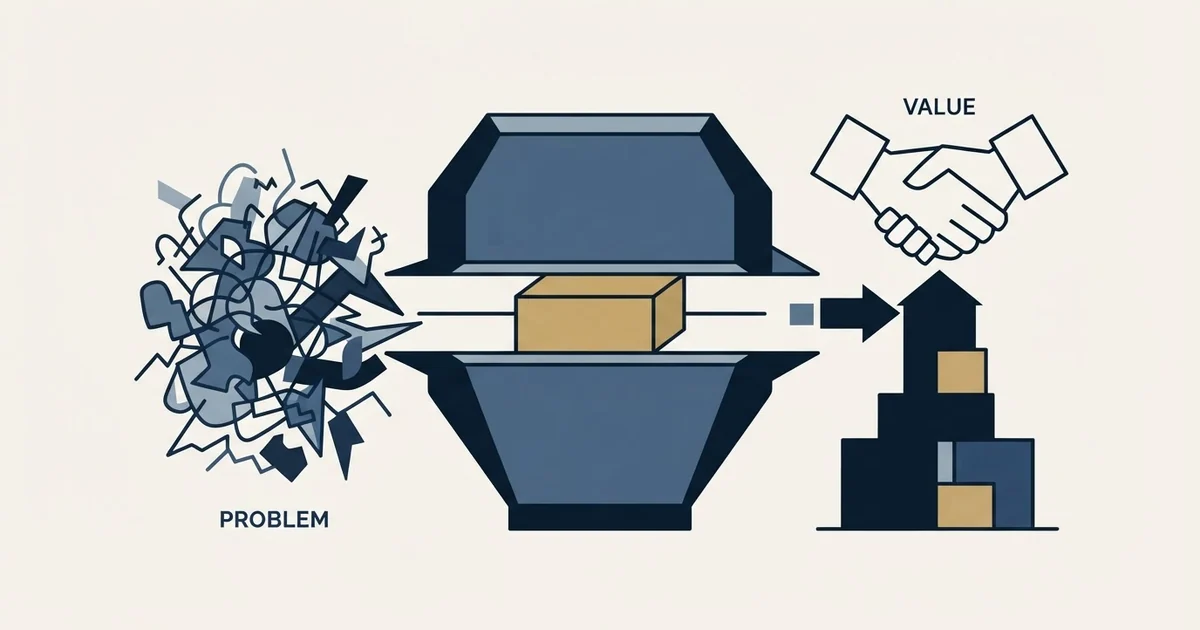
Value-based selling is the quantification step after a diagnosis. It builds a small model with the buyer: a driver they can observe, a baseline they supply, a delta the seller sources conservatively, and a conversion using the buyer's own cost basis. The output is a number somebody outside the room will repeat.
Key takeaways
- The boundary against the adjacent methods is quantification. Highspot's guide states that consultative selling emphasises asking questions and diagnosing needs while value selling takes it further by attaching hard business impact, and that difference decides what work a team has to do rather than what vocabulary it adopts.
- A value model has four parts and the seller legitimately owns exactly one of them. The driver and the baseline come from the buyer, the conversion uses the buyer's own cost basis, and only the delta is a line where the seller's evidence from comparable cases is genuinely better than the buyer's.
- The test of a value case is not whether the champion agrees with it but whether they can reproduce it from memory to their own finance director. A model with four inputs survives that retelling and a model with fourteen does not, which makes thoroughness the enemy of the thing being built.
- Expect the method to end deals as often as it advances them. A driver that converts to a figure nobody would fund is real information arriving early and cheaply, and teams measured on proposals sent rather than on deals closed tend to abandon the approach at exactly that point.
Reviewed and updated October 1, 2026
A seller runs a good diagnosis. The buyer describes what breaks, agrees it is expensive, and says the words every methodology trains a rep to listen for. Then the proposal goes to finance, and the question that comes back is not about the problem at all. It is: where did this number come from. At that point the seller is holding an argument the buyer's own finance function has no reason to accept, and the deal slows down for reasons nobody on the sales side can see.
Value-based selling is the name for the step that closes that gap. It is the part of the sale where a diagnosed problem becomes a figure, and the figure becomes something a person who was never in the room will defend on the seller's behalf.
What separates it from the method next to it
The term sits close enough to consultative and solution selling that the three get used interchangeably, and the distinction is worth drawing precisely because it decides what work you have to do.
Highspot's guide to value selling draws the line directly, under a heading reading "How value selling differs from consultative selling", where the page states: "The value-based selling approach focuses on proving outcomes. Consultative sales emphasizes asking questions and diagnosing needs. The two overlap, but value selling takes it further by attaching hard business impact to every solution."
The same page names the failure mode from inside the category, writing that "Quantifying the worth of target accounts, shifting salespeople away from feature pitches, and winning finance buy-in derail many rollout attempts of the value selling methodology", and that "Sellers often revert to price talk when a prospect pushes back hard".
That is the honest summary. Diagnosis establishes that a problem exists and hurts. Quantification establishes how much, in units the buyer's finance function already uses. The first is a conversation skill. The second is arithmetic performed with the buyer, and it is a different discipline that most teams assume they get for free once the conversation goes well.
- Questions ordered from situation to consequence
- Output is an agreed description of what is broken
- Succeeds when the buyer says it out loud
- Leaves the cost implicit or approximate
- Loses when the problem turns out to be cheap
- Traces the pain to a person whose measures move
- Output is an offer scoped to that pain
- Succeeds when the buyer recognises the solved state
- Prices against a cost the buyer mentioned
- Loses when the buyer already knows the category
- Builds the calculation with the buyer, in their units
- Output is a business case with named assumptions
- Succeeds when somebody outside the room repeats it
- Prices against a figure that survives challenge
- Loses when the assumptions cannot be sourced
Our existing pages carry the first two arguments in full. The consultative process covers diagnosis and what it costs in proposal volume, and solution selling covers tracing a consequence upward until it reaches someone whose own numbers move. This page is about the step after both of them.
The value model, and why a seller's version of it fails
The instrument at the centre of this method is a small arithmetic model with four parts. Teams that adopt the method and get nothing usually build all four alone.
The driver. The specific operational thing that changes. Not efficiency, not productivity: the hours a named team spends on a named task, the proportion of orders entered twice, the days a close takes. A driver you cannot observe is not a driver.
The baseline. What that driver reads today, at this company, taken from the buyer rather than from a market average. The baseline is the part sellers are most tempted to supply and the part that most destroys the model when they do.
The delta. How much the driver moves. This is the only one of the four where a seller's evidence is legitimately better than the buyer's, because the seller has watched it happen elsewhere, and it is therefore the number to state conservatively and to source to a comparable engagement rather than to a brochure.
Deciding who supplies that evidence is a staffing question too, and when a second seller earns a seat turns on the job that person owns on the call.
The conversion. How the buyer turns that movement into money, using the cost basis their own finance team already applies. Every company has one. Asking for it is a better question than inventing one.
- Yes: The driver is something a named person at the buyer can observe directly
- Yes: The baseline came from the buyer, and you can name who gave it and when
- Yes: The delta is stated conservatively and sourced to a comparable case
- Yes: The conversion uses the buyer's own cost basis, asked for rather than assumed
- Yes: Someone on the buyer's side has corrected at least one assumption
- No: The baseline is a published industry average
- No: The whole model was built after the call rather than during it
The fifth item is the one that predicts outcomes. A buyer who edits an assumption has taken partial ownership of the arithmetic, which is the entire point of building it in front of them. A buyer who receives a finished model and says it looks compelling has agreed to nothing, and the model will not be repeated accurately in any room the seller is not in.
A worked example, entirely invented

The company, the people and every figure below are invented illustrative arithmetic, written to show the shape of a model. Nothing here is a measurement of any real engagement.
An invented mid-sized insurer, with an invented operations manager called Priya Nandakumar. The driver is claims documents that arrive by post and are keyed into the claims system by hand. Priya's own count, given on an invented call date, is that four staff spend about three hours a day each on it. That is the baseline, and it is hers.
The delta is where the seller's evidence belongs, and in this invented example the illustrative figure is that in comparable deployments roughly seventy percent of those documents were handled without a person touching them. Stating seventy rather than ninety is the deliberate part, because a model that has to be argued down has already lost the reader.
The conversion is the invented Priya's finance team's loaded hourly figure, which the seller asks for rather than supplies. Multiply the invented figures out and the model produces a range, not a point. The range is the honest output, and a proposal that presents a range with its assumptions listed underneath is harder to dismiss than one presenting a single confident figure with none.
Two rules make the difference between that and a spreadsheet nobody trusts. Every assumption is visible on the same page as the result, so a sceptical reader can attack an input rather than the conclusion. And the seller's own contribution is limited to the delta, because that is the only line where the seller genuinely knows more than the buyer.
Where the method actually breaks
Three failures account for most of the disappointment, and none of them is about the arithmetic being wrong.
The number arrives after the price. A value model produced in response to a pricing objection reads as a justification, because it is one. Built during diagnosis, the same model is context. Same figures, different document, entirely different reception.
Nobody outside the room can repeat it. The test of a value case is not whether the champion agrees with it. It is whether the champion can reproduce it, badly, from memory, to their own finance director. A model with four inputs survives that. A model with fourteen does not, and the fourteen-input version is what a seller builds when they are trying to be thorough.
The seller reverts to price under pressure. This is the failure the category's own publishers name, and it happens at a predictable moment: the first hard pushback. The countermeasure is having decided in advance what you will trade instead of price, which is a preparation task rather than a composure problem. Our pricing discussion templates cover the language for holding that line once it is tested.
There is a fourth thing worth naming that is not a failure of the method. Sometimes the model comes out small. A driver that converts to a figure nobody would fund is real information, arriving earlier and cheaper than it otherwise would, and the correct response is to stop rather than to look for a bigger driver. Value-based selling disqualifies more than it persuades, which is why teams measured on proposals sent tend to abandon it.
Where it sits against the frameworks you already run

The method is not a rival to a qualification framework and is usually run alongside one. MEDDIC asks for metrics and an economic buyer as evidence a deal is real; a value model is the instrument that produces the metric and gives the economic buyer something to hold. Where a team already runs a framework, adopting this changes what the metrics field contains rather than what the process looks like. The wider map of which framework argues what is in our page on the sixteen named methodologies and the four arguments behind them.
Teams that still qualify on prospect enthusiasm rather than infrastructure will find the managed services qualification approach a useful parallel for pricing an ongoing obligation correctly.
The one structural requirement outside the call is that the model has to be capturable in the record. A value case that lives in a rep's head or in an attachment nobody can find is not available to the person forecasting the deal, and it is not available to whoever takes the account over.
Where we differ from standard practice
We sell outbound rather than sales training, so the honest statement of our position is narrow and it is about our own commercial conduct rather than about what we teach.
For every campaign, the criteria that make a meeting qualified are agreed with the client in writing before anything sends, and budget, timing and authority are never billing conditions. That is the same instinct this method applies to a value model: settle the ruler before anybody reads the number, because a definition argued after the fact is argued under pressure and costs more than the thing being defined.
That same discipline of settling terms before the reveal is formalized in the Sandler Selling System, whose up-front agreement and pain-first sequence delays any presentation until cost and authority are known.
On the outbound side, we run one message per campaign, with no bumps and no thread replies. The constraint puts the weight on the premise of the first message, which is the same demand a value case makes: say something specific enough to be checkable, or do not send it.
The short version
Value-based selling is the quantification step after a diagnosis, and its output is a number the buyer's own finance function will accept from somebody who was not in the room.
Build the model from four parts: a driver a named person can observe, a baseline taken from the buyer, a delta stated conservatively and sourced to a comparable case, and a conversion using the buyer's own cost basis. Keep the seller's contribution to the delta alone. Build it during the diagnosis rather than in answer to a price objection, keep it small enough that a champion can reproduce it from memory, and show the assumptions beside the result so a sceptic can attack an input.
Expect it to end deals as often as it advances them. A driver that converts to a figure nobody would fund is the method working.
If the constraint is that there are not enough diagnostic conversations for any of this to be what is limiting you, see what a first campaign produces for your market.
Comparative and failure-mode detail verified against Highspot's value selling guide as fetched on 22 August 2026. Publishers revise these pages; confirm the current text before relying on it.
Frequently asked questions.
Frequently asked questions- What is value-based selling in simple terms?
- It is the step where a diagnosed problem becomes a number. The seller works with the buyer to establish what specific operational thing is going wrong, what it reads today, how far it would move, and how the buyer's own finance team converts that movement into money. The output is a business case with visible assumptions.
- How is value-based selling different from solution selling?
- Solution selling traces a problem to the person whose measures it affects and scopes an offer against it. Value-based selling adds the arithmetic: it produces a defensible figure in the buyer's own units. The two overlap heavily and the practical difference is whether anyone outside the sales conversation can check the claim.
- Who should supply the numbers in a value model?
- The buyer supplies the baseline and the cost basis, because a seller's version of either is the first thing a finance reviewer attacks. The seller supplies the delta, stated conservatively and sourced to a comparable engagement. If a buyer has corrected at least one assumption, they have taken partial ownership of the model.
- When does value-based selling not work?
- When the model is produced in answer to a pricing objection, because it then reads as a justification rather than as context. It also fails when the assumptions cannot be sourced, and on transactional purchases where the buyer already knows what they want and a business case is overhead they did not ask for.
About the author.

Ben Carden is CRO at RevenueFlow, which builds and operates outbound revenue engines for B2B companies. Previously at Gartner Enterprise. Studied at London School of Economics.
Ben Carden · CRO
Connect on LinkedIn →Explore more.
Ready to scale your outreach?
We build GTM engines that book real meetings. See the receipts.
Related articles.
The JOLT Effect: Selling to a Buyer Who Cannot Decide
The loss that shows no competitor and no rejection. What the JOLT research names, why the standard urgency playbook makes it worse, and the four moves that answer it.
Solution Selling: The Generic Term and the Licensed Method
One name covers a generic problem-led posture and a specific licensed methodology. The lineage, the three moves that matter, and the assumption that aged badly.
The Customer-Centric Sales Process: The Edit That Matters
Renaming the pitch achieves nothing. Writing every step as buyer evidence changes the forecast within a quarter, and three other things nobody warns you about.
B2B Sales Methodologies: Four Arguments, Sixteen Names
Sixteen named frameworks collapse into four arguments about what sellers get wrong. Which family fits where your deals die, and why adoption fails more often than choice.
Sales Kickoff Meeting: The Decisions It Has to Leave With
A kickoff is the one moment a whole sales organisation can change at once. The four decisions it has to publish, and the week-six check that tests them.
Sales Call Planning: The Plan a Booked Call Needs
A call cannot produce a commitment nobody named in advance. The four fields a call plan carries, and why the ask has to be decided before the meeting opens.