The Sandler Selling System: Seven Steps, One Worth Stealing
Sandler puts the presentation sixth of seven, after budget and the decision process. The seven published steps, and the up-front contract worth taking on its own.
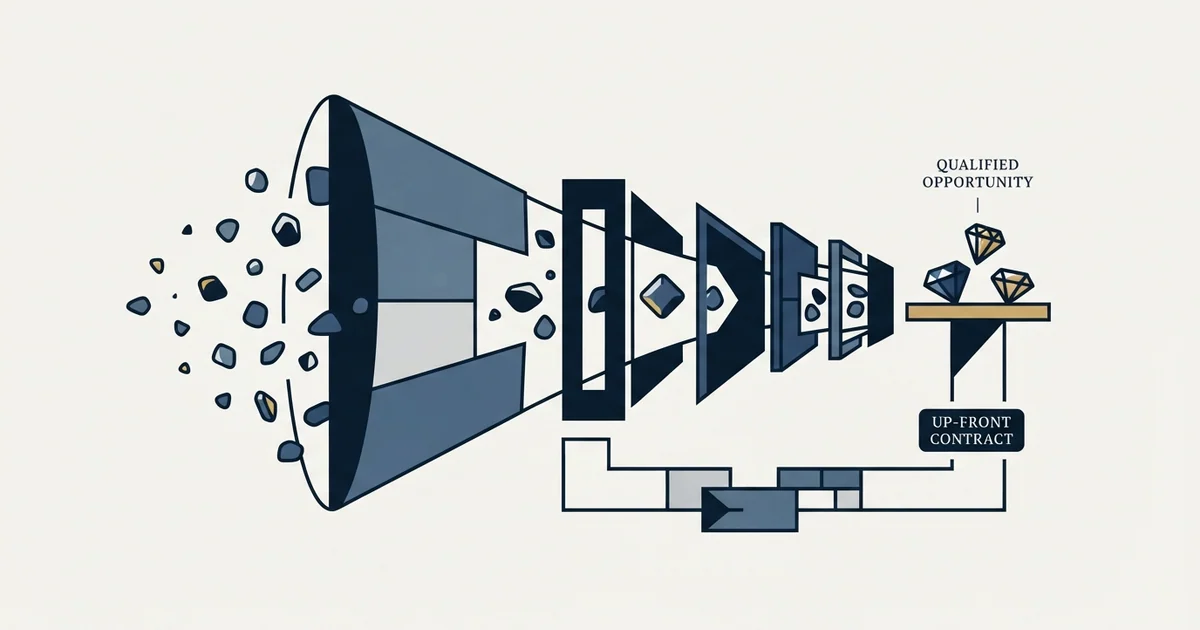
The Sandler Selling System is seven published steps: bonding and rapport, an up-front contract, identifying pain, uncovering budget, identifying the decision process, presenting fulfilment, and confirming the post-sell process. The presentation sits sixth, so nobody demonstrates before knowing what the problem costs and who signs.
Key takeaways
- Sandler publishes the system as seven steps and places the presentation sixth, after budget and after the decision process are established.
- The up-front contract is the most portable element: agreeing the agenda, the length and the acceptable outcomes in advance removes the ambiguous ending.
- The published budget step covers time, money and resources, which is broader than the money question it usually degrades into.
- It is a conversation methodology, so it improves the quality of meetings and does nothing about their number.
Reviewed and updated September 1, 2026
Most sales methodologies tell a seller how to persuade. Sandler's central move is the opposite one: it hands the seller permission to end the conversation early, and builds the whole system around the moments where that permission gets used. That is why teams either take to it immediately or reject it within a fortnight, and the split usually has nothing to do with the quality of the training.
Sandler Training publishes the system openly. Its own page describes the Sandler Selling System as "a seven-step system for successful selling", and characterises it as "a low-pressure, consultative selling approach that puts you, the salesperson, in control of the discovery process". Its own page lists all seven, in order. What follows works through them, then through the conditions under which the system actually pays for itself.
The seven steps, as Sandler publishes them
- Step 01Bonding and rapport
Develop equal business stature and encourage open, honest communication
- Step 02Up-front contract
Establish roles and ground rules to create a comfortable environment within which to do business
- Step 03Identify the pain
Uncover the problems and their potential impact to identify reasons for doing business
- Step 04Uncover the budget
Discover if the prospect is willing and able to invest the time, money and resources needed to fix the problem
- Step 05Identify the decision process
Discuss the who, when, what, where, why and how of the prospect's desired buying process
- Step 06Present fulfilment
Propose your solution to the problem, within the budget, and consistent with the decision-making process
- Step 07Confirm the post-sell process
Establish next steps, discuss future business, and prevent the loss of the sale to competition or buyer's remorse
Two things about that list are worth noticing before anything else.
The presentation is step six of seven. In most sales training the presentation is the event and everything before it is preparation. Here it arrives after budget and after the decision process, which means a Sandler seller is not allowed to demo until they know what the problem costs and who signs. That single ordering decision is most of what people mean when they say a team "runs Sandler".
Once that presentation finally arrives, the words used inside it still need a framework, and a messaging system built for pricing power tackles that separate problem directly.
And the last step is about what happens after the yes. Buyer's remorse and late competitive re-entry are treated as failure modes the process has to close, not as bad luck.
Equal business stature, and why it is the load-bearing idea
The first step reads like a warm-up. It is the premise the rest depends on.
Sandler's page frames the approach against the traditional stereotype of the salesperson, and describes David Sandler working with a clinical psychologist to design an approach built on "mutual respect, clarity, and qualifying decisions" that would take pressure off both the salesperson and the prospect. The company's own line is that while other sales training teaches you how to get better at playing the sales game, this system "is designed to prevent the games from ever being played".
Equal business stature is the operational version of that. A seller who believes they need the deal behaves differently from one who believes the meeting is a mutual evaluation, and buyers read the difference immediately. Everything downstream requires it: you cannot ask a stranger what a problem costs them, or who controls the money, from a position of supplication. The questions come out as an interrogation or they do not come out at all.
This is also the part of the system that survives least well when it is taught as technique. A seller performing confidence while privately needing the number is doing something the buyer can hear.
The up-front contract is the most portable piece
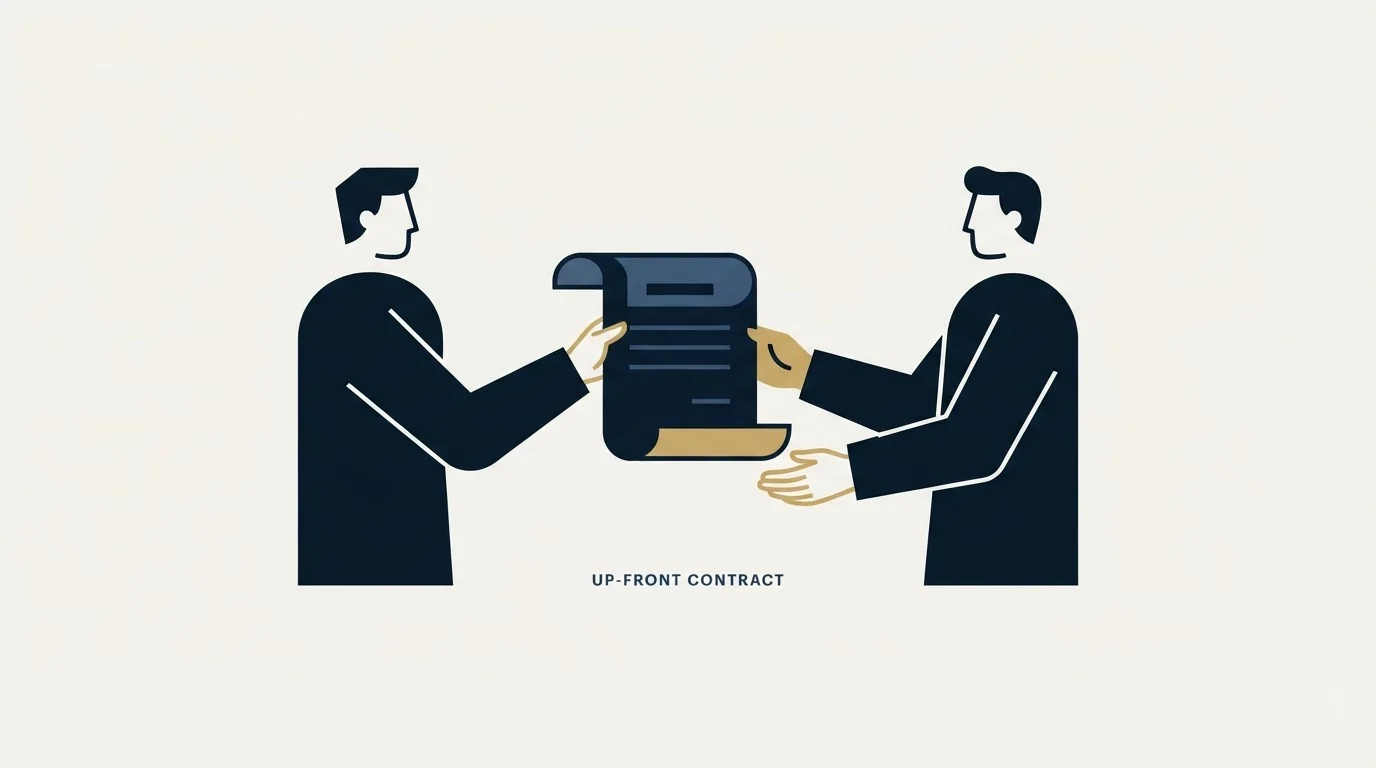
If a team adopts exactly one thing from this system, it should be step two.
An up-front contract is an explicit agreement at the start of a conversation about what will be covered, how long it will take, and what outcomes are acceptable at the end, including the outcome where both parties agree there is nothing here. It is stated out loud and confirmed, rather than assumed.
The mechanical benefit is that it removes the ambiguous ending. A meeting with no agreed outcomes ends in "let me send you some information", which commits nobody and produces a deal that stays open for months at a stage nobody can define. A meeting with an up-front contract ends in one of the outcomes both parties named at the start.
The second benefit is that it legitimises a no. When the seller has said at minute one that a clean no is a fine result, the buyer who reaches minute forty and does not want to proceed has a socially acceptable way to say so. Without that, the polite exit is a vague yes, and a vague yes costs a great deal more than an early no.
Our own version of this discipline sits at the commercial layer rather than in the conversation. The criteria a meeting has to meet are agreed in writing before a campaign launches, so the standard both sides are held to exists before anyone is contacted. It is the same instinct: settle the terms of the exchange before the exchange, and neither party has to negotiate them while also trying to have a useful conversation. Running a discovery call that disqualifies well covers the meeting-level mechanics.
Pain, budget, decision: the qualification core
Steps three through five are Sandler's qualification engine, and they map recognisably onto the checklists that came before and after it.
The pain step has a named question sequence of its own inside Sandler's material, the pain funnel, which walks a buyer from a general complaint down to a stated organisational cost and then to what the problem is costing them personally.
- Pain: the problem and its potential impact
- Budget: willingness and ability to invest time, money and resources
- Decision: the who, when, what, where, why and how of their buying process
- Need, treated as one of four boxes
- Budget, asked as an availability question
- Authority, usually reduced to one name
- Timing, frequently used as a gate
- Situation and Pain established first
- Impact: what solving it is worth
- Critical Event: the forcing function
- Decision: stakeholders and criteria
Sandler's budget step is broader than the word suggests, and the breadth is deliberate: the published wording is time, money and resources. A prospect who has money and no internal capacity to run an implementation is not qualified, and a budget question that only asks about money will not find that out.
The decision step is the one most often taught thinly. "Who is the decision maker" is not the question the published step describes. The who, when, what, where, why and how of the buying process is a map, and a map is what allows a seller to tell the difference between a champion who can convene the right people and an enthusiast who cannot. BANT's failure to represent committee buying is exactly this gap, and MEDDIC exists because one authority field was never enough.
Where the system attracts criticism, the budget step is usually the target, and the criticism has a fair core. Asking early about money works well where the buyer has an allocated line item and badly where the line item gets created because somebody decided to solve the problem. In the second case a truthful buyer says no, and a seller who treats that as disqualifying has just filtered out the population most worth having. Sandler's framing survives this better than a naive reading of it does, because willingness to invest is a different question from having the money already allocated, but the difference has to be taught deliberately or the step degrades into a budget gate.
Buyer indecision after the problem is accepted is a different failure mode, one that a framework for stalled deals treats as fear of choosing badly rather than mere budget hesitation.
Where it fits, and where it does not
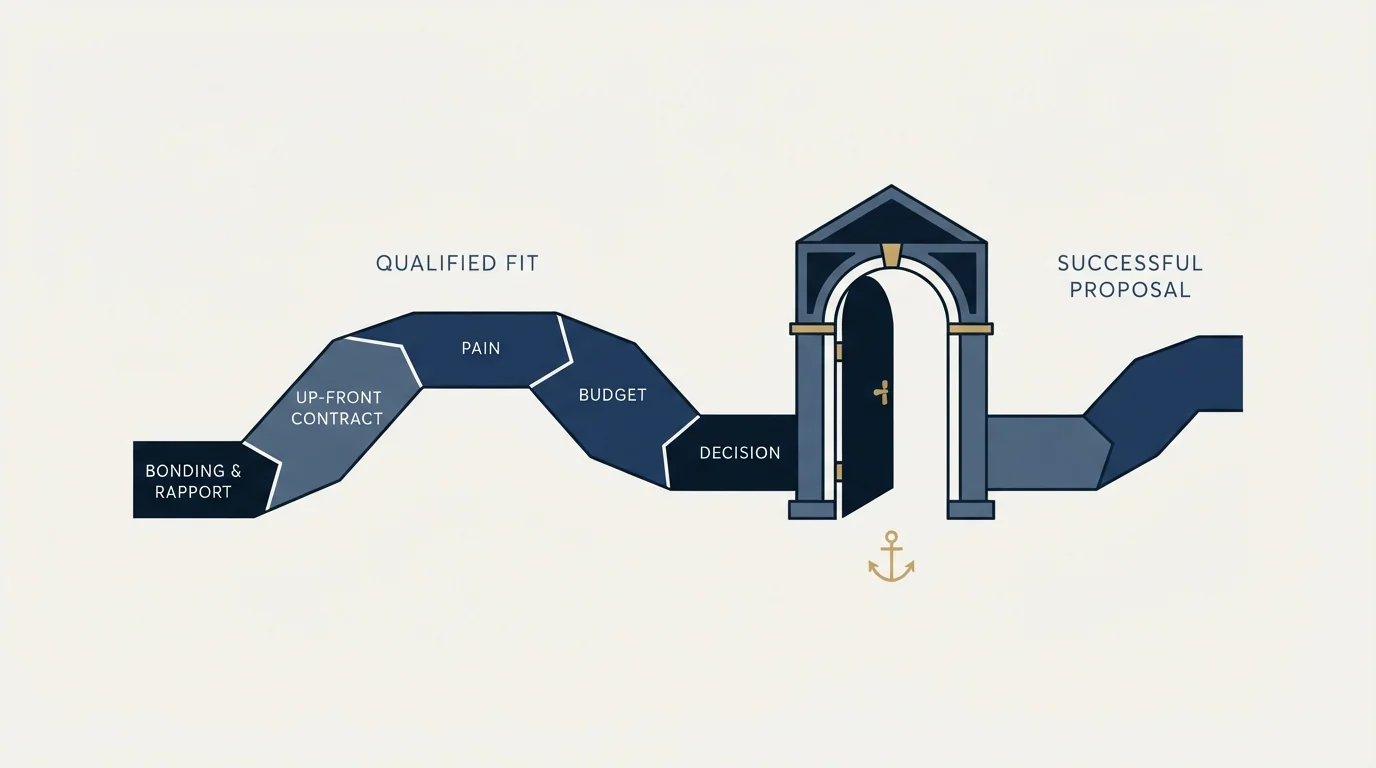
The system was designed for conversations, which is worth saying plainly before a team tries to apply it everywhere.
It fits synchronous, multi-turn selling: calls and meetings where the seller can ask, hear the answer, and change direction. It fits deals with enough value that a fortnight of qualification is cheaper than a quarter of drifting. It fits teams with a spread of experience, because the seven steps give a newer seller a shape to hold when instinct has not arrived yet.
A team weighing it against the system most often named beside it will find both taken from their publishers' own pages in Sandler vs Challenger.
It fits badly where there is no conversation to run it in. Cold outbound is the obvious case. An up-front contract requires two parties, and a first email has one. The pain step requires the buyer to answer a question, and a message that asks a stranger to articulate their pain before they have any reason to reply is asking for work with no relationship to pay for it.
- Yes: Deals are worked in live conversations rather than decided on a form
- Yes: Sellers routinely reach the presentation without knowing who signs
- Yes: Meetings end in send-me-information more often than in a dated next step
- Yes: Managers can name who will hold the process after the training ends
- No: The actual constraint is that too few qualified conversations happen at all
- Depends: Budget is expected to exist before anyone has decided to solve the problem
The fifth item is the one that decides whether the money is well spent, and it is not a criticism of the methodology. A selling system improves what happens to conversations once they exist. It does not create them. A team with excellent qualification and an empty calendar has an excellent version of a problem it does not have, and the fix for that sits upstream in who gets contacted and why rather than in any framework.
Where we differ from standard practice
Much of the advice around this methodology reflects how outbound is commonly run, and since this page sits on our site it is worth saying where our own practice diverges and what it costs us.
Sandler's own material is about conversations, and nothing in the seven steps prescribes a contact cadence. The habit that has grown up around methodologies of this kind does: a sequence of messages to each prospect, later ones landing under the first. We run one message per campaign, with no bumps and no thread replies. A non-responding audience becomes a new campaign built on a genuinely different premise rather than a reminder of the old one. The reasoning is mechanical: a follow-up is delivered to the population that already saw the first message and chose not to answer, which is the population most likely to complain, and that cost lands on the sending domain across everything else running on it. The full argument is in our write-up on why we stopped using follow-ups. The cost we accept is that we reach each contact less often.
There is a point of genuine agreement worth naming. Sandler's budget step asks whether a prospect is willing and able to invest, which is a question for the conversation. We keep budget, timing and authority out of the commercial definition of a qualified meeting entirely, because a real conversation with the right person at the right company should not be voidable afterwards on the strength of a fact that changes every quarter. The reasoning is set out in pay-per-appointment B2B. The full argument, including what it costs us, is in why we stopped using follow-ups.
The short version

The Sandler Selling System is seven published steps, and its distinguishing features are the order and the permission. The presentation comes sixth, after pain, budget and the decision process, so nobody demos into a vacuum. The up-front contract at step two is the single most portable piece and the one worth stealing even if the rest is never adopted. The last step treats post-sale reassurance as part of the process rather than as customer service.
It is a conversation methodology, so it improves conversations and does nothing about their number. If the constraint is the number, that is the half we run, and what a first campaign produces is the honest way to find out what it is worth.
Framework wording and step definitions verified against Sandler's own published page as of mid-2026, with a dated snapshot retained. Verify current terms with the company before relying on them.
Frequently asked questions.
Frequently asked questions- What are the seven steps of the Sandler Selling System?
- Sandler publishes them as bonding and rapport, setting an up-front contract, identifying the prospect pain, uncovering the budget, identifying the decision making process, presenting your fulfilment of the agreement, and confirming the post-sell process. The ordering is the substance: presentation comes sixth, after the seller knows the cost of the problem and how the purchase gets decided.
- What is an up-front contract?
- An explicit agreement at the start of a conversation covering what will be discussed, how long it will take, and which outcomes are acceptable at the end, including the outcome where both sides agree there is nothing here. It is stated aloud and confirmed rather than assumed, which removes the vague ending and makes a clean no socially acceptable for the buyer.
- Is asking about budget early a problem?
- It can be. The question works where a line item already exists and misfires where budget gets created because somebody decided to solve the problem, since a truthful buyer then says no. Sandler frames the step as willingness and ability to invest time, money and resources, which survives that case, but the distinction has to be taught or the step becomes a gate.
- Does Sandler work for cold outbound?
- Not directly. The system is built for synchronous conversation, where the seller can ask something and hear an answer. An up-front contract needs two parties and a first cold message has one. Sandler applies from the meeting onwards, and getting the meeting is a separate discipline with different constraints.
About the author.

Ben Carden is CRO at RevenueFlow, which builds and operates outbound revenue engines for B2B companies. Previously at Gartner Enterprise. Studied at London School of Economics.
Ben Carden · CRO
Connect on LinkedIn →Explore more.
Ready to scale your outreach?
We build GTM engines that book real meetings. See the receipts.
Related articles.
SPICED: What the Five Letters Ask
Situation and Pain come before Impact, and that ordering is the whole argument. What each element asks, which two carry the weight, and what the framework assumes.
Solution Selling: The Generic Term and the Licensed Method
One name covers a generic problem-led posture and a specific licensed methodology. The lineage, the three moves that matter, and the assumption that aged badly.
The NEPQ Sales Process: Seven Phases
Connection through presentation, in the order 7th Level publishes them, plus where a sequence built for one decision maker starts to strain in a committee purchase.
Sales Call Planning: The Plan a Booked Call Needs
A call cannot produce a commitment nobody named in advance. The four fields a call plan carries, and why the ask has to be decided before the meeting opens.
Value-Based Selling: The Arithmetic Step After the Diagnosis
Diagnosis establishes that a problem hurts. Value-based selling is the step that turns it into a figure the buyer's own finance function will defend for you.
CHAMP: Qualification That Starts With the Problem
CHAMP is BANT with the letters moved, and the order is the argument. What each of the four checks should produce, and which one predicts a deal ending in nothing.