SPICED: What the Five Letters Ask
Situation and Pain come before Impact, and that ordering is the whole argument. What each element asks, which two carry the weight, and what the framework assumes.
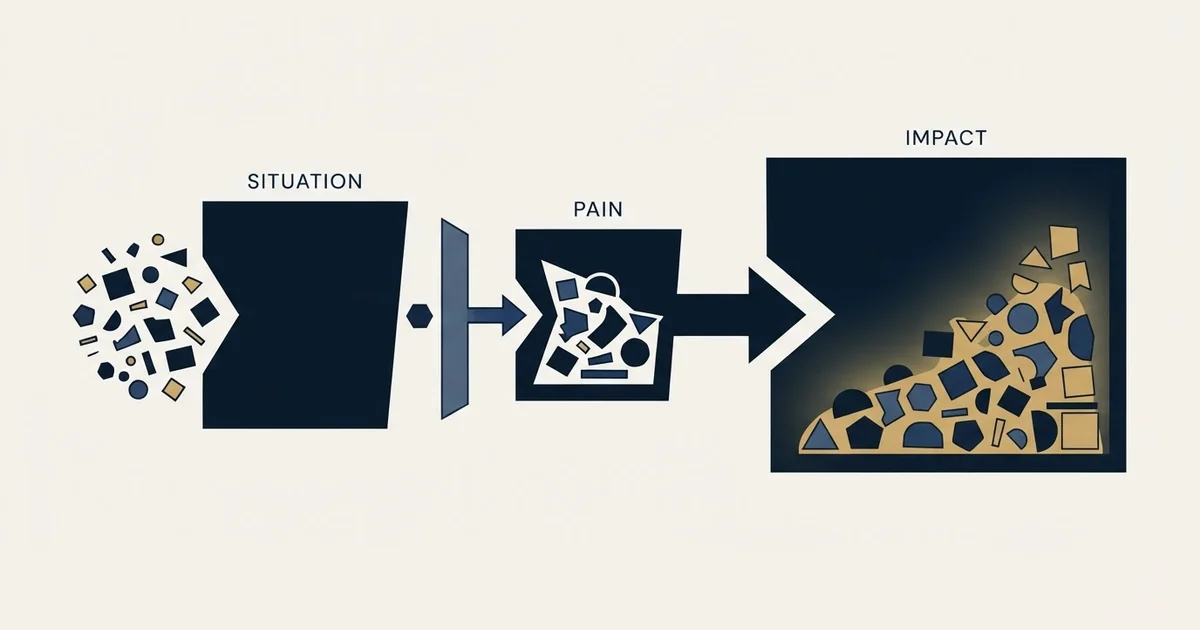
SPICED stands for Situation, Pain, Impact, Critical Event and Decision. It is a discovery framework published by Winning by Design, ordered so that the facts of a customer situation are established before anyone is asked what solving it is worth. Impact and Critical Event carry most of its value.
Key takeaways
- The order is the argument: establishing Situation and Pain before Impact prevents a buyer being asked to price a solution to a problem nobody has shown they have.
- Impact should be a sentence the customer would recognise as their own, which is the test for whether a team is running the framework or performing it.
- Critical Event separates a real opportunity from a pleasant one, and is often an external forcing function rather than a date the buyer has already named.
- The publisher states more than 25,000 professionals have been trained on it, which is an adoption figure rather than evidence of effect.
Reviewed and updated September 2, 2026
SPICED is five letters that stand for Situation, Pain, Impact, Critical Event and Decision, and the argument the framework makes is entirely in the order. Situation and Pain come before Impact, which means a seller has to establish the facts of somebody's world before asking what fixing it is worth. Run those in the other order and you get the familiar failure where a buyer is invited to price a solution to a problem nobody has yet shown they have, and the number that comes back is one neither party believes.
Winning by Design publishes the framework openly on its own site, which makes this unusually easy to evaluate without talking to anyone. This page works through what the letters ask, what the framework is good at, what it quietly assumes about your business, and where it stops applying.
The five elements, as the publisher defines them
- Situation: the customer's current context, including business environment, constraints, priorities and triggers for change, that shapes why this problem exists now
- Pain: the specific friction, inefficiency or risk the customer is experiencing as a result of their situation, expressed in concrete, observable terms
- Impact: the meaningful consequences of solving or not solving the problem, framed in terms that matter to the business, both rational outcomes and emotional stakes
- Critical Event: the deadline, milestone or external force that creates urgency and determines when a decision must be made
- Decision: how the customer will make the choice, including stakeholders involved, success criteria, tradeoffs and the process required to move forward
The publisher's own framing is that SPICED "replaces surface-level qualification with a shared, outcome-driven way to grow revenue", and that it aligns sales, marketing, customer success and revenue operations around the same picture of a customer. The company states that more than 25,000 professionals have been trained on it. That is an adoption figure rather than an outcome figure, and it is worth reading as exactly what it is.
The distinction that makes it different from a checklist
Older qualification frameworks were built to help the seller decide whether to keep spending time on a deal. The letters were boxes, and a filled box meant a lead could be passed along.
SPICED is arranged so the same information also serves the buyer. A customer who has articulated their own situation, the friction it produces, and what that friction costs has done useful thinking regardless of who they eventually buy from. That sounds like a nicety and it has a hard consequence: information collected this way tends to be information the buyer actually said, because they had a reason to say it, rather than a seller's inference typed into a field after the call.
That is the practical test for whether a team is running SPICED or performing it. Read a CRM record and ask whether the Impact line is a sentence the customer would recognise as their own. Where the answer is no, the field records the seller's optimism, and a framework that records optimism in five boxes instead of four is worse than no framework, because it looks like evidence.
Impact and Critical Event do most of the work

Two of the five elements carry disproportionate weight, and a team short on time should invest there.
Impact is where a conversation stops being about features. A number the customer supplies about their own business is more durable than any claim a seller makes, because it survives being repeated to somebody who was not in the room. The published definition includes emotional stakes alongside rational outcomes, which is not decoration: the person championing a purchase internally has a personal exposure attached to it, and a business case that ignores that is missing half of why anyone will fight for it.
Critical Event separates a real opportunity from a pleasant one. An interested buyer with no forcing function is a buyer who will still be interested next quarter, and next quarter's forecast will say so. The published definition is deliberately broad, covering deadlines, milestones and external forces, because the forcing function is frequently not a date the buyer has already named. A contract renewal, a system reaching end of support, a regulatory change, a headcount plan, a launch: each of those produces a date without anyone announcing one.
Teams that identify a critical event but still watch the deal stall afterward will find strategies for indecisive buyers useful for separating fear of choosing badly from comfort with the status quo.
The blueprint Winning by Design publishes for the framework makes a related point that is easy to miss in a training session. Its own summary states that impact and critical events are not always discovered in sequence and require active listening. The letters are not a script to be run in order down a call. They are five things that have to be true by the end of it.
That distinction changes how the framework should be coached. A seller working down the letters in order will ask about Impact at the moment the buyer is still explaining Situation, and the answer will be a guess offered to be helpful. A seller holding the five as an inventory notices that Impact arrived unprompted in minute four, that Critical Event is still empty at minute thirty, and asks about the empty one while the conversation is still open. Reviewing a call against the inventory afterwards is also a much better coaching exercise than reviewing it against a script, because the question becomes which element is missing rather than whether a step was performed.
The same property explains why the framework travels across teams, which is the claim its publisher makes for it most often. A customer success manager inheriting an account does not need the call recording if the five elements were captured in the customer's own words. They need to know what the situation was, what hurt, what solving it was worth, what made the timing what it was, and how the decision got made. Those are exactly the five things a renewal conversation reopens a year later.
What it assumes about your business
This is the part a framework page will not tell you, and it is the useful part.
SPICED assumes a customer who will engage in a diagnostic conversation. Every element requires an answer from the other side, so the framework begins to work at the point where somebody has agreed to talk properly, which makes the structure of the discovery call itself the thing that decides whether the five elements can be collected at all. It assumes enough deal volume and enough people for a shared vocabulary to earn its cost, because a three-person team can hold a common understanding of a deal without one and a hundred-person team cannot. And it assumes a customer relationship that continues after the sale, which is where the framework's promise of a language that survives handoffs into customer success actually pays.
It assumes, most of all, that there is a pipeline to apply it to. A diagnostic framework improves what happens to opportunities once they exist and creates none of them. That boundary is where our own work sits relative to this kind of methodology: demand creation and qualified meetings are upstream of the first S, and the two disciplines are complements rather than substitutes.
- Yes: More opportunities arrive than the team can handle consistently well
- Yes: Different people describe the same deal in incompatible language
- Yes: Deals are lost late, after a good demo, for reasons nobody recorded
- Yes: Somebody is named to own the vocabulary after the training ends
- No: The actual constraint is that too few qualified conversations happen
- No: Buying it in place of deciding who the buyer is
Where SPICED sits among the alternatives

The framework is best understood against the two it is most often compared with, because the differences are real and small.
- Built to help the seller decide whether to keep spending time
- Authority reduced to a single person
- Timing frequently applied as a pass or fail gate
- Cheapest to teach, easiest to fill in wrongly
- Replaces one authority check with several
- Adds decision criteria and decision process explicitly
- Scores an opportunity that already exists
- Heaviest, and earns it on long committee deals
- Ordered so facts precede value
- Impact is supplied by the customer, not asserted by the seller
- Critical Event replaces a guessed timeline with a forcing function
- Designed to carry across teams after the sale
None of the three is a substitute for the others in every situation. BANT still works as a first-call structure on a transactional deal with one decision maker. MEDDPICC still earns its overhead when eight people have to agree. SPICED sits between them and is the most usable of the three at the discovery stage, because it asks for things a customer can answer rather than things a seller has to guess.
The pair compared most often, taken from both publishers' own text and including Winning by Design's own comparison of the two, is set out in MEDDIC vs SPICED.
Teams that still open discovery with budget rather than problem will find a framework reordering BANT around challenges a useful contrast to weigh against SPICED.
The commercial part of the framework is worth one warning. SPICED is a discovery instrument, and turning any discovery instrument into a billing condition breaks it. If a definition of a qualified meeting requires a stated Critical Event, then a genuine conversation with exactly the right person can be rejected afterwards because that person had no deadline in mind at the time. Our own position is that a meeting qualifies when the company matches the audience agreed in writing before launch, the person has real responsibility for the area, they agreed to a relevant business conversation and they attended. Budget, timing and urgency are things to learn on the call and poor things to make an invoice depend on. The reasoning is in what qualified has to mean when money depends on it.
Buying it, if you decide to
The publisher sells training around the framework, and the published shape is worth knowing before a quote arrives. A free micro-course described as 45 minutes introduces it. A paid skills course, Discovery Using SPICED, is published at $500 for a single live two-hour session with a maximum cohort of 25 learners and a certificate on completion. Above that sit role-based courses, executive courses and consulting.
There is also a delivery detail that most buyers only discover at contract stage: the company runs a certified partner programme with a public directory, so the delivery may come from a licensed partner rather than from the firm. That is a reasonable model and a fair thing to ask about before you sign.
Running delivery through licensed partners is a programme in itself, and the platforms that run partner programmes are separated mainly by which unit each one charges on.
The firm behind the framework, what else it publishes, and what its consulting actually consists of are covered in our read of Winning by Design. This page stays on the framework itself.
The short version
SPICED asks five things: what the customer's situation is, what friction it produces, what that friction is worth, what forces a decision by a date, and how the decision gets made. The order is the argument, Impact and Critical Event carry most of the value, and the whole thing degrades into a checklist the moment the fields get filled in from inference rather than from something the customer said.
It improves conversations. It does not produce them. If the constraint is the supply of qualified conversations rather than their quality, that is the part we run, and a first campaign is the cheapest way to see what it looks like in your market.
Framework definitions, training figures and course terms verified against Winning by Design's own published pages as of mid-2026, with dated snapshots retained. Verify current terms with the company before relying on them.
Frequently asked questions.
Frequently asked questions- What does SPICED stand for?
- Situation, Pain, Impact, Critical Event and Decision. Winning by Design defines Situation as the customer context that makes the problem exist now, Pain as the specific friction it produces, Impact as the consequences of solving or not solving it, Critical Event as the force that sets the timing, and Decision as how the choice will actually be made and by whom.
- How is SPICED different from BANT?
- BANT was built to help a seller decide whether to keep spending time, so its four checks are boxes a seller fills in. SPICED is arranged so the same information also serves the buyer, which tends to produce answers the customer actually said rather than inferences typed in afterwards. It also replaces a guessed timeline with a named forcing function.
- Do the five elements have to be gathered in order?
- No. The published blueprint states that impact and critical events are not always discovered in sequence and require active listening. Treat the letters as an inventory of five things that must be true by the end of a conversation rather than a script to work down, and coach against which element is missing.
- Should SPICED be used to define a qualified meeting commercially?
- No. Turning a discovery instrument into a billing condition breaks it, because a genuine conversation with the right person can then be rejected afterwards for having no stated Critical Event. Qualify commercially on the audience, the role, the agreement to a business conversation and attendance, all agreed in writing before launch.
About the author.

Ben Carden is CRO at RevenueFlow, which builds and operates outbound revenue engines for B2B companies. Previously at Gartner Enterprise. Studied at London School of Economics.
Ben Carden · CRO
Connect on LinkedIn →Explore more.
Ready to scale your outreach?
We build GTM engines that book real meetings. See the receipts.
Related articles.
The Sandler Selling System: Seven Steps, One Worth Stealing
Sandler puts the presentation sixth of seven, after budget and the decision process. The seven published steps, and the up-front contract worth taking on its own.
Winning by Design's Sales Methodology: SPICED and the Bowtie
Winning by Design sells a methodology rather than delivery. Here is what SPICED and the Bowtie actually say, and the conditions each one quietly assumes you already meet.
CHAMP: Qualification That Starts With the Problem
CHAMP is BANT with the letters moved, and the order is the argument. What each of the four checks should produce, and which one predicts a deal ending in nothing.
Solution Selling: The Generic Term and the Licensed Method
One name covers a generic problem-led posture and a specific licensed methodology. The lineage, the three moves that matter, and the assumption that aged badly.
The NEPQ Sales Process: Seven Phases
Connection through presentation, in the order 7th Level publishes them, plus where a sequence built for one decision maker starts to strain in a committee purchase.
Sales Call Planning: The Plan a Booked Call Needs
A call cannot produce a commitment nobody named in advance. The four fields a call plan carries, and why the ask has to be decided before the meeting opens.