MEDDIC vs SPICED: What Each Qualifies, From Both Publishers
MEDDIC and SPICED from their own publishers: six themes that audit an existing deal against five elements written to carry across a subscription customer's whole journey.
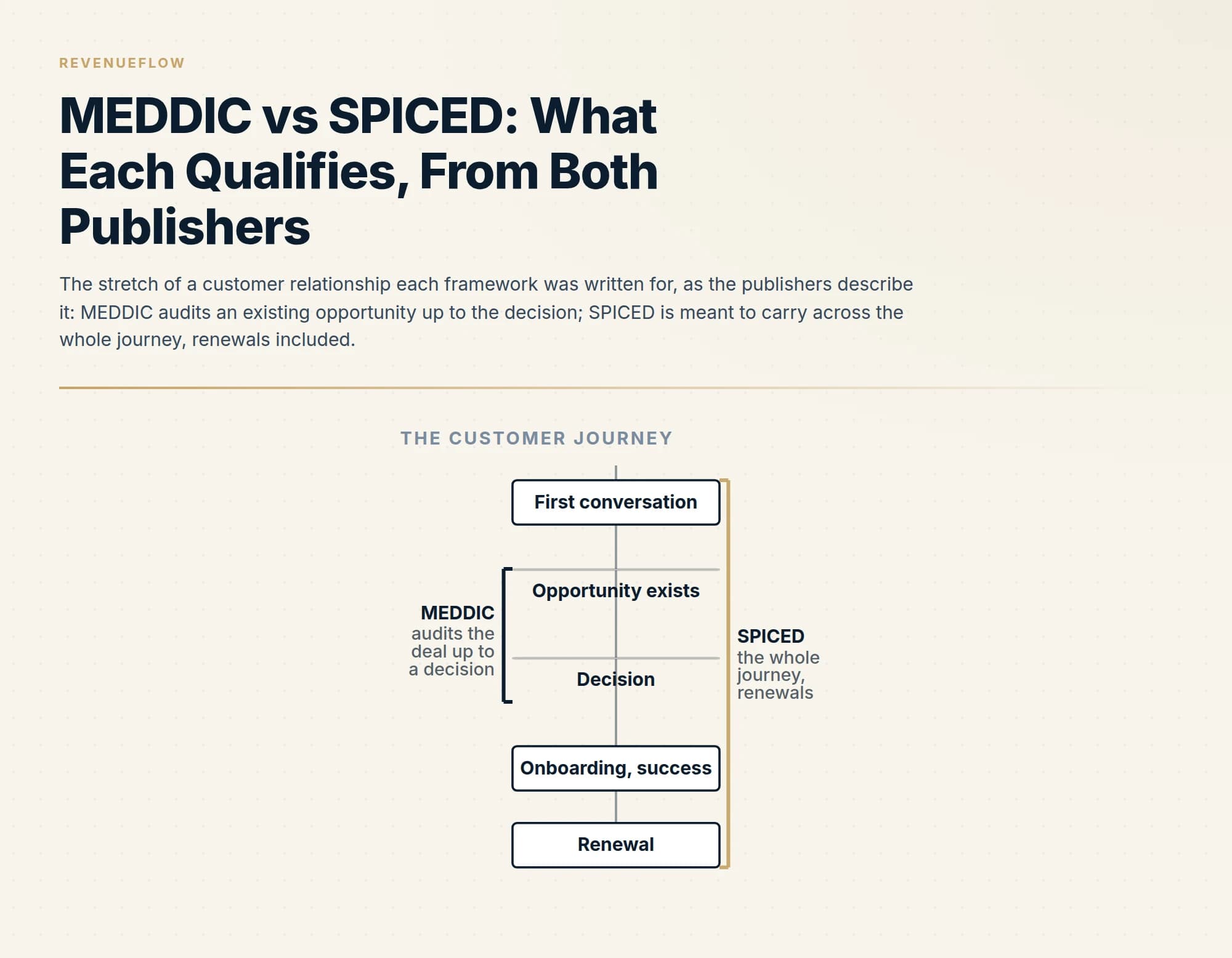
MEDDIC is six recurring reasons deals were won, lost or slipped, turned into a checklist that audits an existing opportunity and produces a defensible forecast. SPICED is five elements written for subscription businesses and meant to carry across teams after the sale. Choose on deal shape, on the record's job and on who reads it at renewal.
Key takeaways
- MEDDIC's creator describes six recurring themes from a why-we-win, why-we-lose, why-deals-slip exercise at PTC; MEDDIC Academy names forecast confidence as the checklist's output.
- SPICED's publisher defines five elements and claims they carry across sales, marketing, customer success and RevOps; Critical Event and Decision are where it overlaps MEDDIC most.
- Winning by Design's own post recommends teams with MEDDIC adopted keep it, maps every MEDDIC letter onto Impact, Decision or Critical Event, and concedes MEDDIC fits large, long, many-stakeholder deals.
- Every MEDDIC row in the publisher's comparison table is a rival's description; MEDDIC's own publishers agree on the job it does and disagree that being seller-side is a limitation.
Reviewed and updated September 19, 2026
MEDDIC and SPICED have something most named frameworks lack: both have a publisher who still writes about them, and one of those publishers has put its own comparison of the two on the record. Winning by Design, which built SPICED, published a post setting the two side by side, and MEDDIC's lineage is described by the people who were in the room at PTC. This page takes MEDDIC from the accounts of the people who built it, SPICED from the framework page its publisher maintains, and the comparison from Winning by Design's own post, with every statement about MEDDIC on that post marked as a rival's description. The four-framework map, with the blind spot each one carries, is on sales qualification frameworks; the contrast between MEDDIC and the older four-letter gate is on MEDDIC vs BANT.
MEDDIC, as the people who built it describe it
MEDDIC came out of a training exercise, which is the best way to understand what the six letters are for. Dick Dunkel, described by MEDDICC Ltd as the creator of the MEDDIC acronym, told Andy Whyte on the Masters of MEDDICC podcast, in a transcript published on 4 September 2022 and fetched on 19 September 2026, that the six themes emerged from a question he ran with colleagues while building an intermediate sales class at PTC: "Why do we win? Why do we lose? And why do deals slip?" In his words, "We started to see some recurring themes." The result: "So we had six things: Metrics, Economic Buyer, Decision Criteria, Decision Process, Pain, and Champions."
So the six letters are a list of the reasons deals were won, lost or slipped, turned into a checklist for deciding which deals to believe. MEDDIC Academy, founded by Darius Lahoutifard, a former PTC sales leader, publishes the six on its checklist page (published 30 January 2017, last modified 28 May 2026, fetched 19 September 2026) and states the job plainly: "Reviewing the MEDDIC CHECKLIST will result in an objective assessment of the level of qualification in the sales campaign and the degree of confidence in the sales forecast." And the consequence of a gap: "The unchecked elements on the MEDDIC CHECKLIST will point the sales team to the right actions in the account, leading to closing that deal."
MEDDIC is applied to an opportunity that already exists, and its output is a forecast a manager can defend. The same page is candid that it stayed internal for a long time: "MEDDIC was just an internal concept for over a decade since PTC was not a sales training company." The two publishers disagree on the year and on how much credit is one person's, which MEDDIC vs BANT sets out; the definitions of the letters alone are the glossary entries for MEDDIC and MEDDPICC.
SPICED, as its publisher defines it
SPICED is five elements, Situation, Pain, Impact, Critical Event and Decision, and Winning by Design publishes the definitions openly on its framework page (published 28 November 2025, last modified 13 August 2026, fetched 19 September 2026). The publisher's framing there is that SPICED "replaces surface-level qualification with a shared, outcome-driven way to grow revenue", and that it "aligns sales, marketing, customer success, and RevOps around what actually drives decisions". The full wording of the five elements, and what the framework assumes about a team adopting it, is on our page about SPICED, and this page does not restate it.
The two elements that matter most for the comparison are the last two. Critical Event, in the publisher's wording, is "The deadline, milestone, or external force that creates urgency and determines when a decision must be made." Decision is "How the customer will make the choice", including stakeholders, success criteria, tradeoffs and process. Those two are where the frameworks overlap most.
The comparison the publisher put on the record
Winning by Design's post, titled MEDDIC and SPICED 2023, Two Different Approaches, was published on 6 September 2023 and last modified on 12 March 2026, fetched on 19 September 2026. Its position is stated in its first paragraph, and it is not the one a rival usually takes: "We recommend those who have invested in MEDDIC and have achieved adoption within the team to continue their investment."
The argument is that the two do different jobs. "Whereas MEDDIC (and its derivatives) tells you where to pay attention, the SPICED approach's framework reveals how to extract the information MEDDIC needs." The post describes MEDDIC as "a stage-based deal qualification methodology" and adds a line about its scope that is a rival's characterisation rather than a fact from MEDDIC's own side: "MEDDIC is the epitome of a departmental function, in that it is only applied in sales, and primarily used by sales professionals." SPICED, by contrast, is described as "a methodology that goes across the entire customer journey".
The post then publishes a comparison table. Five of its rows are below in the publisher's own words; the MEDDIC column is Winning by Design describing a framework it did not build.
| Row | SPICED, in WbD's words | MEDDIC, as WbD describes it |
|---|---|---|
| Origins | By WbD, established in 2012 for SaaS businesses | Established in 1996 for perpetual software sales |
| Business model | Subscription-based model | Ownership-based model |
| Forecasting | Based on actions | Based on stages |
| Target audience | Seller with five or more years of experience | Seller with twenty or more years of experience |
| Primary focus | Customer-centric, establishing impact | Seller-centric, aimed at closing deals |
The table's origins row reads "By WbD Established in 2012 for SaaS businesses." against "Established in 1996 for Perpetual Software Sales."; its business-model row sets a subscription-based model against an ownership-based one, its forecasting row actions against stages, and its target-audience row a seller with five years of experience against one with twenty. The primary-focus row is the sharpest: for SPICED it reads "Customer-centric Focus on establishing impact." and for MEDDIC "Seller-centric Aimed at closing deals."
Read the MEDDIC column against MEDDIC's own publishers and the picture is less one-sided. MEDDIC Academy's page says the checklist's output is an objective assessment of qualification and forecast confidence, which is the seller-side job the table names, and the MEDDICC Ltd page hosting the Dunkel interview summarises his position as "MEDDIC is an operating system, not a checklist." So the two sides agree on what MEDDIC does and disagree on whether that is a limitation. Winning by Design's post also concedes the point in its own voice: "It is amazing how robust MEDDIC still is 25 years after its conception."
Where each one sits in the life of a customer
The most useful difference between the two is the stretch of the customer relationship each one was designed to cover.
MEDDIC begins when an opportunity exists and ends when it closes: a checklist reviewed against a deal, producing confidence in a forecast. Winning by Design's post gives the historical reason, again as its own account of MEDDIC: "Historically, MEDDIC was used for perpetual software sales, priced in the millions of dollars, explaining the focus on getting consensus across a wide variety of decision-makers involved in the Decision process." A large one-time purchase is decided once, and everything in MEDDIC is aimed at that decision.
SPICED was written for a subscription business, where the purchase is re-decided at every renewal and the account passes from sales through onboarding to customer success and back. The publisher's claim that the same five elements carry across teams is the reason for the framework's breadth: if customer success inherits the situation, the pain, the impact, the forcing event and the decision process in the customer's own words, the renewal conversation starts from what was true at the sale.
The caveat on the SPICED span is that it is a design intention stated by the publisher; a framework carries across teams only if somebody makes it.
How the publisher maps one onto the other
The post's most concrete section walks MEDDIC's letters into SPICED's elements, and the mapping shows where the frameworks coincide.
Pain and Metrics, in the post's account, are found through Impact: it says the impact-based framework "provides a 2-dimensional view of" how to uncover impact and identify pain, and adds a distinction MEDDIC's own publishers do not draw: "Whereas MEDDIC only looks for the rational impact, it shows you that through SPICED it also offers you emotional impact." Decision Criteria are built from Impact once it is agreed; Decision Process is SPICED's Decision element plus the roles of a buying centre; and the two remaining letters land on SPICED's timing element: "With SPICED, we have learned that a champion is triggered by Impact and a decider by the date they need that Impact (Critical Event)."
The publisher's own summary of the mapping is a set-theory claim: "All elements of MEDDIC can be found within the SPICED methodology." MEDDIC's publishers make no equivalent claim about SPICED; the mapping is one side's reading, and a coherent one: a team already recording MEDDIC fields could keep them and use SPICED's questions to fill them, which is what the post recommends.
Choosing, or running both with a line between them
Strip the framing away and the decision is about three things: the deal, what the record has to produce, and who beyond sales reads it.
Deal shape. Winning by Design's post says MEDDIC "often shines in complex, long-cycle sales typical of large enterprise solutions" and that "SPICED can be more agile and better suited for shorter cycles or less complex solutions." That is the one place the SPICED publisher concedes ground to MEDDIC without qualification, and it matches MEDDIC's origin: six themes distilled from large perpetual-licence deals with many decision-makers.
What the record is for. If the question a manager asks in a pipeline review is whether to believe a deal, MEDDIC's six fields were built to answer it, and MEDDIC Academy's page names forecast confidence as the output. If the question is what the customer's situation is and why they would act by a date, SPICED's Situation and Critical Event are the fields that hold it, and MEDDIC has no Situation element at all.
Who reads it after the sale. A team where the account leaves sales at signature has little use for a framework that carries into customer success. A subscription business where the same five facts are reopened at renewal does, which is the case SPICED was written for.
Run MEDDIC when
- The deal is large, long and decided by many people at once
- The record's job is to defend a forecast in a pipeline review
- The account does not return to sales after signature
Run SPICED when
- Cycles are shorter and the product is less complex
- The record's job is the customer's situation and forcing event
- Customer success and renewals reopen the same five facts
Running both is what Winning by Design's post argues for, and it works on one condition: the line between them is written down. SPICED questions in discovery, MEDDIC fields once an opportunity is forecastable, and a stated rule for when a deal crosses over. Without the rule, eleven fields that nobody inspects replace four that somebody does. The discovery call is where the SPICED half gets run, whichever framework holds the record afterwards.
- Yes: Which framework holds the record at each stage, stated in one sentence
- Yes: The rule for when a deal crosses from SPICED discovery to MEDDIC forecast
- Yes: Who inspects the fields outside the pipeline review
- No: Every deal carries all eleven fields from the first call
- No: A critical event or an economic buyer is a condition on whether a meeting counted
Where our own practice differs
Both frameworks begin once a conversation exists, and neither creates one. Our work sits before the first S and the first M: getting a qualified conversation onto the calendar, and on that side one position touches both frameworks.
A meeting we book is qualified against criteria agreed in writing before the campaign launches: the company is in the agreed audience, the person has real responsibility for the area, they agreed to a relevant business conversation and they attended. Budget, timing and decision authority are never conditions, because they are rarely knowable at a first conversation. So a MEDDIC economic buyer or a SPICED critical event is something to learn on the call, never a gate on whether the call counted; a diagnostic framework turned into a billing condition stops being diagnostic.
The second difference is cadence. We send one message per campaign, built on one premise, and a later approach is a separate campaign with a separate premise; on LinkedIn we do not send a second message at all. The reasoning, and what it costs, is on the Agoge sequence, where a published fifteen-touch cadence is taken apart from its primary sources.
The short version
MEDDIC is six recurring reasons deals were won, lost or slipped, turned into a checklist that audits an existing opportunity and produces a forecast a manager can defend. SPICED is five elements written for a subscription business, with a forcing event and a decision process as named criteria, meant by its publisher to carry across sales, customer success and renewals. Winning by Design's own comparison says MEDDIC tells you where to pay attention and SPICED how to extract it, recommends that a team with MEDDIC adopted keep it, and concedes that MEDDIC fits the large, long, many-stakeholder deal better. The MEDDIC column of that comparison is a rival's description; MEDDIC's publishers agree on the job and disagree that it is a limit.
Choose on deal shape, on what the record has to produce, and on who reads it after the sale; run both only with a written line between them. Neither framework produces the conversation it qualifies. If the constraint is that too few qualified conversations are starting, a first campaign is the cheapest way to find out what your market returns before deciding how to qualify it.
Every quotation above is from the named page as fetched on 19 September 2026: Winning by Design's MEDDIC and SPICED post (published 6 September 2023, modified 12 March 2026) and SPICED framework page (published 28 November 2025, modified 13 August 2026); MEDDIC Academy's checklist page (published 30 January 2017, modified 28 May 2026); MEDDICC Ltd's Dick Dunkel interview transcript (published 4 September 2022). Publishers revise these pages; confirm the current text before relying on it.
Frequently asked questions.
Frequently asked questions- What is the difference between MEDDIC and SPICED?
- MEDDIC is a six-part checklist reviewed against an opportunity that already exists, and its own publishers say its output is an objective assessment of qualification and forecast confidence. SPICED is five elements written by Winning by Design for subscription businesses, ordered so the customer's situation and pain come before impact, with a forcing event and a decision process as named criteria, and meant to carry across teams after the sale.
- Can MEDDIC and SPICED be used together?
- Winning by Design's own comparison post recommends exactly that for a team that has already adopted MEDDIC, mapping each MEDDIC letter onto SPICED's Impact, Decision and Critical Event. It works when the line between them is written down: SPICED questions during discovery, MEDDIC fields once an opportunity is forecastable, and a stated rule for when a deal crosses over. Without the rule, eleven fields nobody inspects replace four somebody does.
- Which is better for enterprise sales, MEDDIC or SPICED?
- Neither publisher claims a universal winner. Winning by Design's post concedes that MEDDIC often shines in complex, long-cycle enterprise sales with many stakeholders, and says SPICED suits shorter cycles and less complex solutions, which matches MEDDIC's origin in large perpetual-licence deals at PTC. Choose on the deal's size and length, on whether the record must defend a forecast, and on whether customer success reopens the same facts at renewal.
- Does SPICED replace MEDDIC's economic buyer and champion?
- In the publisher's mapping, no. Winning by Design's post says a champion is triggered by Impact and a decider by the date they need that Impact, which is SPICED's Critical Event, so both roles are found through two SPICED elements rather than named as separate criteria. MEDDIC keeps them as explicit fields. A team that needs a named economic buyer on every forecasted deal keeps the MEDDIC field.
About the author.

B2B cold email experts helping companies generate qualified leads through done-for-you outreach campaigns.
RevenueFlow Team
Explore more.
Ready to scale your outreach?
We build GTM engines that book real meetings. See the receipts.
Related articles.
MEDDIC vs BANT: What Each Qualifies and When to Use Which
MEDDIC and BANT from the originators' own text: IBM's BANT form as a gate after the first call, PTC's six themes as an audit of a live deal, and when to run each.
Command of the Sale: Force Management's Process Programme
Command of the Sale is Force Management's sales process and qualification programme, not its messaging one. What the vendor says it is, delivers and how it runs.
Gap Selling vs SPIN Selling: What Each Method Diagnoses
Gap Selling and SPIN Selling from their authors' own pages: four question types that develop a stated need, against a measured gap between two states.
Sandler vs Challenger: What Each Trains, From Both Publishers
Sandler and Challenger from their own publishers: a seven-step system that qualifies before presenting, against a message that reframes the buyer's thinking first.
The Summary Close: Restating What Was Agreed Before the Ask
The summary close restates the buyer's needs, the agreed answer to each and then asks. What the publishers say, the structure, a worked example, and where it fails.
The Urgency Close: Real Deadlines and Manufactured Ones
The urgency close from the publishers who teach it, the test that separates a real deadline from a manufactured one, the structure, and why we never invent one.