The Urgency Close: Real Deadlines and Manufactured Ones
The urgency close from the publishers who teach it, the test that separates a real deadline from a manufactured one, the structure, and why we never invent one.
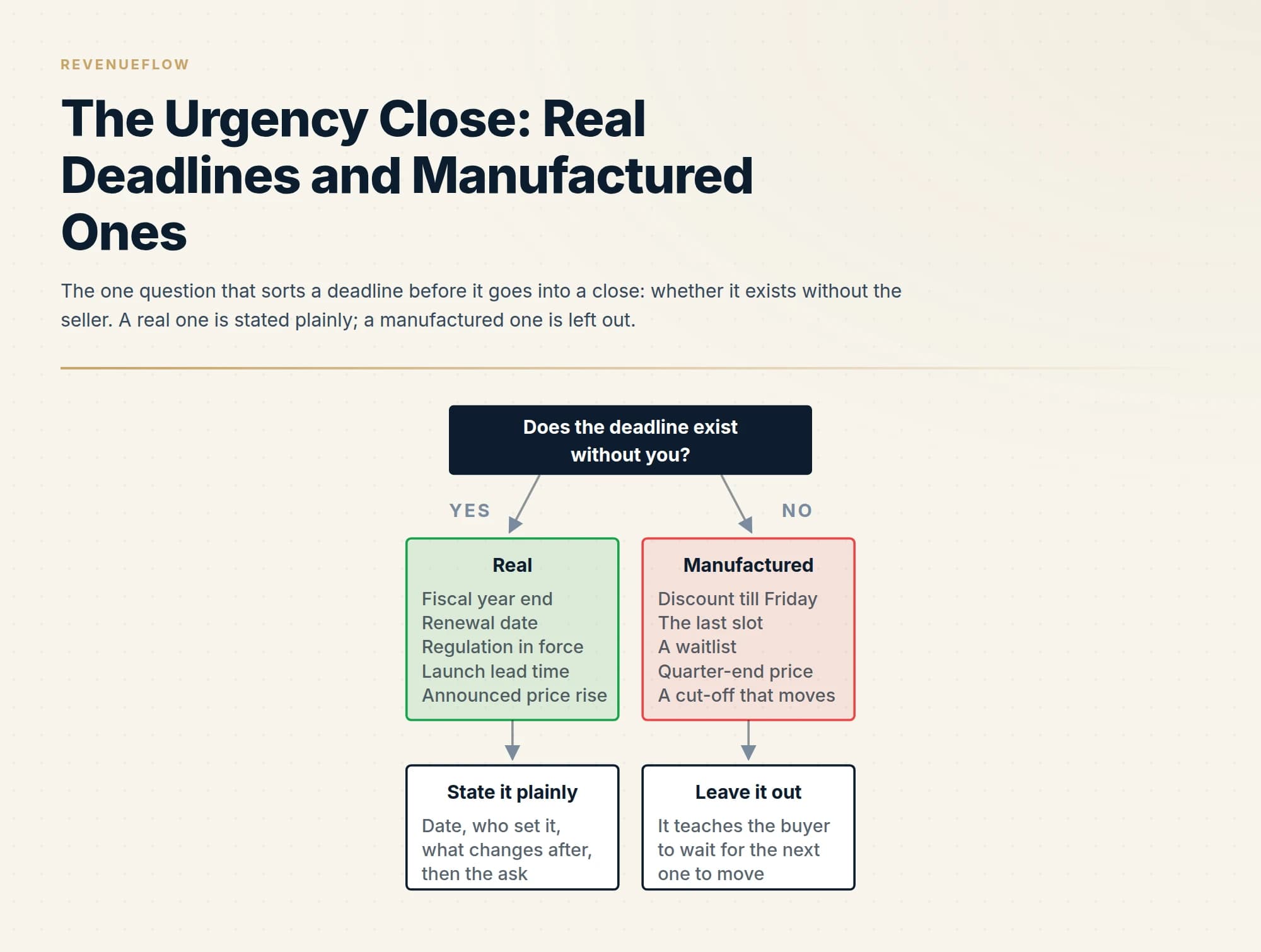
The urgency close attaches a reason to decide now to the ask. A deadline is real when it exists without the seller and has another owner: a fiscal year end, a renewal, a regulation, a launch lead time. When real, state the event, its date, its owner and what changes after, then ask. Otherwise leave it out.
Key takeaways
- The publishers agree on the mechanism and warn about the source: Breakcold on manipulation, Sandler on buyers conditioned to wait for the next deadline, Close.com on reputation, Salesforce on the sincere interest the close depends on.
- Highspot separates the urgency close, which anchors timing to business impact, from the scarcity close, which anchors it to perceived value; the first draws its date from the buyer's situation and the second from something the seller controls.
- The test is ownership: a real deadline passes and the consequence arrives for the buyer, while a manufactured one passes and a new one appears, which is what teaches buyers to wait.
- One message per campaign means the technique has one home for us, a reply thread where the buyer has already agreed the problem; a date sent to somebody who never replied is a follow-up whatever the date.
Reviewed and updated September 19, 2026
A buyer who has agreed the problem, accepted the price and named the people who need to sign is, by every account, ready. Then nothing happens for three weeks, because nothing in the world requires it to happen this week rather than next. The urgency close is the technique for that gap: a reason to decide now rather than later, stated plainly and attached to the ask. It is also the closing technique with the worst reputation, because the reason is so often invented. This page explains the one technique from the publishers who teach it, separates the deadlines that are real from the ones a seller manufactures, and says why the site does not manufacture them.
The library of techniques and what each one assumes is on sales closing techniques, which gives this one a paragraph and a warning. The twelve messages built around real time pressure are on urgency email templates. This is the page for the technique itself.
What the technique is, in the publishers' own words
The definitional page in the row is Breakcold's, published on 13 July 2026, modified on 22 July 2026 and fetched on 19 September 2026: "An urgency close is a persuasive technique commonly used in sales and marketing to create a sense of urgency and encourage immediate action from potential customers." It names the levers in the next clause: "By highlighting time-limited offers, limited availability, or impending price increases, the urgency close is designed to motivate individuals to make a decision quickly." And it names the cost in its own section on disadvantages: "If misused or overused, it can come across as manipulative, leading to a loss of trust and credibility. Customers may perceive the sense of urgency as a sales tactic rather than a genuine offer."
HubSpot's list of eighteen closing techniques, which its page dates to 13 August 2026 and which was fetched on 18 September 2026, files it first under a different name: "This is where salespeople make an offer that includes a special benefit that prompts immediate purchase. This technique creates a sense of urgency and helps prospects overcome buying inertia." Salesforce's guide to closing techniques, published on 19 September 2023 and modified on 22 January 2024, gives it a third name and the condition it depends on: "Also known as the now-or-never close, the scarcity sales close leverages good old-fashioned FOMO (fear of missing out) to get a prospect to buy." and "This mainly works when the prospect is sincerely interested in buying, but needs a small nudge to get to yes."
Highspot's list, published on 17 December 2025 and modified on 15 May 2026, is the one source that separates two things the others run together. Its urgency close "Anchors timing to business impact", and reps who use it do so "by aligning timing with impact, emphasizing the additional cost of not making a change, and anchoring the ask in outcomes already acknowledged." Its scarcity close is listed separately and "Aligns timing with perceived value". That split is the useful one: the first anchors the deadline in the buyer's own situation, the second in something the seller controls.
Sandler's post on closing fourth-quarter deals, published on 20 October 2025, modified on 16 September 2026 and fetched on 19 September 2026, calls the seller-side version the impending event close and states the side effect in one sentence: "One effective method is the impending event close, where you highlight a time-sensitive offer or a looming price increase. However, over-reliance on this tactic can condition customers to delay their purchases, expecting better deals at the year-end."
Read together, the publishers agree on the mechanism and disagree on the source of the deadline. That disagreement is the whole subject.
Real deadlines and manufactured ones
A deadline is real when it exists whether or not the seller mentions it. A deadline is manufactured when the seller made it, can move it, and would move it if the buyer asked. The test is not whether the deadline is true at the moment it is spoken; a discount that expires Friday is true on Thursday. The test is who owns it.
Real deadlines come from the buyer's side or from the world. The buyer's fiscal year ends and unspent budget is lost. A contract with the incumbent renews on a date, and a decision after it is a decision for next year. A regulation takes effect. An implementation needs eight weeks and the launch the buyer named is ten weeks away. A price change has been announced to every customer, with a date, and would happen whether this buyer signs or not. Close.com's guide to creating urgency, written by Steli Efti, published on 21 December 2023 and last updated on 14 July 2026, puts the condition on the last of those plainly: "Of course, you can only use this strategy if you actually plan to raise prices."
Manufactured deadlines come from the seller. The discount that exists only for this buyer and only until Friday. The implementation slot that is somehow always the last one. The waitlist nobody is on. The end-of-quarter price that is offered every quarter. Sandler's sentence describes what those teach: a buyer who has seen the deadline move learns to wait for it to move again. Close.com's guide states the reputational cost in the same terms: "If every sales message you send is urgent, you'll develop a bad reputation in the marketplace."
The tell, for a buyer reading a deadline, is what happens when they do not act. A real deadline passes and the consequence arrives: the budget lapses, the renewal locks, the launch slips. A manufactured deadline passes and a new one appears. The library page on this site names the same tell from the seller's side, that the deadline moves when the buyer does not, and it is the reason a manufactured deadline is the fastest way to lose a deal that was already won.
The structure, when the deadline is real
A real deadline does not need dressing up, and the technique when done honestly is mostly a matter of stating four facts and then asking. Highspot's description is the structure in miniature: timing aligned with impact, the cost of not changing named, the ask anchored in outcomes the buyer has already acknowledged.
The event and its date. Name the thing and when it happens, in the buyer's terms. The renewal on the thirtieth. The budget year that closes in March. The launch in the second week of November. If the seller cannot name a date the buyer would recognise, there is no real deadline and the close should not be attempted.
Who set it. A real deadline has an owner who is not the seller. The buyer's finance calendar, the incumbent's contract, a regulator, the buyer's own launch plan. Saying who set it is what makes the deadline credible, and it is the sentence a manufactured deadline cannot produce.
What changes after it. This is Highspot's cost of not making a change, and it is the buyer's cost, not the seller's. A decision after the renewal means twelve more months on the current contract. A decision after the budget closes means the project competes for next year's money. An implementation that starts after the lead time runs out means the launch goes without it.
The ask. One question, naming the next concrete step, inside the window the date allows. The ask follows from the arithmetic, which is why it does not need pressure: if the implementation takes eight weeks and the launch is in ten, the question is whether to start next week, and the buyer can do the subtraction.
| Deadline | Who owns it | When it passes |
|---|---|---|
| Fiscal year end | The buyer's finance calendar | The budget lapses |
| Renewal date | The incumbent's contract | A further term locks in |
| Regulation in force | A regulator | The buyer is out of compliance |
| Launch lead time | The buyer's own plan | The launch goes without it |
| Announced price change | The seller, announced to every customer with a date | The new price applies to everyone |
| Discount until Friday | The seller, for this buyer | A new Friday appears |
| The last slot | The seller | A new slot opens |
| Quarter-end price | The seller's quota | It returns next quarter |
The announced price rise is the one seller-owned date this page counts as real, because it applies to every customer whether or not this buyer signs.
A worked example, in a reply thread
The example below is invented for this page. The company, Brightmere Logistics, its VP Operations, the Q1 cohort and every date are fictional, and the message sits in a thread where the buyer has already replied and agreed the problem, which is the only place this page recommends the technique. In the invented thread the buyer's new dispatch team starts on 12 January, the incumbent's contract renews on 31 December, and the seller's setup takes six weeks, so counting back from the team's start date puts the decision in the week of 17 November. Both dates belong to the buyer and neither is the seller's to move, which is what makes the message accuracy rather than pressure.
Re: onboarding for the Q1 cohort, to the VP Operations at Brightmere Logistics (invented)
You mentioned the new dispatch team starts on 12 January, and that the current contract with your provider renews on 31 December. 1
Both dates are yours rather than ours, so the arithmetic is fixed: our setup takes six weeks from a signed order, and a renewal on the thirty-first means a second year on the current terms. 2
A start in the week of 17 November lands the setup before the cohort arrives. Should the order go to procurement this week, or is the renewal already being renegotiated? 3
Either answer is useful to us.
- 1The event and its date, and who set it: the buyer's own start date and the incumbent's renewal. Neither is the seller's to move.
- 2What changes after the date, stated as the buyer's cost, with the lead time that makes the deadline binding.
- 3The ask follows from the subtraction and offers the honest alternative, which is what separates it from pressure.
The message contains no offer that expires, no slot that is running out and no word the buyer could later find was untrue. Everything in it can be checked by the buyer against their own calendar, which is the property a manufactured deadline never has.
Where the technique fails
Three failures are worth naming, and the first is the common one.
The deadline is the seller's. Every source on this page names it. Breakcold's manipulation warning, Sandler's conditioned buyers, Close.com's bad reputation. The technique fails the moment the buyer works out who owns the date, and buyers work it out because they have seen it before.
The buyer is not sincerely interested. Salesforce's condition is the second gate: the close nudges a buyer who wants to buy and has stalled; it does not create want. Pressure on a buyer who has not agreed the problem produces a no that could have been a not yet, and the deadline that was supposed to help is what they will remember.
The cost of missing it is the seller's cost dressed as the buyer's. A quarter-end discount is the seller's quota wearing the buyer's clothes. Highspot's version of the technique is the cost of not making a change, and the buyer can tell the difference between a cost they will bear and one the seller will.
Where we differ from standard practice
Our own campaigns send one message per person, built on one premise, and nothing is scheduled behind it. That rule decides where the urgency close can and cannot appear for us, and the answer is narrower than the publishers' pages suggest.
It cannot appear in a first message, because the first message is to a stranger who has agreed nothing, and a deadline in it is by definition the seller's. And it cannot appear as a second message to someone who did not reply, however real the deadline, because a follow-up whose content is a date is still a follow-up: it lands beneath the message they already chose not to answer, and the date does not change what that is. The reasons we send nothing behind the first message, with the cost that choice carries, are in why we stopped using follow-ups, and the market's pressure tactics, including manufactured urgency, are catalogued in high-pressure sales tactics.
Where the technique does belong for us is inside a reply thread, after the buyer has replied with a real position, where a real deadline can be named with its owner and the ask can follow from the subtraction, as in the example above. That is correspondence, and the technique in that setting is closer to accuracy than to pressure.
There is a wider point that the persistence-based sequences make visible. The Agoge sequence is built on the idea that the fifteenth touch reaches people the first one missed, and this site's read of it is that volume-based persistence works less well the more widely it is adopted. Manufactured urgency has the same property. When every seller's deadline is Friday, Friday stops meaning anything, and the sellers left holding a real date find that the buyer has learned not to believe it.
If the constraint is that there are too few conversations in which a real deadline could be named, that is the half we run: a first campaign against your market produces the replies in which the technique has a place.
The short version
The urgency close is a reason to decide now, attached to the ask. The publishers who teach it agree on the mechanism and warn about the source: Breakcold on manipulation, Sandler on buyers conditioned to wait, Close.com on reputation, Salesforce on the sincere interest it depends on, Highspot on anchoring the date in business impact rather than perceived value. A deadline is real when it exists without the seller and has an owner who is not the seller; when it is, state the event, its date, its owner and what changes after it, then ask. When it is not, leave it out. We do not manufacture urgency, and we do not send a date to somebody who never replied.
Publisher pages quoted as fetched on 19 September 2026 (HubSpot and Salesforce on 18 September 2026): Breakcold (published 13 July 2026, modified 22 July 2026), HubSpot (dated 13 August 2026 on the page), Salesforce (published 19 September 2023, modified 22 January 2024), Highspot (published 17 December 2025, modified 15 May 2026), Sandler (published 20 October 2025, modified 16 September 2026), Close.com (published 21 December 2023, updated 14 July 2026). Publishers revise these pages; confirm the current text before relying on it.
Frequently asked questions.
Frequently asked questions- What is the urgency close in sales?
- A closing technique that gives the buyer a reason to decide now rather than later and attaches it to the ask. Breakcold defines it as a persuasive technique that creates a sense of urgency through time-limited offers, limited availability or impending price increases. HubSpot lists it as the now or never close, and Salesforce as the scarcity close, noting it works mainly when the prospect is already sincerely interested.
- How do you tell a real deadline from a manufactured one?
- Ask whether the deadline would exist if the seller never mentioned it, and who owns it. A fiscal year end, a renewal date, a regulation in force, a launch lead time or a price change announced to every customer with a date all pass. A discount until Friday, the last implementation slot, a waitlist or a quarter-end price are the seller's, and the tell is that a new one appears when the old one passes.
- Is creating urgency in sales manipulative?
- Manufactured urgency is, and the publishers who teach the technique say so: Breakcold warns it reads as a sales tactic rather than a genuine offer, Sandler says over-reliance conditions customers to delay purchases expecting better deals, and Close.com says a seller whose every message is urgent develops a bad reputation. Naming a real deadline the buyer already owns, with its date and consequence, is accuracy rather than pressure.
- How should the urgency close be worded when the deadline is real?
- State the event and its date in the buyer's terms, say who set it, name what changes for the buyer after it passes, and then ask one question inside the window the date allows. If setup takes six weeks and the buyer's team starts on a fixed date, the ask is whether to start by the date the subtraction gives, and it offers the honest alternative rather than pressure.
About the author.

B2B cold email experts helping companies generate qualified leads through done-for-you outreach campaigns.
RevenueFlow Team
Explore more.
Ready to scale your outreach?
We build GTM engines that book real meetings. See the receipts.
Related articles.
The Summary Close: Restating What Was Agreed Before the Ask
The summary close restates the buyer's needs, the agreed answer to each and then asks. What the publishers say, the structure, a worked example, and where it fails.
The Columbo Close: One More Thing, and Where It Works
The Columbo close is the question asked from the door once the buyer thinks the selling is over. Its two readings, the buyer it suits, and where it fails.
The Direct Close: Asking Plainly for the Business
The direct close asks for the business with nothing wrapped around the question. The condition the publishers attach, the buyer it suits, where it backfires.
Command of the Sale: Force Management's Process Programme
Command of the Sale is Force Management's sales process and qualification programme, not its messaging one. What the vendor says it is, delivers and how it runs.
Objection Handling Frameworks: LAER, AAA and Others Compared
The named objection-handling frameworks with their publishers quoted: Carew's LAER, RAIN Group's four steps, HubSpot's five, Gong's three and both AAAs.
MEDDIC vs BANT: What Each Qualifies and When to Use Which
MEDDIC and BANT from the originators' own text: IBM's BANT form as a gate after the first call, PTC's six themes as an audit of a live deal, and when to run each.