The Direct Close: Asking Plainly for the Business
The direct close asks for the business with nothing wrapped around the question. The condition the publishers attach, the buyer it suits, where it backfires.
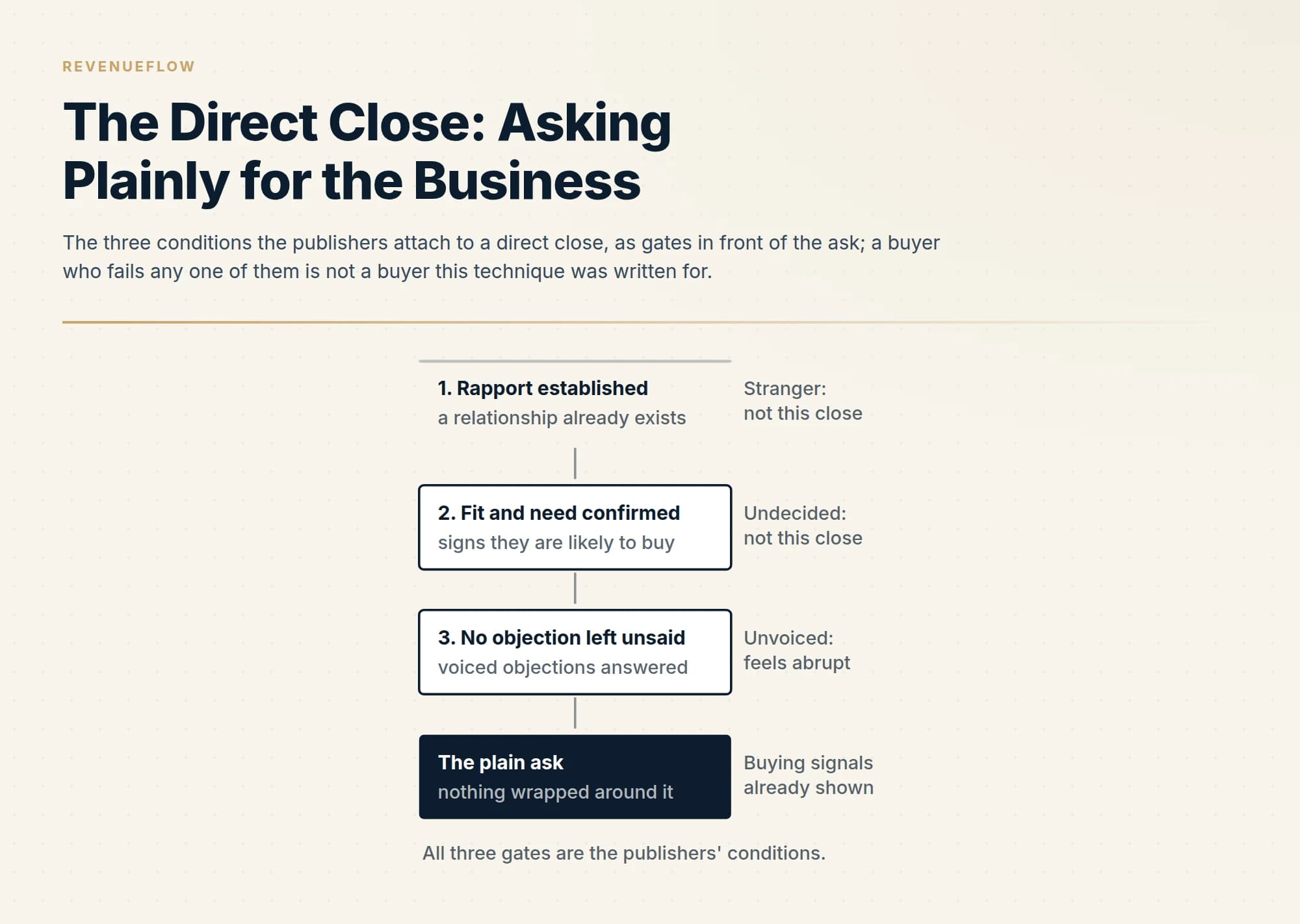
The direct close asks the buyer plainly whether they are ready to buy, with no summary, deadline or choice wrapped around the question. The publishers who teach it attach one condition: a relationship, a confirmed fit and no remaining objections, shown by buying signals. On that buyer it reads as respect; on an undecided one it reads as pressure.
Key takeaways
- Five sales publishers define the direct close in the same sentence, an ask for the sale with no tricks or elaborate setup, and every one of them conditions it on buying signals already shown and no objections left unvoiced.
- It suits decision-makers who prefer concise dialogue and corrects a seller-side failure, presenting past the point where the buyer has decided; ZoomInfo's instruction is to stop presenting and ask directly when the prospect signals readiness.
- It backfires on an undecided buyer, on one with an unvoiced objection, in cultures where directness reads as aggression, and when the seller hesitates; the remedy is upstream, surfacing objections before the ask.
- In a one-message outbound motion the cold message asks only for a conversation; the direct close belongs in the reply thread, once, after fit is established, and never in the first message to a stranger.
Reviewed and updated September 19, 2026
A second call has gone well. The buyer has asked about the start date, confirmed who signs, and said the price is inside the range they had in mind. The seller, trained to keep the conversation moving, moves on to the implementation slide. The direct close is the name the sales-training publishers give to the thing that should have happened instead: stop, and ask plainly for the business.
This page is about that one technique and nothing else: what the publishers who teach it say it is, the condition every one of them attaches to it, the buyer it suits, where it backfires, what it assumes about B2B purchases, and where a plain ask belongs inside an outbound motion that sends one message per campaign. The other named closes are catalogued once on this site, in sales closing techniques, and are not restated here.
What the technique is, in the publishers' words
Five sales publishers who teach the technique describe the direct close in almost the same sentence, which is worth noticing, because it means the technique has no hidden mechanism. ZoomInfo's Pipeline blog, in a page titled for 2026 and fetched on 19 September 2026, defines it in eight words: "The direct close simply asks for the sale. No tricks, no elaborate setup." NetHunt's guide, published 21 August 2023 and modified 30 July 2026, says "The direct close is a straightforward technique where the salesperson simply asks the customer if they're ready to make a purchase." The D2D Experts' guide, published 18 December 2025 and modified 14 September 2026, puts it as "The direct close is straightforward: you explicitly ask for the sale without surrounding it with elaborate setups or conditions."
The dictionary version is the same. MBASkool's entry, undated and read on 19 September 2026, says the term "refers to process of making a sale where the salesperson directly asks the customer to buy the product." And Leadium, in a post dated 11 November 2025, files it with a warning attached: "A risky approach, the 'direct close' involves the seller simply asking the prospect to buy (when they feel they're ready)."
So the technique is an ask with nothing wrapped around it. No summary first, no pair of alternatives to choose between, no deadline. The publishers' sample wordings are as plain as the definition: ZoomInfo's is "Are you ready to move forward with this?" and The D2D Experts offer "Shall I prepare the agreement for signing?" among three examples. What distinguishes the direct close from every other entry in the canon is precisely that there is nothing to describe.
The condition every publisher attaches
Because the ask carries no persuasion of its own, all of the work has to have been done before it. Every source says so, in its own terms. ZoomInfo's when-to-use line: "When you have a strong relationship, clear fit, and no remaining objections. Confidence matters here." NetHunt: "This method is best used when the customer has shown clear signs that they are likely to buy." The D2D Experts' guide has it that the technique "works best when you've already built rapport, confirmed need, and eliminated objections." and tell the reader what readiness looks like: "Look for buying signals: nods, questions about payment, or requests for paperwork." with cues such as "questions about delivery dates, budget confirmations, or feature clarifications."
MBASkool states the condition as a limit rather than a tip: "Direct Close technique works only when the salesperson knows that the prospect is surely going to buy the product", which is why its entry adds that "This type of closing technique is not generally encouraged among salespersons." The reasoning is the same as everyone else's from the other side: where minds still have to be changed, a bare ask changes nothing.
The buyer it suits, and why it works on them
The publishers agree on who answers a plain question with a plain answer. The D2D Experts name the buyer: the directness "can be especially effective with decision-makers who prefer clear, concise dialogue rather than back-and-forth negotiations", and give the reason as respect: "By cutting to the chase, you respect the prospect's time and demonstrate confidence in your solution." ZoomInfo's why-it-works line makes the same point about the seller rather than the buyer: "When rapport is strong and value is clear, directness works better than complexity." followed by "Many reps overcomplicate closing when a straightforward ask would work."
That second sentence is the useful one. The failure the direct close corrects is not a buyer who needs persuading; it is a seller who keeps presenting after the buyer has decided. ZoomInfo's instruction for the moment is the plainest in any of the sources: "When the prospect signals readiness, stop presenting and ask directly." A buyer who has asked about the start date has told you the decision is made, and every additional slide gives them a reason to unmake it.
NetHunt lists the upside in three lines: the technique is "Effective when the customer has shown strong buying signals.", it "Can expedite the sales process.", and it is straightforward and clear. None of those is a claim about conversion, and no source fetched for this page publishes a measured rate for the technique; none is invented here.
Where it backfires
The same sources are as specific about the failure cases, and the cases are all the same case: the ask arrived before the conditions were met.
NetHunt's cons are that the technique "Might be perceived as too forward or aggressive", that it "May not work with customers who are still undecided." and that it "Risks coming off as too salesy." The D2D Experts name the specific mechanism: "If the prospect still has unvoiced objections, a direct close can feel abrupt or off-putting." and add a second, about context rather than the buyer: "In some industries or regions, being too direct can be seen as aggressive." ZoomInfo puts the seller-side failure in one line: "Hesitation kills direct closes. If you're not confident, this technique will backfire."
The pattern underneath is that a bare ask amplifies whatever was already true. Delivered to a buyer who has decided, it reads as respect. Delivered to a buyer with a question they have not voiced, it reads as pressure, and it forces the question out at the worst possible moment: after the ask, as a refusal, rather than before it, as a discussion. The remedy is upstream of the close. Objections that surface at the ask were usually available earlier and were not asked for, and the habit of testing where you are throughout a conversation is what makes a plain ask at the end safe.
- Strong relationship, clear fit, no remaining objections
- Buying signals shown: questions about payment, paperwork, delivery dates
- A decision-maker who prefers concise dialogue
- The seller is confident and stops presenting
- The customer is still undecided
- An objection exists that nobody has voiced
- An industry or region where directness reads as aggression
- The seller hesitates, or is a stranger to the buyer
What it assumes about a B2B purchase
Every wording the publishers offer is addressed to one person who can say yes in the room. ZoomInfo's ask and The D2D Experts' three examples all end in a decision from the person being spoken to. In a small purchase that person exists. In most B2B software and services purchases above a modest size, the person on the call is the one who will have to go and get the decision made by others, and a plain ask to them produces a plain answer that is not the answer: they will have to check.
That does not make the technique wrong in B2B; it changes what the ask is for. Asked of the person who owns the problem, at the point where they have confirmed fit and price, the direct question surfaces the real remaining step, which is usually a name and a process rather than an objection. The answer to a plain ask in a committee purchase is information about the committee, and the frameworks that track that information are qualification frameworks rather than closing ones; how a deal's paper process and buying group are mapped is worked through in MEDDPICC. A direct close in that setting is a question whose honest answer tells you whether you are talking to the right person.
The other B2B fact is that the buyer of anything substantial has been sold to before, and recognises every technique in the canon. The direct close is the one technique a professional buyer cannot resent, because it contains nothing to see through. That is the strongest argument for it in this setting and the reason it survives scrutiny afterwards: it asked a question, and the buyer answered it.
Where a direct ask belongs in an outbound motion
This site runs cold email and LinkedIn outbound and books meetings; the client's own people take the conversation from there. The programme sends one message per campaign, with no bumps and no thread replies, and a later approach to the same audience is a new campaign on a different premise. The reasoning and its cost are in why we stopped using follow-ups. Where that leaves the direct close is specific, and it is worth stating because the technique's name invites the wrong use.
A cold message never asks for the business. It asks for a conversation, from a stranger who has met none of the three conditions above: no relationship, no confirmed need, every objection unvoiced. A first email that asks the reader to buy is a direct close delivered to the buyer the publishers say it backfires on, and no amount of confidence changes that. The ask a cold message can honestly carry is small and specific, and its job is to start the thread in which the real questions get asked.
The reply thread is where the direct ask lives. Once somebody has answered, a conversation exists, and every later message in it is correspondence rather than outreach. When that conversation has established fit and the buyer has shown the signals the publishers list, the plain question is the right next line, and it is written in the thread the buyer started, on their subject line, in one message. The example below is invented, to show the shape rather than to report anything sent.
Re: the receiving-error write-up you asked for
Thanks for the notes from your operations lead; the two sites and the start date you named are noted on our side. 1
The pricing you asked about is the figure in the proposal, with the onboarding fee waived for a two-site start, as discussed. 2
Shall I send the agreement over for signing? 3
- 1Restates what the buyer supplied, in one sentence, so the ask that follows is visibly built on their own words rather than the seller's summary.
- 2Closes the one open question they raised. If a question remains unanswered here, the conditions are not met and this is the wrong message.
- 3The direct close: one question, nothing wrapped around it, sent once in the thread the buyer opened. The reply, whatever it is, is the next real step.
One more boundary follows from where the meetings come from. What counts as a qualified meeting is agreed in writing before a campaign launches: the company fits the profile, the person has real responsibility for the area, they agreed to a relevant conversation, and they attended. Budget, timing and decision authority are never billing conditions, because all three are unknowable from outside and unstable from inside. That is also why the direct close cannot be moved forward into the first meeting: the conditions the publishers attach to it are exactly the facts a first conversation exists to discover, and the discovery call is where they are honestly established.
The short version
The direct close asks for the business plainly, with nothing wrapped around the question; the publishers who teach it, ZoomInfo, NetHunt, The D2D Experts, MBASkool and Leadium, define it the same way and attach the same condition: a relationship, a confirmed fit and no remaining objections, evidenced by buying signals the buyer has already shown. On that buyer it reads as respect and saves the deal from a seller who keeps presenting. On an undecided buyer, or one holding an unvoiced objection, it reads as pressure and forces the objection out as a refusal.
In B2B the honest answer to a plain ask is often a name and a process rather than a yes, which makes the technique a way of finding out whether the right person is in the conversation. In a one-message outbound motion, the cold message asks only for a conversation; the direct close belongs in the reply thread, once, after fit has been established. If the constraint is the number of those conversations rather than how to end them, we plan the first campaign for free.
Definitions, conditions, sample wordings and failure cases are quoted from ZoomInfo's Pipeline blog (page titled for 2026, fetched 19 September 2026), NetHunt (published 21 August 2023, modified 30 July 2026), The D2D Experts (published 18 December 2025, modified 14 September 2026), MBASkool (undated, read 19 September 2026) and Leadium (11 November 2025), all fetched first-hand on 19 September 2026. The reply-thread example is invented. Publishers revise these pages; confirm the current text before relying on it.
Sources: ZoomInfo Pipeline: sales closing techniques, NetHunt: 10 closing techniques, The D2D Experts: sales closing techniques, MBASkool: Direct Close, Leadium: how to close a deal
Frequently asked questions.
Frequently asked questions- What is the direct close in sales?
- A closing technique in which the seller asks plainly for the business, with nothing wrapped around the question. ZoomInfo's Pipeline blog defines it as simply asking for the sale with no tricks and no elaborate setup, NetHunt as the salesperson simply asking whether the customer is ready to make a purchase, and MBASkool as the salesperson directly asking the customer to buy the product. The sample wordings are a single question.
- When should you use a direct close?
- When the conditions the publishers attach to it are all met: a relationship exists, the fit and need are confirmed, and no objection remains unvoiced. The signals they name are questions about payment, paperwork, delivery dates and start dates. MBASkool goes further and says the technique works only when the seller knows the prospect is going to buy, which is why it describes the technique as not generally encouraged.
- Why does the direct close backfire?
- Because a bare ask amplifies whatever was already true. Delivered to a buyer who is still undecided it reads as forward or aggressive, and delivered to a buyer holding an unvoiced objection it forces that objection out as a refusal rather than a discussion. The D2D Experts also note that in some industries or regions directness itself reads as aggression, and ZoomInfo adds that a hesitant seller makes the technique fail.
- Can a direct close be used in a cold email?
- No, and the publishers' own conditions say why: a stranger has no relationship with you, has confirmed nothing and holds every objection unvoiced. A cold message asks for a conversation, never for the business. The direct close belongs in the reply thread, after somebody has answered and the conversation has established fit, written once on the buyer's own subject line. On this site a cold message is sent once, with no bumps and no thread replies.
About the author.

B2B cold email experts helping companies generate qualified leads through done-for-you outreach campaigns.
RevenueFlow Team
Explore more.
Ready to scale your outreach?
We build GTM engines that book real meetings. See the receipts.
Related articles.
The Columbo Close: One More Thing, and Where It Works
The Columbo close is the question asked from the door once the buyer thinks the selling is over. Its two readings, the buyer it suits, and where it fails.
The Urgency Close: Real Deadlines and Manufactured Ones
The urgency close from the publishers who teach it, the test that separates a real deadline from a manufactured one, the structure, and why we never invent one.
The Summary Close: Restating What Was Agreed Before the Ask
The summary close restates the buyer's needs, the agreed answer to each and then asks. What the publishers say, the structure, a worked example, and where it fails.
B2B Sales for Financial Services Companies: Regulated Seller
For the bank, agency, broker-dealer or adviser selling to businesses: the buying group, the credit and renewal windows, and the rules that bind the seller's own message.
Command of the Sale: Force Management's Process Programme
Command of the Sale is Force Management's sales process and qualification programme, not its messaging one. What the vendor says it is, delivers and how it runs.
Objection Handling Frameworks: LAER, AAA and Others Compared
The named objection-handling frameworks with their publishers quoted: Carew's LAER, RAIN Group's four steps, HubSpot's five, Gong's three and both AAAs.